Published: November 19, 2026
Algeria has never counted ethnicity in a census, so this ranking rests on the best available substitute: Joshua Project's in-country counts. Arabic-speaking Algerians number 34,757,000 people in 2026, 72.37 percent of the country. They outnumber the Kabyle in second place by 27,944,000 people, and they alone exceed the other eight ranked groups combined by 22,886,000 people. The Kabyle, at 6,813,000, are the largest Amazigh group by a wide margin. Tenth place cannot be decided, because four groups tie at exactly 90,000 people, so this is an honest Top 9.
The ranking uses Joshua Project's full in-country list for Algeria, with each group's count set against Algeria's 2026 population of 48,028,334 from the United Nations World Population Prospects. The CIA World Factbook gives no split: it records the country as Arab-Amazigh 99 percent, European less than 1 percent. That combined figure is consistent with this table, whose nine groups total 97.08 percent. The Methodology explains the two judgment calls behind the table: one group is excluded as a non-indigenous community, and the tenth spot is a four-way tie. This is the twelfth entry in our series ranking the tribes of every African country. The earlier entries covered Nigeria, Ghana, South Africa, Kenya, DR Congo, Ethiopia, Egypt, Tanzania, Sudan, South Sudan and Uganda.
Key Facts
- Arabic-speaking Algerians rank first with 34,757,000 people, 72.37 percent of Algeria, about 5.1 times the Kabyle in second place and nearly three times the other eight ranked groups combined.
- The top two groups alone, Arabic-speaking Algerians and the Kabyle, cover 41,570,000 people, 86.55 percent of Algeria. The nine ranked groups together cover 46,628,000 people, 97.08 percent.
- The Amazigh groups in this ranking total 11,856,300 people, 24.69 percent of the country, and the Kabyle alone are 57.5 percent of that Amazigh total.
- Algeria has never recorded ethnicity in a census. The most recent fully published census, in 2008, did not ask the question, and the 2022 census results were long delayed. This ranking uses Joshua Project counts, corroborated by the Factbook's combined 99 percent and by Britannica's published Arab and Berber split.
- This is an honest Top 9, not a Top 10. Four groups tie at exactly 90,000 people for tenth place, and Moroccan Arabs, at 198,000, are excluded because Joshua Project does not list them as an indigenous community in Algeria.
| Rank | Tribe | Share of Algeria | Population (2026) | Main Homeland |
|---|---|---|---|---|
| 1 | Arabic-speaking Algerians | 72.37% | 34,757,000 | Across Algeria, the Tell and the northern cities, Algiers, Oran, Constantine and Sétif |
| 2 | Kabyle | 14.19% | 6,813,000 | Kabylia, the Atlas mountains east of Algiers, Tizi Ouzou, Béjaïa and Bouira |
| 3 | Shawiya (Chaoui) | 5.25% | 2,520,000 | The Aurès mountains of eastern Algeria, Batna, Khenchela and Oum el Bouaghi |
| 4 | Central Atlas Amazigh | 3.75% | 1,803,000 | The Atlas highlands of northwestern Algeria, near the Moroccan border |
| 5 | Mozabite | 0.43% | 205,000 | The M'zab valley of the northern Sahara, Ghardaïa |
| 6 | Sahrawi | 0.38% | 183,000 | The Tindouf refugee camps of southwestern Algeria, and the wider Sahara |
| 7 | Suafa (Bedouin) | 0.30% | 143,000 | The northeastern Sahara, around El Oued and the Oued Souf |
| 8 | Chenoua | 0.23% | 112,000 | The Chenoua mountains and the coast west of Algiers, Tipaza and Cherchell |
| 9 | Chaamba (Bedouin) | 0.19% | 92,000 | The northern Sahara around Metlili and El Meniaa, south of Ghardaïa |
The shares in this table come from Joshua Project's in-country counts for Algeria, set against Algeria's 2026 population of 48,028,334. The 2026 figures are Joshua Project's current counts, not a fresh count. Joshua Project lists 37 groups in Algeria totalling 47,960,000 people, 99.86 percent of the UN total.
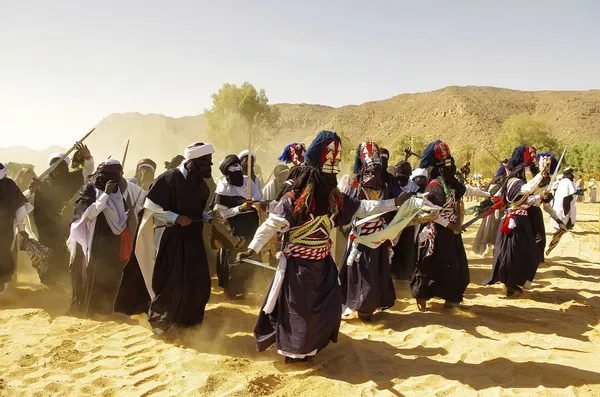
The first names outside the ranking are four groups tied at exactly 90,000 people: the Figig Amazigh, the Menasser Amazigh, the Dui-Menia Bedouin and the Ruarha Bedouin. Each sits just 2,000 people behind the Chaamba in ninth place, and no source separates them, so none of the four can honestly take tenth place alone. Behind them, the Algerian Tuareg number 81,000 and the Tahaggart Tuareg 78,000, 159,000 together. The Tuareg are the people of the S'biba festival pictured above, in Djanet. Moroccan Arabs, at 198,000, would sit sixth if they were ranked. Joshua Project does not list them as an indigenous community in Algeria, so they are excluded and the reason is stated in the Methodology.
1. Arabic-speaking Algerians: 34,757,000
Arabic-speaking Algerians live across the whole country, concentrated in the Tell and the northern cities, Algiers, Oran, Constantine and Sétif. Joshua Project's label covers Arabic-speaking Algerians of Arab and Arabised-Berber descent, and the line between the two is not one any source can draw cleanly. The Factbook's own note says almost all Algerians are Berber in origin but only about 15 percent identify themselves as primarily Berber. Britannica's published split puts Arabs at 73.6 percent, which implies 35,348,854 people, close to Joshua Project's 34,757,000. At 72.37 percent, roughly five Algerians in seven are in this group. They lead the Kabyle by 27,944,000 people, and they alone exceed the other eight ranked groups combined by 22,886,000 people, nearly three times over.
2. Kabyle: 6,813,000
The Kabyle live in Kabylia, the Atlas mountains east of Algiers, in Tizi Ouzou, Béjaïa and Bouira. They are the largest Amazigh group in Algeria and the second largest Berber population in Africa. They have been at the forefront of the fight for recognition of the Berber languages since the Berber Spring of 1980. Tamazight became an official language in 2016, and Yennayer, the Amazigh New Year, has been a public holiday since 2018. Our article on the state of Amazigh culture in Algeria and Morocco sets out that history. At 14.19 percent, the Kabyle sit 4,293,000 people ahead of the Shawiya. One caution is in order: Joshua Project's 6,813,000 sits above the commonly cited estimates of around 5 million Kabyle in Algeria. The order is not affected, since even at 5 million the Kabyle would stay second, 2,480,000 ahead of the Shawiya. The Kabyle are 57.5 percent of all the Amazigh in this ranking, and Joshua Project counts 7,649,000 Kabyle worldwide, including about a million in France.
3. Shawiya (Chaoui): 2,520,000
The Shawiya, also called the Chaoui, live in the Aurès mountains of eastern Algeria, around Batna, Khenchela and Oum el Bouaghi. They speak Tachawit, and their country is the high, dry massif between the Tell and the Sahara. At 5.25 percent, they sit 717,000 people ahead of the Central Atlas Amazigh. They are the second largest Amazigh group in the ranking, at 2.7 times smaller than the Kabyle. They are the only group in the top three whose homeland lies entirely inside Algeria's eastern mountains.
4. Central Atlas Amazigh: 1,803,000
The Central Atlas Amazigh speak Central Atlas Tamazight, and their communities straddle the Algerian-Moroccan border in the Atlas highlands of the northwest. Joshua Project counts 4,944,000 Central Atlas Amazigh worldwide across five countries, so the 1,803,000 in Algeria are a minority of the group. At 3.75 percent, they sit 1,598,000 people ahead of the Mozabite. They are the last group above one million people in this ranking. They are also the last of the three large Amazigh groups that, together with the Kabyle and the Shawiya, make up 11,136,000 people, 23.19 percent of Algeria.
5. Mozabite: 205,000
The Mozabite live in the M'zab valley of the northern Sahara, around Ghardaïa, in one of the most distinctive oasis settlements in Africa. They speak Tumzabt, and they are Ibadi Muslims, a branch of Islam distinct from the Sunni majority, with their own mosques, councils and customs. The valley's fortified towns are a UNESCO World Heritage site. At 0.43 percent, they sit just 22,000 people ahead of the Sahrawi. The Mozabite are the smallest of the Amazigh groups in the top five, and the gap between them and the Central Atlas Amazigh, at 1,598,000 people, is the widest gap in the table.
6. Sahrawi: 183,000
The Sahrawi are the native people of Western Sahara, and most of those in Algeria live in the five refugee camps near Tindouf, in the southwestern desert, where they have lived since 1975. Their number is the most disputed figure in this table. Joshua Project counts 183,000. The UN refugee agency plans its aid on 90,000 of the most vulnerable in the Tindouf camps. It cut that figure from around 155,000 in 2005, after satellite imagery analysis raised doubts about the higher number. The Algerian authorities and the Polisario movement cite around 165,000, and a United Nations estimate put the figure at about 173,600 in 2024. No census of the camps has ever been conducted, so every figure is a planning estimate rather than a count. At the UN agency's figure the Sahrawi would fall out of this ranking altogether, below the Chaamba's 92,000. The sixth place given here therefore rests on Joshua Project's figure, and it is stated as such. At 0.38 percent, the Sahrawi sit 40,000 people ahead of the Suafa.
7. Suafa (Bedouin): 143,000
The Suafa are Bedouin of the northeastern Sahara, around El Oued and the Oued Souf, the region of dunes and date palms near the Tunisian border. They speak Algerian Arabic, and Joshua Project lists them as a distinct Bedouin community rather than part of the Arabic-speaking majority. At 0.30 percent, they sit 31,000 people ahead of the Chenoua. The Suafa are the first of three small groups that close the ranking, all under 150,000 people, and all separated by gaps of 40,000 people or less.
8. Chenoua: 112,000
The Chenoua live in the Chenoua mountains and along the coast west of Algiers, around Tipaza and Cherchell. They speak Chenoua, a language found only in Algeria, and Joshua Project counts the whole group inside the country. At 0.23 percent, they sit 20,000 people ahead of the Chaamba. The Chenoua are the smallest Amazigh group in the ranking. They are the only one of the nine whose homeland is on the Mediterranean coast rather than in the mountains, the desert or the cities.
9. Chaamba (Bedouin): 92,000
The Chaamba are a Saharan Arab tribe of the northern desert, around Metlili and El Meniaa, south of Ghardaïa. They are camel people of the caravan routes, and their name is one of the oldest in the Algerian Sahara. At 0.19 percent, they close the ranking just 2,000 people ahead of four groups tied at 90,000, the tightest cut in this series. No source separates the four groups behind them, so the Chaamba hold ninth place by the smallest margin any ranking in this series has yet produced.
Frequently Asked Questions
Why is this a Top 9 and not a Top 10?
Because tenth place is a four-way tie that no source can break. The Figig Amazigh, the Menasser Amazigh, the Dui-Menia Bedouin and the Ruarha Bedouin each number exactly 90,000 people in Joshua Project's counts, 2,000 behind the Chaamba in ninth place. Joshua Project rounds its counts to the nearest 1,000, and no census or finer count separates the four. Picking one of them for tenth place would be inventing an order the evidence does not support. South Africa's entry in this series was an honest Top 9 for the same reason, with only nine indigenous groups verifiable, and Algeria follows that precedent.
Why are Moroccan Arabs excluded when they would rank sixth?
Because Joshua Project does not list them as an indigenous community in Algeria. Its country page leaves the indigenous column blank for Arab, Moroccan, as it does for Arab, Egyptian general, Arab, general, Arab, Iraqi and Chinese, general. This series ranks the tribes of a country, and it follows the same rule it applied in Egypt, where Sudanese, Syrian and other diaspora groups were excluded and the exclusion was disclosed. Moroccan Arabs number 198,000 in Joshua Project's count and would sit sixth if they were ranked. They are a Moroccan people group resident in Algeria, not a tribe of Algeria, and the dataset's primary table, which stores Joshua Project's raw list, still carries them at sixth place. The article applies the indigenous filter and states it.
How reliable is the Sahrawi figure of 183,000?
It is the least certain figure in the table, and the range is wide. Joshua Project counts 183,000 Sahrawi in Algeria. The UN refugee agency plans its aid on 90,000 of the most vulnerable. The Algerian authorities and the Polisario movement cite around 165,000, and a United Nations estimate put the figure at about 173,600 in 2024. Morocco argues for 45,000 to 50,000. No census of the camps has ever been conducted, so every figure is a planning estimate. The ranking uses Joshua Project's figure because it is the only source that counts the Sahrawi as a people group inside Algeria. The sixth place it gives them depends on that figure. At the UN agency's 90,000, the Sahrawi would fall out of the top nine.
Why is there no census figure for Algeria's tribes?
Because Algerian censuses have never recorded ethnicity. The most recent fully published census, in 2008, did not ask the question, and a further census conducted in 2022 had its definitive results long delayed. Tamazight was recognised as a national language in 2002 and as an official language in 2016. The census does not enumerate Amazigh speakers as an ethnic count, so all Amazigh shares are estimates. The CIA World Factbook records the country only as Arab-Amazigh 99 percent, European less than 1 percent, with no split. Joshua Project's in-country list is therefore the only source that gives a figure for every group. It is corroborated on the combined total by the Factbook and on the broad Arab and Berber balance by Britannica's published split.
Are the Kabyle really 6.8 million people?
Joshua Project counts 6,813,000 Kabyle in Algeria, and that figure sits above the commonly cited estimates. Wikipedia puts the Kabyle at around 5 million in Algeria and around 6 million worldwide, and Store norske leksikon put them at around 5.5 million in 2012. Joshua Project's worldwide Kabyle count is 7,649,000 across six countries. The ranking does not depend on the difference: even at 5 million, the Kabyle would stay second, 2,480,000 ahead of the Shawiya. What the higher figure does affect is the Amazigh total. Joshua Project puts it at 11,856,300 people, 24.69 percent of Algeria, against the Factbook note that only about 15 percent of Algerians identify themselves as primarily Berber. Ancestry, self-identification and language are three different measures, and this ranking uses Joshua Project's people-group counts, which sit closest to the ancestry measure.
Data Sources
- Joshua Project, Algeria people groups: joshuaproject.net/countries/AG
- CIA World Factbook, Algeria, ethnic groups (archived text): archive.govglance.org/factbook/algeria
- United Nations, World Population Prospects 2024 (Algeria population, 2026): population.un.org/wpp
- African Exponent, "Population of Every African Country in 2026": africanexponent.com
- African Exponent, "The State of Amazigh Culture in Algeria and Morocco": africanexponent.com
- Minority Rights Group, Western Sahara country page: minorityrights.org/country/western-sahara
- Wikipedia, Sahrawi refugee camps: en.wikipedia.org/wiki/Sahrawi_refugee_camps
- European Commission, EU Civil Protection and Humanitarian Aid, Algeria (around 173,000 refugees in the Tindouf camps): civil-protection-humanitarian-aid.ec.europa.eu
- Wikipedia, Kabyle people: en.wikipedia.org/wiki/Kabyle_people
- African Exponent, Peoples of Africa dataset v1.0 (November 2026), the site's canonical ethnic-population dataset, which supplied the ranked table
- Wikimedia Commons, "S'biba2 , Algeria.jpg" (feature image, the S'biba festival in Djanet, Akhli, CC BY-SA 4.0): commons.wikimedia.org/wiki/File:S'biba2_,_Algeria.jpg
Methodology
Algeria is the first country in this series with no census ethnic count at any vintage and no Factbook split. The ranking is built on Joshua Project's full in-country list for Algeria, read on 19 November 2026 and stored in the African Exponent Peoples of Africa dataset v1.0. Joshua Project lists 37 groups totalling 47,960,000 people, against the United Nations World Population Prospects 2024 population of 48,028,334 for mid-2026, as carried in the site's own population article. Each group's share is its Joshua Project count divided by that UN total. The nine ranked groups total 46,628,000 people, or 97.08 percent, which does not exceed the whole.
Two sources corroborate the Joshua Project list. The CIA World Factbook's Algeria entry records the country as Arab-Amazigh 99 percent, European less than 1 percent, with no per-group split. 99 percent of the UN total is 47,548,051, close to Joshua Project's 47,960,000. The Factbook was retired in 2026, so its figures were taken from its archived text, and its ethnic field states no estimate year. Encyclopaedia Britannica's published split is Arab 73.6 percent, Berber 23.2 percent, Arabized Berber 3.0 percent, other 0.2 percent. It corroborates the broad balance. The Arab share implies 35,348,854 people against Joshua Project's 34,757,000 Arabic-speaking Algerians, and the Berber share implies 11,142,573 against Joshua Project's Amazigh total of 11,856,300. The Factbook's note that almost all Algerians are Berber in origin but only about 15 percent identify themselves as primarily Berber is also stated. Ancestry, self-identification and language are three different measures, and this ranking uses people-group counts.
Two judgment calls shape the table and both are disclosed rather than resolved silently. First, the indigenous filter. Joshua Project flags most of its Algeria groups as indigenous, but it leaves the indigenous column blank for Arab, Moroccan, Arab, Egyptian general, Arab, general, Arab, Iraqi and Chinese, general. Only groups Joshua Project flags as indigenous are ranked, following the rule applied in Egypt, where diaspora groups were excluded. Moroccan Arabs number 198,000 and would rank sixth if they were included. The dataset's primary table stores Joshua Project's raw list, where they sit sixth, and the dataset should gain an indigenous flag so future runs do not have to re-derive this. Second, the tenth place tie. Four groups, the Figig Amazigh, the Menasser Amazigh, the Dui-Menia Bedouin and the Ruarha Bedouin, each number exactly 90,000 people, 2,000 behind the Chaamba in ninth place. Joshua Project rounds its counts to the nearest 1,000 and no finer source separates them, so this is published as an honest Top 9.
Three further exclusions are stated. Joshua Project's "Deaf" entry, at 243,000 people, is a ministry category rather than an ethnic group and is excluded, as in every entry in this series. Its "Unclassified / Other Individuals" row, at 68,000 people, is not a group and is not ranked. The Tuareg are two Joshua Project entries, Algerian Tuareg at 81,000 and Tahaggart Tuareg at 78,000, and they are not summed into the table. They sit below the cut at 159,000 combined and are discussed only in the near-miss paragraph, where the S'biba festival pictured above belongs to them. No Joshua Project subgroup count is added on top of a family total. The list's own arithmetic supports that. Its 37 groups sum to 99.86 percent of the UN total, so the Bedouin subgroups are counted separately from, not inside, the Arabic-speaking umbrella.
Two figures carry warnings that must be stated. The Sahrawi figure of 183,000 is Joshua Project's count. The published range runs from the UN refugee agency's planning figure of 90,000 to the Algerian and Polisario figure of around 165,000 and the United Nations estimate of about 173,600 in 2024. No census of the Tindouf camps has ever been conducted. At the UN agency's figure the Sahrawi would fall out of the top nine. The Kabyle figure of 6,813,000 sits above the commonly cited estimates of around 5 million in Algeria, but the order is unaffected, since even at 5 million the Kabyle would stay second. Article names follow Joshua Project's labels shortened for readability: the Shawiya are also called the Chaoui, and the Sahrawi are also spelled Saharawi. The Central Atlas Amazigh homeland is stated approximately, since the group straddles the Algerian-Moroccan border. Every derived claim in the article was recomputed from the final table values by script before publication. That covers the shares of all nine groups, the top nine at 97.08 percent, the top two at 86.55 percent, and the top four at 95.55 percent. It covers the 5.1 times multiple of the first group over the second, the 27,944,000 lead, and the first group exceeding the other eight combined by 22,886,000. It covers the Kabyle at 57.5 percent of the Amazigh total, the Amazigh total at 24.69 percent, and every gap between neighbours in the table, including the 2,000 people that decide ninth place.