Published: November 18, 2026
One birth in three will be African
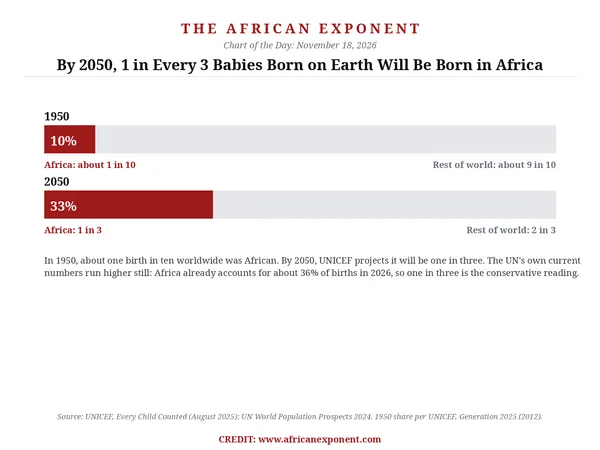
UNICEF's policy paper Every Child Counted, published in August 2025, states the shift plainly: Africa is expected to account for one-third of all global births by 2050. The chart shows how far that is from where the world started. In 1950, about one birth in ten worldwide was African. By 2050, it will be one in three.
The numbers behind the share are already large. Africa recorded about 46.6 million births in 2024, more than four times the 10.9 million of 1950, and the UN projects about 55.3 million a year by 2050. That is roughly 151,000 babies a day, against about 130,000 a day in 2026. Nigeria alone is projected to record about 7.6 million births in 2025, more than the whole of Europe combined, at about 6.3 million. Our ranking of Africa's biggest populations in 2050 shows which countries will drive that growth.
Why it matters
Births are where demography becomes paperwork. UNICEF's paper is about birth registration, and its warning is that the system built to record children is not keeping up with where children are being born. Nearly half of all children under five in sub-Saharan Africa remain unregistered at birth. Registration coverage in Southern Africa is 88 percent, but only 63 percent in West Africa and 41 percent in Eastern and Central Africa. Only three countries, Algeria, Botswana and Sierra Leone, have passed 90 percent. A child without a birth certificate can be locked out of school, health care and legal identity, the exact services the next generation will need most.
The number in context
One thing the one-in-three figure is not: a forecast that African fertility is rising. Fertility is falling across the continent, and the UN expects sub-Saharan Africa's total fertility rate to drop toward 3 births per woman by 2050. Africa's share of births keeps rising because births elsewhere are falling faster, and because a young population means more women of childbearing age. The 2050 figure is also a conservative reading. The UN's own World Population Prospects 2024 series puts Africa's share at about 36 percent already in 2026 and about 42 percent by 2050, on 55.3 million African births out of 132.6 million worldwide. UNICEF's one-third is the floor, not the ceiling.
Data Sources
UNICEF, Every Child Counted: Advancing Birth Registration in Africa, August 2025 (unicef.org); Xinhua, August 11, 2025 (english.news.cn); UN World Population Prospects 2024 birth series, via database.earth (database.earth) and the global births series (database.earth); 1950 share per UNICEF, Generation 2025 and Beyond (2012), via UN News (news.un.org); Nigeria versus Europe 2025 births per UN World Population Prospects 2024 (primebusiness.africa).
Methodology
The headline is UNICEF's own wording from Every Child Counted, its August 2025 policy paper, and is corroborated by Xinhua's report of the paper's launch. The 1950 comparison, about one birth in ten, comes from UNICEF's earlier Generation 2025 report. The older UNICEF Generation 2030 figure of 41 percent of births by 2050, based on the 2012 UN projections, was not used as the headline because UNICEF's 2025 paper supersedes it. Note that the UN's current World Population Prospects 2024 data imply a higher share than UNICEF's one-third, about 36 percent in 2026 and about 42 percent in 2050, so the headline is a conservative statement of the trend. Figures are UN estimates and medium-variant projections, not counts from complete birth registers, which is itself part of the story: registration is incomplete across much of the continent.