Published: November 15, 2026
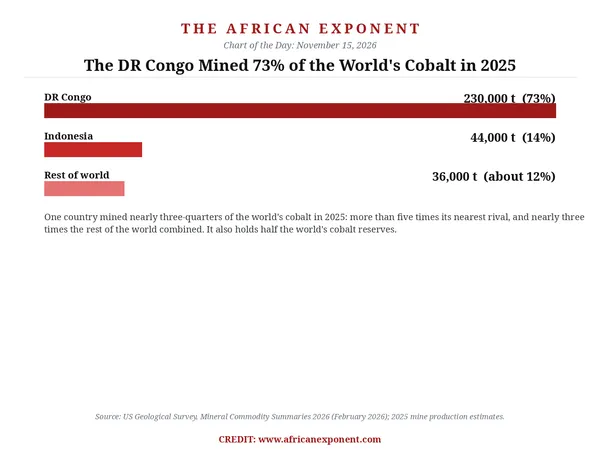
In 2025, one country mined nearly three-quarters of all the cobalt on Earth. The Democratic Republic of Congo produced an estimated 230,000 tonnes of mined cobalt, 73 percent of a world total of about 310,000 tonnes. Indonesia, the next largest producer, mined 44,000 tonnes, less than a fifth as much. Every other country on Earth combined mined 36,000 tonnes, about 12 percent of the total.
The gap is the story. The Congo mined more than five times as much cobalt as Indonesia, and nearly three times as much as the rest of the world put together. The difference between the Congo and all other countries combined is 150,000 tonnes. Cobalt is the metal in the lithium-ion batteries that power electric vehicles and phones, and almost all of it starts in one country's copper belt.
Our ranking of Africa's top cobalt producers in 2025 breaks the same USGS data down country by country.
Why it matters
Kinshasa knows what it holds, and it is using it. In February 2025 the government banned cobalt exports outright to lift prices that had fallen to historic lows, then replaced the ban in October 2025 with export quotas of up to 96,600 tonnes a year for 2026 and 2027, about 42 percent of its 2025 output. In June 2026 it went further, banning exports of unrefined copper and cobalt concentrate to push processing inside the country. One government now controls the volume, and increasingly the form, of the metal every battery maker needs.
The concentration is not a one-year accident. Half of the world's known cobalt reserves, 6 million of 12 million tonnes, sit in the Congo. Output barely moved in 2025, up only 4,000 tonnes, or 1.8 percent, from 226,000 tonnes in 2024, yet the share held at 73 percent because the rest of the world grew no faster. Whoever wants cobalt at scale has to deal with Kinshasa, and Kinshasa has spent the last two years proving it knows that.
The number in context
There is a counterpoint worth stating plainly. Mining the metal is not the same as refining it. China remains the world's leading producer of refined cobalt and its leading consumer, so the Congo captures the mine while others capture the chemistry. Battery makers are also designing cobalt out: cobalt-free batteries built on iron and phosphorus already hold significant market share in China, according to the US Geological Survey. The 73 percent is an estimate, and it measures mined output, not the refined metal that actually goes into a battery. But on the measure that matters most, who digs it up, no other country comes close, and none is likely to soon.
Data Sources
- US Geological Survey, Mineral Commodity Summaries 2026: Cobalt, February 2026 (the Congo accounted for an estimated 73 percent of world mined cobalt in 2025, Indonesia 14 percent; 230,000 of 310,000 tonnes; reserves 6 million of 12 million tonnes; export ban and quotas; China the leading refiner).
- Cobalt Institute, Cobalt Market Report 2025, May 2026, as reported by Farmonaut (the DRC's share of global mined cobalt at 73 percent in 2025, ahead of Indonesia at 14 percent; USGS table reproduced).
- The Oregon Group, Glencore's cobalt output falls 52% in nine months under Congo quotas, October 2026 (Congo mined an estimated 230,000 tonnes of cobalt in 2025, about 73 percent of the world total; Indonesia second, with 14 percent; quota details).
- Reuters reporting on the June 29, 2026 concentrate export ban, via Yoopya, August 6, 2026 (interministerial order banning copper and cobalt concentrate exports, effective immediately, with one-year waivers possible).
- International Energy Agency, Global Critical Minerals Outlook 2025, as summarised by Skillings (the DRC at about 70 percent of global mined cobalt in 2024; used only as a prior-year check, not as the 2025 headline).
Methodology
All figures are the US Geological Survey's estimates in Mineral Commodity Summaries 2026, published February 2026, the latest annual edition as of November 15, 2026; the next edition is not due until February 2027, so no correction to the bank's headline was needed. The Survey's text states the Congo's share as an estimated 73 percent and Indonesia's as 14 percent, from unrounded data; the rounded table figures, 230,000 of 310,000 tonnes, give 74.2 percent, so this post uses the Survey's own stated 73 percent and never prints a precise share computed from the rounded table. The rest-of-world figure is the world total minus the Congo and Indonesia, 36,000 tonnes, about 12 percent on the rounded figures. Every derived figure was recomputed before publication: 230,000 divided by 44,000 is 5.2, more than five times; 230,000 divided by 80,000, the rest of the world combined, is 2.9, nearly three times; the gap is 150,000 tonnes; reserves of 6 million of 12 million tonnes are 50 percent; the 96,600 tonne quota is 42 percent of 2025 output; and output rose 4,000 tonnes, 1.8 percent, from 226,000 tonnes in 2024. The Cobalt Institute's market report of May 2026 independently gives the same 73 percent and 14 percent shares. One figure found in secondary coverage was not used: a claim that the Congo's output was roughly 84 percent of world production, which does not reconcile with the Survey's table and contradicts the Survey's own 73 percent statement.