Published: November 12, 2026
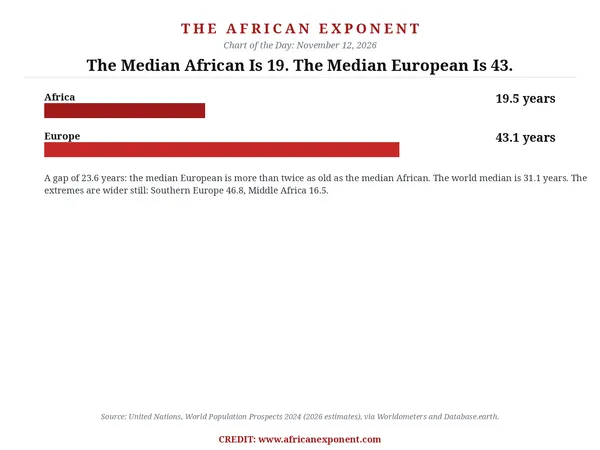
Half of all Africans are 19 years old or younger. Half of all Europeans are 43 or older. Those are the median ages of the two continents in 2026, from the United Nations World Population Prospects 2024, and the gap between them, 23.6 years, is the widest generational divide between any two regions on Earth. The median European is more than twice as old as the median African.
The world as a whole sits between the two poles. The global median age in 2026 is 31.1 years. Africa sits 11.6 years below it; Europe sits 12.0 years above it. North America, at 38.9, and Asia, at 32.5, sit much closer to the world average.
The extremes inside the two continents are wider still. Southern Europe, the oldest sub-region on Earth, has a median age of 46.8 years. Middle Africa, the youngest, is 16.5. That is a 30.3-year gap, nearly three times over. The ten youngest countries in the world in 2026 are all African, led by the Central African Republic at 14.6 years, Somalia at 15.6 and Niger at 15.7. Around 60 percent of Africans are under 25, according to the Pew Research Center.
The age gap is also a size gap. Africa's population in 2026 is about 1.58 billion people, 19.1 percent of humanity, against Europe's 743 million, 9.0 percent. Africa has more than twice as many people as Europe, and the fertility behind that growth runs nearly three times as fast: 3.89 children per woman in Africa against 1.41 in Europe. That is why 1 in every 4 people on Earth will be African by 2050.
Why it matters
Two continents face opposite problems. Africa's challenge is classrooms and first jobs: a median citizen who is still a teenager needs schools, training and work at a scale no African economy has delivered. Europe's challenge is pensions and care workers: a median citizen past 40, in a continent where the workforce is shrinking, needs people to do the jobs its own young cannot fill. The two problems are each other's partial answer, which is why migration between the continents is the most argued-over policy question in both. Whether Africa's youth bulge becomes a workforce or a waiting room depends on the same arithmetic that makes 85 percent of African workers informal: the jobs have to exist, and be formal, before the dividend arrives.
The number in context
Median age is not destiny, and it is not life expectancy: it says nothing about how long anyone lives, only about the shape of the population. Europe was young once: its median age was about 28 in 1950. Africa will age too, just slowly: the same UN projections put its median age at about 35 by 2100, still younger than Europe is today. The gap will narrow, but on the UN's numbers it will not close in this century. The youngest and oldest continents are on different clocks, and both have decades to plan for what that means.
Data Sources
- United Nations, Department of Economic and Social Affairs, Population Division, World Population Prospects 2024, medium variant (2026 median-age estimates: Africa 19.5, Europe 43.1, world 31.1, Southern Europe 46.8, Middle Africa 16.5; populations Africa 1,584,985,259, Europe 743,482,362; fertility Africa 3.89, Europe 1.41), as tabulated by Worldometers and Database.earth.
- Worldometers, Africa Demographics 2026 (median age in Africa 19.5 years in 2026; fertility 3.89) and World Population by Region, 2026 (Europe median age 43.1; Africa 19.1 percent of world population; Europe 9.0 percent).
- Database.earth, Median Age by Country in 2026 (UN WPP 2024: world 31.10; Europe 43.06; Southern Europe 46.80) and Median Age of Middle Africa (2026: 16.46).
- Global South World, Global ageing trends: UN report reveals median age by region in 2025, August 18, 2025 (WPP 2024, 2025 values: Africa 19.3, Europe 42.7) and Southern Europe is nearly 30 years older than Central Africa, October 12, 2026 (Southern Europe 46.4 vs Middle Africa 16.4 in 2025).
- Pew Research Center, 5 facts about Africa's population growth, May 19, 2026 (around 60 percent of Africans have been under 25 since 1950).
- The Data Visual, The World's Youngest Populations in 2026, October 2026 (UN WPP 2024: Central African Republic 14.63, Somalia 15.63, Niger 15.72, Chad 15.74, DR Congo 15.86; the ten youngest countries are all African).
Methodology
All figures are 2026 estimates from the United Nations World Population Prospects 2024, medium variant, the latest UN revision available on November 12, 2026; the next revision has been postponed to July 11, 2027. The headline pair, Africa 19.5 and Europe 43.1, is confirmed by two independent tabulations of the same UN release: Worldometers and Database.earth agree on both figures to one decimal place (19.48 and 43.06 unrounded). The bank entry for this candidate gave the 2025 pair, Africa 19.3 and Europe 42.7, which also verifies against the same sources; this post uses the 2026 pair because it is published in November 2026, and the headline, 19 vs 43, is identical either way. One source, populationpyramid.net, reports higher median ages for the same UN release (Europe 44.1, Middle Africa 17.6) and was not used, because two other tabulations agree with each other and with the figures printed here. Every derived figure was recomputed before publication: the gap is 43.1 minus 19.5, or 23.6 years; the ratio is 43.1 divided by 19.5, or 2.21, more than twice; Africa sits 31.1 minus 19.5, or 11.6 years, below the world median, and Europe 43.1 minus 31.1, or 12.0 years, above it; the sub-regional gap is 46.8 minus 16.5, or 30.3 years, a ratio of 2.84; Africa's population is 1,584,985,259 divided by 743,482,362, or 2.13 times Europe's; and the fertility ratio is 3.89 divided by 1.41, or 2.76.