Published: November 8, 2026
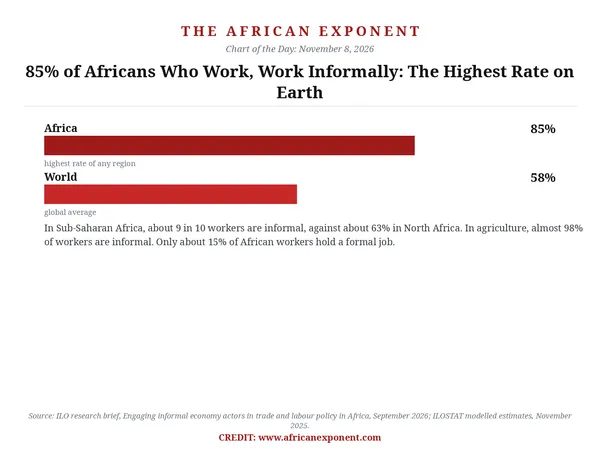
Of every 100 Africans who work, 85 do so informally. They have no written contract, no pension, no paid leave and no legal protection if they are hurt or fired. The International Labour Organization puts the figure at 85 percent of total employment, the highest informal rate of any region on Earth. The world average is about 58 percent.
Turn the number around and the picture is starker. Only about 15 percent of African workers hold a formal job. Roughly 6 in every 7 African workers earn their living outside the formal economy: about 1.5 times the world average, and 27 points above it.
The gap runs through the continent as well as across it. In Sub-Saharan Africa, about 9 in 10 workers are informal. In North Africa the rate is about 63 percent. In agriculture, the sector that still employs most Africans, almost 98 percent of workers are informal. Women carry the heavier load: about 89 percent of employed women work informally, against about 82 percent of men, according to the African Development Bank's African Economic Outlook 2026.
Trade does not escape the pattern. In 11 African countries with data, covering 45 percent of employment on the continent, more than three quarters of jobs linked to trade and global supply chains are informal. Trade-linked work is less informal than non-trade work, by 8.1 percentage points in Africa, but about 75 percent of trade-linked jobs are still informal. The pipeline is thin: only about 3 million formal jobs are created each year for the 10 to 12 million young Africans entering the labour market, the African Development Bank says. Our ranking of where young Africans cannot find work shows the same pressure from the other side.
Why it matters
Informality is not a side issue. It is how most of Africa actually works. Governments cannot tax what they cannot see, workers cannot borrow against income they cannot prove, and trade policy is written by and for the formal minority. The ILO's point in its new research brief is blunt: informal workers and small businesses power African trade, yet they have almost no voice in the trade and labour policies that govern their livelihoods. The brief points to cooperatives, links with workers' and employers' organisations, and the national committees set up under the African Continental Free Trade Area as routes for informal workers into the rooms where decisions are made.
There is a real debate underneath the number. One side says informality is a failure to fix, and the answer is formalisation: registration, contracts and protection for every worker. The other says the formal economy will not absorb 10 to 12 million new entrants a year any time soon, so the urgent task is to recognise informal work as it is and protect the people doing it. Either way, the starting point is the same. In Africa, the formal job is the exception, not the rule.
Data Sources
- International Labour Organization, Engaging informal economy actors in trade and labour policy in Africa, research brief, September 2026 (85 percent informal employment in Africa, the highest rate of any region; world average about 58 percent; Sub-Saharan Africa about 9 in 10; North Africa about 63 percent; agriculture almost 98 percent; trade-linked jobs about 75 percent informal in 11 countries covering 45 percent of African employment).
- International Labour Organization, Informal workers need stronger voice in Africa's trade policies, ILO research finds, October 2, 2026 (same figures, plus the representation gap).
- The High Street Journal, Informal Workers Left Out of Africa's Trade Policy, ILO Warns, October 3, 2026 (independent report of the same ILO release).
- The Eastleigh Voice, reporting the African Development Bank's African Economic Outlook 2026, September 16, 2026 (about 89.2 percent of employed women in informal employment, against 82 percent of men; about 86 percent of total employment informal).
- International Labour Organization, Employment and Social Trends 2026, reported in Ecofin Agency, Sub-Saharan Africa Adds 15.4 Million Workers in 2025 (labour force grew 15.4 million between 2024 and 2025, employment by 14.6 million, more than 85 percent of jobs informal).
Methodology
The headline figures are from the ILO research brief Engaging informal economy actors in trade and labour policy in Africa, dated September 2026 and published October 2, 2026, built on ILOSTAT modelled estimates from November 2025. The figures were re-checked on publication day, November 8, 2026. No newer ILO release exists, and the brief remains the latest available. The gender split comes from the African Development Bank's African Economic Outlook 2026: the 90 percent and 84 percent pair in our research bank could not be reproduced to the two-source standard, so it was replaced with the AfDB 2026 figures (89.2 percent of women, 82 percent of men), which agree closely with the ILO's 2018 figures (89.7 percent and 82.7 percent). The older ILO 2018 estimate put Africa's overall informal rate at 85.8 percent, consistent with the current 85 percent. Every derived figure in this post was recomputed from the published totals before publication.