Published: November 8, 2026
Clean water and a safe toilet are the most basic services a state can provide. In 2026, only five African countries score above 90 on both at once. This ranking measures every African country on the same two numbers: the share of people using at least basic drinking water, and the share using at least basic sanitation. The combined score is the simple average of the two. All figures are 2024 estimates from the WHO/UNICEF Joint Monitoring Programme, published through the World Bank.
Key Facts
- Seychelles ranks first with a combined score of 98.71, just 0.06 points ahead of Mauritius (98.65). The two island states are effectively tied at the top.
- The top four countries all score above 97. Five countries score above 90, and the top 10 average is 91.72.
- Nigeria ranks 21st of 52 with a score of 65.08. Its water access is solid at 82.2%, but only 47.9% of Nigerians use at least basic sanitation.
- Ethiopia ranks 48th with a score of 32.98. Seychelles scores almost three times higher. Ethiopia has the lowest basic sanitation access in Africa, at 10.4%.
- Five of the top 10 are North African countries. Only two are mainland sub-Saharan countries: South Africa (9th) and Botswana (10th). Fourteen of the 52 ranked countries score below 50.
| Rank | Country | Basic water (%) | Basic sanitation (%) | Combined score |
|---|---|---|---|---|
| 1 | Seychelles | 97.7 | 99.7 | 98.71 |
| 2 | Mauritius | 99.9 | 97.4 | 98.65 |
| 3 | Tunisia | 96.7 | 98.5 | 97.64 |
| 4 | Egypt | 97.3 | 97.1 | 97.19 |
| 5 | Libya | 96.4 | 88.5 | 92.43 |
| 6 | Morocco | 92.2 | 87.8 | 90.00 |
| 7 | Algeria | 92.4 | 85.9 | 89.16 |
| 8 | Cabo Verde | 92.3 | 83.1 | 87.70 |
| 9 | South Africa | 90.2 | 77.4 | 83.79 |
| 10 | Botswana | 91.8 | 72.1 | 81.94 |
The median African country scores 60.31, so half the continent sits below 60.3 on this measure. The top 10 average (91.72) is 2.67 times the bottom 10 average (34.36). Senegal just misses the top 10 in 11th place at 75.28, a full 6.66 points behind Botswana.
1. Seychelles (98.71)
Seychelles tops the ranking with 97.7% of its people using at least basic drinking water and 99.7% using at least basic sanitation. Its sanitation figure is the highest in Africa. It leads Mauritius by 0.06 points on unrounded scores, a margin so small the two countries are effectively tied. Seychelles is also the smallest country in the top 10 by population, with about 120,000 people.
2. Mauritius (98.65)
Mauritius has the highest basic water access in Africa, at 99.9%. Its sanitation access is 97.4%, the third-highest figure on the continent. The island state misses first place by the smallest margin in this ranking. Like Seychelles, it shows what small island states can achieve when water and sanitation networks reach almost everyone.
3. Tunisia (97.64)
Tunisia pairs 96.7% water access with 98.5% sanitation access, the second-highest sanitation figure in Africa. It sits just behind Mauritius and just ahead of Egypt. Tunisia is one of two North African countries in the top four, with Egypt.
4. Egypt (97.19)
Egypt has the most balanced profile in the top 10. Its water access (97.3%) and sanitation access (97.1%) differ by only 0.2 points. Egypt is also the most populous country in the top 10, with about 113 million people, so its high scores cover far more people than any other country on this list. That scale makes its fourth-place finish the most impressive result in the ranking.
5. Libya (92.43)
Libya has the fifth-highest water access in Africa, at 96.4%. Its sanitation access is 88.5%, a gap of 7.9 points between its two numbers. Libya is the last country to score above 92.
6. Morocco (90.00)
Morocco scores 90.00 after rounding, with 92.2% water access and 87.8% sanitation access. Its exact score is 89.995, a hair below 90. Morocco is the fifth North African country in the top 10, and the last country to reach 90 on the rounded score.
7. Algeria (89.16)
Algeria pairs 92.4% water access with 85.9% sanitation access. Its water figure is the sixth-highest in Africa. Algeria sits behind Morocco and 1.46 points ahead of Cabo Verde.
8. Cabo Verde (87.70)
Cabo Verde has 92.3% water access and 83.1% sanitation access. It is the second-smallest country in the top 10 by population, with about 525,000 people. Cabo Verde is the only West African country in the top 10, and one of three island states on the list.
9. South Africa (83.79)
South Africa has 90.2% water access but only 77.4% sanitation access, a gap of 12.8 points. It is Africa's largest economy by nominal GDP, yet it ranks only ninth here. South Africa is one of only two mainland sub-Saharan countries in the top 10, and its sanitation figure is the second-lowest in the top 10.
10. Botswana (81.94)
Botswana has the highest basic water access in mainland sub-Saharan Africa, at 91.8%. But its sanitation access is 72.1%, the lowest in the top 10. The 19.7-point gap between its two numbers is the widest in the top 10. Botswana still holds tenth place by 6.66 points over Senegal, which ranks 11th at 75.28.
Just outside the top 10, Senegal ranks 11th (75.28), Djibouti 12th (73.34) and Gabon 13th (73.00). Rwanda ranks 15th at 71.36: its sanitation access (81.3%) is the highest in mainland sub-Saharan Africa, but its water access (61.4%) keeps it out of the top 10.
Frequently Asked Questions
Which African country has the best water and sanitation access in 2026?
Seychelles, with a combined score of 98.71. Mauritius is second at 98.65, just 0.06 points behind. Tunisia is third at 97.64.
What does basic water and sanitation access mean?
Basic drinking water means using an improved water source that takes 30 minutes or less to reach, there and back. Basic sanitation means using an improved toilet that is not shared with other households. These are rungs of the WHO/UNICEF service ladder below safely managed services, which add tests for water quality, availability and treatment.
Why does Nigeria rank only 21st?
Nigeria's water access is 82.2%, which is respectable. Its sanitation access is only 47.9%, so more than half of Nigerians lack even a basic toilet. The combined score of 65.08 reflects that sanitation gap, and it leaves Nigeria 21st of 52 countries.
How is the combined score calculated?
The score is the simple average of two percentages: the share of people using at least basic drinking water, and the share using at least basic sanitation. Both figures are 2024 estimates from the WHO/UNICEF Joint Monitoring Programme. The two halves carry equal weight, and ranks are decided on unrounded scores.
Which African countries have the worst water and sanitation access?
The Central African Republic ranks last of the 52 countries scored, at 25.27. DR Congo is 51st at 25.99, South Sudan 50th at 27.09, Chad 49th at 32.68 and Ethiopia 48th at 32.98. In the Central African Republic, only 36.5% of people use basic drinking water and 14.0% use basic sanitation.
Data Sources
- World Bank, World Development Indicators: People using at least basic drinking water services (% of population) and People using at least basic sanitation services (% of population), 2024 values, accessed November 8, 2026.
- WHO/UNICEF Joint Monitoring Programme for Water Supply, Sanitation and Hygiene: country household data files, 2024 estimates, used to cross-check every figure in the top 10.
- African Exponent: Top 10 African Countries with the Best Water and Sanitation Systems in 2025 (April 8, 2025), the previous edition this ranking supersedes.
Methodology
We ranked all 52 African countries that have 2024 values for both indicators. Equatorial Guinea and Eritrea have no published 2024 values for one or both indicators, so they are excluded from the ranking, not ranked last. The combined score is the simple average of the two percentages, with equal weight. Scores are shown to two decimals, and ranks are decided on unrounded scores. Seychelles and Mauritius are effectively tied: 0.06 points separate them. Morocco rounds to 90.00; its exact score is 89.995.
We use basic services, not safely managed services, because safely managed data is missing for much of Africa. Only 30 of 52 countries have a published safely managed water figure, so a safely managed ranking would exclude nearly half the continent. Basic access is the lowest rung that still counts as a service, and it is measured the same way in every country.
Every figure in the top 10 was cross-checked against the WHO/UNICEF Joint Monitoring Programme country files. All 20 figures matched the World Bank values to rounding. Related reading: our most electrified countries ranking and our healthiest countries ranking use the same 2024 vintage approach.
This ranking supersedes the April 2025 edition, which ranked countries on African Infrastructure Development Index scores from 2018 and mixed-vintage figures, with no stated formula. The 2026 edition uses a transparent formula and a single 2024 vintage for every country.
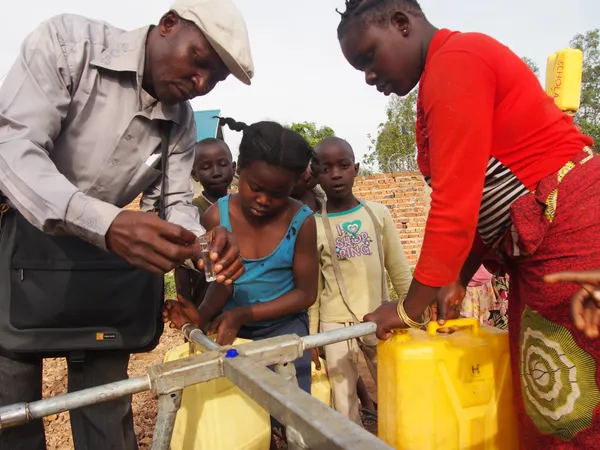
Feature image: An Oxfam worker tests water quality at a newly installed tap stand. Photo: Oxfam, CC BY 2.0, via Wikimedia Commons.