Published: November 7, 2026
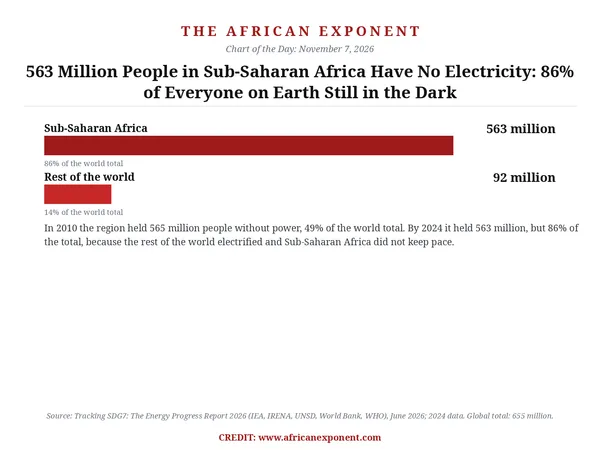
Of the 655 million people on Earth who live without electricity, 563 million are in Sub-Saharan Africa. That is 86 percent of the global total. The rest of the world combined accounts for just 92 million.
The number shocks twice over. First, because one region holds almost the entire problem. Second, because the number has barely moved. In 2010, Sub-Saharan Africa held 565 million people without power. Fourteen years later it holds 563 million, two million fewer. Over the same period the region's share of the world total climbed from 49 percent to 86 percent, because the rest of the world electrified while Sub-Saharan Africa stood still.
The region is not failing to connect people. Between 2022 and 2024 it added an average of 42 million new electricity connections a year. But its population grew by about 38 million people a year, so the net reduction was only about 4 million a year. In rural areas the deficit actually grew, from 376 million people in 2010 to 447 million in 2024.
Three countries hold about a third of the world's entire deficit. Nigeria has the largest gap on Earth, about 87 million people without power, a position it has held for four straight years. The Democratic Republic of Congo holds about 85 million and Ethiopia about 57 million. Together the three account for about 229 million people, about 35 percent of the global total. Our ranking of Africa's most electrified countries shows the other side of the same story, with six countries at full access while others sit far below.
Why it matters
Electricity is the precondition for almost everything else in development: light for studying, refrigeration for vaccines, power for workshops, phones and small businesses. The World Bank and African Development Bank's Mission 300 plan aims to connect 300 million more Africans by 2030, and has already connected more than 50 million. But the new report says the pace of electrification must triple, to 1.3 percent a year, to reach universal access by 2030. At the current pace, about 644 million people would still be without power in 2030, and about 92 percent of them would be in Africa.
The picture is not uniformly bleak. East Africa cut its electricity access deficit by 35 million people between 2010 and 2024, led by grid expansion and decentralised energy in Kenya and Rwanda. Globally, about 800 million people have gained access to electricity since 2010. The tools work where they are deployed at scale. The gap is now almost entirely African, which means the solution has to be African too, and it has to move faster than population growth.
Data Sources
- IEA, IRENA, UNSD, World Bank and WHO, Tracking SDG7: The Energy Progress Report 2026, released June 24, 2026 (2024 data; 655 million people without electricity globally, over 560 million in Sub-Saharan Africa; rural deficit 376 million in 2010 to 447 million in 2024).
- Daba Finance, Sub-Saharan Africa Accounts for 86% of Global Electricity Access Gap, June 28, 2026 (563 million, 86% share, 49% in 2010, 42 million connections a year against 38 million population growth a year).
- Energy News Africa, Sub-Saharan Africa Holds 86% Of Global Electricity Access Gap, June 29, 2026 (Nigeria 87.2 million, the world's largest deficit).
- Times Chicago, Energy Poverty: Bringing Electricity to Every Community, October 31, 2026 (Democratic Republic of Congo about 85 million, Ethiopia about 57 million).
Methodology
The figures are from Tracking SDG7: The Energy Progress Report 2026, published by the IEA, IRENA, UNSD, the World Bank and the WHO and released June 24, 2026, with 2024 as the data year. This edition supersedes the 2025 edition used in our research bank, which reported 666 million people without electricity globally and 565 million in Sub-Saharan Africa for 2023. The newer figures were checked on publication day, November 7, 2026. Every derived figure in this post was recomputed from the published totals before publication.