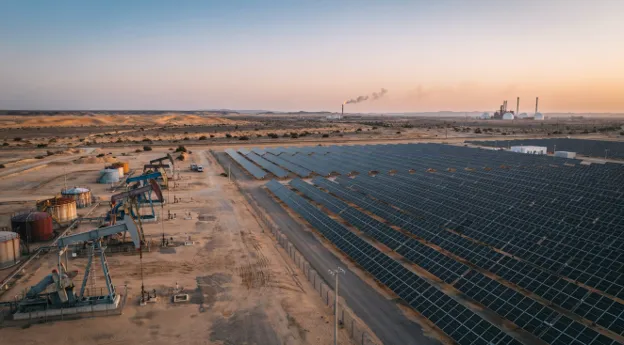
Oil's share of global energy demand fell below 30% in 2024. That's the first time it's happened on record, five decades after oil peaked near 46% of the mix.
Renewables didn't get there overnight. Renewables supplied 16.7% of global final energy consumption in 2011. By 2021, that number had climbed to 18.7%. The International Energy Agency projects close to 20% by 2030. Oil demand doesn't disappear on this timeline. But the assumption underneath most national oil strategies, that demand simply waits while a country develops its reserves, is no longer safe to make.
Farhat Bengdara, who chaired Libya's National Oil Corporation from 2022 to 2024, sees the same fate closing in on oil that already overtook coal. "Oil is going to be like coal in the future," he said. "We are moving to solar on our operations, for water, for light, as much as we can." His own figures for that shift differ slightly from the published record, but the direction he's describing tracks it closely. Producers still treating the transition as a distant policy conversation, rather than an operational one, are the ones most exposed to it.
Solar Already Pays for Itself on the Oil Field
A utility-scale solar installation pays for itself in three to five years and runs for 30. Maintenance costs run 3% to 4% of annual plant revenue. Chevron's Lost Hills field has run on solar since 2020: a 29-megawatt array supplies 80% of the site's electricity, and one of the field's biggest operating costs dropped as a result. Oman went bigger. Its Miraah facility runs more than 1,000 megawatts of solar thermal capacity to support enhanced oil recovery, at a fraction of the cost of gas-fired steam generation.
Heavy equipment still runs on fuel. Nobody is putting a drilling rig on batteries yet. But water systems and site lighting, the two applications Farhat Bengdara flagged from his own time running NOC, are exactly where solar already wins. Remote facilities, well sites, and tank farms have long depended on expensive grid extensions or diesel generators just to keep the lights on. Solar lighting systems built for oilfield conditions now install without trenching new power lines, and need almost no upkeep.
Libya gets roughly 3,200 hours of sunlight a year. The unit economics there beat most of the markets where oil majors have already made the switch.
Gas Is the Bridge Most Producers Are Actually Building
Solar covers facility power. It doesn't touch export revenue, and export revenue is what keeps a national oil company solvent. That's where gas comes in.
Global LNG supply is set to grow more than 7% in 2026, its fastest pace since 2019. That extra supply is expected to lift global gas demand growth, and Asia Pacific demand alone accounts for roughly half of that increase. National oil companies sitting on large gas reserves, Libya among them, are repositioning gas as the fuel that carries them through the transition, not a byproduct to burn off. Farhat Bengdara's NOC built its own gas strategy with Ernst & Young during his tenure: one of four pillars in a turnaround that also covered capability building, corporate governance, and the environmental commitments announced at COP28 under the Think Tomorrow initiative.
Flaring makes the stakes concrete. Burning off associated gas at the wellhead, because no infrastructure exists to capture and sell it, wastes a revenue stream and adds emissions nobody needed to create. Capture that gas instead, route it to LNG export or domestic power, and a liability becomes exactly the kind of asset international buyers are competing for right now.
Capital Is Already Sorting Producers Into Two Groups
Stranded assets in upstream oil and gas could exceed $1 trillion in present-value terms, according to research published in Nature Climate Change, under plausible shifts in climate and demand assumptions. More than 15% of that risk traces through global equity ownership to investors in OECD countries, largely through pension funds and other financial markets that rarely get named when a national oil company's governance comes up. That's the audience actually pricing the risk. Reserves in the ground no longer guarantee investment on their own.
What separates the producers still attracting capital from the ones being quietly deprioritized comes down to habits: cheaper on-site power, gas that gets captured instead of flared, and reporting an outside investor can actually verify.
None of that requires abandoning oil or gas. None of it requires a single dramatic pivot. It requires cutting operating costs with solar where the sun makes it cheap, building the gas infrastructure that turns a wasted byproduct into a saleable one, and doing both before falling demand and cautious capital do it for them.