Published: November 6, 2026
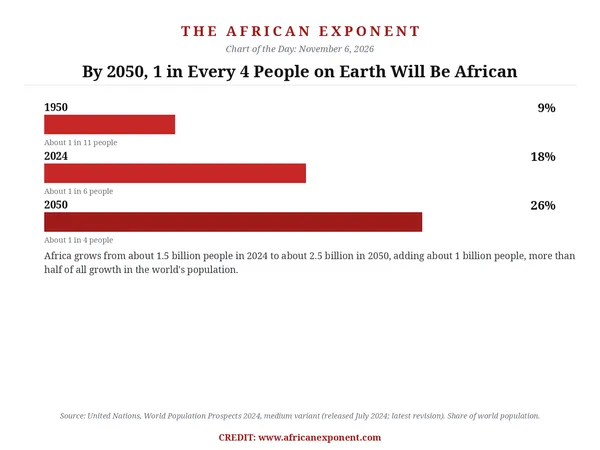
By 2050, about one in every four people alive will be African. The United Nations projects Africa's population at about 2.5 billion in 2050, out of a world total of 9.66 billion. That is a share of about 26 percent, up from about 18 percent in 2024 and about 9 percent in 1950.
The shift is the largest demographic reweighting of the modern era. Africa's population stood at about 1.5 billion in 2024. Between now and 2050 it adds about 1 billion people, a rise of about two thirds. Over the same period the world's population grows by about 1.46 billion, so more than two thirds of all the growth in humanity happens in Africa. Five countries drive most of it: Nigeria, Ethiopia, the Democratic Republic of Congo, Egypt and Tanzania.
Nigeria is the engine of the story. Its population grows from about 233 million in 2024 to about 359 million in 2050, an increase of about 126 million, the second largest national increase anywhere on Earth. Our ranking of Africa's biggest populations in 2050 puts Nigeria first, ahead of Ethiopia and Egypt.
Why it matters
A continent where one in four humans lives is a continent no boardroom, ballot box or climate negotiation can treat as peripheral. Africa's working age population will be the largest in the world, its consumer market will roughly double in size in a generation, and its cities will hold much of the century's urban growth. Investors, employers and governments that plan around today's map will be planning for a world that no longer exists.
The numbers cut the other way too. A billion more people need schools, clinics, jobs, power and water, and most of the growth lands in countries where those systems are already stretched. Africa's median age is 19, so the wave arrives as classrooms and first jobs, not as experienced workers. Whether 2050 brings a dividend or a strain depends on what is built in the next ten years, not on the projection itself. The projection is a schedule, not a promise.
Data Sources
- United Nations, World Population Prospects 2024, medium variant, released July 11, 2024 (regional population totals and projections to 2050; latest revision, next revision postponed to July 11, 2027).
- StatRanker, World population trends, growth, decline and projections for 2050 (WPP 2024 figures: world 9.664 billion in 2050, Africa about 2.5 billion).
- The Namibian, By 2100, one-third of all people could be African (one in six today, one in four in 2050; Africa 2.5 billion in 2050).
Methodology
The figures are the United Nations World Population Prospects 2024, medium variant, released July 11, 2024. The United Nations has postponed the next revision to July 11, 2027, so the 2024 revision is the latest available as of November 6, 2026; this was checked on publication day. Africa's 2050 share is 2.5 billion of a world total of 9.664 billion, or about 26 percent. Every derived figure in this post was recomputed from the published totals before publication.