Published: November 8, 2026
Nigeria is Africa's most populous country and one of the most diverse nations on Earth. More than 250 peoples share one federation of 36 states and 242.4 million people. This ranking counts the 10 largest tribes by their estimated population inside Nigeria in 2026.
Key Facts
- Nigeria's 10 largest tribes hold about 188.0 million people, about 78% of the national population of 242.4 million (UN, 2026).
- The Hausa rank first at about 72.7 million people, 30.0% of Nigeria and nearly twice the Yoruba figure. That is more people than the entire population of South Africa.
- The Yoruba (37.6 million) and the Igbo (36.8 million) sit almost level at ranks 2 and 3, separated by only about 0.7 million people.
- Nigeria has published no official ethnic breakdown since the 1963 census. Ranks 1 to 8 apply the CIA World Factbook's ethnic shares (2018 estimates) to the UN 2026 total. Ranks 9 and 10 are Joshua Project in-country counts. Every figure is an estimate, not a census count.
- Two pairs tie on Factbook shares: Tiv and Kanuri at 2.4% each, and Ibibio and Ijaw at 1.8% each. Ties follow the Factbook's listing order.
The Ranking
| Rank | Tribe | Heartland | Share of Nigeria | Population (2026 est.) |
|---|---|---|---|---|
| 1 | Hausa | North West | 30.0% | 72.7 million |
| 2 | Yoruba | South West | 15.5% | 37.6 million |
| 3 | Igbo | South East | 15.2% | 36.8 million |
| 4 | Fulani | North and Middle Belt | 6.0% | 14.5 million |
| 5 | Tiv | Middle Belt (Benue) | 2.4% | 5.8 million |
| 6 | Kanuri | North East (Borno) | 2.4% | 5.8 million |
| 7 | Ibibio | South South (Akwa Ibom) | 1.8% | 4.4 million |
| 8 | Ijaw | Niger Delta | 1.8% | 4.4 million |
| 9 | Anaang | South South (Akwa Ibom) | 1.4% | 3.4 million |
| 10 | Ebira | North Central (Kogi) | 1.1% | 2.6 million |
Together, the 10 tribes hold 188.0 million of Nigeria's 242.4 million people, 77.6% of the country. The remaining 54.4 million Nigerians belong to more than 240 other peoples. The largest of them, the Edo, counts about 2.4 million people and just misses this list. For the continental picture, see our ranking of the largest tribes in Africa.
Selected Details
1. Hausa: 72.7 million
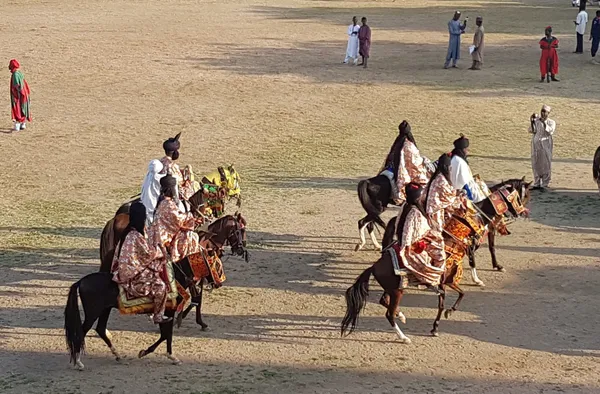
The Hausa heartland covers the North West: Kano, Katsina, Sokoto, Kaduna, Zamfara, Jigawa and Kebbi, with large Hausa communities across the north and into Niger. The Hausa language, a Chadic tongue, works as a trade language across West Africa, so far more people speak it than this ethnic count. The old Hausa city-states made Kano a great market city of the Sudan belt. The horsemen in this article's cover photo ride in Kano's Durbar, the festival of horsemanship that still defines Hausa royal culture.
2. Yoruba: 37.6 million
The Yoruba heartland is the South West: Lagos, Oyo, Ogun, Osun, Ondo and Ekiti, with Yoruba land reaching into Kwara and Kogi. Ile-Ife is the spiritual home of the Yoruba, and the Oyo Empire was one of the great states of West Africa. Yoruba towns were among the largest cities in precolonial Africa. Yoruba religion and culture also travelled across the Atlantic and live on in Cuba, Brazil and beyond.
3. Igbo: 36.8 million
The Igbo heartland is the South East: Anambra, Imo, Enugu, Ebonyi and Abia, with Igbo areas in Delta and Rivers states. Before colonial rule, most Igbo lived in self-governing village groups rather than kingdoms, with Nri as an old ritual centre. That tradition of independence still shapes Igbo political culture. Today Igbo traders and business owners live in every major Nigerian city.
4. Fulani: 14.5 million
The Fulani, who call themselves Fulɓe, spread across the north and the Middle Belt, and across the whole West African Sahel. Cattle herding kept many Fulani mobile for centuries, while others settled as scholars, clerks and rulers. In 1804, Usman dan Fodio's jihad built the Sokoto Caliphate, and Fulani emirs still rule several northern cities. Politics often lumps the Fulani together with the Hausa, but they are a distinct people. The Factbook counts them separately, and so does this ranking.
5. Tiv: 5.8 million
Benue State is the Tiv heartland, and Tiv land reaches into Taraba, Nasarawa and Plateau. The Tiv are farmers first, known above all for their yam harvests. Their language belongs to the Bantoid branch, kin to the Bantu languages of Central and Southern Africa. That makes Benue one of the northernmost homes of that vast language family. The Tiv tie with the Kanuri on Factbook share and take rank 5 on the Factbook's listing order.
6. Kanuri: 5.8 million
The Kanuri live in Borno and Yobe, around Lake Chad, with Maiduguri as their main city. They are the heirs of Kanem-Bornu, an empire that endured for roughly a thousand years beside the lake. The Kanuri language is Nilo-Saharan, unrelated to Hausa, which underlines how many different worlds meet inside northern Nigeria. Insurgency in the North East since 2009 has displaced many Kanuri families, one reason current counts here carry extra uncertainty.
7. Ibibio: 4.4 million
The Ibibio heartland is Akwa Ibom State, with Uyo as the capital. The Ibibio speak a language closely related to Efik and to Anaang, who appear at rank 9 in this list. Their coastal position made them early trading partners on the old Calabar and Cross River routes. The Ibibio tie with the Ijaw on Factbook share and take rank 7 on the Factbook's listing order.
8. Ijaw: 4.4 million
The Ijaw, also called Izon, are the people of the Niger Delta creeks in Bayelsa, Delta and Rivers states. Fishing and trade by canoe shaped Ijaw life for centuries, and the delta city-states once traded palm oil with the world. The Ijaw are the largest people of the delta itself. Some references rank them far higher than the Factbook does; the Methodology below explains why this ranking follows the Factbook figure.
9. Anaang: 3.4 million
The Anaang are the second people of Akwa Ibom, centred on Ikot Ekpene, west of the Ibibio. Anaang is a distinct language, though it is close to Ibibio, and the two peoples share much history. Ikot Ekpene is famous across Nigeria for raffia work and carving. The Factbook folds the Anaang into its "other" category, so this rank uses Joshua Project's in-country count of 3,362,000.
10. Ebira: 2.6 million
The Ebira live in Kogi State, around Okene, where northern and southern Nigeria meet. That crossroads position has made Ebira land a mixing point of cultures for centuries. Ebira weavers are known for their cloth, and the Ajaokuta steel plant stands in Ebira country. Like the Anaang, the Ebira sit inside the Factbook's "other" category, so this rank uses Joshua Project's in-country count of 2,579,000.
Frequently Asked Questions
What is the biggest tribe in Nigeria?
The Hausa are Nigeria's largest tribe, at about 72.7 million people in 2026, or 30.0% of the population. They are nearly twice the size of the second-ranked Yoruba.
How many tribes are there in Nigeria?
Nigeria has more than 250 ethnic groups speaking over 500 languages. The 10 largest hold about 78% of the population, and the other 54.4 million people are spread across more than 240 smaller peoples.
Why are these population figures estimates?
Nigeria has not published an official ethnic breakdown since the 1963 census, and later censuses did not count ethnicity at all. This ranking applies the CIA World Factbook's ethnic shares, dated 2018, to the United Nations population total for 2026, and uses Joshua Project counts for ranks 9 and 10. The order of the top eight is stable across references, but the exact figures should be read as estimates.
Are the Hausa and the Fulani one tribe?
No. They are distinct peoples with different languages and histories, and the Factbook counts them separately at 30.0% and 6.0%. The combined label "Hausa-Fulani" is a political term, not an ethnic one, so this ranking lists the two peoples separately.
Which tribes just missed the top 10?
On Joshua Project counts, the Edo (about 2.4 million), the Nupe (about 2.1 million) and the Igala (about 1.9 million) are the next largest peoples inside the Factbook's "other" category, just behind the Ebira.
Data Sources
- CIA World Factbook: Nigeria, People and Society: ethnic group shares (2018 estimates), mirrored at IndexMundi.
- United Nations, World Population Prospects 2024: Nigeria total population, 242,432,000 in 2026, as listed by Joshua Project.
- Joshua Project: Nigeria people groups: in-country counts for Anaang (3,362,000), Ebira (2,579,000), Edo (2,389,000), Nupe (2,119,000) and Igala (1,890,000), accessed November 8, 2026.
Methodology
This ranking counts people by ethnic group inside Nigeria only; it does not count the Nigerian diaspora or related peoples in other countries. For ranks 1 to 8, the CIA World Factbook's ethnic shares (2018 estimates) are applied to the United Nations total for Nigeria in 2026, 242,432,000 people. The Factbook itemises only those eight groups and places all others in an "other" category of 24.9%. Ranks 9 and 10 are therefore the two largest remaining peoples, taken from Joshua Project's in-country counts, which use language-based group definitions and are not directly comparable to the Factbook shares; that seam is flagged here rather than hidden. Two pairs tie exactly on Factbook share (Tiv and Kanuri at 2.4%; Ibibio and Ijaw at 1.8%) and are ordered as the Factbook lists them. The Hausa and Fulani are counted separately, as the Factbook counts them. Other references differ: Minority Rights Group, for example, puts the Ijaw at 10% of the population. Where sources conflict, this ranking follows the Factbook shares because they are the standard reference and the only set itemised for all of the top eight on one consistent basis. Populations are rounded to the nearest 0.1 million in the text; shares for ranks 9 and 10 are computed from the Joshua Project counts. Cover photo: horsemen at the Durbar festival in Kano, September 2016, by DonCamillo, Wikimedia Commons, CC BY-SA 4.0.