Published: November 10, 2026
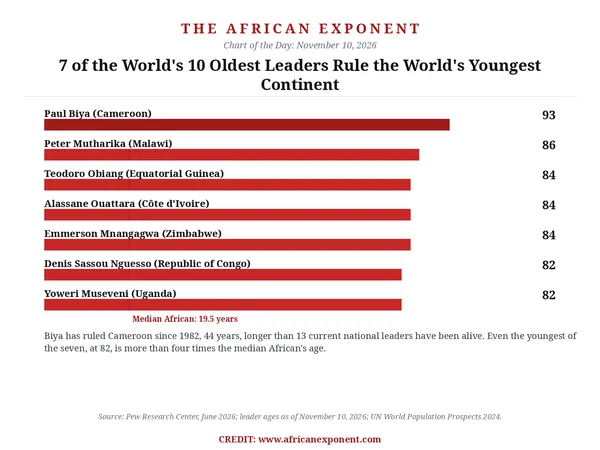
Pew Research Center examined the ages of national leaders in 186 United Nations member states and found that 7 of the 10 oldest are African. Cameroon tops the list. President Paul Biya is 93, the oldest serving national leader on Earth, and he has held power since 1982.
The other six are Malawi's Peter Mutharika, 86; Equatorial Guinea's Teodoro Obiang, 84; Côte d'Ivoire's Alassane Ouattara, 84; Zimbabwe's Emmerson Mnangagwa, 84; the Republic of Congo's Denis Sassou Nguesso, 82; and Uganda's Yoweri Museveni, 82. The other three in Pew's top 10 are Saudi Arabia's King Salman, 90, Palestinian President Mahmoud Abbas, 90, and Italian President Sergio Mattarella, 85.
Set those ages against the people they govern. The median African is 19.5 years old, according to the United Nations World Population Prospects 2024, and around 60 percent of Africans are under 25. Biya is 73.5 years older than the median African, about 4.8 times that age. Even the youngest of the seven, at 82, is more than four times the median African's age. The median national leader worldwide is 63, itself more than three times the median African's age.
The gap is also a gap in time. Biya took power in November 1982. The median African alive today was born around 2007, by which time Biya had already ruled for 25 years. Obiang has been in power since 1979, 47 years. Museveni has ruled Uganda since 1986, about 40 years. The three longest-serving of the seven have held power for 131 years between them.
Why it matters
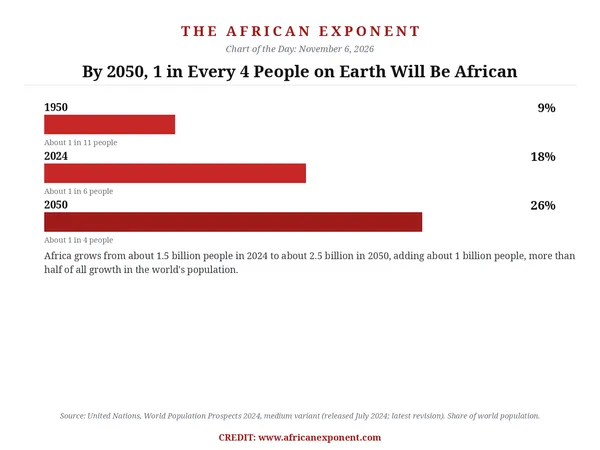
Africa is the world's youngest continent and its fastest-growing population. By 2050, 1 in every 4 people on Earth will be African. The decisions that will shape that future, on jobs, education, debt and digital access, are being made by leaders whose political careers began before most of their citizens were born. Supporters call that experience. Critics call it a gerontocracy, a system in which power stays with a generation that will not live with the long-term consequences of its choices. Either way, the numbers say the distance between the governed and the governors is wider in Africa than anywhere else on Earth.
The number in context
Age alone does not settle the argument. Malawi's Mutharika, 86, won a democratic election in September 2025, returning to office after five years out of power. And youth is no guarantee of openness: the world's youngest leader, Nepal's 36-year-old Prime Minister Balen Shah, took office after youth-led protests ousted his predecessor. Pew also notes that 7 of the world's 10 oldest leaders govern countries Freedom House rates "not free", a reminder that the age gap overlaps with a democracy gap. The question the chart raises is not whether old leaders can govern well. It is whether a continent of teenagers can be represented by leaders in their eighties and nineties, and what happens when the generation gap finally closes.
Data Sources
- Pew Research Center, As Trump turns 80, who are the oldest and youngest world leaders?, June 9, 2026 (7 of the 10 oldest leaders are African; Biya 93, the world's oldest; King Salman 90; median age of national leaders 63; 16 of 186 leaders older than Trump, 80; youngest leader Nepal's Balen Shah, 36; 7 of the 10 oldest govern countries Freedom House rates "not free"; ages as of June 14, 2026).
- Pew Research Center, 5 facts about Africa's population growth, May 19, 2026 (median age in Africa about 19 today, rising to 35 by 2100; around 60 percent of Africans under 25; United Nations World Population Prospects 2024).
- Worldometers, Africa Demographics 2026, United Nations World Population Prospects 2024 (median age in Africa 19.5 years in 2026).
- Agence France-Presse, Brazil's Lula among world's oldest leaders, October 26, 2026 (the same seven African leaders with current ages: Biya 93, Mutharika 86, Obiang 84, Mnangagwa 84, Ouattara 84, Sassou Nguesso 82, Museveni 82; Mattarella 85; Salman 90).
- Ubuntu Times, Africa's Ageing Leaders: Ten Political Heavyweights and the Growing Demand for Change, October 21, 2026 (leaders' ages and tenures as of October 2026; Biya president since 1982, nearly 44 years; Mutharika returned to the presidency in September 2025).
Methodology
Pew Research Center analysed the ages of current heads of government in 186 United Nations member states, using government biographies and regional news reports, with ages as of June 14, 2026. Leader ages in this article are updated to November 10, 2026, from birthdates confirmed in October 2026 reporting, and no leader among the seven has left office since Pew's analysis. The median age of Africa, 19.5 years in 2026, comes from the United Nations World Population Prospects 2024. An earlier draft of this series used 19.7 years for the median age; the 2024 revision's annual series gives 19.5 for 2026, and this article uses the corrected figure. Every derived figure in this post was recomputed from these sources before publication: 93 minus 19.5 is 73.5 years, and 93 divided by 19.5 is about 4.8; 63 minus 19.5 is 43.5 years, and 63 divided by 19.5 is about 3.2; the three longest tenures, 47 plus 44 plus 40, sum to 131 years; and the median African, born around 2007, arrived 25 years after Biya took power in 1982.