Published: November 9, 2026
Nine intercity railways are under construction across Africa right now. Together they add up to 5,878 kilometres of new track. Egypt is building more than any other country, by far. Its high-speed network alone is longer than the five smallest projects combined. South Africa, the continent's most industrial economy, has no intercity railway under construction.
Key Facts
- Egypt ranks first with 1,760 kilometres under construction: its 660-kilometre Green Line from Ain Sokhna to Marsa Matrouh, plus the 1,100-kilometre Blue Line from 6th of October City to Abu Simbel. A third line of 225 kilometres is still in planning and is not counted.
- The nine projects total 5,878 kilometres. The top two, Egypt and Tanzania, account for 3,160 kilometres, more than the other seven projects combined at 2,718 kilometres.
- Egypt alone beats the bottom five combined. The five smallest projects, from Nigeria's Kano to Maradi line down to the Kaduna to Kano line, total 1,638 kilometres. Egypt's 1,760 kilometres beats that by 122 kilometres.
- Nigeria is the only country with two projects in the ranking. Its Kano to Katsina to Maradi line (400 km) and its Kaduna to Kano line (203 km) total 603 kilometres, or 10.3 percent of all the track being built.
- South Africa is missing entirely. No intercity railway is under construction there. Algeria's 950-kilometre mining railway opened in February 2026, so it drops out of this ranking just as Egypt's network takes the top spot.
| Rank | Project | Country | Km under construction | Status |
|---|---|---|---|---|
| 1 | Egypt High-Speed Rail (Green and Blue lines) | Egypt | 1,760 | Under construction; trial runs started Sep 2026 |
| 2 | Tanzania Standard Gauge Railway | Tanzania | 1,400 | Under construction; sections to Mwanza, Kigoma and Burundi |
| 3 | Trans-Guinean Railway (Simandou) | Guinea | 650 | About 80% complete; in commissioning |
| 4 | Kenitra-Marrakech High-Speed Line | Morocco | 430 | About 30% complete; service due 2029 |
| 5 | Kano-Katsina-Maradi Railway | Nigeria | 400 | 70% complete; cross-border to Niger |
| 6 | Awash-Kombolcha-Hara Gebeya Railway | Ethiopia | 392 | Relaunched May 2026 after years suspended |
| 7 | Naivasha-Kisumu-Malaba SGR | Kenya | 371 | Relaunched Mar 2026; track-laying began Jul 2026 |
| 8 | Malaba-Kampala SGR | Uganda | 272 | Early works only; no track laid yet |
| 9 | Kaduna-Kano Railway | Nigeria | 203 | About 90% complete; opening set for 3 Dec 2026 |
Egypt and Tanzania hold 53.8 percent of all the kilometres in this ranking. The average project is 653 kilometres long, and the median is 400 kilometres. The closest race is sixth place: Ethiopia's 392 kilometres leads Kenya's 371 by only 21 kilometres. Morocco leads Nigeria's Kano to Maradi line by 30 kilometres.
1. Egypt High-Speed Rail (1,760 km)
Egypt is building Africa's first high-speed network, and it is building it at a scale no other country matches. The Green Line runs 660 kilometres from Ain Sokhna on the Red Sea, through the New Administrative Capital and Cairo, to Alexandria and Marsa Matrouh on the Mediterranean. Trial running began in September 2026, and the transport minister says passengers should be riding it by July 2027. The Blue Line runs 1,100 kilometres south from 6th of October City through Upper Egypt to Abu Simbel, and it is under full construction. Together the two lines come to 1,760 kilometres. Siemens Mobility leads the consortium with Orascom Construction and The Arab Contractors, and a Deutsche Bahn and Elsewedy Electric venture will operate the network. Trains will run at up to 250 kilometres per hour. A third line of 225 kilometres, from Qena to Hurghada and Safaga, is still in planning, with no start date given. It is not counted in the 1,760 kilometres. The full three-line programme is about 2,000 kilometres.
2. Tanzania Standard Gauge Railway (1,400 km)
Tanzania has the second-largest build under way, and it is the most complex. The Dar es Salaam to Makutupora section opened in June 2024, with passenger trains running since then and freight added in June 2025. Everything beyond that is still being built: 1,400 kilometres of it, according to Railway Gazette International. The lots now under construction run from Makutupora through Tabora to Isaka and Mwanza on Lake Victoria, west to Kigoma on Lake Tanganyika, and across the border to Musongati in Burundi. The Tabora to Kigoma section is 411 kilometres of main line, worth 2.74 billion dollars, with its foundation stone laid on July 20, 2026. The Uvinza to Musongati branch is East Africa's first cross-border standard gauge project, and 84 of its 240 kilometres lie in Burundi. The whole network is due for completion around 2030. Tanzania's railway will then link the port of Dar es Salaam to three lakes: Victoria, Tanganyika and, through Burundi, the route toward the Democratic Republic of Congo.
3. Trans-Guinean Railway, Guinea (650 km)
Guinea's Trans-Guinean railway is the line that unlocks the Simandou iron ore deposit, the world's largest untapped high-grade iron ore reserve. The 650-kilometre heavy-haul line runs from the Simandou mountains in the southeast to the Atlantic coast at Morebaya. It is about 80 percent complete and in commissioning. The first iron ore shipments left in November 2025, and President Mamadi Doumbouya rode the inaugural passenger train through West Africa's longest railway tunnel, 11.6 kilometres, on October 12, 2026. The line is built for 120 million tonnes of ore a year, split between the SimFer consortium led by Rio Tinto and the Winning Consortium Simandou. Ten stations are due by the end of 2026, which will open the line to public passengers and farm freight. The full ramp-up is expected by 2028.
4. Kenitra-Marrakech High-Speed Line, Morocco (430 km)
Morocco already has Africa's only operating high-speed line, the Al Boraq service from Tangier to Kenitra, opened in 2018. The Kenitra to Marrakech extension adds 430 kilometres and takes the network south through Rabat and Casablanca. King Mohammed VI launched construction on April 24, 2025. The line is about 30 percent complete, with a budget of 53 billion dirhams, about 5.3 billion dollars. Trains will run at up to 320 kilometres per hour, cutting Tangier to Marrakech to two hours and 40 minutes. Service is due in 2029, ahead of the 2030 World Cup that Morocco will co-host with Spain and Portugal. The line alone is longer than either of Nigeria's two projects.
5. Kano-Katsina-Maradi Railway, Nigeria (400 km)
Nigeria's second entry is a cross-border line. The 400-kilometre railway runs from Kano through Katsina to Maradi in Niger, opening a new trade route between northern Nigeria and its neighbour. It is 70 percent complete. The government says a 250-kilometre section, from Dawanu through Kano, Kazaure and Daura to Katsina, will be inaugurated on December 3, 2026. The line was barely 5 percent complete when President Tinubu took office in 2023. It is part of a wider push to finish northern Nigeria's railways, alongside the Kaduna to Kano line at number nine.
6. Awash-Kombolcha-Hara Gebeya Railway, Ethiopia (392 km)
Ethiopia's line is the comeback story in this ranking. Construction began in 2015 under a 1.7 billion dollar contract, then stopped during the war in northern Ethiopia in 2021. The contractor left, the line was damaged, and the dispute went to arbitration in London. That arbitration was decided in late 2026. The Ethiopian Railways Corporation has now taken over the works with its own crews. About 70 kilometres of track have been repaired, and construction is under way at Kombolcha and Dessie. The corporation aims to finish the first phase, as far as Kombolcha, within two years, then decide on the second phase to Hara Gebeya. The full line is 392 kilometres, linking the Addis Ababa to Djibouti main line to northern Ethiopia.
7. Naivasha-Kisumu-Malaba SGR, Kenya (371 km)
Kenya's standard gauge railway stalled at Naivasha for six years after Chinese funding dried up. President William Ruto relaunched it on March 19, 2026, and track-laying began on July 1, 2026 in Narok. The extension has two sections: Naivasha to Kisumu, 264 kilometres, and Kisumu to Malaba on the Ugandan border, 107 kilometres. Together they come to 371 kilometres of main line. The budget has risen to 651 billion shillings, about 5 billion dollars, with most of it expected from foreign lenders. Kenya Railways targets Kisumu by July 2027, but the Treasury's latest budget papers list June 2030. The line will connect with Uganda's Malaba to Kampala railway at number eight, completing the standard gauge route from the port of Mombasa to Kampala.
8. Malaba-Kampala SGR, Uganda (272 km)
Uganda's line is the weakest entry in this ranking, and we say so plainly. The 272-kilometre railway from Malaba on the Kenyan border to Kampala was launched in November 2024, with a 2.7 billion euro contract for Turkish builder Yapi Merkezi. Two years later, no physical track has been laid. Financial close has slipped to January 2027, and only preliminary works are under way under a limited notice to proceed. Land acquisition is about 70 percent complete. The contract itself was briefly declared cancelled in June 2026, then reinstated in November 2026. The line is included because early works are genuinely under way, but it is not in the same state as the projects above it. If funding slips again, it will drop out of the next edition of this ranking.
9. Kaduna-Kano Railway, Nigeria (203 km)
Nigeria's second project is also its closest to completion. The 203-kilometre Kaduna to Kano standard gauge line is about 90 percent complete. President Tinubu is expected to inaugurate it on December 3, 2026, along with the 190-kilometre Jaji to Kano section. The line extends the Abuja to Kaduna railway, opened in 2016, giving northern Nigeria a continuous standard gauge link from the capital to Kano, its largest northern city. It was under 30 percent complete when Tinubu took office in 2023. At 203 kilometres it is the smallest project in this ranking, and Egypt's network is almost nine times its length.
Just outside the ranking, the famous Lobito Corridor railway is not here yet. Its new 830-kilometre line from Chingola in Zambia to Luacano in Angola only named preferred builders on October 27, 2026. Contracts are not signed, and construction is months away. Algeria's 950-kilometre Bechar to Tindouf railway opened on February 1, 2026, so it has just left the list. Senegal's 19-kilometre airport rail link opened on September 28, 2026. Urban metros are excluded from this ranking: Abidjan's 37.4-kilometre metro is about 65 percent complete, but it is a city line, not an intercity railway.
Frequently Asked Questions
What is the biggest rail project under construction in Africa in 2026?
Egypt's high-speed rail network, with 1,760 kilometres under construction across two lines: the 660-kilometre Green Line from Ain Sokhna to Marsa Matrouh, and the 1,100-kilometre Blue Line from 6th of October City to Abu Simbel. A third line of 225 kilometres is still in planning.
How many kilometres of railway is Africa building right now?
5,878 kilometres across nine intercity projects, as of November 9, 2026. Egypt and Tanzania account for 3,160 kilometres of that total, more than the other seven projects combined.
Why is the Lobito Corridor railway not in the ranking?
The new 830-kilometre Zambia to Angola line is not under construction yet. Preferred builders were only named on October 27, 2026, contracts are still being negotiated, and the Africa Finance Corporation expects building work to start in six to eight months. It should lead the next edition of this ranking once work starts.
Why is South Africa not in the ranking?
No intercity railway is under construction in South Africa as of November 2026. Its rail building is limited to upgrades of existing lines. South Africa's absence is striking: it is Africa's most industrial economy, yet it has no new intercity line being built, while Egypt, Tanzania and Guinea are building 3,810 kilometres between them.
How are Africa's biggest rail projects ranked?
By route kilometres under construction as of November 9, 2026, counting only intercity and mainline railways with active building works. Urban metros and light rail are excluded, as are rehabilitation of existing lines and projects still at tender or feasibility stage. Every figure was checked against at least two sources, and the method is set out in full below.
Data Sources
- Railway Gazette International, November 5, 2026, Tanzania seeks investors for standard gauge projects: the Tanzania SGR table, with 1,400 kilometres under construction across four sections.
- Wikipedia, High-speed rail in Egypt: the three lines at 660, 1,100 and 225 kilometres, and the planning status of the third line.
- Egypt Today, September 21, 2026, Egypt puts 1st high-speed electric rail line on track for trial run: Line 1 at 660 kilometres with 21 stations, and trial running from September 2026.
- WeeTracker, November 17, 2025, Egypt Moves Ahead With Africa's Largest High-Speed Rail Network: Line 2 under full construction, Line 3 in planning and early implementation.
- Construction Review Online, The $17 Billion Trans-Guinean Scheme: the 652-kilometre Trans-Guinean railway and its commissioning phase in 2026.
- Skillings, July 2026, Simandou's $27B Rail Link: the Trans-Guinean line about 80 percent complete, with first ore shipments under way.
- Wikipedia, Kenitra-Marrakesh high-speed rail line: the 430-kilometre line, launched April 24, 2025, due to open in 2029.
- Construction Review Online, October 2026, Kenitra Marrakech High Speed Rail Extension Enters New Works Phase: about 30 percent complete, with a 53 billion dirham budget.
- Punch, November 9, 2026, Kaduna-Kano rail project at 90%, inauguration set for 2026: Kaduna to Kano at 203 kilometres and 90 percent, and Kano to Katsina to Maradi at 400 kilometres and 70 percent.
- The Reporter Ethiopia, October 2026, Government Steps In To Finish Kombolcha Railway: the 392-kilometre Awash to Hara Gebeya line, with about 70 kilometres of track repaired.
- Capital Ethiopia, October 18, 2026, ERC aims for two-year completion of Awash-Kombolcha railway project: construction under way at Kombolcha and Dessie, with arbitration concluded in September 2026.
- Construction Review Online, March 19, 2026, Kenya Revives Ksh500 Billion SGR Extension to Kisumu and Malaba: the 264-kilometre Naivasha to Kisumu section and the 107-kilometre Kisumu to Malaba section.
- Kenya-Today, October 24, 2026, Kenya raises Kisumu-Malaba SGR extension budget to KSh651 bn: 371 kilometres of main line, with construction begun in July 2026.
- Zawya via Reuters, October 21, 2026, Uganda seeks $169mln from OPEC Fund to rerail SGR: the 272-kilometre Malaba to Kampala line, with no track laid and financial close targeted for January 2027.
- ENR, November 8, 2026, Preferred Bidders Picked for Multibillion-dollar Zambia-Angola Rail Project: the 830-kilometre Lobito line, with construction still months away.
- Construction Review Online, October 19, 2026, Bechar-Tindouf Railway Corridor Opens: Algeria's 950-kilometre line, opened February 1, 2026.
- Rail Journal, October 6, 2026, Dakar regional express reaches international airport: Senegal's 19-kilometre airport link, opened September 28, 2026.
Methodology
We ranked intercity and mainline railway projects by route kilometres under construction as of November 9, 2026. A project counts when building works are actively under way on its route. The as-of date is November 9, 2026, and it is stated here, in the Key Facts and in the standfirst. Urban metros and light rail are excluded, as are rehabilitation of existing lines and projects still at tender or feasibility stage. That scope is why this is a ranking of nine projects, not ten: only nine intercity railways are verifiably under construction in Africa right now.
Every figure in the table was checked against at least two sources. Where sources disagreed, we say so here. Egypt is ranked on 1,760 kilometres, the two lines under construction. Egypt Today reported in September 2026 that the first three lines, totalling 2,000 kilometres, are under construction, but the transport minister gave no start date for the third line in October 2026, and the line is described as in planning. The 225-kilometre third line is therefore excluded, and the full programme total of about 2,000 kilometres is stated separately. Tanzania is ranked on 1,400 kilometres, the total Railway Gazette International published on November 5, 2026. A lot-by-lot count of main line gives about 1,330 kilometres, and the difference is sidings, loops and different section boundaries. The ranking uses the published 1,400-kilometre total, and 84 of those kilometres lie in Burundi, on the Uvinza to Musongati branch. Kenya is ranked on 371 kilometres, the sum of the two published section lengths, 264 plus 107. The Treasury lists the same project at 369 kilometres, a 2-kilometre rounding difference. Guinea is ranked on 650 kilometres, the rounded figure; the exact figure reported is 652 kilometres. The 1,300-kilometre figure sometimes quoted for Guinea counts both tracks of the double-track line, and it is not used. Nigeria's Kaduna to Kano line is reported at 203, 205 and 200 kilometres by different outlets; we use 203 kilometres, from the most recent report, dated November 9, 2026.
Two inclusions are judgement calls, and we flag them. Uganda's Malaba to Kampala line is included at 272 kilometres although no track has been laid, because early works are genuinely under way under a limited notice to proceed. If main construction does not start, it will be removed from the next edition. Ethiopia's Awash to Hara Gebeya line is included at its full 392 kilometres although the near-term target is the first phase to Kombolcha, about 270 kilometres, because work is reported at both Kombolcha and Dessie, and Dessie lies beyond Kombolcha. The line never operated, so the current work is completion and repair of war damage, not rehabilitation of an operating line.
Three near misses are excluded for clear reasons. The Lobito Corridor's new 830-kilometre line has named preferred builders but no signed contracts and no building work. Algeria's 950-kilometre Bechar to Tindouf line opened on February 1, 2026. Senegal's 19-kilometre airport link opened on September 28, 2026. Also excluded: Tanzania's Isaka to Kigali line at 521 kilometres and Morocco's Marrakech to Agadir line at 240 kilometres, both at feasibility or planning stage; and Abidjan's 37.4-kilometre metro, which is a city line outside this ranking's scope. This ranking supersedes the 2025 edition, 5 African Railway Projects to Watch in 2025.
All derived claims in this article were recomputed from the table before publication. The nine values total 5,878 kilometres. The top two total 3,160 kilometres, against 2,718 for the other seven. Egypt's 1,760 kilometres beats the bottom five combined at 1,638 kilometres, by 122 kilometres. Egypt is 8.67 times the smallest project, Kaduna to Kano at 203 kilometres. Tanzania is 2.15 times Guinea. Nigeria's two projects total 603 kilometres, or 10.3 percent of the whole ranking. Related reading: our busiest airports in Africa ranking and our largest economies in Africa ranking.
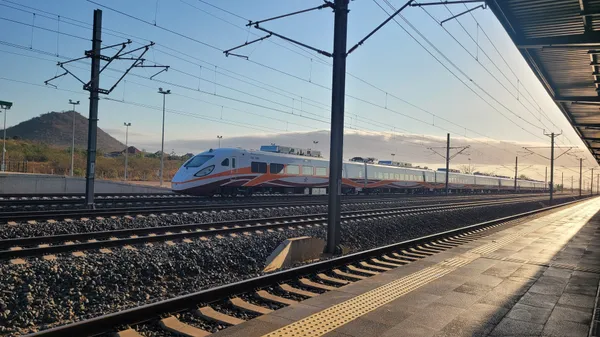
Feature image: a Tanzania SGR electric train at a station near Morogoro. Photo: Robert E Mawere, Wikimedia Commons, CC BY-SA 4.0.