Published: November 9, 2026
Almost one Ghanaian in two is Akan. That single fact shapes Ghana's politics, its languages and its culture more than any other, and this ranking shows how far ahead the lead is. Ghana is in a rare position in Africa: its 2021 census actually counted ethnicity, so these numbers rest on an official count rather than guesswork.
The ranking applies the ethnic shares from the Ghana Statistical Service 2021 Population and Housing Census, which the CIA World Factbook carries identically, to Ghana's 2026 population of 35,697,557 from the United Nations World Population Prospects 2024. The census itemises eight groups; ranks 9 and 10 are the largest remaining peoples from Joshua Project's in-country counts, flagged where they appear, and the Methodology explains the seam.
Key Facts
- The Akan rank first with 16.3 million people, 45.7 percent of Ghana and 2.47 times the Mole-Dagbani, the second largest group.
- The Akan alone outnumber ranks 3 to 8 combined, all 12.2 million of them.
- The top three groups, Akan, Mole-Dagbani and Ewe, hold 27.5 million people, exactly the 77 percent the census itself reports.
- Ranks 1 to 8, the groups the census names, cover 98.4 percent of Ghana. Every other people in the country shares the remaining 1.6 percent.
- The Mande share nearly doubled between the 2010 and 2021 censuses, from 1.1 percent to 2.0 percent, the fastest proportional rise in the table.
| Rank | Tribe | Share of Ghana | Population (2026) | Main Homeland |
|---|---|---|---|---|
| 1 | Akan | 45.7% | 16,313,784 | South and central forest belt |
| 2 | Mole-Dagbani | 18.5% | 6,604,048 | The north |
| 3 | Ewe | 12.8% | 4,569,287 | Volta and Oti, the south-east |
| 4 | Ga-Dangme | 7.1% | 2,534,527 | The Accra coast |
| 5 | Gurma | 6.4% | 2,284,644 | The north-east |
| 6 | Guan | 3.2% | 1,142,322 | Scattered centre and north |
| 7 | Grusi | 2.7% | 963,834 | Upper East and Upper West |
| 8 | Mande | 2.0% | 713,951 | Upper East and Bono |
| 9 | Yoruba † | Joshua Project | 568,000 | Urban south, especially Accra |
| 10 | Hausa † | Joshua Project | 340,000 | Zongo communities, Accra and Kumasi |
† Ranks 9 and 10 are Joshua Project resident counts (accessed November 9, 2026), not census shares. The census places every people outside its eight named groups in a single "other" category of 1.6 percent. The two sources count slightly different populations, so no combined top 10 percentage is printed. See the Methodology.
The near misses on the same Joshua Project basis are the Banda, also called Nafana, at 110,000 people, and the Akpafu-Lolobi at 101,000, a Ghana-Togo Mountain people whose exact census placement is not documented. Two famous names are deliberately absent as separate entries: the Mossi, at 569,000 on Joshua Project's count, are already inside the Mole-Dagbani at rank 2, and the Gonja, at 434,000, are already inside the Guan at rank 6. Counting them twice is the most common error in lists of this kind.
1. Akan: 16,313,784
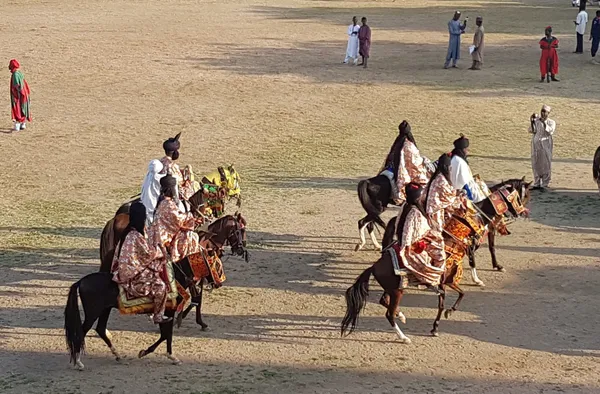
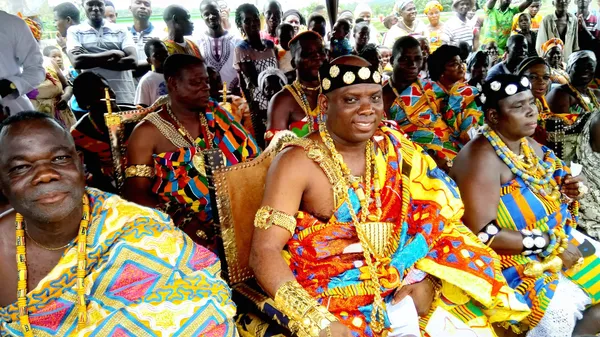
The Akan are not one tribe so much as a family of peoples speaking related Twi languages: the Asante, Fante, Akyem, Akuapem, Kwahu, Bono, Nzima, Ahanta and Wassa among them. Together they hold the southern and central forest belt and 45.7 percent of the country, down from 47.5 percent in the 2010 census but still untouchable at the top. The Asante are the best known of the family: the cover photograph shows Ashanti chiefs in full gold regalia at the Akwasidae festival in Kumasi. The scale is hard to overstate. The Akan outnumber ranks 3 to 8 combined, all 12.2 million of them, and they outnumber the Mole-Dagbani and Ewe put together by more than 5 million people. One family of peoples holds nearly half the country.
2. Mole-Dagbani: 6,604,048
The north's great family takes its name from the Mole and the Dagbani peoples who anchor it. It includes the Dagomba of Dagbon, the Mamprusi, the Nanumba, the Dagaaba, the Wala and the Mossi, peoples who trace their kingdoms to a common ancestor, Naa Gbewaa. At 18.5 percent it is the only group besides the Akan in double digits after the Ewe, and it grew faster than any other large group between censuses, rising from 16.6 percent in 2010. Even so, the Akan are two and a half times its size.
3. Ewe: 4,569,287
The Ewe hold Ghana's south-east, the Volta and Oti regions, and their homeland continues across the border into Togo, where the Ewe are one of the largest peoples. In Ghana they number 4.6 million, 12.8 percent of the country, down from 13.9 percent in 2010. The Anlo Ewe's Hogbetsotso festival, marking the people's historic migration to the coast, is one of Ghana's best known traditional celebrations. The Ewe complete the top three that the census itself singles out: Akan, Mole-Dagbani and Ewe together are 77 percent of Ghana.
4. Ga-Dangme: 2,534,527
The Ga and the Adangbe, grouped by the census as Ga-Dangme, are the peoples of the Accra coast, which means the capital city stands on their land. The Ga celebrate Homowo, the harvest festival that mocks a historic famine, across Accra every year. At 7.1 percent and 2.5 million people, they are the largest group whose homeland is a single coastal strip, and every president of Ghana has governed from their territory.
5. Gurma: 2,284,644
The Gurma peoples of the north-east centre on the Konkomba, with the Bimoba and the Basari among them, across the Oti and Northern regions. Their share rose from 5.7 percent in 2010 to 6.4 percent in 2021, one of the steadier gains in the table. The Konkomba alone account for the largest part of the group's 2.3 million people, though the census publishes the family as one.
6. Guan: 1,142,322
The Guan are the table's quiet complication. They are scattered peoples rather than a single bloc, spread from the Eastern Region through Oti to the Savannah, and the family includes the Gonja, whose kingdom is one of the oldest in the north. Many published lists place the Gonja with the Mole-Dagbani or rank them alone. The census classification used here, following the Ghana Statistical Service's own grouping, puts the Gonja inside the Guan, and this ranking follows the census. The Guan hold 3.2 percent of Ghana.
7. Grusi: 963,834
The Grusi, sometimes written Gurunsi, are the peoples of the far north-west and north-east fringes, centring on the Kasena and the Sisala in the Upper East and Upper West regions. Just under a million people, 2.7 percent of the country, they are the smallest group in the table with a compact homeland of their own, and their share edged up from 2.5 percent in 2010.
8. Mande: 713,951
The census's Mande category, often written Mande-Busanga, covers the Bissa, also called Busanga, in the Upper East, and the Wangara and Ligbi in the Bono area, peoples whose roots run to the old Mande trading networks of the western Sudan. Their recorded share nearly doubled between the two censuses, from 1.1 percent in 2010 to 2.0 percent in 2021, the fastest proportional rise of any group in the ranking. At 714,000 they close the census's own list.
9. Yoruba: 568,000 †
Beyond the census's eight named groups, the largest remaining people in Ghana on Joshua Project's resident counts are the Yoruba, at 568,000. These are long-settled communities of Nigerian origin, concentrated in Accra and the urban south, where Yoruba families have traded and lived for generations. Because Joshua Project counts everyone resident in Ghana while the census shares describe Ghanaians, this figure and the next sit on a different basis from ranks 1 to 8, which is why they carry their own flag in the table and the Methodology.
10. Hausa: 340,000 †
The Hausa take the final place at 340,000 on Joshua Project's count. Hausa settlement in Ghana is centuries old, built on the kola and cattle trades, and Hausa quarters, the zongos, are a feature of Accra, Kumasi and towns across the country. The language long served as a lingua franca of trade and of the early colonial forces. Like the Yoruba above them, Ghana's Hausa are a resident community counted by Joshua Project rather than a group the census itemises.
Frequently Asked Questions
Does Ghana's census really count tribes?
Yes. The Ghana Statistical Service asked about ethnicity in the 2021 Population and Housing Census and published the shares in its General Report: Akan 45.7 percent, Mole-Dagbani 18.5 percent, Ewe 12.8 percent, Ga-Dangme 7.1 percent, Gurma 6.4 percent, Guan 3.2 percent, Grusi 2.7 percent, Mande 2.0 percent and other 1.6 percent. The CIA World Factbook carries the identical figures. Ghana is unusual in this: Nigeria, for comparison, has published no official ethnic breakdown since 1963.
Why are the Asante and Fante not ranked separately?
Because the census counts the Akan as one category, and this ranking follows the census. The Akan are a family of related peoples, and sources that split them, such as Joshua Project, produce much smaller numbers per people that cannot be mixed with the census family totals without double counting. On Joshua Project's own basis the Fante alone number about 3.8 million, which shows how different the two systems are.
Why are the Yoruba and Hausa in a Ghana ranking?
Because hundreds of thousands of them live in Ghana. Both communities have been settled in Ghanaian cities for generations, the Hausa for centuries. The census folds them into its 1.6 percent "other" category rather than naming them, so ranks 9 and 10 use Joshua Project's resident counts for Ghana, flagged as a different basis in the table and Methodology.
Why is Gonja not in the top 10 on its own?
The Gonja number about 434,000 on Joshua Project's count, which would not reach the top 10 anyway. More importantly, the census classification places the Gonja inside the Guan family, so they are already counted at rank 6. Ranking them separately as well would count the same people twice.
What changed between the 2010 and 2021 censuses?
The Akan share fell from 47.5 percent to 45.7 percent, the Ewe fell from 13.9 percent to 12.8 percent, and the Mole-Dagbani rose from 16.6 percent to 18.5 percent. The Mande share nearly doubled, from 1.1 percent to 2.0 percent. The order of the top eight did not change. Beware older web tables that mix the two censuses: a common hybrid shows the Akan at their 2010 share alongside the Mole-Dagbani at their 2021 share, and it is wrong in both directions.
Data Sources
- Ghana Statistical Service, 2021 Population and Housing Census, General Report Volume 3C (ethnic composition, p.36) and census highlights: census2021.statsghana.gov.gh
- CIA World Factbook, Ghana, ethnic groups (2021 est.): cia.gov/the-world-factbook
- UK Home Office, Country Policy and Information Note: internal relocation, Ghana (December 2024), quoting the 2021 census ethnic shares: gov.uk
- Joshua Project, Ghana country listing (Yoruba, Hausa, Banda, Akpafu-Lolobi counts), accessed November 9, 2026: joshuaproject.net/countries/GH
- United Nations, World Population Prospects 2024 (Ghana population, 2026): population.un.org/wpp
Methodology
Ranks 1 to 8 apply the ethnic shares of the Ghana Statistical Service 2021 Population and Housing Census (General Report Volume 3C, p.36) to Ghana's 2026 population of 35,697,557 (UN World Population Prospects 2024). The CIA World Factbook carries the identical 2021 shares, so every census figure in the table is confirmed by two sources. The census counted 30,832,019 people in 2021. Every census category except the Ewe is a family of peoples, and the ranking uses the census's own categories throughout: the Akan include the Asante, Fante, Akyem and others; the Mole-Dagbani include the Dagomba, Mamprusi and Mossi; and the Gonja are counted inside the Guan, following the Statistical Service's classification of Gonja as a Guan (Guang) people. Joshua Project subgroups that belong to these families, including the Mossi (569,000), Gonja (434,000) and Busanga (300,000, the census's Mande), are never added on top of a family total.
Ranks 9 and 10 are a disclosed seam. The census names only eight groups and places everyone else in an "other" category of 1.6 percent, worth 571,161 people at the 2026 total. The largest peoples outside the eight families, on Joshua Project's in-country counts, are the Yoruba (568,000) and the Hausa (340,000). Those two counts sum to 908,000, more than the census's whole "other" bucket, because the census shares describe Ghanaians while Joshua Project counts everyone resident in Ghana, including long-settled communities of Nigerian origin. For that reason this ranking prints no combined top 10 percentage: ranks 1 to 8 sum cleanly to 98.4 percent of Ghana, and the arithmetic sum of all ten rows would exceed 100 percent purely as an artefact of the two bases. Every derived claim in the article (the 2.47 times Akan lead, the top three at 77 percent, the Akan outnumbering ranks 3 to 8 combined) was recomputed from the final table values by script before publication.