Published: November 9, 2026
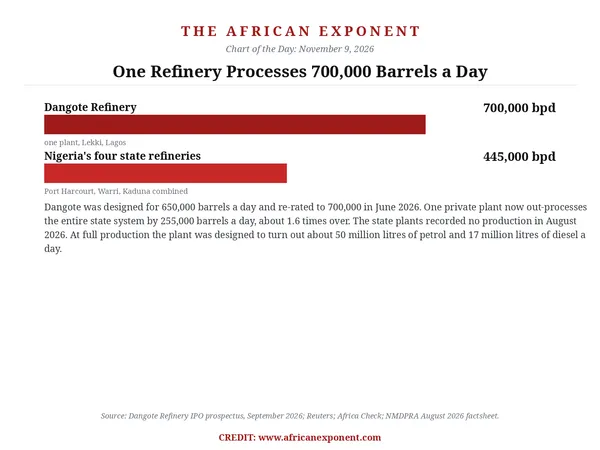
One privately built refinery in Lagos now processes more crude oil in a day than all four of Nigeria's state-owned refineries were designed to handle. The Dangote Petroleum Refinery runs at 700,000 barrels a day, against a combined 445,000 barrels a day of nameplate capacity at the Port Harcourt, Warri and Kaduna plants. That is about 1.6 times the entire state system. It runs through a single crude distillation unit, which makes it the largest single-train refinery on Earth.
The plant was designed for 650,000 barrels a day and reached it in February 2026. In June 2026 the company re-rated it to 700,000 barrels a day, a figure in its September 2026 share-sale prospectus, confirmed by chief executive David Bird to Reuters. The refinery's own website still shows the original 650,000 figure, but the prospectus is the newer document.
Port Harcourt's two plants were built for 210,000 barrels a day, Warri for 125,000 and Kaduna for 110,000: 445,000 between them. They ran for years at less than half that capacity before being shut down, and the regulator recorded no production from them at all in August 2026. Dangote alone processes 255,000 barrels a day more than their combined design capacity.
At full production it was designed to turn out about 50 million litres of petrol and 17 million litres of diesel a day. In August 2026 the regulator recorded petrol production of 41.94 million litres a day, against national consumption of 41.5 million. The plant also exported 9.73 million litres of petrol a day that month. S&P Global Energy named it the world's largest single exporter of jet fuel in April and May 2026.
The turnaround is financial too: the refinery lost $476 million across 2025. In the first half of 2026 it made a $1.82 billion after-tax profit on revenue of $13.91 billion. The share sale closed on October 27, 2026, about three times oversubscribed, with about $4.78 billion in orders for $1.6 billion of shares. The shares are expected to list on the Nigerian Exchange in early December.
Why it matters
Nigeria is Africa's biggest oil producer, and for decades it exported crude and imported petrol. One plant has ended that absurdity, built with about $20 billion of private money, commissioned in May 2023. A $14.3 billion expansion would double capacity to 1.4 million barrels a day by 2029, making it the largest refinery on Earth, ahead of India's Jamnagar at 1.24 million. The question is not whether the plant works. It is who controls the country's fuel supply now that one private refinery is the supply. A monopoly that ends imports is still a monopoly.
The number in context
Two honest caveats. First, 700,000 barrels a day is capacity, not every-day output: average utilisation was 83.6 percent in the first half of 2026. Second, the expansion to 1.4 million barrels a day is announced, not built, and 2029 is a target. The scale is already real: no other refinery in Africa comes close.
Data Sources
- Dangote Petroleum Refinery and Petrochemicals FZE, initial public offering prospectus, September 7, 2026, as reported by ThisDay, Dangote Refinery Recorded N19.5 Trillion Revenue, N2.55tn Profit in Six Months, September 9, 2026 (capacity re-rated to 700,000 barrels a day in June 2026; chief executive David Bird: "We're at full capacity, 700,000 barrels per day"; first-half 2026 revenue $13.91 billion, profit after tax $1.82 billion, EBITDA $2.60 billion, average utilisation 83.6 percent; $476 million loss across 2025; $14.3 billion expansion to 1.4 million barrels a day by 2029; world's largest single exporter of jet fuel in April and May 2026, per S&P Global Energy).
- Dangote Petroleum Refinery (company), refinery-dangote.com (650,000 barrels a day design capacity; world's largest single-train refinery).
- Africa Check, Factsheet: Nigeria's ailing refineries and perennial repairs, updated April 22, 2025 (Port Harcourt 210,000, Warri 125,000 and Kaduna 110,000 barrels a day; 445,000 combined; ran for years at less than half capacity before shutdown).
- Nigerian Midstream and Downstream Petroleum Regulatory Authority, August 2026 factsheet, as reported by The Whistler, Higher Petrol Prices Push Consumption Down 17% To 41.5m Litres Daily, September 24, 2026 (national petrol consumption 41.5 million litres a day; Dangote petrol production 41.94 million litres a day; petrol exports 9.73 million litres a day; diesel production 18.01 million litres a day; jet fuel production 24.48 million litres a day; no production from NNPCL refineries).
- Reuters, October 28, 2026, as reported by StreamlineFeed, Dangote Refinery IPO Reportedly Oversubscribed Three Times at Close (about N6.4 trillion, or $4.78 billion, in orders against a N2.15 trillion base offer; plant processes roughly 700,000 barrels of crude a day).
- Serrari, Dangote Refinery Eyes December Listing as NGX Nears N230tn, November 4, 2026 (allotment basis to the Securities and Exchange Commission on November 10, clearance targeted for November 17, trading expected in early December 2026).
- Seso, The Dangote Refinery Is Rewiring Africa, May 2026 (full 650,000 barrels a day capacity reached in February 2026; 93.62 percent utilisation in March 2026; 48.2 million litres of petrol a day that month).
- Wikipedia, Dangote refinery (design output of about 50 million litres of petrol and 17 million litres of diesel a day at full production; full refining capacity reached in February 2026; expansion to 1.4 million barrels a day by 2029).
Methodology
The headline figure is 700,000 barrels a day, the refinery's current capacity. Our research bank carried the original 650,000 barrels a day design figure, but the prospectus for the refinery's September 2026 initial public offering states that capacity was re-rated from 650,000 to 700,000 barrels a day in June 2026, and chief executive David Bird confirmed the 700,000 figure to Reuters that September. The company's own website still shows the 650,000 design figure, so the article states both and uses the prospectus figure as the current one. The 735,000 barrels a day figure in circulation refers to October 2026 crude receipts, a peak flow, not capacity, and is not used. The state-refinery comparison uses nameplate capacities from Africa Check: Port Harcourt 210,000, Warri 125,000 and Kaduna 110,000 barrels a day, 445,000 combined. The August 2026 petrol figures are from the Nigerian Midstream and Downstream Petroleum Regulatory Authority's factsheet for that month. The IPO figures are from Reuters' reporting on the offer's close. The listing date is indicative, per the published timetable. Every derived figure in this post was recomputed from the published totals before publication: 700,000 against 445,000 is about 1.6 times, a gap of 255,000 barrels a day; the expansion to 1.4 million barrels a day is exactly double the current capacity; and the share sale drew about three times the orders sought.