Published: November 10, 2026
Key Takeaways
- Africa's pharmaceutical market is worth about $28bn to $30bn in 2025, on a narrow definition of finished products. Four independent research firms cluster at $27.7bn to $29.3bn. Broader definitions run as high as $64bn.
- More than 70% of medicines and about 99% of vaccines are imported. Local production covers about 30% of demand by value, from about 690 plants, and 85% of those plants sit in just eight countries.
- Africans spend about $19 a year each on medicines, against about $193 globally. Africa holds about 1.8% of global market value but carries about 26% of the world's disease burden.
- Egypt is the largest market, at $7bn to $8bn, roughly a third of the continent. South Africa is second. Both are the manufacturing core, and both are covered in detail below.
- Out-of-pocket payments fund 30% to 36% of health spending, and insurance covers only about 19% of Sub-Saharan Africans on average. The demand story is affordability, not just disease.
Market Size & Growth
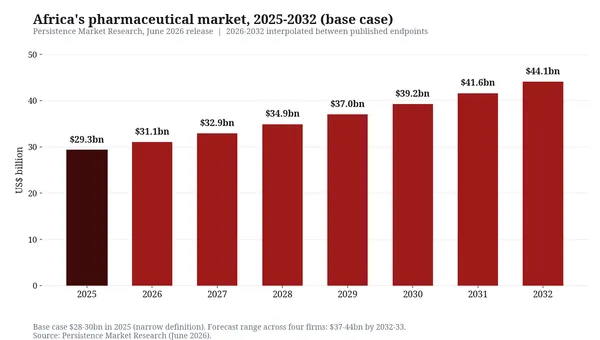
Four independent research firms put Africa's pharmaceutical market at $27.7bn to $29.3bn in 2025, on a narrow definition of finished products at revenue value. Persistence puts it at $29.3bn in 2025, rising to $44.1bn by 2032 (6.1% a year). Grand View puts it at $28.5bn in 2025 and $37.0bn by 2033 (3.3% a year). Market Data Forecast puts it at $28.5bn in 2025 and $39.7bn by 2034 (3.8% a year). The forecast range is therefore $37bn to $44bn by 2032 to 2033: a disagreement about growth rates, not size. Brookings puts it at $20.8bn in 2013, heading toward about $50bn by 2030.
Broader definitions run much higher. Fairfield puts the market at $64.2bn in 2025 and DataHorizzon at $40.6bn, but both count biotechnology, contract manufacturing and adjacent products: a wider basket, not a bigger market. Credence Research ($59.9bn) fails its own growth arithmetic and is not used here.
How the Market Is Structured
Prescription generics are the volume core. Infectious diseases and vaccines account for 24% of market value in 2025 (Persistence Market Research). Non-communicable diseases are the fastest-growing demand pool: the WHO puts them at 37% of deaths in sub-Saharan Africa in 2023, up from 28% a decade earlier. Biologics and biosimilars are the fastest-growing category (11.6% a year to 2034), but no credible whole-market share was found.
Three channels move the product: public tenders and donor programmes, private retail pharmacies, and hospitals buying direct. No reliable continent-wide split is published, so none is stated here. An informal channel also matters: patent-medicine vendors and drug shops are a major last-mile route, and the WHO estimates about 19% of medicines in the region are substandard or falsified.
The Country Map
| Country | Market size | Local production | Defining feature |
|---|---|---|---|
| Egypt | $7-8bn (2025, EDA) | About 90% of consumption made locally | Largest market; generics powerhouse; 180+ factories |
| South Africa | $4.2-6.3bn (2025) | Significant local base; APIs imported | Most sophisticated regulator; home to Aspen |
| Nigeria | $2-4.5bn | About 30% local; improving toward 50:50 | Largest population prize (about 240m) |
| Morocco | About $2.5bn (2024) | About 70% of volume made locally | Francophone export platform; about 50 plants |
| Algeria | $2.8bn (2020, latest credible) | 83% of needs met locally | Import-substitution model; state flagship Saidal |
| Kenya | $0.8-1.4bn | About 30% of demand local | East Africa's largest market |
| Ghana | No reliable published figure | About 30% local | FDA Ghana at WHO Maturity Level 3 |
| Ethiopia | $1.1-1.8bn | Disputed: 8% or 40%+ (see profile) | State-led industrial parks; central public buyer |
Sizes are not directly comparable: audited ex-factory figures, revenue estimates and broader baskets are mixed here. Algeria's figure is 2020. See also our ranking of the most competitive pharmaceutical industries.
Egypt. Largest market: $7bn to $8bn in 2025 (Egyptian Drug Authority), roughly a third of the continent. More than 180 factories; about 90% of consumption made locally.
South Africa. Second market: $4.2bn (IQVIA audited) to $6.3bn (IMARC). Most sophisticated regulated market; SAHPRA caps private prices. Aspen's Mounjaro held 53% of the GLP-1 market by September 2026.
Nigeria. Largest population prize (about 240m); market $2bn (KPMG) to $4.5bn. NAFDAC reports imports falling from 70% in 2019 toward 50% in 2025. GSK and Sanofi ended direct operations in 2023-24.
Morocco. Market MAD 25.9bn, about $2.5bn, in 2024. About 70% of volume made locally in roughly 50 plants; 14,000+ pharmacies. Export platform for Francophone West Africa.
Algeria. Import-substitution model: local production covered 83% of needs in 2025-26, up from 65% in 2022, across 233 establishments. Latest credible size $2.8bn (2020).
Kenya. East Africa's largest market ($0.8bn to $1.4bn). About 30% of demand is local; only 20% of the Essential Medicines List is made locally. See our earlier report on why Kenya still imports 70% of its medicines.
Ghana. No reliable published market size. About 30% of drugs are made locally by 30+ manufacturers; the regulator reached WHO Maturity Level 3 in 2020. Insurance covered about 70% by October 2026.
Ethiopia. Market $1.1bn to $1.8bn; local share disputed (above 40% per the World Bank, 8% per the manufacturers' association). Kilinto's 279-hectare zone hosts foreign plants; state buyer EPSS dominates procurement.
Senegal. No reliable published size; the vaccine story. The Institut Pasteur de Dakar is Africa's only WHO-prequalified vaccine maker. Its MADIBA plant targets 300m doses a year (EIB 75m euros; IFC $45m).
Rwanda. No reliable published size; the regulatory and biotech story. Kigali hosts the African Medicines Agency (operational October 2025) and BioNTech's mRNA site (about $150m).
The Value Chain
Africa's strength sits in the middle of the chain. Local plants mostly do formulation and packaging: turning imported ingredients into tablets, capsules and syrups. The continent imports more than 95% of its active ingredients, mainly from India and China, spending more than $2bn a year on them. Distribution is fragmented: wholesalers feed tens of thousands of retail pharmacies. Donor-funded procurement (Gavi, UNICEF, Global Fund) buys most antiretrovirals and vaccines. Pooled procurement is the emerging fix: the AfCFTA mechanism (launched 2021) and Nigeria's Medipool aggregate demand so plants can borrow against guaranteed orders.
Key Players by Country
The companies below make, import or distribute at scale in each market. For the wider field, see our rankings of the top 50 local manufacturers and the top 10 manufacturing companies.
South Africa
| Company | What it does | Note |
|---|---|---|
| Aspen Pharmacare | Africa's largest drugmaker (JSE-listed). | R34.87bn revenue FY2026; distributes Lilly's Mounjaro. |
| Adcock Ingram | Prescription, OTC, hospital; leader in IV fluids. | R9.76bn revenue FY2025; Natco raising stake to 49%. |
| Biovac | Cape Town vaccine maker; fill-and-finish. | 20m+ doses a year; $110m package (Apr 2026). |
Egypt
| Company | What it does | Note |
|---|---|---|
| EIPICO | Largest private maker; generics, OTC, 300+ products. | EGP 9.44bn revenue in 2025 (+24.4%). |
| EVA Pharma | Research-based maker; oncology, cardiometabolic. | Makes insulin locally with Lilly. |
| Pharco Pharmaceuticals | Largest MENA maker by volume (company claim). | Cut hepatitis C treatment to under $100 a course. |
Nigeria
| Company | What it does | Note |
|---|---|---|
| Fidson Healthcare | Maker and distributor; Lagos and Ota plants; NGX-listed. | NGN 119.06bn revenue in 2025 (+41%). |
| Emzor Pharmaceutical | Indigenous maker; 140+ products. | Building a $23m API plant in Sagamu. |
GSK and Sanofi now distribute through third parties in Nigeria.
Morocco
| Company | What it does | Note |
|---|---|---|
| Sothema | Largest listed maker; generics, biosimilars, oncology. | MAD 2.8bn revenue in 2024 (+13.3%). |
| Cooper Pharma | Maker since 1933; branded generics, consumer health. | About 1,600 staff. |
| Laprophan | Maker since 1949; 500+ products, 14 areas. | Revenue about $250-300m in 2026. |
Algeria
| Company | What it does | Note |
|---|---|---|
| Saidal | State-owned group; sole public maker. | State holds 80%. |
| Biopharm | Largest private maker; branded generics, oncology. | No revenue published. |
Kenya
| Company | What it does | Note |
|---|---|---|
| Dawa Life Sciences | Nairobi maker; about 200 generics. | 100m+ treatments a year across 25 African markets. |
| Cosmos Ltd | Maker since 1978; malaria, TB, HIV, diabetes. | Voluntary licences from GSK and Boehringer Ingelheim. |
| Universal Corporation Ltd | WHO-prequalified maker in Kikuyu. | Strides bought 51% (2016, $14m). |
Ghana
| Company | What it does | Note |
|---|---|---|
| Ernest Chemists | Largest drug company in Ghana; making, retail, wholesale. | Founded 1986; plants in four cities. |
| Kinapharma | Maker, distributor, marketer; 150+ brands. | no official website found |
| Dannex Ayrton Starwin | Maker from the 2019 merger of three firms; GSE-listed. | no official website found |
Ethiopia
| Company | What it does | Note |
|---|---|---|
| Julphar Ethiopia | Addis Ababa maker; generics for local and African markets. | Plant opened 2013, the group's first in Africa. |
| Cadila Pharmaceuticals Ethiopia | Akaki joint venture; tablets, capsules, liquids. | Operating since 2003; longest-running Indian presence. |
Senegal and Rwanda
| Company | What it does | Note |
|---|---|---|
| Institut Pasteur de Dakar | Dakar vaccine maker since 1896. | Africa's only WHO-prequalified vaccine maker. |
| BioNTech (Rwanda) | mRNA vaccine manufacturing in Kigali. | About $150m committed; test production from 2025. |
Multinationals mostly distribute rather than manufacture. Sanofi is the exception, with a Cairo plant making 120m units a year. Pfizer manufactures through Biovac; Hikma makes in Algeria and Morocco; Strides in Kenya.
Regulation & Policy
Africa has 54 national medicines regulators, but only nine meet the WHO Maturity Level 3 bar: Egypt, Ethiopia, Ghana, Nigeria, Rwanda, Senegal, South Africa, Tanzania and Zimbabwe. The African Medicines Agency became operational in October 2025, based in Kigali under Director General Dr Delese Mimi Darko. As of November 2026, 34 of 55 African Union states have ratified its treaty; Nigeria became the 34th on 30 October 2026. The ladder runs from the harmonisation programme (launched 2009), through five regional joint-assessment programmes, to the agency and AfCFTA pooled procurement (launched 2021). In February 2025 the nine Maturity Level 3 regulators signed a reliance agreement to accept each other's decisions.
The last 24 months brought a policy pile-up. Nigeria's June 2024 order zeroed duties on listed pharma inputs for two years; 87 local makers benefited by October 2026. Ghana's policy of 28 October 2026 targets raising the local share from 30% to 60%. Kenya launched a 2026-2030 manufacturing strategy in June 2026. Egypt made unified registration mandatory on 1 November 2025.
Demand: Who Buys, and Who Pays
Patients pay most of the bill. Out-of-pocket spending averaged 35.8% of health expenditure in the WHO African Region between 2012 and 2020, and 30.4% across sub-Saharan Africa in 2023. The extremes: Nigeria 71.9%, Egypt 57.2%, Kenya 24.2% and South Africa 6.7% in 2023. Insurance covers about 19% of Sub-Saharan Africans on average; Rwanda is the outlier at 85.3% through community-based insurance. Ghana's scheme covered about 70% by October 2026; cardholders rose from 18 million in 2024 to 22 million in 2025. Nigeria covered 21.7 million people in 2025 (about 13% on the official report's basis), rising to 23 million by October 2026. Donors pay for much of the volume core: external resources exceed 20% of health spending in half of the region's countries, and antiretrovirals and vaccines are largely donor-procured.
Supply: Local vs Imported
More than 70% of medicines are imported, mainly from Asia, and about 99% of vaccines. Local production covers about 30% of demand by value, concentrated in final formulation and packaging. About 690 plants operate on the continent, and 85% of them sit in eight countries, half of them in North Africa. Most plants run at only 30% to 60% of capacity, against over 70% in advanced economies. The deepest dependence is active ingredients: more than 95% imported, costing African firms over $2bn a year in 2023. Half of African countries have no pharmaceutical production at all. The direction is uneven: Egypt makes about 90% of what it consumes and Algeria 83%, while Nigeria's import share is improving toward 50:50 and Kenya still imports about 70%.
Prices & Economics
African patients pay far above world reference prices. A 2025 Lancet Global Health analysis of 54 countries found private patients paid 3.0 to 11.5 times reference prices for the cheapest generics, and over 25 times for brands. No region met the WHO target of 80% availability of essential medicines. Public procurement does far better: an earlier Lancet analysis put the median at 1.11 times the reference price.
Tender versus retail is visible in South Africa. The state tender price for metformin 500mg, 56 tablets, was R11.48 from September 2025, or about R0.21 a tablet. The December 2025 reference list puts abacavir 300mg, 60 tablets, at R1,163.39 including VAT. In Nigeria, paracetamol cost NGN 300 to 800 a sachet in early 2026 ($0.22 to $0.59 at the official rate); branded amoxicillin cost NGN 4,060 ($3.01). Prices have risen fast: Augmentin cost NGN 12,300 ($9.12) against NGN 3,000 to 5,000 previously. In Mozambique, a month of heart-disease prevention cost 14 to 18 days' wages for the lowest-paid worker.
Investment Landscape
Gavi's vaccine manufacturing accelerator offers up to $1.2bn over ten years (launched June 2024). The biggest 2026 deal was Biovac's $110m package (April 2026, IFC and European Investment Bank). It funds Africa's first end-to-end multi-vaccine plant in Cape Town: 30 to 40 million doses a year, with completion in 2028. BioNTech has committed about $150m to its mRNA site in Kigali, inaugurated in December 2023. Dakar's MADIBA plant carries 75 million euros from the European Investment Bank and $45 million from the International Finance Corporation. In Egypt, the African Development Bank approved a 15 million euro loan in March 2025 for Minapharm's second biotech facility. It is part of a 78.9 million euro programme (capacity 3 million to 7.65 million doses a year by 2032).
The biggest single transaction was not an investment in Africa at all. Aspen sold its Asia-Pacific business to BGH Capital for R26.5bn (December 2025; completed May 2026 for about R27bn), funding its refocus on Africa. In Nigeria, the presidential value-chain initiative claims about $2bn in financing commitments. In retail, LeapFrog exited East Africa's Goodlife Pharmacy (about 150 stores) to CFAO Healthcare in 2026; BII-backed Growth Investment Partners invested in Ghana's mPharma in December 2025 (amount undisclosed). The African Development Bank estimates about $11bn is needed by 2030. See our earlier report on who is building capacity and who is financing it.
Challenges & Risks
Regulatory fragmentation is the top-cited barrier. At the African Medicines Agency's inaugural week in October 2026, manufacturers reported 80% citing unpredictable review timelines and 77% citing differing requirements across countries. Import dependence is second: more than 95% of active ingredients come from India and China, and the trade deficit was about $12.5bn in 2020. Foreign exchange is third: the naira's collapse pushed GSK and Sanofi out of Nigeria in 2023, and 12 multinationals exited the country between 2020 and 2024. Fake medicines are fourth: the WHO estimates at least one in ten medical products in low- and middle-income countries is substandard or falsified, and a review put poor-quality medicines at 18.7% prevalence in Africa. Donor dependence is fifth: the January 2025 US aid freeze cancelled 5,200 USAID awards, cut US HIV disbursements from $6.7bn to $4.6bn, and closed about 1,700 HIV sites. Small markets, energy costs and workforce complete the list: vaccine manufacturing needs about 12,500 skilled staff by 2040, against fewer than 4,000 today.
Opportunities & White Spaces
Harmonised registration is the first prize: one approval accepted across the continent would turn 54 small markets into one addressable market. Active ingredients are the biggest gap: Ghana's October 2026 policy targets them, Nigeria's executive order zeroes duties on them, and Minapharm's programme in Egypt is the working model. Vaccines are the largest guaranteed demand expansion: 60% made in Africa by 2040, from under 1% today, with demand set to more than double to 2.7 billion doses. Fill-and-finish is the low-risk entry; drug substance is the margin. Chronic disease is the fastest-growing demand pool. Diabetes cases are projected to rise 142%, from 24.6 million in 2024 to 59.5 million in 2050, the fastest increase of any region. And 72.6% are undiagnosed (International Diabetes Federation). GLP-1 drugs show the licensing route: Aspen's Mounjaro deal with Eli Lilly (signed August 2023, effective January 2024) is the template for champions that license in rather than invent. Retail consolidation and pooled procurement complete the list: guaranteed offtake makes local plants bankable.
Outlook to 2030
Base case: about $44bn by 2032, growing at 6.1% a year from $29.3bn in 2025 (Persistence Market Research). On that trajectory the market passes about $39bn around 2030. Broader definitions put it far higher, which is why the definition matters more than the digit. Three things decide whether the base case holds. First, whether the African Medicines Agency turns treaty signatures into faster approvals. Second, whether AfCFTA pooled procurement gives local plants orders they can borrow against. Third, whether anyone builds an active-ingredient plant at scale. The lesson of 2025 is the fourth factor: donor funding can fall by nearly a third in a year, so domestic budgets and insurance are the real hedge.
FAQ
How big is Africa's pharmaceutical market? About $28bn to $30bn in 2025, on a narrow definition. Broader definitions run as high as $64bn.
Why does Africa import most of its medicines? Local plants mostly do formulation and packaging, and more than 95% of active ingredients come from India and China. About 690 plants share a $29bn market, and most run below 60% of capacity.
Which country has the largest pharmaceutical market in Africa? Egypt, at $7bn to $8bn in 2025, roughly a third of the continent (Egyptian Drug Authority). South Africa is second.
Is local manufacturing actually growing? Yes, in pockets: Egypt makes about 90% of what it consumes and Algeria 83%. But the continent still imports over 70% of its medicines, and vaccine production remains under 1%.
What is the African Medicines Agency, and does it matter? It is the continent's medicines regulator, operational since October 2025 and based in Kigali. A drug registered once could eventually be sold across Africa; 34 of 55 states have ratified its treaty.
Data Sources & Methodology
Definition. The market size used in this article is the narrow definition: finished pharmaceutical products (prescription, over-the-counter, vaccines and biologics) sold in Africa, on a revenue basis. Broader definitions that add biotechnology, contract manufacturing and dietary supplements are not comparable and are not averaged into the base case. The base case is about $28bn to $30bn in 2025, the cluster where four independent firms (Persistence Market Research, Grand View Research, Market Data Forecast and Precision Business Insights) land within $1.6bn of each other.
The range, and why it is shown. Persistence Market Research: $29.3bn in 2025, $44.1bn by 2032, 6.1% a year (June 2026 release). Grand View Research: $28.5bn in 2025, $37.0bn by 2033, 3.3% a year. Market Data Forecast: $28.5bn in 2025, $39.7bn by 2034, 3.8% a year. Fairfield Market Research ($64.2bn in 2025) and DataHorizzon Research ($40.6bn, pharmaceuticals plus biotechnology) use broader scopes and are cited only as the top of the range. Credence Research ($59.9bn in 2024) is not cited: its own growth rate does not reproduce its own forecast. An earlier Persistence edition (April 2025) put the market at $46.8bn in 2022 on a different scope and is not mixed with the June 2026 edition used here. Country market sizes in the Country Map table are not comparable across sources: IQVIA figures are audited ex-factory data, others are revenue estimates on broader baskets. The African Union figure of "nearly 60% imported", cited in one market report, is the low-end outlier against the 70% to 90% consensus and is not used in the body.
Per-capita and shares. Africa's population in 2025 is 1,549,867,579 (UN World Population Prospects 2024). Per-capita pharmaceutical spending of about $19 is derived: $28.5bn divided by 1.55bn people gives $18.4, and $29.3bn gives $18.9. Global spending is about $1.6tn (IQVIA, invoice prices, excluding COVID-19 vaccines), giving a global per-capita figure of about $193 and Africa's share of global market value at 1.5% to 1.8%, depending on the global total used. The often-quoted 3% figure is Africa's share of global drug production, not market value, and the two are not conflated here. Egypt's share of the continental market is stated as "roughly a third" on the Egyptian Drug Authority chairman's wording; the 38% figure from one research-house press release does not reproduce against the Authority's own market size ($7.5bn to $8bn implies 26% to 27% of a $29bn market) and is not used.
Currencies. Nigerian naira prices are converted at the official rate of NGN 1,349 per US dollar on 9 November 2026. Rand prices are given in rand only; no rand-to-dollar conversion is used. Morocco's market is given in dirhams (MAD 25.9bn) with an approximate dollar equivalent of $2.5bn.
Verification. Every figure in this article was checked against a primary source and one independent source, and every derived claim (shares, multiples, per-capita figures, growth rates) was recomputed by script; the full audit is on file with the editors. Figures that could not be verified to that standard were omitted, including: the claim that Africa's market grew from $215bn to $750bn; the 10% by 2025 vaccine interim target as met (it was missed; local production remains under 1%); any continent-wide channel split or over-the-counter share; Kenya's Social Health Authority enrolment figures; South Africa's medical-scheme coverage; the unverified Morocco Benslimane vaccine plant; the unverified claim of a ransomware attack on Pharma 5; and government claims on Nigeria's executive-order cost savings that carry no second source. Ghana's market size is not stated because the only figure found is a single-source industry estimate. Ethiopia's local-production share is stated as a dispute, with both figures and their sources, because the two published figures cannot be reconciled. Biovac's new plant is stated at 30 to 40 million doses a year, its initial phase; larger figures in some sources describe later phases or group capacity and are not used without that caveat. Aspen's agreement with Eli Lilly on Mounjaro was announced on 30 August 2023 and took effect in January 2024; September 2025 brought the injector-pen approval, not the deal. Pharma 5's official site (pharma5.ma) did not respond when checked on 10 November 2026 and is not linked; Kinapharma's site (kinapharma.com) likewise did not respond, and no official site was found for Dannex Ayrton Starwin. Saidal's site was verified live by browser fetch on 16 October 2026; Emzor's site returns a bot-protection response to automated checks but is indexed and retrievable.
Sources. Persistence Market Research (June 2026); Grand View Research (August 2025); Market Data Forecast (October 2026); Brookings, "Realizing Africa's pharmaceutical potential" (28 May 2026); UNCTAD, "Building the case for investment in local pharmaceutical production in Africa" (April 2025); IQVIA Middle East and Africa Pharmaceutical Business Insights (MAT Q2 2026); WHO African Region Health Expenditure Atlas 2023; Lancet Global Health, Oldfield et al. (January 2025); Egyptian Drug Authority via the Egyptian Gazette (October 2026); KPMG, "Repositioning Nigeria's Pharmaceutical Industry" (July 2026); GTAI Morocco and Algeria analyses (October 2026); Aspen Pharmacare FY2026 results; Fidson Healthcare FY2025 annual report; EIPICO 2025 results; Gavi African Vaccine Manufacturing Accelerator; African Development Bank; Africa CDC; WHO list of national regulatory authorities at Maturity Level 3 (August 2026); DIA Global Forum Q and A with African Medicines Agency Director General Dr Delese Mimi Darko (November 2026); International Diabetes Federation Diabetes Atlas, 11th edition (2025). Full source URLs are on file with the editors.