Published: November 14, 2026
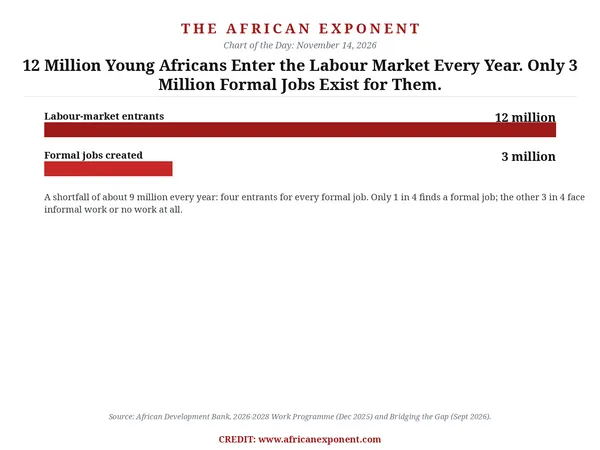
Every year, about 12 million young Africans enter the labour market. Every year, the formal economy creates only about 3 million jobs for them. The shortfall is about 9 million a year: four entrants for every formal job, and only 1 in 4 of them finds a formal job at all.
The African Development Bank puts the annual flow at 10 to 12 million entrants, against about 3 million formal jobs. Even at the low end of that range, the gap is 7 million a year. At the top end, which this chart uses, it is 9 million. The Bank restated the same pairing in September 2026, in its report Bridging the Gap, and in its 2026 to 2028 work programme. This is not a one-year shock. It is the standing arithmetic of the African labour market, and a decade on, the gap has not closed.
The shortfall does not stay a shortfall. It becomes informality. 85 percent of Africans who work, work informally, the highest rate on Earth, and the 4-to-1 mismatch is the arithmetic behind that number. When 3 in 4 of each year's entrants cannot get a formal job, the informal economy is where most of them end up.
Why it matters
A gap of 9 million a year compounds. Held for a decade, it is about 90 million young people without a formal job. That is the scale on which the continent's youth bulge either becomes a workforce or a waiting room. By 2050, 1 in 4 people on Earth will be African, and most of them will be young. Whether that is a dividend or a time bomb is decided, in large part, by whether the formal economy can ever create jobs at the rate young Africans arrive.
The Bank's own response shows the scale of the task. Its Jobs for Youth in Africa strategy set out to create 25 million jobs over a decade. At a shortfall of 9 million a year, that target covers less than three years of the gap. Closing it needs about 1 million formal jobs a month, four times the roughly 250,000 a month the economy creates now. No single programme closes a gap that wide. It takes the growth rate, the investment and the skills pipeline all moving at once.
The number in context
There is a counterpoint worth stating plainly. A formal job is a narrow measure. Millions of young Africans build real livelihoods outside it, in farming, trade and the digital economy, and some of the continent's fastest-growing work, from mobile money agents to motorcycle logistics, barely existed a decade ago. The 12 million figure is also an estimate, a range of 10 to 12 million, not a census count. But even on the most generous reading, 10 million entrants against 3 million jobs, the formal economy absorbs less than a third of each year's cohort. The direction of the number is not in doubt, only its exact size.
Data Sources
- African Development Bank, 2026-2028 Work Programme and Budget Document, December 2025 (the gap between the 10 to 12 million new entrants to the labour market each year and the approximately 3 million jobs currently available).
- African Development Bank, Bridging the Gap: Inequality and the Imperative for Inclusive Growth in Africa, September 2026 (only around 3 million formal jobs are created each year compared with the 10 to 12 million young people entering the labour force annually).
- African Development Bank and International Labour Organization, Youth, Jobs and Skills Marker System, launched July 16, 2025 (10 to 12 million young Africans entering the labour market annually, against only 3 million formal jobs).
- African Development Bank Acting Vice President Martin Fregene, Annual Meetings, Brazzaville, May 28, 2026, reported by The Eastleigh Voice, May 30, 2026 (11 million young Africans enter the labour market every year, but only three million get formal jobs).
Methodology
All figures are the African Development Bank's estimate, restated in the Bank's own publications in December 2025 and September 2026 and by its senior officials in May 2026, so the figure is current as of November 14, 2026. The Bank gives a range, 10 to 12 million entrants a year against about 3 million formal jobs. This post uses the top of the range, 12 million, as its headline, and states the range wherever the headline figure is used. Every derived figure was recomputed before publication: the shortfall is 12 minus 3, or 9 million a year (7 million at the low end of the range); the ratio is 12 divided by 3, or 4 to 1; the formal share is 3 divided by 12, or 25 percent; per month, 12 million entrants is 1 million a month against 250,000 formal jobs; held for a decade, a 9 million annual shortfall is about 90 million; and the Bank's 25 million job target divided by a 9 million annual shortfall covers about 2.8 years. One figure was not used: an AfDB official's statement that Africa needs to create at least 1.6 million jobs every month, because 1.6 million a month is 19.2 million a year and does not reconcile with the 9 million annual shortfall, so it cannot be a restatement of the same gap.