Published: November 13, 2026
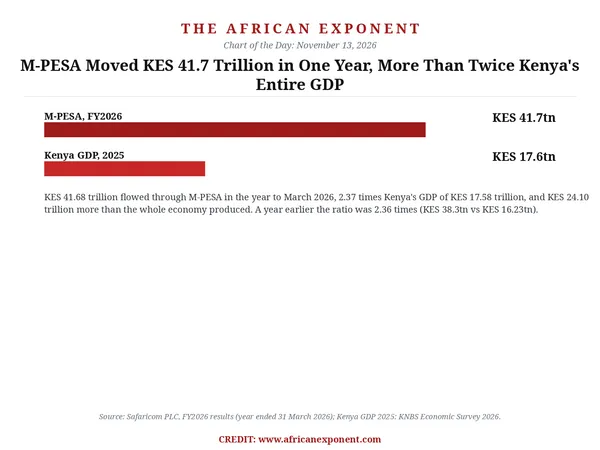
In the year to March 31, 2026, M-PESA processed 46.4 billion transactions worth KES 41.68 trillion, about $322 billion. Kenya's whole economy produced KES 17.58 trillion in 2025. One company's payment rail carried 2.37 times the whole economy, KES 24.10 trillion more than GDP itself.
The comparison is not new. It has never been this wide. A year earlier, M-PESA moved KES 38.3 trillion against 2024 GDP of KES 16.23 trillion, a ratio of 2.36. Value grew 8.9 percent in FY2026. Volumes grew far faster, 25.1 percent, to about 127 million transactions a day, or KES 114.2 billion a day. People are using M-PESA more often for smaller, everyday payments. The average transaction fell about 13 percent, from roughly KES 1,032 to KES 898.
M-PESA is also now Safaricom's biggest business. Its revenue rose 13.4 percent to KES 182.7 billion in FY2026, 45.6 percent of Safaricom Kenya's service revenue, almost matching the KES 197.9 billion from voice, SMS and internet combined. The platform holds about 9 in 10 mobile money subscriptions in Kenya, 88.8 percent at June 2026, per the Communications Authority. Airtel Money has climbed to 11.1 percent.
Formal financial inclusion in Kenya reached 84.8 percent of adults in 2024, up from 26.7 percent in 2006, in the FinAccess Household Survey run by the Central Bank of Kenya, KNBS and FSD Kenya. M-PESA did not create that shift alone. No other single product carried as much of it.
Why it matters
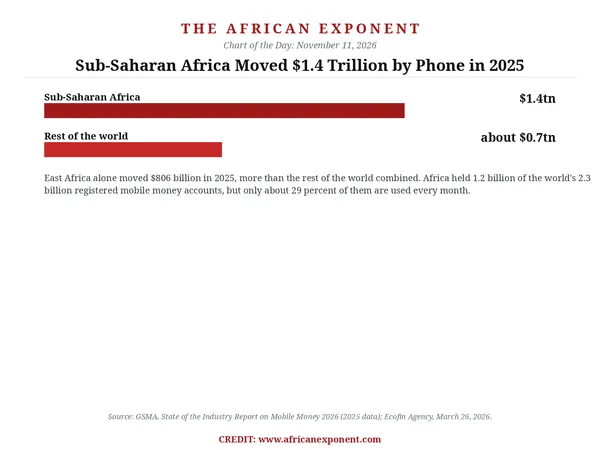
A payment system that moves more than twice GDP is no longer just a product. It is infrastructure, and if it stops, it is a national event. Safaricom raised M-PESA's processing capacity from 4,500 to 6,000 transactions a second during FY2026. The platform now settles school fees, salaries, government collections and merchant payments, not just person-to-person transfers. The question for Kenya is what happens when the rails of the economy sit inside one company. The regulator's answer so far has been competition: Airtel Money climbed from about 6 percent to 11 percent of subscriptions in two years. For the rest of Africa, is M-PESA a Kenyan exception or a template? Mobile money moved about $1.4 trillion across Sub-Saharan Africa in 2025. No other market has one rail this dominant. Kenya shows what deep adoption looks like, and the concentration risk that comes with it.
The number in context
One caveat keeps the headline honest. Transaction value counts each transfer leg, so the same shilling can be counted several times as it moves from person to merchant to supplier. It covers payments, savings, credit and remittances, not just spending. GDP counts only value added. So 2.37 times GDP describes the scale of the flow, not money created. Against other flows, the scale holds: M-PESA's KES 41.68 trillion is about 2.4 times everything Kenya produced in a year, and it is still growing faster than the economy itself. A flow that big, through one pipe, is the story either way.
Data Sources
- Safaricom PLC, Audited Results for the Financial Year Ended 31 March 2026, May 7, 2026 (M-PESA value KES 41.68tn; volume 46.4bn; revenue KES 182.7bn, 45.6% of Safaricom Kenya service revenue of KES 400.8bn; FY2025 value KES 38.27tn), as reported by Tech-Ish and People Daily, July 11, 2026.
- Kenya National Bureau of Statistics, Economic Survey 2026 / Facts and Figures 2026 (GDP at current market prices: KES 17,577,557m in 2025; KES 16,232,295m in 2024; real growth 4.6% in 2025).
- World Bank, World Development Indicators, Gross domestic product 2025, July 15, 2026 (Kenya GDP $135,941m in 2025), corroborated by the IMF World Economic Outlook, October 2026 ($135.92bn, about KES 17.57tn).
- Communications Authority of Kenya, Sector Statistics, Q4 FY2025/26, as reported by Khusoko, September 20, 2026 (M-PESA 88.8% of mobile money subscriptions at June 2026; Airtel Money 11.1%; 54.0m subscriptions) and Tech-Ish, September 25, 2026.
- FinAccess Household Survey 2024 (Central Bank of Kenya, KNBS, FSD Kenya), 2024 FinAccess infographic (formal financial inclusion 84.8% in 2024, up from 26.7% in 2006).
- Safaricom PLC, Audited Results Booklet, year ended 31 March 2025 (M-PESA value KES 38,291bn; volume 37,153m), via Quartr.
Methodology
All figures are the latest available on November 13, 2026. The headline uses Safaricom's FY2026 results (year ended March 31, 2026, released May 7, 2026), not the FY2025 figures in the series bank: the bank entry flagged that FY2026 reporting put M-PESA's value higher, at about KES 41.7tn, and instructed a check before publication. The FY2026 value, KES 41.68tn, is confirmed by Safaricom's own results and by six independent reports that agree on every figure used here. The FY2025 comparison uses KES 38.3tn (the FY25 booklet's KES 38,291bn; the FY26 report restates it as KES 38.27tn, a rounding difference that changes no derived figure). Kenya's GDP is calendar 2025, KES 17.58tn, from the Kenya National Bureau of Statistics, corroborated by the World Bank's $135.94bn and the IMF's $135.92bn for 2025. Two corrections to the bank entry were made on publication day and are stated here, not hidden: the bank's 2006 financial inclusion figure of 19 percent does not reproduce, the verified FinAccess figure is 26.7 percent; and the bank's M-PESA market share of about 91 percent was the mid-2025 reading, while the latest Communications Authority figure, at June 2026, is 88.8 percent, which is what this post uses. The dollar figure, about $322bn, converts at the GDP-implied 2025 rate of KES 129.3 per dollar. Transaction value is a flow measure: it counts each transfer leg, so it is not value added and is not directly comparable to GDP as output; the ratio is used here as a scale comparison, and the article says so. Every derived figure was recomputed before publication: the ratio is 41.68 divided by 17.58, or 2.37; the gap is 41.68 minus 17.58, or KES 24.10tn; the prior-year ratio is 38.29 divided by 16.23, or 2.36; value grew 41.68 divided by 38.27 minus 1, or 8.9 percent; volume grew 46.4 divided by 37.1 minus 1, or 25.1 percent; the average transaction is 41,680 divided by 46.4, or KES 898, against 38,270 divided by 37.1, or KES 1,032, a fall of about 13 percent; the daily flow is 41.68 trillion divided by 365, or KES 114.2bn, and 46.4 billion divided by 365, or 127.1 million transactions a day; and M-PESA's revenue share is 182.7 divided by 400.8, or 45.6 percent.