Published: November 12, 2026
Key Facts
- Chad ranks first. 97 in 100 people there have no reliable electricity, and only 3 in 100 say their power works most or all of the time. The figures come from Afrobarometer Round 10, surveyed in 2024/2025.
- The top 10 average 91.3% without reliable power. The average across all 38 countries surveyed is 57%.
- Nigeria ranks 7th. Only 10 in 100 Nigerians have reliable power, and 53 in 100 have a connection that works only occasionally or about half the time. That 53% is the highest such share in all 38 countries surveyed.
- Malawi has the highest share of people with no connection or a connection that never works: 87 in 100. Only 14 in 100 Malawians are connected to the grid at all.
- South Africa is not in the top 10. Despite load shedding, 65 in 100 South Africans have reliable power, which puts the country 13th worst on this measure.
| Rank | Country | Without reliable power | With reliable power | No connection or never works |
|---|---|---|---|---|
| 1 | Chad | 97% | 3% | 85% |
| 2 | Zambia | 96% | 4% | 73% |
| 3 | Mali | 94% | 6% | 66% |
| 4 | Guinea | 93% | 7% | 69% |
| 5 | Sierra Leone | 92% | 8% | 77% |
| 6 | Madagascar | 91% | 9% | 75% |
| 7 | Nigeria | 90% | 10% | 37% |
| 8 | Malawi | 89% | 11% | 87% |
| 9 | Zimbabwe | 86% | 14% | 66% |
| 10 | Uganda | 85% | 15% | 73% |
All figures are shares of all adults surveyed. Afrobarometer Round 10, 2024/2025, 38 countries, 50,961 interviews. Reliable power means electricity that works most or all of the time. Chad alone, at 97% without reliable power, is nearly double the five best supplied countries combined, at 49%, and 48.5 times Mauritius, at 2%. The top 10 average of 91.3% is 4.71 times the average of the 10 best supplied countries, at 19.4%.
1. Chad
97% without reliable power (Afrobarometer Round 10, 2024/2025). Only 3 in 100 Chadians say their electricity works most or all of the time, the lowest share in the survey. Only 29 in 100 live in areas served by a grid, and 85 in 100 have no connection or one that never works. The World Bank puts access to electricity at 13.4% in 2024, the lowest of the 10 countries here. In July 2026 a fire at the Farcha 1 plant in N'Djamena destroyed three generator groups, losing 18 to 21 MW, and residents were still suffering long cuts nearly four weeks later.
2. Zambia
96% without reliable power (Afrobarometer Round 10, 2024/2025). Only 1 in 25 Zambians enjoys reliable power from the national grid, and the reliable share has fallen 22 points since 2014/2015, the biggest fall of any country in the survey. Drought cut output at the Kariba Dam, which was generating only 166 MW of 1,080 MW capacity in May 2025. ZESCO cut homes to 5 hours of electricity a day in June 2025, and some residents faced up to 21 hours a day without power during the 2024/2025 drought crisis.
3. Mali
94% without reliable power (Afrobarometer Round 10, 2024/2025). Only 6 in 100 Malians have reliable power, down 17 points since 2014/2015. Malians cope by going around the grid: 65 in 100 use an alternative source of electricity, mostly solar, the highest share of all 38 countries. In July 2026 suspected sabotage damaged the high voltage line from the Manantali Dam, leaving large parts of Bamako without electricity and running water for two days. A fuel blockade by armed groups had already worsened blackouts in late 2025.
4. Guinea
93% without reliable power (Afrobarometer Round 10, 2024/2025). Only 7 in 100 Guineans have reliable power. The country produces only about 1,000 MW and needs an estimated 5,000 to 10,000 MW more to industrialise, which leaves its aluminium ambitions waiting beyond 2030. The state utility paid only a small fraction of what it owed the Kaleta and Souapiti hydro operators in 2026, about $4.5 million of $139.4 million billed by Kaleta and $6 million of $240.9 million billed by Souapiti.
5. Sierra Leone
92% without reliable power (Afrobarometer Round 10, 2024/2025). Only 8 in 100 Sierra Leoneans have reliable power, and only 24 in 100 are connected to the grid at all. The Karpowership plant, contracted for 45 MW in the dry season, has generated only 5.6 to 6 MW since January 2026 over government arrears above $48 million. Residents of eastern Freetown go 3 to 4 days without light, then get about 30 minutes of low voltage supply. Bo and Kenema get only 7 hours of light three times a week.
6. Madagascar
91% without reliable power (Afrobarometer Round 10, 2024/2025). Only 9 in 100 Malagasy have reliable power, down 7 points since 2014/2015. Daily outages of 6 to 12 hours in parts of Antananarivo set off Gen Z protests under the slogan "Leo Delestage" from 25 September 2025. The energy minister was sacked on 27 September, and the government was dissolved two days later. The protests left at least 5 people dead in the first days, and the UN counted at least 22 killed in the wider unrest.
7. Nigeria
90% without reliable power (Afrobarometer Round 10, 2024/2025). Only 10 in 100 Nigerians have reliable power, and 53 in 100 have a connection that works only occasionally or about half the time. That 53% is the highest such share in all 38 countries, and it is the Nigerian story in one number: most people are connected, but the power rarely stays on. The national grid collapsed on 29 December 2025, with generation crashing to 0 MW and about 15 hours needed for full restoration. It was the third collapse of the year, after 10 September and 7 March. The regulator counts only 2 collapses in 2025 against 9 in 2024, using a strict definition that excludes smaller disturbances.
8. Malawi
89% without reliable power (Afrobarometer Round 10, 2024/2025). Only 14 in 100 Malawians are connected to the grid, the lowest connection rate of all 38 countries, and 87 in 100 have no connection or one that never works, the highest share in the survey. The World Bank puts access to electricity at 15.6% in 2024. Peak demand reached 451.61 MW against only 370 MW of available generation in August 2026, and a nationwide blackout hit on 9 September 2026. The energy minister pledged in October 2026 to halve blackouts by December, using repairs at the Nkula hydro plant and a 50 MW import from Mozambique.
9. Zimbabwe
86% without reliable power (Afrobarometer Round 10, 2024/2025). Only 1 in 7 Zimbabweans enjoys a reliable supply of electricity from the national grid. Small businesses faced about 16 hours of darkness a day in early 2026, and a shutdown of Hwange Unit 3 in September and October 2025 pushed outages to 18 to 20 hours in some areas. The picture may be improving: the utility claimed 304 days without load shedding in 2026, though residents in Harare suburbs still reported 4 to 6 hour daily outages in October 2026, which the utility blamed on faults and maintenance.
10. Uganda
85% without reliable power (Afrobarometer Round 10, 2024/2025). Only 15 in 100 Ugandans have reliable power. Outages nearly doubled after the state owned UEDCL took over the grid from Umeme in April 2025, and fault response time rose from about 12 hours to about 20 hours. UEDCL recorded about 4,487 hours of outages between May 2025 and March 2026, and the national grid collapsed 5 or more times in 2026. UEDCL says it needs $994 million over five years to fix the network.
Frequently Asked Questions
Which African country has the worst power cuts in 2026?
Chad. 97 in 100 people there have no reliable electricity, according to Afrobarometer Round 10, surveyed in 2024/2025. Only 3 in 100 Chadians say their power works most or all of the time, and 85 in 100 have no connection or one that never works.
How many Nigerians have reliable electricity?
Only 10 in 100. A further 53 in 100 have a connection that works only occasionally or about half the time, the highest such share in all 38 countries surveyed. Nigeria ranks 7th worst in Africa on this measure, even though most Nigerians are connected to the grid.
Does South Africa have the worst power cuts in Africa?
No. South Africa is famous for load shedding, but 65 in 100 South Africans have reliable power, which puts the country 13th worst on this measure, outside the top 10. Nigeria, at 90% without reliable power, is 2.57 times worse than South Africa, at 35%.
Why is Zambia ranked so high?
Drought cut output at the Kariba Dam, the backbone of Zambian power, to 166 MW of 1,080 MW capacity in May 2025. Zambia's reliable share has fallen 22 points since 2014/2015, the biggest fall of any country in the survey. At the worst of the 2024/2025 crisis, some residents faced up to 21 hours a day without power.
How was this ranking made?
It ranks the share of people without a reliable electricity supply, from Afrobarometer Round 10, surveyed in 2024/2025 across 38 countries with 50,961 interviews. Reliable means electricity that works most or all of the time. Each country's figure carries a margin of error of 2 to 3 points, so the top three, Chad, Zambia and Mali, are effectively tied at the bottom. The ranking covers only the 38 countries surveyed; 16 African countries were not surveyed in this round.
Data Sources
- Afrobarometer Dispatch No. 1233, "Persistent access and connectivity gaps leave majority of Africans without reliable power", 21 September 2026 (Round 10, 2024/2025, 38 countries): afrobarometer.org
- Afrobarometer Round 10 Summary of Results for Nigeria, 2024 (NOIPolls, fieldwork 19 June to 17 July 2024): afrobarometer.org
- Afrobarometer Dispatch No. 1178, Zambia (Edward Chibwili, 7 May 2026), and Round 10 Summary of Results for Zambia, 2024: afrobarometer.org
- Afrobarometer Dispatch No. 1244, "Electricity in East Africa", 23 October 2026: afrobarometer.org
- Afrobarometer Dispatch No. 952, Zimbabwe (Mpako and Moyo-Nyede, 5 March 2025): afrobarometer.org
- World Bank World Development Indicators, access to electricity, percent of population (EG.ELC.ACCS.ZS), 2024 values, retrieved 12 November 2026: data.worldbank.org
- Reporting cited: Benin Web TV on the Farcha 1 fire in Chad (20 August 2026); Xinhua and News Diggers on Zambia load shedding (26 June 2025 and 10 June 2026); News Central TV on the Manantali line sabotage in Mali (7 July 2026); AlCircle on Guinea power supply (26 October 2026); Sierra Leone Monitor on Karpowership (30 October 2026); Global Voices on the Madagascar protests (7 October 2025); The Sun on the Nigeria grid collapse (30 December 2025); Nyasa Times on Malawi blackouts (19 August and 31 October 2026); My Zimbabwe News and The Herald on Zimbabwe load shedding (15 March and 28 October 2026); Daily Monitor on Uganda outages (26 October 2026).
Methodology
This ranking uses one uniform measure for every country: the share of adults without a reliable electricity supply, from Afrobarometer Round 10, surveyed in 2024/2025. Reliable means the respondent's mains connection works most or all of the time. "Without reliable power" is 100 minus the reliable share. The survey covered 38 of Africa's 54 countries with 50,961 face to face interviews. The 16 countries not surveyed in this round are Algeria, Egypt, Libya, Sudan, South Sudan, Eritrea, Djibouti, Ethiopia, Somalia, DR Congo, Rwanda, Burundi, Niger, Burkina Faso, Central African Republic and Equatorial Guinea, so they do not appear in this ranking.
Each country's figure carries a margin of error of 2 to 3 percentage points at 95% confidence. Ranks 1 to 3, Chad 97%, Zambia 96% and Mali 94%, sit within that margin of each other, so the top of the table is effectively a statistical dead heat. The same applies to adjacent pairs such as Guinea, Sierra Leone and Madagascar at 93%, 92% and 91%. Figures are rounded to whole percents, so the three bands in the table can sum to 99% or 101% for some countries.
Two figures were checked against a second Afrobarometer publication. Nigeria's 10% reliable share matches its Round 10 Summary of Results exactly: 9.1% most of the time plus 0.9% all of the time. Zambia's 4% matches Dispatch No. 1178, "only one in 25 citizens", and its Summary of Results, 3.8% plus 0.3%. Zimbabwe's 14% matches Dispatch No. 952, "only one in seven citizens". Uganda's figure differs by one point between publications: this article uses 15% from Dispatch No. 1233, while Dispatch No. 1244 states 16%. The rank is unaffected either way, since Guinea-Bissau, next below the top 10, sits at 74% without reliable power.
World Bank access to electricity figures are a different measure and are not mixed into this ranking. Access counts anyone with electricity, including off grid and solar, while this ranking counts only mains grid power that works most or all of the time. That is why Zambia shows 53.6% access but only 4% reliable power, and Nigeria shows 62.5% access but only 10% reliable power. The gap between access and reliability is the story of this ranking, not a contradiction in the data.
This article supersedes the site's March 2025 editorial list, Top 10 African Countries with the Worst Power Outages in 2024/2025, which named no dataset and ranked countries on mixed indicators. All figures in this ranking come from the sources listed above, and every derived claim in the article was recomputed from the final table before publication.
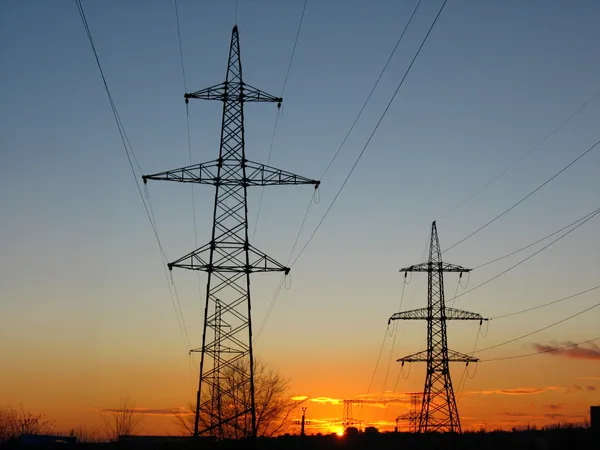
Image: electricity pylons at sunset. Photo: Novoklimov / Wikimedia Commons (CC BY 4.0). The photo is illustrative.