Published: November 13, 2026
Key Takeaways
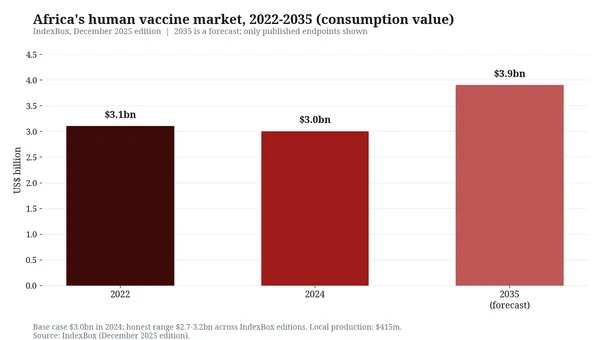
- Africa's human vaccine market is worth about $3.0 billion in 2024, measured as consumption value, and is forecast to reach about $3.9 billion by 2035. Local production is worth only about $415 million of that total.
- About 99% of the vaccines used in Africa are imported. Only about 1% are made on the continent, and only one African manufacturer, the Institut Pasteur de Dakar, holds World Health Organization prequalification for a vaccine.
- Demand is about 1 billion doses a year today and is projected to more than double to over 2.7 billion doses by 2040, driven by population growth and new malaria vaccines.
- Financing is now real: Gavi's African Vaccine Manufacturing Accelerator makes up to $1.2 billion available over ten years, and Biovac and the Institut Pasteur de Dakar have secured hundreds of millions in development finance.
- The binding constraint is demand certainty. Factories need governments and donors to commit to buy African-made vaccines, and the Moderna pause in Kenya in 2024 shows what happens when orders do not arrive.
Market Size & Growth
Start with the definition. This briefing measures the market as the value of human vaccines consumed in Africa, at producer and importer revenues, excluding logistics, retail margins and delivery costs. On that definition, IndexBox puts the market at $3.0 billion in 2024, up 22% on 2023, and forecasts $3.9 billion by 2035, growth of about 2.5% a year in value. The same firm's earlier editions put 2024 at $2.7 billion and $3.2 billion, so the honest range is $2.7 billion to $3.2 billion, with $3.0 billion as the base case. A narrower number circulates alongside it: Gavi values African vaccine demand at over $1 billion a year, the procurement channel Gavi and UNICEF finance, and the demand a manufacturer can actually sell into through pooled tenders.
For scale, the global human vaccine market was $46.9 billion in 2024, according to Research and Markets. Africa's $3.0 billion is about 6.4% of that total, while the continent holds about 18% of the world's people. Per person, Africa spends about $2.00 a year on vaccines, against a global average of about $5.70. Biologics is the junior partner: Africa's biosimilars market was about $201 million in 2025, forecast to reach about $452 million by 2032, according to Credence Research. Its importance is strategic: the same plants, skills and regulators that make vaccines make insulin and antibody therapies, and Egypt and South Africa already produce insulin locally.
How the Market Is Structured
Four segments make up the market. Routine childhood immunisation is the volume core, bought in bulk through UNICEF tenders and financed by Gavi and governments. Outbreak and campaign vaccines, cholera, yellow fever, meningitis and Ebola, are episodic, bought in surges and often stockpiled. Newer vaccines, malaria and HPV, are the growth segment, with prices falling fast as supply scales. Adult and travel vaccines are a small private market. Veterinary vaccines are a separate $1.0 billion market, led by Ethiopia, Egypt and South Africa.
| Segment | Share of the market | Who buys | How it is supplied |
|---|---|---|---|
| Routine childhood vaccines | Largest share by volume | Governments, via Gavi and UNICEF | Almost entirely imported, mainly from India |
| Outbreak and campaign vaccines | Episodic, surge-driven | Gavi, WHO, governments, emergency stockpiles | Imported; one African source for yellow fever |
| New vaccines (malaria, HPV) | Fastest growing | Gavi and UNICEF, with government co-finance | Imported; African production is the stated next step |
| Biologics and biosimilars | About $201m in 2025 | Hospitals, public tenders, private insurers | Imported, except insulin in Egypt and South Africa |
Two facts shape everything else. First, the buyer is not the patient: routine vaccines are free at the point of use in most of Africa, so the customer is a tender, and the price is set in Geneva and Copenhagen. Second, supply is extraordinarily concentrated: the Serum Institute of India makes the R21 malaria vaccine and supplies a large share of routine vaccines, and a handful of multinationals, Sanofi, Pfizer, GSK and Bharat Biotech, supply the rest. African factories compete against that concentrated, low-cost supply, not against each other.
The Country Map
Eight countries hold essentially all of Africa's vaccine and biologics manufacturing. South Africa has the deepest base, Senegal has the only globally prequalified vaccine, Egypt has the largest ambitions and the strongest regulator, and Rwanda, Morocco, Kenya, Nigeria and Ghana are building. The table ranks them by what is actually operating, not by what has been announced.
| Country | What exists today | Capacity | Defining feature |
|---|---|---|---|
| South Africa | Biovac, Aspen, Afrigen all operating | Biovac expanding to 500m doses a year | Only end-to-end vaccine production on the continent |
| Senegal | Institut Pasteur de Dakar, yellow fever since 1937 | 30m doses a year from 2026; 300m targeted by 2030 | Africa's only WHO-prequalified vaccine maker |
| Egypt | VACSERA, EVA Pharma, Biogeneric Pharma | National target 385m doses a year by 2030 | First African regulator at WHO maturity level 3 |
| Rwanda | BioNTech Kigali, inaugurated Dec 2023 | About 50m doses a year initially | Africa's first commercial-scale mRNA plant |
| Morocco | MARBIO (SENSYO Pharmatech), Benslimane | 116m units a year planned | Largest fill-finish platform in Africa by design |
| Kenya | Kenya BioVax Institute building; Moderna paused | 72m doses a year targeted | State-led build, first trial batch targeted end 2027 |
| Nigeria | Biovaccines Nigeria Ltd, no production yet | None operating | Largest demand pool, still entirely imported |
| Ghana | Atlantic Lifesciences, DEK Vaccines | First vaccine targeted 2027 | New policy and $100m funding drive in 2026 |
South Africa is the only country where vaccine manufacturing is a real industry rather than a project. Biovac in Cape Town has delivered more than 450 million doses across Southern Africa, and in November 2025 it became the first South African company in more than 50 years to make a vaccine from end to end, an oral cholera vaccine now in clinical trials. Afrigen, also in Cape Town, runs the World Health Organization's mRNA technology transfer hub and in June 2026 won the continent's first Good Manufacturing Practice certification for an end-to-end mRNA facility.
Senegal has the longest record: the Institut Pasteur de Dakar has made yellow fever vaccine since 1937 and is one of only four WHO-prequalified yellow fever manufacturers in the world, and the only one in Africa. Its AfricAmaril plant lifts yellow fever capacity to 30 million doses a year, and its MADIBA project targets 300 million by 2030. Egypt is the volume and regulatory leader: VACSERA produced more than 30 million COVID-19 doses by early 2022, EVA Pharma runs an mRNA hub targeting 100 million RNA doses a year, and Egypt became, in 2024, the first African country whose regulator reached WHO maturity level 3. Rwanda is the mRNA bet: BioNTech's Kigali site, inaugurated in December 2023, is designed for about 50 million doses a year initially, backed by up to 145 million dollars from CEPI. Kenya is the cautionary tale: Moderna paused its planned mRNA plant in April 2024 after more than $1 billion in losses, and the state-owned Kenya BioVax Institute is now building a $60.8 million fill-finish facility rated at 72 million doses a year, with a first trial batch targeted for the end of 2027.
The Value Chain
A vaccine reaches an African child through six steps, and Africa is present at only some of them. Research and development happens in a handful of centres: Afrigen, KEMRI, universities, and the Institut Pasteur de Dakar. Antigen and drug substance production is almost entirely absent: the Institut Pasteur's yellow fever production is the exception, and Biovac's cholera vaccine is the first new end-to-end product in decades. Fill and finish, putting bulk vaccine into vials, is where most African capacity sits, at about 2 billion doses a year, but it depends on imported bulk. Procurement is the final step and decides whether the chain survives: UNICEF is the world's largest vaccine buyer, delivering nearly 3 billion doses a year, and Gavi finances the purchase for the poorest countries.
Key Players by Country
Each table lists the players that actually operate in the country, what they do there, and a link to the company's official website. Where a significant player has no official website, that is stated rather than linking a substitute.
South Africa
| Company | What it does in this market | Position | Website |
|---|---|---|---|
| Biovac | Vaccine manufacturer; routine paediatric vaccines, oral cholera vaccine end to end, future IPV, PCV, MenX | South Africa's primary vaccine supplier; 450m+ doses delivered | biovac.co.za |
| Aspen Pharmacare | Fill-finish: Johnson and Johnson COVID-19 vaccine 2021 to 2022; insulin fill-finish for Novo Nordisk | Africa's largest pharmaceutical manufacturer by revenue | aspenpharma.com |
| Afrigen Biologics | WHO/MPP mRNA technology transfer hub; mRNA vaccines for COVID-19, TB, RSV, Rift Valley fever | First GMP-certified end-to-end mRNA facility in Africa (Jun 2026) | afrigen.co.za |
Senegal
| Company | What it does in this market | Position | Website |
|---|---|---|---|
| Institut Pasteur de Dakar | Yellow fever vaccine since 1937; MADIBA plant for measles, rubella, polio, rotavirus; outbreak vaccines (Lassa, Marburg) | Only WHO-prequalified vaccine manufacturer in Africa | institutpasteurdakar.sn |
Rwanda
| Company | What it does in this market | Position | Website |
|---|---|---|---|
| BioNTech | mRNA vaccine manufacturing (malaria, TB, HIV, mpox); clinical trial material | First commercial-scale mRNA facility in Africa, if completed | biontech.com |
Egypt
| Company | What it does in this market | Position | Website |
|---|---|---|---|
| VACSERA | State-owned vaccine manufacturer; COVID-19 vaccine production | 30m+ COVID-19 doses by early 2022 | vacsera.com |
| EVA Pharma | mRNA vaccine platform; insulin glargine; animal-health vaccines | 100m RNA doses a year targeted; 1.5bn animal vaccine doses commercialised | evapharma.com |
| Biogeneric Pharma | mRNA technology transfer from Afrigen; biologics development | Early-stage; first mRNA training at Afrigen in 2022 | biogenericpharma.com |
Morocco
| Company | What it does in this market | Position | Website |
|---|---|---|---|
| MARBIO (SENSYO Pharmatech) | Fill-finish for vaccines and biotherapeutics; first "Made in Morocco" vaccine due soon | Joint venture: Moroccan state, Mohammed VI Investment Fund, Recipharm | recipharm.com (Recipharm, partner; no standalone MARBIO site found) |
Kenya
| Company | What it does in this market | Position | Website |
|---|---|---|---|
| Kenya BioVax Institute | State-owned fill-finish and end-to-end vaccine manufacturing (pneumonia, typhoid first) | Building; first trial batch targeted end 2027 | No official website found |
| Moderna | Planned mRNA plant, PAUSED April 2024; HIV and malaria candidates still in development | No African orders since 2022; $1bn+ losses on cancellations | modernatx.com |
Nigeria
| Company | What it does in this market | Position | Website |
|---|---|---|---|
| Biovaccines Nigeria Ltd | Reviving domestic vaccine production; Integrated Biotech Park in design; mRNA R&D lab at NIMR | Joint venture: Federal Government 49%, May & Baker 51%; no production yet | No official website found |
Ghana
| Company | What it does in this market | Position | Website |
|---|---|---|---|
| Atlantic Lifesciences | Private vaccine manufacturing partner; first locally made vaccine targeted 2027 | Seeking $100m+ with government backing | No official website found |
| DEK Vaccines Ltd | Private vaccine manufacturing partner | Named partner in the national programme | dekvaccines.com |
The multinational layer sits above these tables. Sanofi, Pfizer and GSK supply most imported vaccines and are the technology transfer partners African plants depend on. The Serum Institute of India supplies the R21 malaria vaccine and a large share of routine vaccines through UNICEF. Bharat Biotech now manufactures the RTS,S malaria vaccine under transfer from GSK, and EuBiologics of South Korea makes the Euvichol cholera vaccine that Biovac is learning to produce. Their sites are sanofi.com, pfizer.com, gsk.com, seruminstitute.com, bharatbiotech.com and eubiologics.com. The International Vaccine Institute (ivi.int) is the non-profit technology transfer partner behind Biovac's cholera vaccine and Kenya's Konza plant.
Regulation & Policy
Regulation is the quiet bottleneck. A vaccine cannot be sold to UNICEF or Gavi without WHO prequalification, and prequalification requires a national regulator the WHO trusts. Only one African manufacturer has cleared that bar, the Institut Pasteur de Dakar for yellow fever, which is why Africa CDC expects only three manufacturers to secure prequalification for nine vaccines over the next five years.
Three changes in the last 24 months matter most. First, the African Medicines Agency became operational in October 2025, headquartered in Kigali, with 34 of the African Union's 55 member states having ratified its treaty. It is meant to end the practice of registering the same vaccine separately in dozens of countries, the single largest regulatory cost in the market. Second, Egypt's regulator reached WHO maturity level 3 for medicines and vaccines in 2024, the first in Africa. Third, South Africa's regulator certified Afrigen's mRNA facility to Good Manufacturing Practice standard in June 2026, the first such certification for an end-to-end mRNA plant on the continent. The framework is the Partnerships for African Vaccine Manufacturing, launched in 2021 and renamed the Platform for Harmonised African Health Products Manufacturing in February 2024. Its target is unchanged: 60% of the vaccines Africa uses made in Africa by 2040. The 2025 interim target of 10% was not met.
Demand: Who Buys, and Who Pays
The buyer is, overwhelmingly, the donor system. Gavi finances vaccine purchase for the poorest countries, UNICEF buys and delivers them, and governments co-finance a rising share as their incomes grow. In Kenya, donors still finance more than 80% of vaccine needs, and the country is due to exit Gavi support by 2030. Ghana faces the same transition by 2030 and estimates it will need $50 million to $60 million a year for vaccine procurement without donor support, against $15 million in counterpart funding paid in 2026. Households pay almost nothing for routine childhood vaccines, which are free at the point of use.
That structure creates the market's central tension. Demand is large and growing, 1 billion doses today, 2.7 billion by 2040, but it is allocated through UNICEF tenders that reward the lowest qualified price, and it is financed by donors whose budgets are now shrinking. Gavi's June 2025 replenishment raised just over $9 billion against an $11.9 billion target, a shortfall of about $2.9 billion, after the United States terminated a $2.6 billion grant.
Supply: Local vs Imported
Africa imports about 99% of the vaccines it uses. Local production, measured by value, was about $415 million in 2024, about 13.8% of the $3.0 billion consumed. Both figures are true and describe different things: most local output is fill-finish of imported bulk, which adds value without making the vaccine, while end-to-end local production, where the antigen itself is made in Africa, is about 1% of doses used.
Concentration is extreme. The Africa CDC, CHAI and PATH assessment counts 25 active vaccine manufacturing projects, but most are at early stages, and a June 2026 survey of 27 African manufacturers found only one had even applied to its national regulator for a vaccine intended for the broader African market. The binding constraint is antigen production: fill-finish capacity of about 2 billion doses a year already roughly doubles current demand, so more fill-finish lines would add little. The second constraint is people: Africa CDC estimates 9,000 to 14,000 full-time staff will be needed in vaccine manufacturing and research by 2040.
Prices & Economics
Vaccine prices in Africa are set by pooled procurement, not by markets, and they are falling for the newest products. Three anchor prices tell the story.
| Vaccine | Price per dose | What changed |
|---|---|---|
| R21/Matrix-M malaria vaccine | $2.99 | Gavi-UNICEF deal, Nov 2025; down from about $4, a 25% cut; saves up to $90m over five years |
| RTS,S (MOSQIVAC) malaria vaccine | EUR5.50 from early 2027 | Bharat Biotech, Oct 2026; down from EUR9.30, about a 40% cut; saves about $50m in 2027 to 2029 |
| Oral cholera vaccine (Euvichol) | $1.65 | UNICEF awarded price, recent years; $2.50 indicative for single-dose vial presentation |
A full course of the R21 malaria vaccine costs $11.96 at the new price, for a disease that still kills more than 500,000 people a year, mainly children under five in sub-Saharan Africa. These prices are also the wall African manufacturers must climb: a new plant has to match a $2.99 malaria dose or a $1.65 cholera dose while carrying the cost of a new facility, a small initial volume, and the multi-year expense of WHO prequalification. Margins are thin and depend on volume. Biologics are the exception: insulin and monoclonal antibodies sell at far higher prices per dose, which is why EVA Pharma's insulin and Aspen's insulin fill-finish matter commercially even though they are small in volume.
Investment Landscape
Investment has moved in three waves: pandemic-era announcements, development finance in 2024 to 2025, and a consolidation wave in 2026 in which the strongest projects attracted the largest cheques. The investor mix is almost entirely public: development finance institutions, Gavi, CEPI, the European Union and governments. Private capital is largely absent, for the reason the Moderna pause illustrates: returns depend on procurement decisions private investors cannot control. The exceptions are Recipharm's minority stake in Morocco's MARBIO and the Serum Institute and Bharat Biotech, whose technology transfers are commercial decisions to secure future supply relationships.
| Date | Deal | Amount |
|---|---|---|
| Jun 2024 | Gavi African Vaccine Manufacturing Accelerator launched | Up to $1.2bn over ten years |
| Apr 2024 | Moderna pauses Kenya mRNA plant | $500m plan shelved; $1bn+ losses on cancellations |
| 2024 | IFC package for Institut Pasteur de Dakar MADIBA plant | $45m ($15m IFC, $30m DFC and AfDB) |
| May 2025 | CEPI expands partnership with BioNTech Kigali | Up to $145m |
| Oct 2025 | European Investment Bank and European Commission, BioNTech Kigali | EUR95m blended finance |
| Jan 2025 | CEPI grant to Afrigen for Rift Valley fever mRNA vaccine | $6.2m |
| Apr 2026 | EIB Group quasi-equity for Biovac multi-vaccine facility | EUR75m, plus $20m IFC senior financing |
| Jul 2026 | African Development Bank loan to Biovac | $15m |
| May 2026 | World Bank AIM2030 initiative launched | Target: double African pharma capacity by 2030 |
| Oct 2026 | Ghana seeks funding for domestic vaccine manufacturing | $100m+ sought |
Challenges & Risks
Demand risk comes first. Moderna's exit is the evidence: no new African orders after 2022, more than $1 billion in losses, and a walk away from a $500 million plant. Without committed buyers, a plant built for 50 million doses a year runs half empty and unit costs rise above the import price.
The donor squeeze comes second. Gavi's $2.9 billion funding gap for 2026 to 2030, the loss of United States funding, and the United Kingdom's reduced pledge mean the largest buyer in the market has less money just as African supply arrives.
The prequalification bottleneck comes third. Only one African manufacturer is WHO-prequalified, and a 2026 survey found only one of 27 African manufacturers had even applied to its regulator for a vaccine aimed at the broader African market.
Skills and inputs come fourth. The sector needs 9,000 to 14,000 trained staff by 2040, and the training pipeline is still small. Antigens, bioprocessing equipment, vials and cold chain inputs are all imported.
Overcapacity in the wrong place comes fifth. Fill-finish capacity of about 2 billion doses already exceeds demand of about 1 billion doses. The scarce resource is drug substance capacity.
Opportunities & White Spaces
The clearest opening is cholera. Global supply falls far short of demand, Biovac's new facility is designed to cover about 40% of the global supply gap, and the Institut Pasteur's expansion adds a second African source. A cholera vaccine is also the fastest realistic route to a second African WHO prequalification, which would unlock accelerator payments and UNICEF tenders.
The second opening is malaria vaccines. More than 40 million doses have already been delivered to 24 African countries, prices have fallen to $2.99 a dose for R21, and no African plant yet makes either malaria vaccine. A technology transfer of R21 or RTS,S production to an African manufacturer is the single highest-value deal available in this market.
The third opening is the mRNA platform: Afrigen, BioNTech and EVA Pharma are building three versions of African-owned mRNA capacity, valuable because production can switch between diseases. The fourth opening is biologics beyond vaccines: insulin is already made in Egypt and fill-finished in South Africa, and the biosimilars market, though small at about $201 million, grows at about 7.8% a year. The fifth opening is veterinary vaccines, a $1.0 billion market in 2024, where the regulatory bar is lower and the buyers are farmers and governments, not donors.
Outlook to 2030
The base case is modest growth in value and a transformation in where the product is made. The market reaches about $3.9 billion by 2035 on IndexBox's forecast, while demand in doses more than doubles to 2.7 billion by 2040. Local production rises from about 1% of doses to something materially higher, but the 30% interim target for 2030 will be missed on current trajectories, just as the 10% target for 2025 was. A realistic 2030 outcome is 5% to 10% of doses made in Africa, concentrated in cholera, yellow fever and a first malaria or routine vaccine, with the 60% target remaining a 2040 ambition.
Three swing factors decide which version of that future arrives. First, WHO prequalification: if Biovac's cholera vaccine and one or two others clear prequalification by 2028, accelerator money flows, UNICEF tenders open, and the model is proven. Second, government offtake: if African Union member states commit to buying a defined share of routine vaccines from African makers, demand risk falls and private capital follows. Third, the Gavi funding gap: if the $2.9 billion shortfall is closed by new donors, the buyer side holds; if not, procurement volumes fall and African entrants face the hardest possible market entry. The honest summary: Africa is building the factories before securing the market for their output. The alternative, waiting for demand certainty, is what left the continent importing 99% of its vaccines during a pandemic.
FAQ
How big is the vaccine market in Africa?
About $3.0 billion in 2024, in consumption value, according to IndexBox's latest edition, with a range of $2.7 billion to $3.2 billion across editions. Forecast: about $3.9 billion by 2035.
How much of Africa's vaccines are made in Africa?
About 1% by doses, according to the Africa CDC, CHAI and PATH assessment. About 99% are imported. Measured by value, local production was about $415 million in 2024, about 13.8% of consumption, because most local output is fill-finish of imported bulk.
Which country manufactures the most vaccines in Africa?
South Africa, by depth: Biovac, Aspen and Afrigen together cover routine vaccines, fill-finish, insulin and mRNA development. Senegal's Institut Pasteur de Dakar is the only African manufacturer with WHO prequalification, for yellow fever vaccine.
What is the African Vaccine Manufacturing Accelerator?
A Gavi financing mechanism launched in June 2024 that makes up to $1.2 billion available over ten years to African vaccine manufacturers. It pays milestone payments when a vaccine reaches WHO prequalification and a top-up per dose on vaccines supplied through UNICEF tenders, up to $250 million per manufacturer.
Will Africa really make 60% of its vaccines by 2040?
That is the African Union's target, set in 2021, with interim targets of 10% by 2025 and 30% by 2030. The 2025 target was not met; a realistic 2030 outcome is 5% to 10% of doses made in Africa. Reaching 60% by 2040 requires WHO prequalification for several African-made routine vaccines, committed government offtake, and the Gavi funding gap to be closed.
Data Sources & Methodology
All figures in this briefing were checked against at least two sources on November 13, 2026, and are stated in US dollars unless noted. Market size: IndexBox, "Africa, Vaccines for Human Medicine, Market Analysis, Forecast, Size, Trends and Insights", editions of March, September and December 2025, which disagree on 2024 and are shown as a range. Global market: Research and Markets, "Human Vaccines, Global Strategic Business Report", December 2025. Biosimilars: Credence Research, "Africa Biosimilars Market", 2025. Demand, capacity and local production share: Africa CDC, Clinton Health Access Initiative and PATH, "Current and planned vaccine manufacturing in Africa", 2023 assessment. Framework and targets: Africa CDC Partnerships for African Vaccine Manufacturing framework, and the Gavi African Vaccine Manufacturing Accelerator page.
Prices: UNICEF Supply Division oral cholera vaccine price data, updated January 12, 2026. Gavi and UNICEF R21/Matrix-M pricing agreement, November 24, 2025. Bharat Biotech MOSQIVAC pricing announcement, October 2026. Company facts: Biovac and South African Medical Research Council, November 11, 2025. European Investment Bank, April 16, 2026. African Development Bank, July 24, 2026. Institut Pasteur de Dakar official site. CEPI and BioNTech, May 2025. European Investment Bank and European Commission, October 2025. Moderna statement, April 11, 2024. EVA Pharma, DNA Script and Quantoom Biosciences, February 5, 2025. Kenya BioVax reporting in The Standard, Health Business and Willow Health Media, 2026. Biovaccines Nigeria Ltd 2025 annual report. Ghana pharmaceutical manufacturing policy reporting, November 2026. Donor funding: Gavi replenishment reporting, June 2025, and Centre for Global Development analysis. The companion deep dive on the pharmaceutical market in Africa covers the wider medicines market this briefing builds on.
Definitions: "consumption value" means producer and importer revenues, excluding logistics, retail margins and delivery costs. "End-to-end production" means the antigen or drug substance is made in Africa, not only filled and finished. "Local production share by doses" counts vaccines whose antigen is produced on the continent. Where sources disagreed, this briefing states the range and names the base case rather than picking one figure silently. Euro figures are stated in euros, not converted. Population: Africa about 1.5 billion people, world about 8.2 billion, used for per-capita calculations. All company website links were checked live on November 13, 2026. Three players, Kenya BioVax Institute, Biovaccines Nigeria Ltd and Atlantic Lifesciences, have no official website, and that is stated in their tables rather than linking a substitute.