Published: November 17, 2026
South Sudan is the youngest country in this series, and its tribal ranking is the most disputed. The Dinka number 4.45 million people in 2026, 35.8 percent of the country. They outnumber the Nuer in second place by 2,512,079 people, and they alone exceed the Nuer and the Azande combined. The contest that matters in South Sudan is not for first place. That was never in doubt. It is for the shape of everything below it, where the official count and the best alternative count disagree sharply on the Nuer, and where tenth place is decided by 7,000 people.
The ranking uses the CIA World Factbook's ethnic shares for the top two groups, applied to South Sudan's 2026 population of 12,436,037 from the United Nations World Population Prospects. The Factbook names the other groups without giving their shares, so ranks 3 to 10 use Joshua Project's in-country counts. No census has ever counted South Sudan by tribe. The Methodology explains the disputes behind the figures. This is the tenth entry in our series ranking the tribes of every African country, after Nigeria, Ghana, South Africa, Kenya, DR Congo, Ethiopia, Egypt, Tanzania and Sudan.
Key Facts
- The Dinka rank first with 4.45 million people, 35.8 percent of South Sudan, about 2.3 times the Nuer in second place and about 1.5 times the Nuer and Azande combined.
- The top two groups alone, the Dinka and the Nuer, cover 6.4 million people, 51.40 percent of South Sudan. The ten ranked groups together cover 10.2 million people, 81.74 percent.
- The Nuer figure is disputed: the Factbook gives 15.6 percent, or 1.94 million people, while Joshua Project counts 1.47 million, 471,022 fewer.
- No census has ever counted South Sudan by tribe. The 2008 census recorded no ethnic breakdown, and its southern count was rejected by Southern Sudanese officials.
- The Shilluk are the most uncertain figure in the ranking. Joshua Project counts 534,000, while Wikipedia's own pages give figures from 381,000 to 1,965,000.
| Rank | Tribe | Share of South Sudan | Population (2026) | Main Homeland |
|---|---|---|---|---|
| 1 | Dinka | 35.80% | 4,452,101 | Bahr el Ghazal and Greater Upper Nile, around Wau, Rumbek, Aweil and Bor |
| 2 | Nuer | 15.60% | 1,940,022 | Greater Upper Nile, around Bentiu, Akobo and Nasir |
| 3 | Azande | 7.50% | 933,000 | Western Equatoria, around Yambio, Nzara and Tambura |
| 4 | Bari | 6.06% | 754,000 | Central Equatoria, around Juba |
| 5 | Shilluk | 4.29% | 534,000 | Upper Nile, on the west bank of the White Nile around Kodok (Fashoda) and Malakal |
| 6 | Sudanese Arab | 3.03% | 377,000 | The northern borderlands around Abyei and Renk, with trading communities in Juba and Malakal |
| 7 | Toposa | 2.88% | 358,000 | Eastern Equatoria, around Kapoeta |
| 8 | Lotuho (Otuho) | 2.47% | 307,000 | Eastern Equatoria, around Torit |
| 9 | Luwo | 2.09% | 260,000 | Western Bahr el Ghazal, around Wau |
| 10 | Belanda Viri | 2.01% | 250,000 | Western Bahr el Ghazal, around Wau |
The shares in this table come from two sources. Ranks 1 and 2 use the CIA World Factbook's ethnic shares, applied to South Sudan's 2026 population of 12,436,037. Ranks 3 to 10 use Joshua Project's in-country counts. The 2026 figures are estimates, not a census count. South Sudan has never published an ethnic breakdown.
The first name outside the ranking is the Mongallese Arabs, at 243,000 people in 2026, just 7,000 behind the Belanda Viri. Behind them, the Moru sit at 232,000 and the Jur Modo at 210,000. The gap at the cut is the tightest in this series, and the two gaps above it are nearly as tight: the Sudanese Arabs lead the Toposa by 19,000, and the Luwo lead the Belanda Viri by 10,000. The bottom half of this table should be read as approximate. The top five are separated by comfortable gaps, the smallest of them 179,000 people.
1. Dinka: 4,452,101
The Dinka live across Bahr el Ghazal and Greater Upper Nile, around Wau, Rumbek, Aweil and Bor. They are cattle people, and cattle are the measure of wealth and the price of marriage across Dinka life. At 35.8 percent, more than one in three South Sudanese is Dinka. They lead the Nuer by 2,512,079 people. Their count is the first of the disputed figures in this ranking. Joshua Project splits the Dinka into six language groups that total 4,085,000 people. That is 367,101 below the Factbook figure used here. Adding the Dinka-speaking Ageer, at 25,000, still leaves the Joshua Project total 342,101 below it.
2. Nuer: 1,940,022
The Nuer live in Greater Upper Nile, around Bentiu, Akobo and Nasir. They are cattle people like the Dinka, and the two groups are closely related. At 15.60 percent, they sit 1,007,022 people ahead of the Azande, and they are the last group above one million people from the official Factbook shares. Their count is the most disputed in this ranking. Joshua Project counts the Nuer at 1,469,000 people. That is 471,022 below the Factbook figure used here, or 24.3 percent lower. Even on Joshua Project's count, the Nuer would still rank second, 536,000 ahead of the Azande.
3. Azande: 933,000
The Azande live in Western Equatoria, around Yambio, Nzara and Tambura. They are farmers, and they are the largest non-Nilotic group in South Sudan. Their language, Zande, belongs to the Ubangian family, not the Nilotic family of the Dinka and Nuer. At 7.50 percent, they sit 179,000 people ahead of the Bari. Wikipedia's list of South Sudan's ethnic groups counts them a little lower, at 878,000 people. That is 55,000 below the figure used here.
4. Bari: 754,000
The Bari live in Central Equatoria, around Juba. The capital city stands on Bari land, which makes the Bari the hosts of the country's government and its largest town. At 6.06 percent, they sit 220,000 people ahead of the Shilluk. Wikipedia's list counts them a little lower, at 672,000 people. That is 82,000 below the figure used here.
5. Shilluk: 534,000
The Shilluk live on the west bank of the White Nile in Upper Nile, around Kodok, once called Fashoda, and Malakal. They built a kingdom that lasted from 1490 to 1865, and their king is still a traditional authority today. At 4.29 percent, they sit 157,000 people ahead of the Sudanese Arabs. Their figure is the most uncertain in this ranking. Wikipedia's own pages give figures from 381,000 to 1,965,000. Joshua Project's 534,000 sits near the middle of that range. Even at 381,000, the Shilluk would still rank fifth, just 4,000 ahead of the Sudanese Arabs.
6. Sudanese Arab: 377,000
The Sudanese Arabs in South Sudan live in the northern borderlands around Abyei and Renk, with trading communities in Juba and Malakal. At 3.03 percent, they sit 19,000 people ahead of the Toposa, one of the closest gaps in the ranking. Their place in this table is a judgment call, and the Methodology states it openly. Joshua Project flags them as indigenous to South Sudan, and Wikipedia's list of the country's ethnic groups counts 348,000 Arabs. But the Factbook's own list of South Sudan's peoples does not name Arabs at all. Without the two Arab entries, the Moru would take tenth place and the Jur Modo would be the near-miss.
7. Toposa: 358,000
The Toposa live in Eastern Equatoria, around Kapoeta, and are cattle herders of the semi-arid east. They belong to the Karamojong cluster of peoples that stretches into Uganda and Kenya. At 2.88 percent, they sit 51,000 people ahead of the Lotuho. Their count carries a warning. Wikipedia's demographics article puts them at about 207,000 people. At that figure the Toposa would fall to thirteenth, behind the Jur Modo, and the Mongallese Arabs would take tenth place.
8. Lotuho (Otuho): 307,000
The Lotuho, also called the Otuho, live in Eastern Equatoria, around Torit. They are pastoralists of the country around Torit, in the Imatong foothills. At 2.47 percent, they sit 47,000 people ahead of the Luwo. Wikipedia's demographics article puts them at over 207,000 people, around 100,000 below the figure used here.
9. Luwo: 260,000
The Luwo live in Western Bahr el Ghazal, around Wau. They are the Luo of South Sudan, also called the Jur Chol, and they are farmers and fishers of the river country. At 2.09 percent, they sit 10,000 people ahead of the Belanda Viri, one of the closest gaps in the ranking. Wikipedia's demographics article puts the Luo in South Sudan at about 171,000 people, 89,000 below the figure used here.
10. Belanda Viri: 250,000
The Belanda Viri live in Western Bahr el Ghazal, around Wau. They are also called the Bviri, and they are the largest single people of the Fertit, the collective name for the peoples of the western Bahr el Ghazal. At 2.01 percent, they close the ranking just 7,000 people ahead of the Mongallese Arabs, and they are the smallest group in the top ten. Their name appears in the Factbook's own list of South Sudan's peoples, as Bviri. It is one of the few points where the two sources agree on a group below the top two.
Frequently Asked Questions
Why do the Dinka and Nuer figures come from the Factbook when Joshua Project counts them lower?
The series method takes the best official basis first, and the Factbook is the only official source that gives shares for South Sudan at all. The Factbook gives the Dinka 35.8 percent and the Nuer 15.6 percent. Joshua Project's Dinka language groups total 4,085,000 people, 367,101 below the Factbook figure, and its single Nuer entry is 1,469,000, 471,022 below it. The gap is stated here and in the Methodology rather than hidden. The ranks do not change on either count: the Dinka stay first and the Nuer stay second by a wide margin.
Why are Sudanese Arabs in a South Sudan ranking?
Because Joshua Project flags them as indigenous to South Sudan, and Wikipedia's list of the country's ethnic groups counts 348,000 Arabs. The Sudanese Arabs in the south are long-settled communities of the northern borderlands around Abyei and Renk, and Arabic-speaking trading communities in Juba and Malakal. The call is disclosed because the Factbook's own list of South Sudan's peoples does not name Arabs at all. Without the two Arab entries, the Moru would take tenth place and the Jur Modo, at 210,000, would be the near-miss.
Why is the Shilluk figure so uncertain?
Because no modern count of the Shilluk is settled. Joshua Project counts 534,000 in South Sudan. Wikipedia's demographics article says just over 381,000, the Shilluk people's own page gives 800,000 to 1,000,300, and the list of ethnic groups gives 1,965,000. The Joshua Project figure is used because it sits near the middle of the published range and agrees with other estimates of about 500,000. Even at 381,000, the Shilluk would still rank fifth, just 4,000 ahead of the Sudanese Arabs. At 1,965,000, they would rank second, ahead of the Nuer.
Why are the Azande ranked when Joshua Project does not flag them as indigenous?
Joshua Project's indigenous flag marks cross-border peoples in only one of their countries. The Azande live across the borders of South Sudan, DR Congo and the Central African Republic, so the flag is blank for South Sudan. But they are a native people of Western Equatoria, the Factbook names them among South Sudan's peoples, and every published ranking puts them third. The same applies to the Kuku, the Kakwa and the Acholi. Only genuinely migrant groups are excluded, such as the Amhara at 13,000. The flag quirk is stated in the Methodology.
Why has no census ever counted South Sudan by tribe?
Because no census of the south has ever asked the question. The 2008 census of Sudan as a whole recorded nationality, not ethnicity, and its southern count of 8.26 million was rejected by Southern Sudanese officials as unacceptable. A further southern census was started in 2009, ahead of the independence referendum, and no census of independent South Sudan has published an ethnic breakdown. Every figure in this ranking is therefore an estimate, and the article says so wherever a figure is disputed.
Data Sources
- CIA World Factbook, South Sudan, ethnic groups, 2016 edition (Dinka 35.8%, Nuer 15.6%): allcountries.org/world_fact_book_2016/south_sudan/south_sudan_people.html
- CIA World Factbook, South Sudan, ethnic groups (2024 mirror): theodora.com/wfbcurrent/south_sudan/south_sudan_people.html
- Joshua Project, South Sudan people groups: joshuaproject.net/countries/OD
- United Nations, World Population Prospects (South Sudan population, 2026): population.un.org/wpp
- African Exponent, "Population of Every African Country in 2026": africanexponent.com
- Wikipedia, "Demographics of South Sudan": en.wikipedia.org/wiki/Demographics_of_South_Sudan
- Wikipedia, "Shilluk people": en.wikipedia.org/wiki/Shilluk_people
- Wikipedia, "List of ethnic groups in South Sudan": en.wikipedia.org/wiki/List_of_ethnic_groups_in_South_Sudan
- World Population Review, "South Sudan Population 2026": worldpopulationreview.com/countries/south-sudan
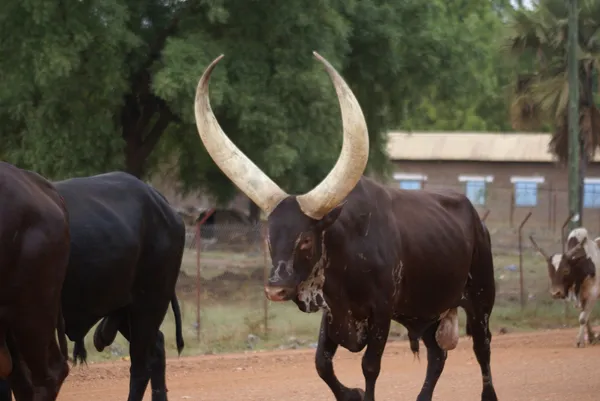
- Wikimedia Commons, "Cattle of the Dinka people, Juba, South Sudan - 20101230-04.jpg" (feature image, Ranjit Bhaskar, CC BY-SA 2.0): commons.wikimedia.org/wiki/File:Cattle_of_the_Dinka_people,_Juba,_South_Sudan_-_20101230-04.jpg
Methodology
South Sudan has never published an ethnic breakdown in any census. The 2008 census of Sudan as a whole recorded nationality, not ethnicity, and its southern count of 8.26 million was rejected by Southern Sudanese officials. A further southern census was started in 2009, ahead of the independence referendum, and no census of independent South Sudan has published an ethnic breakdown. This ranking is therefore built on the CIA World Factbook's ethnic shares for the top two groups. They are the best official basis available. The shares are applied to South Sudan's 2026 population of 12,436,037 from the United Nations World Population Prospects, as carried in the site's own population article, where South Sudan ranks 31st of 54 countries. The Factbook was retired in 2026, so no live Factbook page was used. The exact shares come from the 2016 Factbook edition, which gives the Dinka 35.8 percent and the Nuer 15.6 percent (2011 est.). The 2024 mirror and the final January 2026 edition give the same list with the Dinka at approximately 35 to 40 percent and the Nuer at approximately 15 percent.
The Factbook names the other groups without giving their shares, so ranks 3 to 10 come from Joshua Project's in-country counts, the same seam used for Nigeria, Ghana and Sudan. Joshua Project lists 80 groups for South Sudan. They total 12,352,000 people against the UN 2026 total of 12,436,037, with 84,000 unclassified. The eight seam groups total 3,773,000 people, inside the Factbook's unnamed remainder of 6,043,914. None of them sits inside the Dinka or the Nuer totals, so there is no double count. The top ten total of 10,165,123, or 81.74 percent, does not exceed the whole. Two gaps in the sources are stated openly. First, the Factbook's list names 20 groups but omits the Toposa, the Lotuho and the Luwo entirely, although they rank seventh, eighth and ninth here. Second, World Population Review's ethnicity table, which repeats 1.6 percent for eight groups in a row, evenly splits an unallocated residual rather than reporting measured shares, so it is cited only to show the range of published figures and never used as the basis for a table figure.
Four disagreements between the sources are disclosed rather than resolved silently. First, the Nuer. The Factbook gives 15.6 percent, or 1,940,022 people, while Joshua Project counts 1,469,000, which is 471,022 lower. Wikipedia's demographics article is internally inconsistent on the Nuer, giving 18.6 percent in its introduction and 15.6 percent in its Nuer section. Second, the Dinka. Joshua Project's six Dinka language groups total 4,085,000, which is 367,101 below the Factbook figure. Adding the Dinka-speaking Ageer at 25,000 still leaves the total 342,101 below it. Third, the Shilluk. Published figures run from 381,000 to 1,965,000, and the Joshua Project figure of 534,000 is used because it sits near the middle of the range. Fourth, the Toposa, the Lotuho and the Luwo. Wikipedia's demographics article puts all three lower than Joshua Project: the Toposa at about 207,000 against 358,000, the Lotuho at over 207,000 against 307,000, and the Luo at about 171,000 against 260,000 for the Luwo.
Where Joshua Project splits one people, the entries are combined and the combination is stated. The Dinka corroboration adds six Joshua Project entries: Southwestern at 1,332,000, Southeastern at 931,000, Northeastern at 886,000, South Central at 787,000, Northwestern at 94,000, and Central at 55,000, for 4,085,000 people. The Ageer at 25,000 are Dinka-speaking but listed separately by Joshua Project, so they are not added. The Bari row uses Joshua Project's Karo, Bari at 754,000. The Bai, Bari at 7,100 are not merged, because Bai is a distinct language. The Kuku, Bari at 32,000 are not merged into the Kuku at 195,000, because the two entries may overlap; merged, the Kuku would total 227,000 and would still sit outside the Top 10. Two scope calls are disclosed. Joshua Project does not flag the Azande, the Kuku, the Kakwa or the Acholi as indigenous to South Sudan, because they live across its borders, but they are native peoples of Equatoria and the Factbook names them, so they are included. Joshua Project does flag both Arab entries as indigenous, so the Sudanese Arabs at 377,000 and the Mongallese Arabs at 243,000 are included, although the Factbook's own list does not name Arabs. Without the two Arab entries, the Moru would take tenth place and the Jur Modo would be the near-miss. The Fertit are a collective name for the peoples of Western Bahr el Ghazal, not a single counted tribe: Joshua Project's Fertit peoples total about 476,000, and World Population Review gives Fertit 4.9 percent, about 609,000. Either figure would rank fourth or fifth if Fertit were counted as one group, so the ranking follows Joshua Project's separate entries, with the Belanda Viri as the largest single Fertit people.
Groups inside a ranked family are not ranked separately. All six Joshua Project Dinka entries sit inside the Dinka 35.8 percent. The single Joshua Project Nuer entry sits inside the Nuer 15.6 percent. Non-indigenous and diaspora groups are excluded. The Amhara, Ethiopian at 13,000 are Ethiopian migrants. Deaf South Sudanese at 56,000 are excluded because deafness is not an ethnicity, and Joshua Project's unclassified 84,000 are excluded. Figures are estimates, not census results. Every derived claim in the article was recomputed from the final table values by script before publication. That covers the Dinka at 35.8 percent, the 2.3 times multiple over the Nuer, the 1.5 times multiple over the Nuer and Azande combined, the top two at 51.40 percent, and the top ten at 81.74 percent. It also covers the Dinka lead over the Nuer of 2,512,079, the Nuer gap to Joshua Project of 471,022, and the Belanda Viri holding tenth place by 7,000.