Published: November 17, 2026
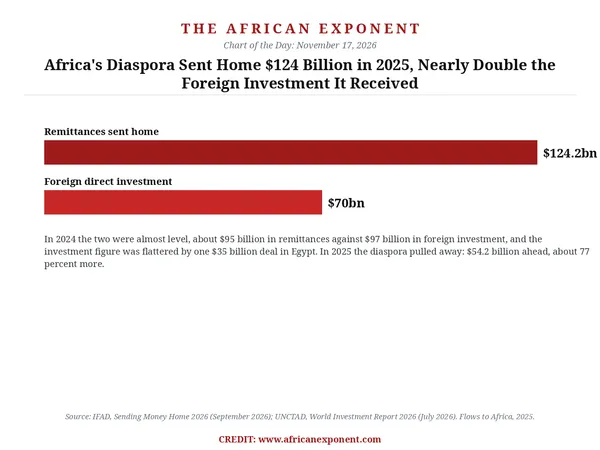
In 2025, Africans living abroad sent $124.2 billion home to the continent, according to the United Nations International Fund for Agricultural Development (IFAD). In the same year, foreign direct investment into Africa totalled about $70 billion, according to UN Trade and Development (UNCTAD). The money families sent home was $54.2 billion larger than all the foreign investment the continent received. That is about 77 percent more, or nearly 1.8 times as much.
The gap is the story. The $54.2 billion difference alone is larger than all the foreign investment that went to West Africa ($20 billion) and North Africa ($22 billion) combined in 2025. The money is concentrated: Egypt received $41.5 billion, about one-third of the continent's total, followed by Nigeria at $22.8 billion and Morocco at $13.7 billion. The top five recipients, Egypt, Nigeria, Morocco, Ethiopia and Kenya, took $90.1 billion between them, about 73 percent of all remittances to Africa.
Our ranking of the African countries that receive the most remittances shows which countries the money lands in.
A year earlier the two were almost level. In 2024, remittances stood at $95.1 billion against headline foreign investment of $97 billion, and the investment figure was flattered by a single $35 billion deal, Egypt's Ras El-Hekma development. Strip that deal out and underlying investment was about $62 billion, already below remittances. In 2025 the gap widened on both sides: remittances climbed to $124.2 billion, up about 31 percent, while investment fell about 26 percent from 2024's exceptional level. Even so, 2025 was still the third-highest year for investment into Africa since 1990.
Why it matters
Remittances go straight to households. About three-quarters of the money is spent on immediate needs, food, shelter and utilities, and about $42 billion of Africa's total reaches rural areas. Yet for all their scale, these flows are still taxed by cost. On IFAD's measure, sending $200 to Africa through non-bank channels averaged 7.2 percent in late 2025, more than double the United Nations target of under 3 percent. Fully digital transfers cost 4.59 percent, against 7.30 percent for cash-based services. Every point cut from that cost is billions kept by the families who earned it, not by intermediaries. The question is whether governments will treat the diaspora as the continent's largest financier, and make it cheap to send money home.
The number in context
The comparison flatters remittances in one way and understates them in another. Foreign investment builds factories, mines and ports. Money spent on food and school fees does not. So the $70 billion arguably buys more lasting capacity than the $124.2 billion. But over the decade, remittances to Africa rose 86 percent, from about $66.8 billion in 2016, while the number of emigrants grew far more slowly. IFAD itself warns that these are private family resources and cannot substitute for public investment. The number proves the diaspora is Africa's biggest financier. It does not prove the money is building the continent's future.
Data Sources
- IFAD, Sending Money Home 2026: Beyond remittances, from lifeline to resilience, one family at a time (September 2026)
- UNCTAD, World Investment Report 2026 (July 2026)
- ISS African Futures, Remittances as development finance: Africa's overlooked billions (August 2025)
Methodology
Remittance figures are IFAD's aggregates from World Bank balance of payments data, with estimates filling gaps for countries whose 2025 data had not yet been reported when the report was compiled; the World Bank's published country values confirm the largest recipients (Egypt $41.52 billion, Nigeria $22.79 billion, Morocco $13.66 billion). The 2025 headline uses the newest full-year releases for both series, IFAD's September 2026 report and UNCTAD's World Investment Report 2026, which supersede the 2024 figures in the original candidate entry (remittances $95.1 billion, headline investment $97 billion, about $62 billion excluding Ras El-Hekma, per ISS African Futures' August 2025 analysis of World Bank and UNCTAD data). UNCTAD's 2026 report later revised the 2024 investment total to $94 billion, which would put the 2024 ex-deal figure at about $59 billion; the direction of the story is unchanged. The 2024 to 2025 remittance rise of about 31 percent compares the ISS 2024 figure with the IFAD 2025 figure, two different vintages of the same underlying World Bank series. Figures were re-verified against the primary sources on publication day.