Published: 24 November 2026
Key Takeaways
- African neobanks are big on flows and small on revenue. Revenue-like estimates put the Middle East and Africa market at roughly $2 billion to $12 billion in 2025, while one widely quoted $372 billion figure counts gross transaction value, not revenue. This briefing leads with revenue and shows the flow figure separately, with its definition attached.
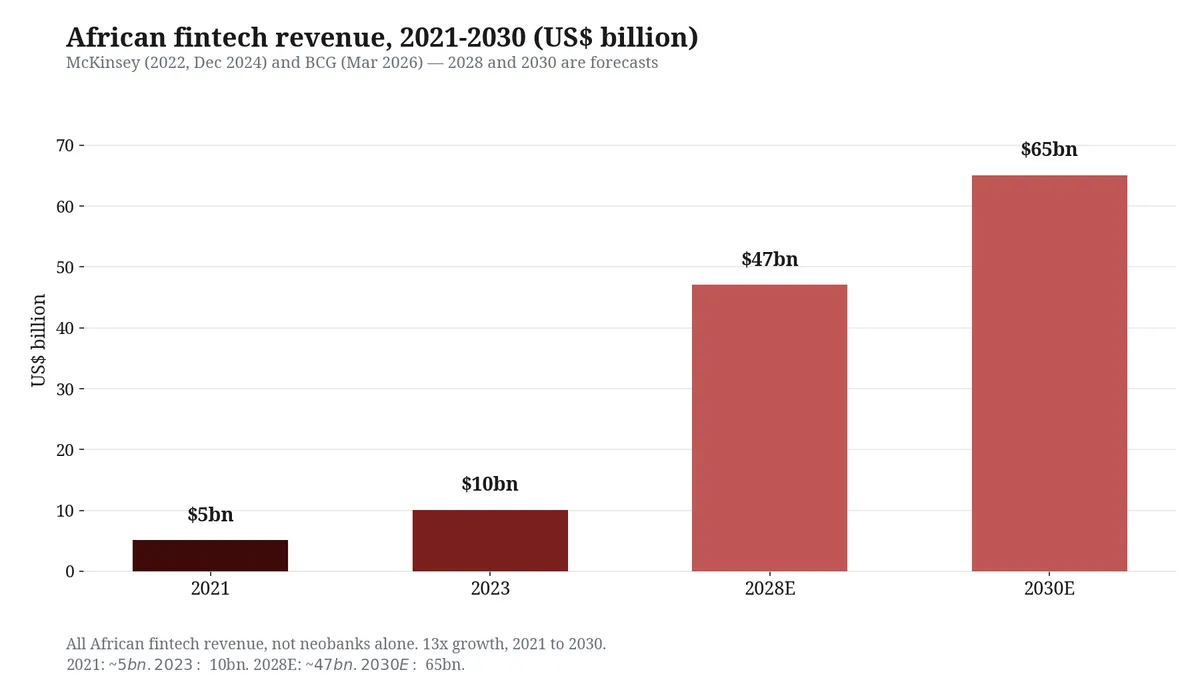
- The wider African fintech revenue path is the growth story to trust. It runs from about $5 billion in 2021, about $10 billion in 2023, about $47 billion expected by 2028 and about $65 billion by 2030. That is a 13-fold rise, according to McKinsey and BCG. Neobanks are a subset of that total, not the whole of it.
- Nigeria has the deepest bench of digital banks anywhere on the continent, with OPay at 39.3 million monthly active users and Moniepoint processing ₦412 trillion in 2025. South Africa has the most mature licensed market, led by GoTyme (formerly TymeBank) with more than 13 million customers.
- The rules tightened sharply in 2026. Nigeria upgraded its biggest digital banks to national licences in January, Kenya replaced its digital-lender regime in September, and Ghana revoked Zeepay's e-money licence in July before a court wound the company up.
- Profit is still the open question. OPay reported a $72.5 million net profit for 2025, and Moniepoint says its Nigerian business is profitable. Kuda lost $40 million in 2023 on $32.1 million of revenue. Deposits per customer remain thin: about R745 at GoTyme and about $13 at Kuda.
How big is the market, really?
Start with the definition, because this market has three sizes and most coverage mixes them up. The first is revenue: the fees and net interest a neobank earns. The second is transaction value: the gross money flowing through accounts and wallets. The third is deposits held. They differ by 10 to 100 times, so a briefing that quotes one number without saying which it is will mislead. This briefing leads with revenue, the number that pays salaries and funds lending, and treats transaction value as a separate measure of scale.
On revenue, the published estimates cluster between about $2 billion and $12 billion for the Middle East and Africa in 2025. GMI Insights puts the region at $1.94 billion in 2025, on a global neobanking market of $97 billion. Verified Market Reports gives two figures on two scopes: $1.8 billion for neobanks narrowly defined and $5.5 billion for neobanking broadly defined. Straits Research puts the region at $11.75 billion, which is 5.4 percent of its $217.66 billion global figure. The honest headline for Africa is therefore a range, roughly $2 billion to $12 billion for the Middle East and Africa combined, with Africa itself a subset of that. No credible Africa-only neobank revenue figure exists in public sources, and this briefing does not invent one.
The $372 billion figure needs a warning label. Mordor Intelligence puts the Middle East and Africa neobanking market at $372.35 billion in 2025, rising to $431.66 billion in 2026 and $903.9 billion by 2031. That is a transaction-value model, not revenue, and Saudi Arabia alone is 34.84 percent of the regional value. Statista's figures point the same way: Northern Africa neobanking transaction value of $11.28 billion in 2024, against global transaction value of 5.91 trillion euros, and an Africa neobanking figure of $39.19 billion by 2028. Flows are real and large. They are not what the banks earn.
A sanity check keeps the revenue range honest. McKinsey puts all African banking revenue at about $107 billion in 2025, with the top five markets (Egypt, Kenya, Morocco, Nigeria and South Africa) taking about 70 percent and South Africa alone at $26.4 billion. The core revenue cluster for neobanks, about $2 billion to $5 billion, is roughly 2 to 5 percent of that $107 billion pool. Even the top of the published range, about $12 billion, is only about 11 percent. Africa's share of the global neobank market is about 2 to 5 percent by revenue: 2.0 percent on GMI's figures ($1.94 billion of $97 billion) and 5.4 percent on Straits' figures. The continent is a small share of a fast-growing global market, and the growth is real even if the base is small.
The wider fintech numbers give the growth path. McKinsey's 2022 study put African fintech revenue at about $5 billion in 2021 and about $65 billion by 2030, a 13-fold rise. McKinsey's December 2024 analysis put the path at about $10 billion in 2023 and about $47 billion by 2028. BCG confirmed the $65 billion by 2030 figure in March 2026, calling it the highest growth multiple of any region. Neobanks are one slice of that fintech total, alongside payments, lending and wealth, so the $65 billion is context for the sector, not a neobank forecast.
The scale of use is best read in customers, where the numbers are company-reported and checkable. GoTyme (formerly TymeBank) passed 13 million customers in October 2026. Kuda has more than 7 million customers in Nigeria. FairMoney reported 30 million registered users in September 2026. Carbon reports more than 3 million customers. The benchmark from outside Africa is Nubank of Brazil. It had 131 million customers at December 2025, up from 118.6 million at March 2025. It serves each customer for about $0.70 a month while earning about $11.2 a month per active customer, a 16-to-1 ratio. That ratio is the economics lesson of this whole briefing: a digital bank wins by serving millions of customers at a cost per customer its branch-based rivals cannot match.
Four ways to be a digital bank
Four models share this market, and the licence is what separates them. The first model is the licensed digital bank, which holds its own banking licence and takes deposits directly: GoTyme Bank, Discovery Bank, Bank Zero and OM Bank in South Africa. The second is the licensed microfinance bank that operates app-first: Kuda, FairMoney, Carbon, Moniepoint, Sparkle and VBank in Nigeria, all licensed by the Central Bank of Nigeria. Deposits at these microfinance banks are insured by the Nigeria Deposit Insurance Corporation up to ₦2 million per depositor, against ₦5 million at commercial banks, according to a June 2026 comparison by Brands.ng. The third model is the licensed mobile-money operator that functions as a bank in practice: OPay and PalmPay in Nigeria, which hold customer balances, pay interest on savings and lend, under mobile-money operator licences. The fourth is the digital arm of an incumbent bank. ALAT at Wema Bank was Nigeria's first fully digital bank when it launched in 2017. GTWorld at GTBank, AccessMore at Access Bank, Equity Mobile in Kenya, the KCB app and Standard Bank's digital channels in South Africa are other examples.
The African twist is that the branch is replaced by the agent, not by the app alone. OPay and PalmPay each run more than 500,000 agents. Moniepoint has more than 600,000 agent managers and more than 140,000 point-of-sale terminals. GoTyme reaches customers through Pick n Pay and Boxer store kiosks and planned 140 customer hubs by the end of 2026. This hybrid of app plus agent plus retail kiosk is the African model, and it is why a purely app-based comparison with European neobanks misses the point. The agent network is the distribution, the trust mechanism and, for many customers, the customer service desk.
Our earlier deep dive on mobile money covers the payment rails these banks sit on, and the distinction matters here: mobile money moves the money, while digital banks hold it, pay interest on it and lend it. Readers who want the rails story should start there. Readers who want the best digital banking services ranked bank by bank should see our top-10 banks ranking.
Where the market actually lives
Eight markets account for most of the continent's digital banking activity and nearly all of its instructive variation. The table uses the best available proxy of size for each country, because no single statistic is published for all eight.
| Country | Best proxy of size | Adults with an account, 2024 (World Bank Findex 2025) | Defining feature |
|---|---|---|---|
| Nigeria | OPay 39.3m monthly active users; Moniepoint ₦412tn processed in 2025 | 63.3% | Deepest neobank bench; microfinance-bank and mobile-money-operator licensing; agent networks |
| South Africa | GoTyme 13m customers; Capitec 26m active clients | 81.1% | Most mature licensed digital-bank market; highest banking revenue ($26.4bn) |
| Kenya | Equity 88.4% of transaction volumes digital; 281 licensed digital credit providers | 90.1% | Bank-led digital plus licensed digital lenders, on M-PESA rails |
| Egypt | MNT-Halan 8m+ customers; InstaPay 434m transactions in Q1 2026 | Country figure not pulled in this run; central bank puts inclusion at 77.6% (Dec 2025) | Non-bank lender-led; state instant-payment rails |
| Ghana | Account ownership 81.2%; first non-telco e-money licence | 81.2% | Mobile-money-led; central-bank e-money licensing; Zeepay licence revoked July 2026 |
| Morocco | Mobile payments up 60% in 2024; CIH Pay 1.2m+ active users | About 80% formal access (2023, single source) | Bank-led digital; payment-institution licensing |
| Tanzania | Kuda licensed to launch; CRDB and NMB digital ecosystems | Not verified | Next frontier for Nigerian neobank expansion |
| Uganda | FlexiPay wallet and agent growth; Equity and KCB regional presence | Formal borrowing only 10.8% of adults | Agent-led digital banking in East Africa |
Nigeria is the volume story. Five of the continent's biggest digital banks operate there, the regulator created two licence routes that fit them (microfinance banks and mobile-money operators), and the agent networks are the largest anywhere in Africa. Account ownership reached 63.3 percent of adults in 2024, up from 45.3 percent in 2021. That is an 18-point rise in three years. 54.5 percent of adults made or received a digital payment. But only 32.8 percent hold a mobile money account, the lowest of any major African market, and formal borrowing reaches only about 6 percent of adults. Nigeria's digital banks grew by serving people the formal system had already banked, and the unbanked third of the country is still largely untouched.
South Africa is the maturity story. It has the continent's only cluster of fully licensed digital-only banks, the highest banking revenue at $26.4 billion, and account ownership of 81.1 percent. GoTyme's 13 million customers make it South Africa's largest digital bank, and Capitec's 26 million active clients show what a digital-first incumbent can do. The market is also the most competitive. Discovery Bank turned its first normalised profit in the year to June 2026. Bank Zero charges no monthly fee at all. OM Bank added 189,000 customers in a single quarter. The fight now is over the mass market, where monthly fees of R0 to R7.50 set the price of entry.
Kenya is the bank-led story. Equity and KCB, the country's two largest banks, now do almost everything digitally: 98.2 percent of Equity's transactions happen outside branches, and about 99 percent of KCB's do. Underneath them sits the licensed digital-lender market. The Central Bank of Kenya brought it into regulation in 2022, and it grew fast. 281 digital credit providers were licensed by October 2026. Their outstanding loans reached Sh110.1 billion at December 2025, nearly double the Sh55.2 billion a year earlier. Kenya's account ownership, 90.1 percent, is the highest of the eight markets, and mobile-money borrowing (32.4 percent of adults) now far exceeds formal borrowing (12.6 percent). The digital bank in Kenya is usually a feature of a big bank or a licensed lender, not a standalone brand.
Egypt is the lender-led story, and it has no licensed standalone digital bank at all. The market is led by MNT-Halan, a non-bank lender turned super-app with more than 8 million customers and more than $15.5 billion disbursed. Alongside it sits the central bank's own Instant Payment Network and its InstaPay app. InstaPay processed 434 million transactions worth more than EGP 2 trillion in the first quarter of 2026. Financial inclusion reached 77.6 percent of adults by December 2025, up from 27 percent in 2016, and account holders rose from 17.1 million to 54.7 million over the same period, a 3.2-fold rise. Egypt shows that digital banking can scale through lenders and state rails without a single neobank licence being issued.
Ghana is the cautionary story. It has the continent's most open e-money licensing regime, account ownership of 81.2 percent, and a central-bank-backed inclusion wallet in GhanaPay. It also has the year's biggest regulatory event. The Bank of Ghana revoked Zeepay's e-money licence on 14 July 2026, saying the company had issued electronic money without holding the cash backing to cover it. The High Court later ordered the company wound up. The lesson travels: a licence is a privilege the regulator can withdraw, and the float that backs customer balances is the first thing it checks.
Morocco is the bank-led North African story. Mobile payments rose 60 percent in 2024. CIH Bank's CIH Pay passed 1.2 million active users in 2025. The competition authority ended the CMI card-acquiring monopoly in 2024, letting four banks launch their own acquiring arms from May 2025. A May 2026 amendment to the payment-institutions law tightened oversight of systemically important firms. Formal access sits at about 80 percent, though that figure rests on a single source and should be read as indicative.
Tanzania and Uganda are the frontier markets. Tanzania is the next expansion target for Nigeria's neobanks: Kuda is licensed to launch there, and the local CRDB and NMB digital ecosystems are already deep. Uganda runs on agents and on the regional banks, with Stanbic's FlexiPay wallet growing fast, but only 10.8 percent of adults borrow from a formal institution, against 90.2 percent who borrow from any source. Both markets will be won by whoever builds the agent network first.
From cash-in to credit: how value moves
The value chain starts with cash and ends with a digital balance, and the money is made in the middle. A customer hands cash to an agent, who credits the wallet or account. That cash-in is the most expensive step, because the agent must be paid and the cash moved and secured. The customer then sends money, pays a merchant or a bill, or saves it. Each of those steps is cheap to process but only earns a fee if the provider charges for it. The final step is cash-out, when the recipient withdraws physical money and a second agent commission is paid. Whoever controls the agents controls the market, which is why the biggest players built their own networks rather than renting someone else's.
Once the money is digital, the value shifts up the chain to lending, and lending is the profit engine. Kuda's 2023 revenue of $32.1 million breaks down as $9 million of interest on loans and $8 million from treasury and fixed deposits. Fees brought $4.5 million and partner commissions $8.3 million. Those four lines sum to $29.8 million, leaving $2.3 million in other income. Moniepoint disbursed more than ₦1 trillion of credit in 2025, which is only about 0.24 percent of the ₦412 trillion it processed, a measure of how much of its flow is still payments rather than lending. FairMoney disbursed more than ₦150 billion of loans in 2025 and paid more than ₦7 billion of interest on savings. MNT-Halan's gross loan book reached EGP 46.7 billion, about $960 million, by mid-2026. The pattern is consistent: payments bring the customer in, savings keep the balance, and lending is where the money is made.
Above the payments layer sit the rails that make it all interoperable. They are mostly state-built: Nigeria's instant payment system, Egypt's Instant Payment Network, Kenya's M-PESA rails, Morocco's Maroc Pay, South Africa's PayShap, and the Pan-African Payment and Settlement System for cross-border flows. The rails are the one part of the chain the neobanks do not own, and the regulators set their terms.
Who runs each market
The tables below list the players that actually operate in each market, with what they do there and a link to the company's official website. Only official sites are linked. Where a site returned a bot-block or could not be reached from this machine on 24 November 2026, the link is still the company's official domain, except where the notes say otherwise. No player is listed without a verifiable fact attached.
Nigeria
| Player | What it does in Nigeria | Position | Official website |
|---|---|---|---|
| OPay | Consumer wallet, transfers, bill pay, savings (OWealth), loans, 500,000+ agents | 39.3m monthly active users in 2025, up 57% from 25.1m in 2024; $358bn transaction value in 2025; revenue $536.3m, net profit $72.5m | opayweb.com |
| Moniepoint | SME banking, point-of-sale and agent network, business and personal accounts, credit, remittances | ₦412tn (about $294bn) processed in 2025; 14bn+ transactions; 6m+ active businesses; ₦1tn+ credit disbursed | moniepoint.com |
| PalmPay | Consumer wallet, transfers, bill pay, savings, credit, merchant services; pre-installed on Transsion phones | 35m+ registered users; 15m daily transactions in Q1 2025; 500,000+ agents; about 1m SME clients | palmpay.com |
| Kuda | Digital-only bank: accounts, savings pockets, overdrafts, Kuda Business for SMEs | 7m+ customers; ₦29tn+ in transactions in 2025; savings crossed ₦656bn; ₦125bn+ overdrafts accessed | kuda.com |
| FairMoney | Digital lending turned full digital bank: savings, current accounts, fixed deposits, cards, SME loans, asset finance | 30m registered users (Sep 2026); ₦150bn+ loans disbursed in 2025; ₦7bn+ interest paid on savings | fairmoney.ng |
| Carbon | Digital microfinance bank: instant loans, savings, transfers, bill pay, cards, SME loans | 3m+ customers; personal loans ₦2,500 to ₦1,000,000; SME loans to ₦10m | getcarbon.co |
| VBank (V by VFD) | Digital bank: accounts, savings, virtual cards, investments | 500,000+ active users (single source, indicative) | vbank.ng |
| ALAT (Wema Bank) | Nigeria's first fully digital bank (2017): accounts, savings goals, loans, bill pay | 1.5m users (2025 compilation, single source, indicative) | alat.ng |
| Sparkle | Digital microfinance bank for individuals and SMEs: accounts, expense tracking, team management | Founded 2019 by Uzoma Dozie, former Diamond Bank chief executive; no published user count found | sparkle.ng |
| GTBank (GTWorld) | Incumbent digital banking: app, internet banking, transfers, cards | One of Nigeria's largest banks by assets; digital arm GTWorld | gtbank.com |
South Africa
| Player | What it does in South Africa | Position | Official website |
|---|---|---|---|
| GoTyme Bank (formerly TymeBank) | Digital bank: transactional accounts, GoalSave savings, fixed deposits, MoreTyme buy-now-pay-later, personal lending | 13m+ customers (Oct 2026); 8m+ monthly active; deposits R9.69bn; advances R5.08bn; total income R2.72bn | gotyme.co.za |
| Capitec | Digital-first incumbent: Global One account, branches plus app, 850+ branches | 26m active clients; 12.4m app active users; largest retail bank by clients | capitecbank.co.za |
| Discovery Bank | Digital-only bank: transactional, savings, credit and home loans, Vitality Money rewards | 1.57m customers, 3.77m accounts (year to 30 Jun 2026); deposits R27.2bn; revenue R3.1bn; first normalised profit R370m | discovery.co.za/bank |
| Bank Zero | App-only mutual bank, customers are co-owners: personal and business, zero monthly fees | About 700,000 customers (Nov 2025 comparison); R0 per month | bankzero.co.za |
| OM Bank (Old Mutual) | Digital bank for mass-market incomes of R1,000 to R30,000 a month: accounts, savings, lending | 473,000 customers by end-Q1 2026, up from 284,000 at end-Dec 2025; launched publicly Sep 2025 | oldmutual.co.za |
| Standard Bank (digital arm) | Incumbent: digital retail clients, payments franchise | 4.5m+ digitally active retail clients in South Africa (Sep 2025); 69% of transactional clients digital | standardbank.co.za |
Kenya
| Player | What it does in Kenya | Position | Official website |
|---|---|---|---|
| Equity Bank (Equity Group) | Digital-first incumbent: Equity Mobile and USSD, Equitel, EazzyBiz, Pay With Equity | 98.2% of transactions outside branches in 2025; 88.4% of volumes digital; profit after tax KES 75.5bn in 2025, up 55% | equitygroupholdings.com |
| KCB Bank (KCB Group) | Incumbent digital: new mobile app (Feb 2025), KCB M-PESA, Vooma, PAPSS cross-border | About 99% of transactions outside branches; 1.35m monthly active app users; digital lending KES 520bn disbursed in 2025 | kcbgroup.com |
| NCBA / M-Shwari, Fuliza | Bank-telco digital credit with Safaricom: savings and overdraft on M-PESA | M-Shwari launched Nov 2012, the first major digital credit product in Kenya | Official website not verified in this run |
| Tala / Branch | Independent digital lenders offering app credit | Among the licensed digital credit providers; entered Kenya around 2014; no current user counts verified | Official website not verified in this run |
| Carbon Kenya | Digital lending, launched Dec 2019 | Loans of $50 to $500 via mobile; no current scale verified | getcarbon.co |
Egypt
| Player | What it does in Egypt | Position | Official website |
|---|---|---|---|
| MNT-Halan | Lending-led super-app: consumer finance, micro-enterprise loans, payments, e-wallets, savings, investments, e-commerce | 8m+ customers served; $15.5bn+ disbursed (Jun 2026); gross loan book EGP 46.7bn; valuation $1.4bn (Jun 2026) | mnt-halan.com |
| InstaPay / IPN (infrastructure, not a bank) | Central Bank of Egypt instant-payment network and app | 434m transactions, more than EGP 2tn in Q1 2026; about 22m registered customers at end-Jun 2026 | Official website not verified in this run |
| Fawry | Payments and digital banking services, largest merchant network | Led Egypt's mobile-payments competitive landscape in a 2025 MarketIntelo report; no current user count verified | Official website not verified in this run |
| National Bank of Egypt, Banque Misr, CIB (digital arms) | Incumbent digital: apps, Meeza cards, wallets, Apple Pay tokenisation (Dec 2024) | NBE holds 38.3% of banking assets and about 20.4m customers | Official website not verified in this run |
Ghana
| Player | What it does in Ghana | Position | Official website |
|---|---|---|---|
| Zeepay | Cross-border payments infrastructure and remittance settlement across 20+ countries; first non-telco e-money licence | Licence revoked 14 Jul 2026; company wound up by High Court order after the revocation; see Regulation section | No verified official site; company wound up |
| Hubtel | All-in-one fintech: payments, wallets, business tools | Leading Ghana fintech app by downloads and usage (ASJ, Aug 2025) | Official website not verified in this run |
| GhanaPay | Mobile wallet built by the Bank of Ghana with Ghanaian banks, for financial inclusion | Bank-linked wallet bridging mobile money and banks | Official website not verified in this run |
| Stanbic, CalBank, Fidelity (digital accounts) | Branchless digital accounts under universal banking licences | Stanbic Digital, CalBank Instant and Fidelity@Work offer low-fee digital accounts (Apr 2026 guide, single source) | Official websites not verified in this run |
Morocco
| Player | What it does in Morocco | Position | Official website |
|---|---|---|---|
| CIH Bank (CIH Mobile, CIH Pay, WE PAY) | Most digital-forward Moroccan bank: app, m-wallet, tap-to-pay, Apple Pay and Google Pay | CIH Pay 1.2m+ active users in 2025 (single source, indicative); 327 branches at end-2024; Lana Cash payment institution with 1,000+ points of sale | Official website not verified in this run |
| Attijariwafa Bank, Bank of Africa, BCP | Incumbent digital plus new merchant-acquiring subsidiaries | Four banks launched or expanded acquiring from 1 May 2025 after the CMI monopoly ended | Official websites not verified in this run |
Tanzania and Uganda have no player table here because no official website could be verified for their digital banks in this run. Kuda is licensed to launch in Tanzania, and Stanbic's FlexiPay wallet is the notable digital product in Uganda. Both will get full tables when their sites and figures are verified.
The rules are tightening
Nigeria. The Central Bank of Nigeria upgraded the licences of Moniepoint Microfinance Bank, OPay, Kuda, PalmPay and Paga to national status in January 2026. It also raised the minimum capital for a national microfinance bank to ₦5 billion, from ₦2 billion. The upgrades are conditional on compliance assessments covering know-your-customer checks, governance and risk, and nationally licensed firms must keep physical complaint touchpoints. The move followed ₦1 billion fines each for Moniepoint and OPay in 2024 for know-your-customer breaches, and a 2024 order pausing new customer onboarding at the four biggest fintechs until the gaps were fixed. The central bank's wider recapitalisation programme, announced in March 2024, had a deadline of 31 March 2026. Its Payment System Vision 2028 and a revised Guide to Charges effective 1 May 2026 complete the picture. The revised guide, according to NairaTechie, scrapped card maintenance fees. Nigeria now regulates its digital banks as systemically important, and the January 2026 upgrades made that formal.
South Africa. The South African Reserve Bank published its Digital Payments Roadmap in April 2024, the same month Old Mutual received approval for the OM Bank licence. The next change is the one to watch. On 20 October 2026 the Reserve Bank governor, Lesetja Kganyago, said the bank plans to publish a new authorisation framework by the end of November 2026. It would let approved non-banks issue e-money, process merchant payments and access clearing and settlement directly, without a sponsor bank. At publication on 24 November the framework had not yet appeared, so this briefing records it as due by end-November. Deposit insurance covers up to R100,000 per depositor per bank. The Reserve Bank's repo rate stood at 7.25 percent after the 23 September 2026 hike, with prime at 10.75 percent, which sets the funding cost every South African digital bank works against.
Kenya. The Central Bank of Kenya has licensed digital credit providers since September 2022 under regulations gazetted in March that year. The count rose from 85 at the end of 2024 to 195 by January 2026 and 281 by October 2026, and outstanding loans reached Sh110.1 billion at December 2025, nearly double the Sh55.2 billion a year earlier. On 27 December 2024 the Business Laws (Amendment) Act extended the central bank's mandate to all non-deposit-taking credit providers, not only digital lenders. On 29 September 2026 the Non-Deposit-Taking Credit Providers Regulations replaced the 2022 digital-lender rules, with transition provisions for existing licence holders. Formal financial access reached 84.8 percent in the 2024 FinAccess survey, up from 83.7 percent in 2021. Kenya's message to digital lenders is now the same as Nigeria's to digital banks: get a licence, keep it, and expect the rules to change.
Egypt. The Central Bank of Egypt's financial inclusion strategy lifted inclusion from 27 percent in 2016 to 77.6 percent by December 2025. The Instant Payment Network launched in March 2022. InstaPay fees of 0.1 percent, with a minimum of EGP 0.50 and a maximum of EGP 20, took effect on 1 April 2025. Card tokenisation for Apple Pay went live at the three biggest banks in December 2024. The Financial Regulatory Authority's strategy for the non-banking financial sector covers lenders like MNT-Halan. No licensed standalone digital bank exists in Egypt, and none should be claimed to.
Ghana. The Payment Systems and Services Act of 2019 governs e-money issuers, and the Bank of Ghana's deposit protection scheme covers up to GHS 6,000 per depositor. The defining event is Zeepay. On 14 July 2026 the Bank of Ghana revoked Zeepay Ghana's Dedicated Electronic Money Issuer licence with immediate effect under section 13 of the Act. The central bank said the company had issued electronic money without maintaining the cash backing to cover customer, agent and merchant balances. It had also ignored directives to inject funds and wind down its e-money business. The Digital Chamber of Ghana backed the decision. Zeepay said it would cooperate. The High Court then ordered the company wound up, appointing the Registrar of Companies as liquidator, after a separate judgment ordering Zeepay and its chief executive, Andrew Takyi-Appiah, to pay more than $11.6 million to a customer. Zeepay had raised about $42 million by 2025 and moved a reported $3 billion across its rails that year. The collapse is the sharpest reminder in this briefing that a digital banking licence is only as good as the float behind it.
Morocco. Bank Al-Maghrib licenses payment institutions under Law 103-12, amended by Law 87.21 in about May 2026 to strengthen oversight of systemically important institutions. The Competition Council's 2024 decision ended the CMI card-acquiring monopoly, and four banks' acquiring subsidiaries went live from 1 May 2025. Crypto remains banned domestically, with a draft law in preparation, and a retail digital-dirham pilot has been completed with IMF and World Bank support, with no issuance commitment.
Who buys, and who pays
Three customer groups drive demand. The first is the mass-market consumer who is unbanked or underbanked: about 300 million African adults, 42 percent of the total, hold neither a bank nor a mobile-money account, according to the World Bank's Findex 2025. The barriers they cite start with money: 59 percent say they do not have enough. Then come devices, with 77 percent saying they cannot afford one. Literacy follows, with 34 percent reporting difficulty reading or typing. About 80 million unbanked adults in Sub-Saharan Africa already have a phone, an ID and a registered SIM, which is the addressable market for the next wave of accounts. The second group is the young urban salary earner, aged roughly 18 to 35, who is Kuda's and GoTyme's core customer and who chooses on price, speed and design. The third is the small business and informal trader: Moniepoint's core, with more than 6 million businesses, and the reason agent networks double as merchant acquiring networks.
Who pays is straightforward. Consumers pay through fees on transfers and withdrawals, through lending spreads, and through the investment income their deposits earn for the bank. Kuda's 2023 revenue shows the mix: $9 million of interest on loans, $8 million from treasury and fixed deposits, $4.5 million of fees and $8.3 million of partner commissions. Merchants pay acquiring and transaction fees, for example 1.5 percent for Pay by Bank in South Africa. Employers and governments pay through salary and disbursement rails, such as GhanaPay and Egypt's Meeza salary and pension cards. The borrowing numbers show the gap digital credit fills. In Nigeria 78.9 percent of adults borrowed in 2024, but only about 6 percent from a formal institution. In Kenya 81.9 percent borrowed against 12.6 percent formally. In Uganda 90.2 percent borrowed against 10.8 percent formally. In Kenya, mobile-money borrowing reaches 32.4 percent of adults, more than double the formal figure. That is the demand digital banks are built to serve.
Built at home, running on borrowed rails
Most of this market is built locally. Moniepoint runs a proprietary core banking system. Kuda built its technology with Wema Bank as its partner. Tyme Group built its platform in South Africa with a development hub in Vietnam, and GoTyme's technology partner is BPC. The imported layer is the card schemes, Visa, Mastercard and Verve, and the global core-banking vendors, Temenos and Finacle, which serve the incumbents. No verified vendor shares exist for this article, and none are asserted.
The local moat is distribution, not code. Pick n Pay and Boxer kiosks carry GoTyme, more than 500,000 agents each carry OPay and PalmPay, more than 140,000 point-of-sale terminals carry Moniepoint, and more than 1,000 Lana Cash points carry CIH Bank in Morocco. Handset distribution is the other moat: Transsion, Africa's biggest smartphone seller, pre-installs PalmPay on its Tecno, Infinix and itel phones under a 2020 agreement covering 20 million phones. Shoprite's Money Market Account, run with African Bank, reached 4.3 million users by June 2026. The pattern is the same everywhere: the winner is the player that meets the customer where they already shop, work and charge their phone.
What banking costs now
Prices are the acquisition weapon, and the anchor prices below are all as of 2026. In Nigeria, Kuda pays up to 15 percent a year on savings, with flexible savings up to 10 percent, and gives 25 free interbank transfers a month to BVN-verified accounts, then charges ₦10 per transfer. OPay charges from ₦10 per transfer after three free ones, with ₦50 applying to larger interbank transfers of ₦10,000 and above. It pays 15 percent a year on the first ₦100,000 in its OWealth savings product, with fixed savings up to 18 percent. Moniepoint pays up to 14 percent a year on savings. In South Africa, GoTyme pays a 6 percent base rate on GoalSave, rising to a 10 percent bonus rate, with 12-month fixed deposits up to about 9 to 10 percent, and charges nothing for instant payments up to R5,000. Capitec charges R7.50 a month for its Global One account, R2 for an interbank payment and R10 per R1,000 withdrawn at an ATM. Bank Zero charges R0 a month, with immediate payments at R6.50 and savings of 5.00 to 6.50 percent, up to 7.47 percent on 45-day notice from 25 September 2026. Discovery Bank charges R90 to R325 a month by tier. In Egypt, InstaPay charges 0.1 percent of the amount, with a minimum of EGP 0.50 and a maximum of EGP 20.
The rates behind those prices explain the spreads. Nigeria's monetary policy rate was 27.5 percent through most of 2025. It was cut to 27.0 percent at the last 2025 monetary policy meeting. The average maximum bank lending rate was 29.32 percent in December 2025, and prime was 18.02 percent. Two further cuts followed in 2026, to 26.5 percent in February and 23 percent in September, so the 2025 figures above are the year-end anchor, not the current rate. High policy rates let digital banks pay 15 percent on savings and still lend profitably, which is why the Nigerian savings-rate war is possible at all. In South Africa, the repo rate of 7.25 percent sets a much lower ceiling, which is why GoTyme's 10 percent bonus rate is a loss leader designed to win deposits.
The economics anchor is the unit cost. Nubank serves each customer for about $0.70 a month and earns about $11.2 a month per active customer. Kuda, by contrast, lost $40 million in 2023 on $32.1 million of revenue, with only about $5 million of cash against roughly $55 million of annual operating costs, according to audited filings cited by DailyTech. The gap between those two pictures is the whole profitability question, and it is answered in the next sections.
Where the money is going
| Date | Company | Deal | Amount |
|---|---|---|---|
| Dec 2024 | Tyme Group | Series D at $1.5bn valuation; Nubank led with $150m for a 10% stake, M&G Catalyst $50m | $250m |
| Oct 2024 | Moniepoint | Series C first close at $1bn valuation; DPI led, with Google Africa Investment Fund, Verod Capital, Lightrock | $110m |
| Oct 2025 | Moniepoint | Series C completion; LeapFrog, Visa, IFC, Proparco, Swedfund, Lightrock | Total round over $200m |
| Feb 2023 | MNT-Halan | Equity and debt at $1bn valuation, Egypt's first fintech unicorn | $400m |
| Jul 2024 | MNT-Halan | Equity and debt raise for international expansion | $157.7m |
| Jun 2026 | MNT-Halan | Equity round first close at $1.4bn valuation; Al Ahly Capital led; first tranche $30m of a $70m+ round | Undisclosed |
| Oct 2025 | MNT-Halan | Securitised bond, seventh issuance | EGP 3.4bn (about $71.4m) |
| Apr 2026 | MNT-Halan | Securitisation bond, fifth tranche of seventh programme | EGP 2.214bn (about $41.3m) |
| Aug 2021 | OPay | Series C at about $2bn valuation; SoftBank Vision Fund 2 led | $400m |
| Aug 2021 | Kuda | Series B at $500m valuation; Valar Ventures and Target Global co-led | $55m |
| Mar 2021 | Kuda | Series A; Valar Ventures led | $25m |
| Jul 2025 | Kuda | Funding round, amount undisclosed in round terms; total raised about $112m | $20m |
| Aug 2021 | PalmPay | Series A; total raised about $140m including a $40m seed in Nov 2019 | $100m |
| Aug 2026 | PalmPay | Reported Series B or pre-IPO raise at over $1bn valuation; reported, not closed at time of reporting | About $200m |
| Jun 2025 | Lesaka acquires Bank Zero | Acquisition agreed; Competition Tribunal approved Nov 2025; central bank approval pending Sep 2026 | About R1.1bn |
The funding cycle turned in 2025. African fintech equity funding reached $693.9 million across 54 startups in 2025. That is up 42 percent from $489.1 million in 2024, at an average ticket of $12.85 million, according to Disrupt Africa's funding report. Total African tech funding reached $1.64 billion in 2025, up from $1.1 billion in 2024, but across fewer startups, 178 against 200, so capital concentrated in proven scale players: Moniepoint, MNT-Halan and PalmPay. The country split in that report is not used here because two summaries of the same report conflict. The funding winter of 2024, when total tech funding fell to $1.1 billion from $2.4 billion in 2023, is over in volume terms, but the money now goes to companies that can show revenue, deposits and a path to profit.
What could go wrong
Profitability is still unproven for most players. Kuda lost $40 million in 2023 on $32.1 million of revenue, a loss equal to about 1.25 times its revenue. Free-transfer models subsidise growth: Kuda cut its "zero-fee forever" promise in 2024 to 25 free transfers a month. The profitable exceptions are company-reported and not independently audited in public. Moniepoint says its Nigerian business is profitable. OPay reported a $72.5 million net profit for 2025 on $536.3 million of revenue, a 13.5 percent margin. PalmPay was reported profitable by mid-2025. Until audited accounts say otherwise, treat profitability claims as claims.
Fraud is the tax on growth. Nigeria's digital-payment fraud losses were ₦52.26 billion in 2024. A single ₦31.1 billion incident drove that total, 59.5 percent of the year's losses. Losses fell to ₦25.85 billion in 2025, a drop of about 51 percent. Cases fell more slowly, from 70,111 to 67,518, a 3.7 percent drop. Social engineering accounted for 47 percent of the volume and ₦17.84 billion of losses. Internet banking was the most damaging channel, at ₦13.37 billion across 4,507 cases. Lagos accounted for 63 percent of the volume. Cumulative losses from 2020 to 2025 reached ₦134.48 billion. The central bank and the industry body target a fraud response time under 30 minutes.
Regulation can end a business. The ₦1 billion know-your-customer fines in Nigeria in 2024, the ₦5 billion national microfinance-bank capital requirement from January 2026, and the Zeepay revocation and winding-up in Ghana all show that licences are conditional. Kenya's replacement of its entire digital-lender regime in September 2026 means compliance is a moving target even for licensed players.
Currency and macro risk cuts both ways. The naira's devaluation of about 40 percent in 2023 and 2024 hit Kuda's dollar-denominated revenue. Egypt's monetary easing cycle drives credit growth but leaves foreign-exchange risk in place. South Africa's repo rate of 7.25 percent raises funding costs for every lender. A digital bank's margins are set by its central bank as much as by its app.
Cash still wins too often. The State of Inclusive Instant Payment Systems in Africa 2026 was released on 19 November 2026. It found that 55 percent of surveyed digital-payment users still use cash for about half their transactions. It also found that 89 percent of adults live in countries with instant-payment access, but use lags behind. Instant-payment volumes fell 8 percent in 2025, the first decline in five years, on fraud and failed transfers. The report's totals are 71.4 billion transactions worth $1.8 trillion, an average of about $25 per transaction. Trust, not technology, is the binding constraint.
Deposits are thin. GoTyme holds R9.69 billion of deposits across more than 13 million customers, about R745 per customer. Kuda held about $96 million of deposits against 7.2 million users in 2023, about $13 per user. Low balances per customer mean a small lending base, which is the monetisation problem in one number. Concentration adds to it: Nigeria's top players depend on one market, and the Chinese ownership of OPay and PalmPay raises data and sovereignty questions in public debate, which this briefing records neutrally as an ownership-concentration risk.
The gaps worth filling
Small-business credit is the largest open gap. Formal borrowing reaches only about 6 percent of Nigerian adults, and Moniepoint's ₦1 trillion of credit disbursed in 2025 is a fraction of its ₦412 trillion of payment flows. FairMoney's asset finance for motorcycles and smartphones shows that collateralised lending to informal workers can work, and MNT-Halan's target of a $4.5 billion to $5 billion financing portfolio by the end of 2026 shows the scale incumbents are chasing.
Savings mobilisation is the second gap. Formal saving in Sub-Saharan Africa jumped 12 points to 35 percent of adults in the Findex 2025, the fastest rise in a decade. High-yield savings of 15 percent at Kuda and OPay, against 1 to 4 percent at traditional banks, is the acquisition wedge that drove it. The banks that convert savers into borrowers win twice.
Diaspora and cross-border payments are the third gap. Moniepoint launched MonieWorld in the United Kingdom in April 2025, Kuda launched remittance services in Canada and Tanzania, and KCB moved KES 74.8 billion over the Pan-African Payment and Settlement System in 2025. The corridor business is still small, but it is the one where a digital bank can charge a real fee without competing on free transfers.
Agent and retail hybrids are the fourth gap. Shoprite's Money Market Account reached 4.3 million users through African Bank, GoTyme's 140 customer hubs target the same logic, and Lana Cash's 1,000-plus points in Morocco show the model travels. Distribution where branches do not reach is still the cheapest growth available.
Second-wave institutional fintech is the fifth gap, named by BCG in March 2026. It means banks as customers of digital infrastructure, and interoperable rails. If the South African Reserve Bank's non-bank authorisation framework lands by end-November, fintechs could clear directly without a sponsor bank. Listings are the funding path behind all of it. OPay targets a United States listing at about $4 billion. PalmPay has discussed a Hong Kong listing alongside a reported $200 million pre-IPO raise. Tyme Group has talked about listing within five years of December 2024. If they happen, they re-price the sector. Underserved segments close the list. The gender gap in account ownership has narrowed to 4 points across low- and middle-income countries, but rural women remain underserved. Morocco's five participative banks, at 7 percent of assets in 2024, show Islamic banking as a live niche.
What 2030 could look like
The base case is the fintech revenue path: about $47 billion by 2028 and about $65 billion by 2030. That is 13 times the 2021 level, on McKinsey and BCG figures. Neobanks take a subset of that, and the subset grows only if deposits per customer rise. On transaction value, Mordor's model puts the Middle East and Africa at $903.9 billion by 2031, with Nigeria the fastest-growing market at 22.61 percent a year. Statista puts Africa neobanking at $39.19 billion by 2028. The South Africa figure sometimes quoted from the same models is $2 billion in 2025 rising to $50.7 billion by 2034. It is not used here. The implied growth is implausibly steep against the $2 billion base, and it is model output, not a forecast to headline.
Five swing factors decide which base case holds. First, the South African Reserve Bank's non-bank authorisation framework, due by end-November 2026: if it lands, entry costs fall. Second, the outcome of Nigeria's bank recapitalisation programme, whose deadline was 31 March 2026: consolidation or exits among smaller microfinance banks. Third, the listing outcomes for OPay and PalmPay: success re-rates the sector, failure chills funding. Fourth, fraud and trust: the 2025 fall in instant-payment volumes is the first warning sign. Fifth, currency stability in the naira and the Egyptian pound. Company guidance points the same way. GoTyme targets the third-largest bank in South Africa by monthly active users in the first quarter of 2027, with a credit card in 2027. Discovery Bank targets doubling its customers and R3 billion of profit by 2029. MNT-Halan targets a $4.5 billion to $5 billion portfolio by the end of 2026. Tyme Group talks of listing within five years of December 2024. The market's direction is set. Whether the profits follow is the question the next four years will answer.
Five questions researchers keep asking
How big is the digital banking market in Africa?
On revenue, the honest answer is a range: roughly $2 billion to $12 billion for the Middle East and Africa in 2025, with Africa a subset of that, and no credible Africa-only figure in public sources. On transaction value, the figure is far larger: Mordor Intelligence puts the Middle East and Africa at $372.35 billion in 2025. The two numbers measure different things, revenue and flows, and should never be quoted as if they were the same market.
Which African country has the most neobank customers?
Nigeria, in aggregate, through the combined scale of OPay, PalmPay, Moniepoint, Kuda and FairMoney, whose registered and active users run into the tens of millions. South Africa has the single largest digital bank, GoTyme (formerly TymeBank), with more than 13 million customers. Nigeria has the deepest bench; South Africa has the single largest bank.
Are African neobanks profitable?
Some say they are, most are not yet, and the claims are company-reported rather than independently audited. OPay reported a $72.5 million net profit for 2025. Moniepoint says its Nigerian business is profitable. Kuda lost $40 million in 2023. The honest answer is that the sector is still in the loss-making growth phase, with two or three exceptions.
What licence does a Nigerian digital bank need?
Either a microfinance bank licence from the Central Bank of Nigeria, as Kuda, FairMoney, Carbon, Moniepoint and Sparkle hold, or a mobile-money operator licence, as OPay and PalmPay hold. Since January 2026 the largest firms hold national microfinance-bank licences, which require ₦5 billion of minimum capital. Deposits at microfinance banks are insured up to ₦2 million per depositor, against ₦5 million at commercial banks.
Why do African neobanks still need agents if they are digital?
Because most customers still transact in cash, and the agent is where cash becomes digital money. OPay and PalmPay each run more than 500,000 agents, Moniepoint has more than 600,000 agent managers, and GoTyme uses supermarket kiosks. The agent network is the distribution, the trust mechanism and the customer service desk, and no African digital bank has scaled without one.
Where the numbers come from
Definitions. Neobank (narrow) means a licensed deposit-taking institution with no or few branches, operating app-first. Digital banking (broad) adds the digital arms of incumbent banks and the licensed mobile-money operators that hold customer balances and lend. Market size is stated by definition every time: revenue (fees plus net interest), transaction value (gross flows), or deposits. The three are never mixed. Currency conversions use about ₦1,450 to the dollar where a source gives its own conversion; otherwise the source's own dollar figure is used.
Sources. World Bank, Global Findex Database 2025 (survey year 2024; press release 16 July 2025). McKinsey, "Fintech in Africa: The end of the beginning" (August 2022); McKinsey Africa banking report 2025, via Forbes Africa (8 April 2026); McKinsey December 2024 fintech analysis. BCG, "Beyond Payments: Unlocking Africa's Second Fintech Wave" (13 March 2026). Mordor Intelligence, Middle East and Africa Neobanking Market (2026 edition). GMI Insights, Neobanking Market (2026 to 2035). Verified Market Reports, Neobanking and Neobanks (2026 editions). Straits Research, Neo and Challenger Bank Market. Statista, Payment Methods in Africa dossier. AfricaNenda, UNECA and World Bank, State of Inclusive Instant Payment Systems in Africa 2026 (released 19 November 2026). Disrupt Africa, African Tech Startups Funding Report 2025 (February 2026). GoTyme Bank Holdings, annual financial statements for the year ended 30 June 2026. Nubank, Nu Holdings Q1 2025 and full-year 2025 results. NIBSS and the Central Bank of Nigeria, Nigeria Electronic Fraud Forum 2026 disclosures; CBN Payments System Vision 2028. Central Bank of Kenya, Bank Supervision Annual Report 2025, via The Star (September to October 2026). Central Bank of Nigeria licence-upgrade announcement, January 2026, via Premium Times and Nairametrics (26 to 27 January 2026). Bank of Ghana public notice BG/GOV/SEC/2026/21 (14 July 2026) and MyJoyOnline coverage of the Zeepay revocation and winding-up. Company announcements: Nubank (16 December 2024), Moniepoint (October 2024 and October 2025), MNT-Halan (June 2026), FairMoney (September 2026), GoTyme media briefing (October 2026).
Where sources disagreed, and what was used. FairMoney's customer count: older compilations cite about 6 million, but the company's September 2026 announcement says 30 million registered users. The gap is definition (registered against active) plus growth, so this briefing uses 30 million registered users and does not present 6 million as current. OPay's user counts: 50 million-plus registered, 39.3 million monthly active in 2025 and 60 million-plus in one 2026 ranking. Monthly active users are the comparable figure and are used throughout. OPay's valuation: the last priced round was $2 billion in 2021, while Opera's stake filing implies about $3.1 billion at end-2025; the implied figure is used and the 2021 round is stated. GoTyme's customer counts of 10 million (October 2025), 11 million (early 2026), 12 million (March 2026) and 13 million-plus (October 2026) are a time series, not a conflict, and the latest is used. OPay's transfer fee is reported as ₦10 and as ₦50 in different sources; this briefing presents it as from ₦10 after three free transfers, with ₦50 applying to larger interbank transfers. The Mordor market-size figure is presented only as transaction value, never as revenue. The South Africa $50.7 billion 2034 model output is not used. The KCB PAPSS transaction-count figure is not used because its volume-to-value pairing looks inconsistent in the source; only the KES 74.8 billion value is cited. The Disrupt Africa country funding split is not used because two summaries of the same report conflict. Moniepoint's company claim of powering 8 in 10 in-person payments in Nigeria is not used, because it is not independently measured. Nigeria's account-ownership figure is 63.3 percent, pulled from the Findex database on publication day; the research notes carried an approximate 64 percent. The South African Reserve Bank's non-bank authorisation framework is recorded as due by end-November 2026 because it had not been published by publication day. The Zeepay revocation was verified on publication day against the Bank of Ghana's public notice and multiple news reports, and the High Court winding-up order was confirmed the same day.