Published: November 22, 2026
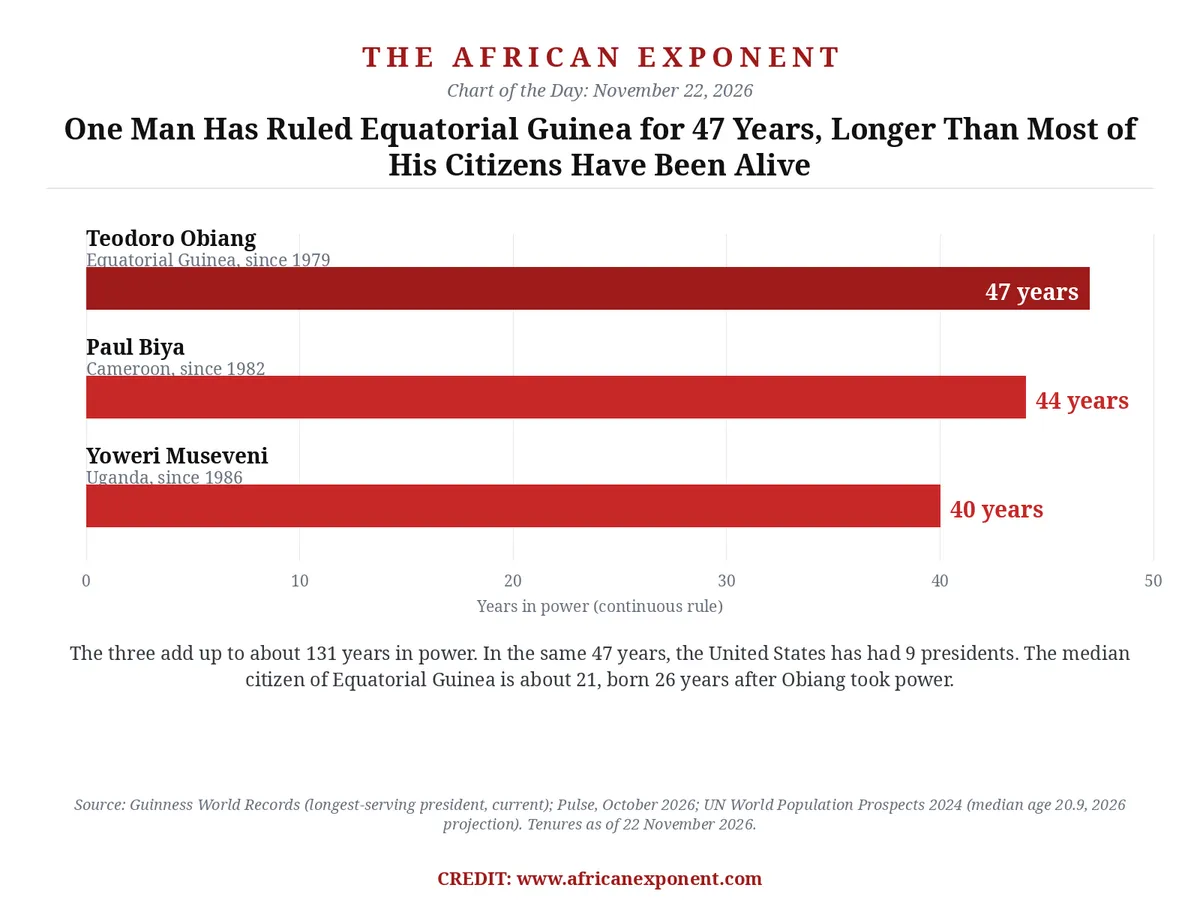
Teodoro Obiang Nguema Mbasogo has ruled Equatorial Guinea since August 3, 1979, when he seized power in a coup that overthrew his own uncle, Francisco Macias Nguema. That is 47 years, and he is still president. Guinness World Records lists him as the longest-serving president currently in office, and the holder of the all-time record. His current term, his sixth, runs to 2029. If he completes it, he will have ruled for 50 years.
He is not alone at the top. Paul Biya has ruled Cameroon for 44 years, since November 6, 1982, and won an eighth term in October 2025 at the age of 92. Yoweri Museveni has ruled Uganda for 40 years, since January 1986, and won a seventh term in January 2026 with 71.65 percent of the vote. The three longest uninterrupted presidencies in Africa add up to about 131 years. In the same 47 years, the United States has had nine presidents.
For the full ranking, see our Top 10 Longest-Serving Presidents in Africa in 2026.
Why it matters
The gap is not only between rulers. It is between a ruler and his people. The median citizen of Equatorial Guinea is about 21 years old, born around 2005, a full 26 years after Obiang took power. Obiang has now ruled for more than twice as long as the median citizen has been alive. About 84 percent of the country's people were born after he took power, and more than half are under 25. An entire country has grown up knowing exactly one ruler, and the question of succession, widely expected to involve his son Teodorin, vice president since 2016, is the one question nobody in Malabo can answer in public. The debate this number splits is the oldest one in African politics: is 47 years of one-man rule stability, or stagnation?
The number in context
Two honest caveats. First, the 47 years count continuous rule from the 1979 coup. Guinness dates the formal presidency from October 12, 1982, after Obiang first ruled through a military council. Second, the top three here means the three longest uninterrupted presidencies. Denis Sassou Nguesso of the Republic of Congo has spent a combined 42.6 years as head of state across two spells, longer in total than Museveni, but his rule was interrupted from 1992 to 1997. King Mswati III of Eswatini has sat on the throne since 1986, but he is a monarch, not a president. Neither changes the headline: no president anywhere on earth has ruled longer than Obiang, and no three presidents anywhere have ruled longer, without a break, than Obiang, Biya and Museveni.
Data sources
Guinness World Records, "Longest-serving president, current": guinnessworldrecords.com. Pulse Ghana, "6 African leaders who have stayed in power for more than 30 years", October 12, 2026: pulse.com.gh. TalkAfricana, "Top 10 Longest Serving Presidents in Africa (2026)": talkafricana.com. Britannica, "Paul Biya", updated October 6, 2026: britannica.com. Al Jazeera, "Uganda's President Yoweri Museveni wins seventh term", January 17, 2026: aljazeera.com. United Nations World Population Prospects 2024, Equatorial Guinea median age 20.9 years (2026 projection), via Population Pyramids: populationpyramids.org, corroborated by Worldometers: worldometers.info.
Methodology
Tenures are counted as continuous rule to November 22, 2026: Obiang 47 years (since August 3, 1979), Biya 44 years (since November 6, 1982), Museveni 40 years (since January 1986). The three add up to about 131 years on whole-year figures; the precise one-decimal tenures (47.3, 44.0, 40.8) sum to 132.1. "Top three" means the longest uninterrupted presidencies in Africa; Denis Sassou Nguesso's combined 42.6 years across two spells and King Mswati III's 40 years and 6 months on the throne are excluded on that definition and are disclosed in the article. The bank entry for this chart put Equatorial Guinea's median age at about 22; the UN World Population Prospects 2024 projection for July 1, 2026 is 20.9 years, so this post uses about 21. The claim that about 84 percent of Equatorial Guinea's people were born after Obiang took power is computed from the UN's 2026 age bands: everyone under 45 (81.9 percent of the population) plus two fifths of the 45 to 49 band, assuming an even spread within that band. Guinness World Records dates Obiang's formal presidency from October 12, 1982; this post counts his rule from the August 1979 coup, the same definition used in our November 5, 2026 ranking of Africa's longest-serving presidents.