Published: November 20, 2026
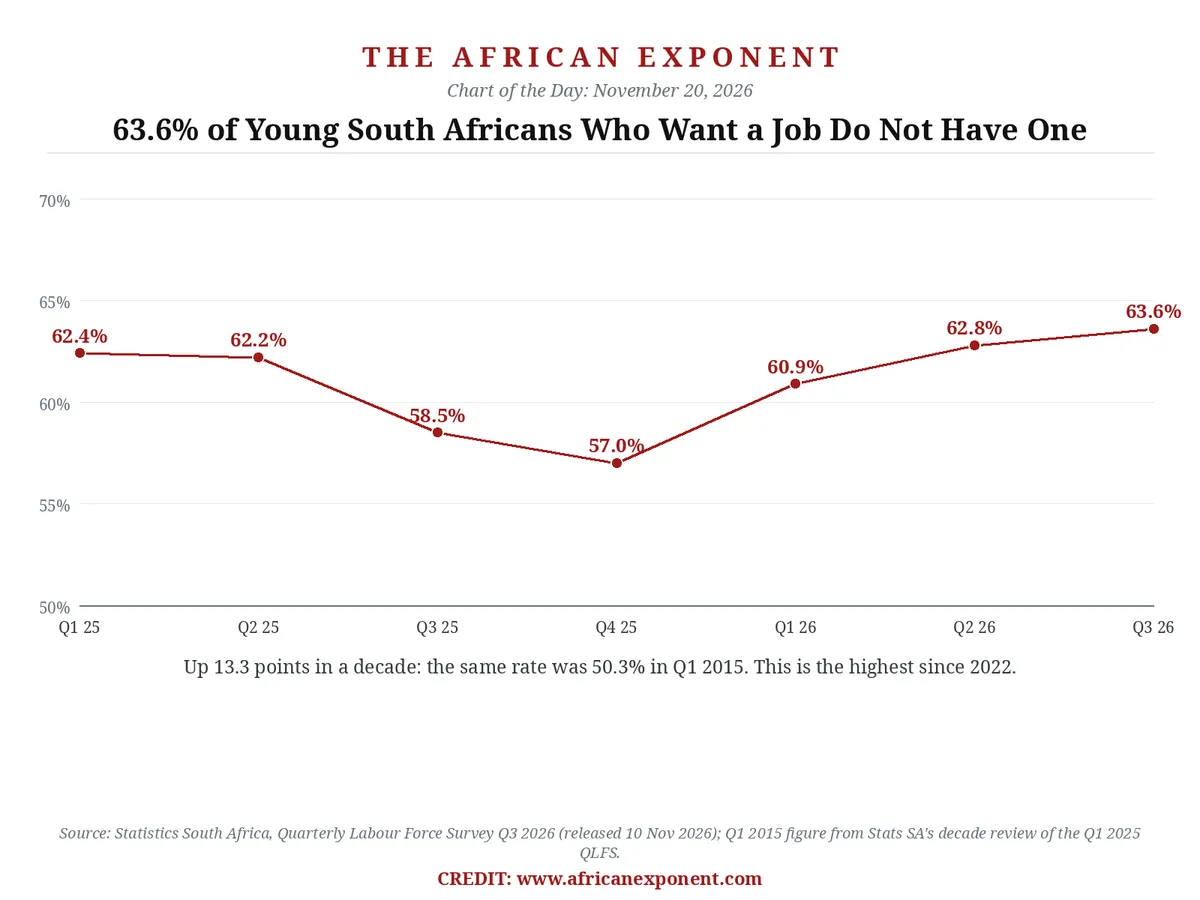
South Africa's official youth unemployment rate, for people aged 15 to 24 who are in the labour force, reached 63.6% in the third quarter of 2026, according to Statistics South Africa's Quarterly Labour Force Survey, released on November 10. That means nearly two in three young South Africans who want a job do not have one, and the rate is the highest since 2022.
Our ranking of youth unemployment across Africa puts South Africa near the top of the continent, and this chart shows how the rate got there.
The chart tells the story of the last seven quarters. The rate eased to 57.0% at the end of 2025, then rose in every quarter of 2026: 60.9% in the first quarter, 62.8% in the second, and 63.6% in the third. It is 5.1 points higher than a year earlier, and 13.3 points higher than the 50.3% recorded in the first quarter of 2015. A decade of promises has left the youngest jobseekers worse off than they were ten years ago.
The comparison with older South Africans is almost as stark. For ages 25 to 34, unemployment stands at 41.4%. For the whole 15 to 34 youth band it is 47.3%. And for the country as a whole it is 33.7%. A 15 to 24 year old who wants work is nearly twice as likely to be unemployed as the average South African worker.
Why it matters
South Africa is Africa's most industrialised economy, and its youth unemployment rate is among the highest in the world. The problem is not a lack of young people looking for work: about 1.8 million people aged 15 to 24 are actively searching. The problem is that the economy does not create jobs for them. Only 1.02 million people in that age group are employed at all, out of about 10.4 million, an employment rate of 9.8%. When the first job never arrives, the damage compounds: skills rust, wages stay low for life, and a generation learns to expect nothing from the formal economy.
The number in context
Two caveats keep the picture honest. First, the unemployment rate counts only people in the labour force, those working or actively looking. A wider measure counts the 3.7 million young people aged 15 to 24 who are not in employment, education or training at all, 35.7% of the age group. That share actually eased from 37.1% in early 2025, so more young people are studying or training even as the jobless rate rose. Second, this is not the all-time high: youth unemployment peaked at 66.5% in the third quarter of 2021, during the pandemic. But it is the worst reading in four years, and it rose in every quarter of 2026 while the national rate rose too. The direction, not just the level, is the warning.
Data sources
Statistics South Africa, Quarterly Labour Force Survey Q3 2026 (P0211), released November 10, 2026: IOL report of the release; Eyewitness News report. Trading Economics, South Africa Youth Unemployment Rate, citing Statistics South Africa: tradingeconomics.com. Statistics South Africa, "South Africa's Youth in the Labour Market: A Decade in Review" (Q1 2015 and Q1 2025 figures): statssa.gov.za.
Methodology
All figures are Statistics South Africa's official (LU1) unemployment rates from the Quarterly Labour Force Survey, a household survey that is not seasonally adjusted. The headline rate covers ages 15 to 24 in the labour force. The quarterly series runs from the first quarter of 2025 (62.4%) to the third quarter of 2026 (63.6%); the decade comparison uses the first quarter of 2015 (50.3%). The bank entry for this chart carried the first-quarter 2025 figure of 62.4% as its headline; the third-quarter 2026 release supersedes it, so this post uses 63.6% and charts the full quarterly series. The Q2 2022 peak of 64.8% and the all-time high of 66.5% in the third quarter of 2021 mean 63.6% is the highest since 2022, not a record. The 1.8 million unemployed figure is derived from the published rate and the published employment count (1.02 million employed, 9.8% of the age group). This post reuses data from our youth unemployment ranking with a fresh single-stat angle, as the candidate entry directs.