Published: November 21, 2026
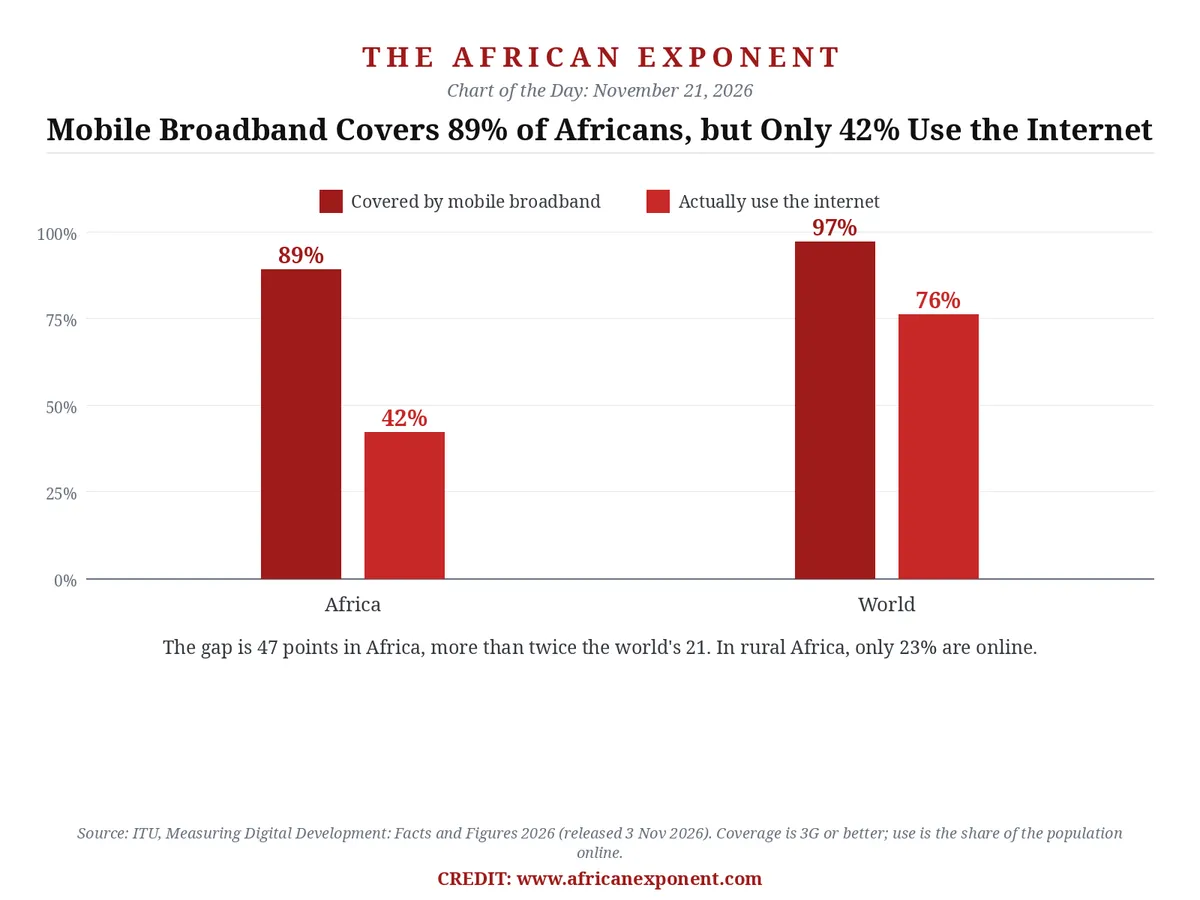
Mobile broadband now reaches 89% of Africans, according to the International Telecommunication Union's Facts and Figures 2026, released on November 3. But only 42% of Africans actually use the internet. That leaves a 47-point gap between the signal and the user, the widest of any region on earth. Nearly six in ten Africans are offline even though the network already passes where they live.
The world tells a different story. Globally, 97% of people live under mobile broadband coverage and 76% use the internet, a gap of 21 points. Africa's gap is more than twice as wide. In Africa, coverage runs at more than twice the rate of use, 89% against 42%. In the rest of the world the two lines nearly meet. The chart's second pair makes the point plainly: this is not a global problem. It is an African one.
For the country-by-country picture, see our ranking of the Top 10 African Countries Leading in Internet Connectivity and Reliability in 2026.
Why it matters
The excuse that Africa has no infrastructure is mostly dead. The towers are built, and the signal reaches nine in ten people. What keeps people offline now is the price of a handset and a data bundle, and the skills to use them. A 5GB mobile data plan costs 4.5% of average income in Africa, nearly four times the world median of 1.2% and more than twice the 2% affordability target the Broadband Commission set. Fixed broadband is worse, at 12.0% of average income. And 68% of Africans aged 10 and above own a mobile phone while only 42% use the internet, a 26-point gap that says the device is in the hand and the connection is not being used. A GSMA roadmap published in September put the covered-but-offline population at about 906 million people, on 2025 data, with 122 million beyond any network at all. The debate now is whether governments should subsidise handsets and data, or whether satellite is the fix.
The number in context
Two caveats keep the picture honest. First, the direction is good: use has risen from 27% in 2020 to 42% in 2026, and the urban-rural gap has narrowed, from city dwellers being 3.1 times as likely to be online in 2023 to 2.2 times now. Second, the gap is worst where the network is thinnest. In rural Africa only 23% are online, against 52% in cities, and 21% of rural people have no mobile broadband at all. The next divide is already forming: 5G reaches 15% of Africans against 59% of the world, and Africa has three or fewer 5G subscriptions per 100 people. Women trail men too, 38% online against 45%. The network arrived first. The users are still catching up.
Data sources
International Telecommunication Union, Measuring Digital Development: Facts and Figures 2026, released November 3, 2026: full report (PDF) and online version. Internet Society, "There Are 6.3 Billion People Connected to the Internet, Yet 2 Billion Remain Offline": internetsociety.org. TechAfrica News, "ITU Report: Africa's Internet Use Stands at 42% Against 76% Globally": techafricanews.com. GSMA and the Partnership for Digital Access in Africa, "Advancing Digital Connectivity in Africa" roadmap, September 21, 2026: gsma.com.
Methodology
All headline figures are the International Telecommunication Union's 2026 estimates from Facts and Figures 2026, released November 3, 2026. Coverage means the share of the population living within reach of a mobile broadband network, 3G or better, whether or not they use it. Use means the share of individuals who actually use the internet. The bank entry for this chart carried 86% coverage and 36% use, from the 2025 edition and 2024 coverage data; the 2026 edition supersedes both, so this post uses 89% and 42% and the 47-point gap. ITU's Africa region excludes the North African states, which ITU counts in its Arab States region. The GSMA figures quoted here, 92% coverage and about 906 million people covered but offline, are September 2026 publications on 2025 data for geographic Africa, and are used as a dated illustration, not the headline; the coverage difference from ITU's 89% reflects the different regional definitions and vintages. The 2026 aggregates are ITU estimates, and fewer than half of economies have reported recent official household-survey data on internet use, so ITU estimates fill the gaps.