Published: November 20, 2026
Angola has never had an official ethnic census table to argue about, until now. The final results of the 2024 census, released in November 2025, give the first ethnolinguistic shares the country has ever published, and they change the picture. The Ovimbundu are still first, but by far less than the old books claimed. This ranking applies the census shares for the top three groups to the United Nations 2026 population of 40,215,179, and completes the list with Minority Rights Group estimates for the smaller groups.
Key Facts
- Angola's 2024 census puts the Ovimbundu at 29.1 percent (11,702,617 people), not the 37 percent carried by the CIA World Factbook and most reference books.
- The Ovimbundu lead the Kimbundu by 844,519 people, a gap of 2.1 percentage points. The old figures had a 12-point gap.
- The top two groups hold 22,560,715 people, 56.1 percent of Angola. The top three hold 28,351,701, or 70.5 percent.
- The ten ranked groups total up to 34,990,806 people, up to 87.0 percent of the country. About 5.2 million Angolans belong to smaller groups outside the top ten.
- Angola counted 36,604,681 people in its 2024 census, 3,610,498 fewer than the United Nations 2026 projection of 40,215,179 used for this ranking.
The Top 10 Tribes of Angola by Population in 2026
| Rank | Tribe | Share | Population (2026) | Basis |
|---|---|---|---|---|
| 1 | Ovimbundu | 29.1% | 11,702,617 | 2024 census |
| 2 | Kimbundu (Ambundu) | 27.0% | 10,858,098 | 2024 census |
| 3 | Bakongo (Kongo) | 14.4% | 5,790,986 | 2024 census |
| 4 | Lunda-Chokwe | 8.0% | 3,217,214 | MRG 1998 |
| 5 | Nyaneka-Nkumbi | 3.0% | 1,206,455 | MRG 1998 |
| 6 | Ambo (Ovambo) | 2.0% | 804,304 | MRG 1998 |
| 7 | Mestico | 2.0% | 804,304 | Factbook |
| 8 | European | 1.0% | 402,152 | Factbook |
| 9 | Herero | Up to 0.5% | Up to 201,076 | MRG 1998 |
| 10 | San | 0.01% | 3,600 | MRG 1998 count |
Notes: Shares for the top three groups are from Angola's 2024 census (RGPH 2024), final results released November 2025. Ranks 4 to 6 and 9 to 10 use Minority Rights Group 1998 estimates, which subdivide the Factbook's "other 22%" category. Ranks 7 and 8 use the CIA World Factbook. The Ambo and the Mestico tie at 2.0 percent (804,304 people each); the Ambo take sixth place because Joshua Project subgroup counts put the Ovambo above the Mestico figure. The Herero figure is a ceiling ("up to 0.5%"), so the top-ten total is also a ceiling. The San figure is a 1998 count, not a share. Populations are shares applied to the United Nations 2026 population of 40,215,179.
Just Outside the Top 10
The closest call sits at the bottom of the table. Minority Rights Group lists the Kwisi at the same "up to 0.5%" ceiling as the Herero, but the Kwisi are a tiny remnant people of the southwest coast whose language died out in the 1960s and who have largely been absorbed into the Kuvale. No reliable count exists, so they are not ranked. The Kuvale themselves are counted separately by Joshua Project at 112,000, but in the Minority Rights Group family taxonomy they fall inside the Herero peoples of the southwest, so they are not added as a separate rank. The Hungu, whom Joshua Project counts at 1,044,000, sit inside the Kimbundu family and are not added on top of it. About 5.2 million Angolans, 13.0 percent of the country, belong to smaller groups outside the top ten.
Ovimbundu
The Ovimbundu live on the Bie Plateau of central Angola and in the coastal strip to its west, around Benguela and Lobito. They speak Umbundu. Historically they divided into 22 chiefdoms, and they built their wealth on caravan trade before turning to cash-crop farming in the twentieth century. Most Ovimbundu are Christian, largely through the Congregational church founded by American missionaries. The 2024 census puts them at 11,702,617 people, 29.1 percent of Angola. That is 3,176,999 fewer than the old 37 percent figure would give, and it leaves them just 844,519 ahead of the Kimbundu.
Kimbundu (Ambundu)
The Kimbundu, also called the Ambundu or Northern Mbundu, live around Luanda and in the highlands to its east, including Malanje. They speak Kimbundu. Their history runs through the Ndongo kingdom, and they dominate the capital city today. The 2024 census puts them at 10,858,098 people, 27.0 percent of Angola, up from the 25 percent in the old figures. Joshua Project's independent count of 9,853,000 sits close by, which gives the census figure a useful cross-check.
Bakongo (Kongo)
The Bakongo live in the far north, in Uige, Zaire and Cabinda provinces and in parts of Luanda. They speak Kikongo. Their history runs through the Kongo kingdom, whose capital was Mbanza Kongo. The same people continue across the border into DR Congo and the Republic of Congo, as our DR Congo ranking shows. The 2024 census puts them at 5,790,986 people, 14.4 percent of Angola. Minority Rights Group gives 14 percent, close by. Joshua Project counts fewer, 4,185,000, but the order is not affected.
Lunda-Chokwe
The Lunda-Chokwe live in the thinly populated east of Angola, spilling over into DR Congo and Zambia. The Chokwe are famous for their art, above all the Cokwe thinker sculpture, and the Lunda-Chokwe sand-drawing tradition known as Sona joined UNESCO's Intangible Cultural Heritage list in 2023. Minority Rights Group puts the combined group at 8.0 percent, or 3,217,214 people in 2026 terms. Joshua Project counts the Chokwe alone at 2,571,000, with the Lunda as a separate entry, which fits the combined figure.
Nyaneka-Nkumbi
The Nyaneka-Nkumbi are cattle herders of Huila province in the southwest. They live only in Angola, unlike the neighbouring Ovambo and Herero, who also live in Namibia. Their elaborate hairstyles are among the most photographed in southern Africa. Minority Rights Group puts them at 3.0 percent, or 1,206,455 people in 2026 terms.
Ambo (Ovambo)
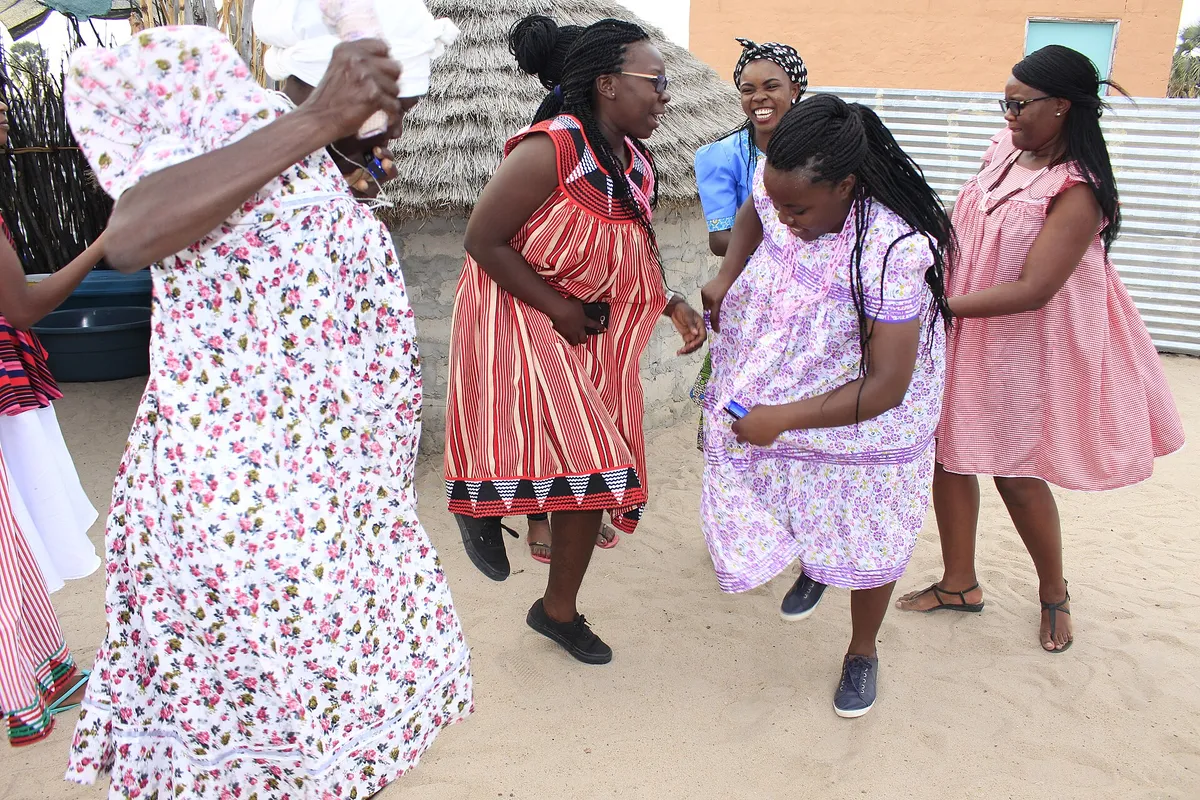
The Ambo, also called the Ovambo, live in Cunene province in the far south, on both sides of the Angola-Namibia border. The Kwanyama are their largest subgroup, with 1,003,783 native speakers in Angola in 2024. Minority Rights Group puts the Ambo at 2.0 percent, or 804,304 people. Joshua Project's subgroup counts run higher, with the Kwanyama alone at 914,000, which is why the Ambo take sixth place ahead of the Mestico on an exact tie. The feature photo shows Ovambo bridesmaids dancing the day before a wedding in northern Namibia.
Mestico
The Mestico are Angolans of mixed European and African ancestry, largely urban and concentrated in Luanda. The Factbook puts them at 2.0 percent, or 804,304 people, tied exactly with the Ambo. One secondary source puts the mixed-race share higher, at about 7 percent, but the same source gives a headcount near 500,000, which points the other way, so the Factbook figure stands and the dispute is recorded here.
European
Angola's European population is mostly of Portuguese extraction, a legacy of five centuries of Portuguese rule. The Factbook puts the group at 1.0 percent, or 402,152 people in 2026 terms. One secondary estimate puts the white population nearer 300,000, so the Factbook figure may be on the high side, but it is the published figure and the order is not affected.
Herero
The Herero are cattle pastoralists of the southwest, in Angola and across the border in Namibia. Minority Rights Group gives them as "up to 0.5 percent" rather than a firm share, so the population shown here, 201,076, is a ceiling, not a count. Joshua Project counts the Herero at 30,000 and the related Kuvale at 112,000, both inside that ceiling. The Herero sit ninth on the strength of the ceiling figure, and the true count is almost certainly lower.
San
The San, the Khoisan peoples of southern Africa, live in small bands in the remote southeast, above all in Cuando Cubango. They are Angola's oldest inhabitants and its smallest ranked group. Minority Rights Group counted about 3,600 San in 1998, the figure used here. The indigenous rights organisation IWGIA puts the San alone at 5,000 to 14,000, inside a total of about 25,000 indigenous people in Angola. Either way the San close the ranking at a fraction of one percent of the country.
Frequently Asked Questions
Why does this ranking say the Ovimbundu are 29.1 percent when most sources say 37 percent?
The 37 percent figure traces to the 1970 colonial census, carried forward by the CIA World Factbook and a 1998 Minority Rights Group estimate. Angola's 2024 census, whose final results were released in November 2025, is the first census to publish ethnolinguistic shares, and it puts the Ovimbundu at 29.1 percent. Britannica's current text ("about one-fourth") and Joshua Project's count (9,162,000) point the same way. We use the census as the newest official source and report the old figure so readers can see the change.
Why do the lower ranks come from 1998 estimates?
The 2024 census release reported shares only for the three largest groups. For ranks 4 to 10 we use Minority Rights Group's 1998 estimates, which subdivide the Factbook's "other 22 percent" category, plus the Factbook itself for the Mestico and European groups. The seam is flagged in the table and in the Methodology below.
What does "up to" mean for the Herero?
Minority Rights Group gives the Herero as "up to 0.5 percent" rather than a firm share, so the population shown (201,076) is a ceiling, not a count. Joshua Project counts the Herero at 30,000 and the related Kuvale at 112,000, both inside that ceiling.
Why are the Kwisi not in the top 10?
Minority Rights Group lists the Kwisi at the same "up to 0.5 percent" ceiling as the Herero, but they are a tiny remnant people of the southwest coast whose language died out in the 1960s and who have largely been absorbed into the Kuvale. No reliable count exists, so we do not rank them.
Why is the United Nations population higher than the census count?
The 2024 census counted 36,604,681 people. The United Nations projects 40,215,179 for mid-2026. The gap of 3,610,498, about 9.0 percent, is the difference between an enumeration and a projection. This series uses the United Nations figure for every country so the rankings stay comparable, and the gap is disclosed here as it was for Uganda.
Data Sources
- Angola National Institute of Statistics (INE), 2024 General Population and Housing Census, final results released 20 November 2025, as reported by Lusa via 360 Mozambique: Angolan Population Grows and Surpasses 36 Million in 2024
- Minority Rights Group, Angola country profile: minorityrights.org/country/angola
- CIA World Factbook, Angola (2024 edition): theodora.com/wfbcurrent/angola/angola_people.html
- Joshua Project, Angola people groups: joshuaproject.net/countries/AO
- United Nations, World Population Prospects 2024: population.un.org/wpp
- Encyclopaedia Britannica, Angola, People: britannica.com/place/Angola/People
Methodology
Angola has no published census ethnic table before 2024. The 2014 census (25,789,024 people) asked about home language and religion, not ethnicity. The 2024 census (36,604,681 people) is the first to publish ethnolinguistic shares, and its final results, released on 20 November 2025, give the top three groups: Ovimbundu 29.1 percent, Kimbundu 27 percent, Bakongo 14.4 percent. Those three shares are the basis for ranks 1 to 3. Ranks 4 to 6 and 9 to 10 use Minority Rights Group's 1998 estimates, which subdivide the Factbook's "other 22 percent" residual: Lunda-Chokwe 8 percent, Nyaneka-Nkumbi 3 percent, Ambo 2 percent, Herero up to 0.5 percent, San about 3,600 people. Ranks 7 and 8 use the CIA World Factbook: Mestico 2 percent, European 1 percent. All populations are the stated shares applied to the United Nations World Population Prospects 2024 mid-2026 total for Angola, 40,215,179, the same base this series uses for every country.
The two blocks are never summed across taxonomies. Joshua Project subgroup counts are used only as cross-checks, never added on top of a family total: the Hungu (1,044,000) sit inside the Kimbundu family, the Kwanyama and Ndonga inside the Ambo, and the Kuvale inside the Herero peoples. The Lingala entry (175,000) is a language community and is excluded, as are the Cape Verdean (94,000), Chinese (61,000) and Deaf (164,000) entries, which are not ethnic groups for this ranking. The Kwisi are excluded because no reliable count exists. The Ambo and the Mestico tie exactly at 2.0 percent; the Ambo rank sixth because Joshua Project's Ovambo subgroup counts exceed the Mestico figure. The Herero figure is a ceiling, so the top-ten total (up to 34,990,806, up to 87.0 percent) is also a ceiling. The San figure is a 1998 count; the indigenous rights organisation IWGIA gives a range of 5,000 to 14,000 for the San alone.
Two cautions. First, the 2024 census count (36,604,681) sits 3,610,498 below the United Nations 2026 projection (40,215,179), a gap of about 9.0 percent. The series uses the United Nations figure for consistency across countries, and the gap is disclosed. Second, the older Factbook shares (Ovimbundu 37 percent, Kimbundu 25 percent, Bakongo 13 percent) are still carried by most reference books. This article uses the newer census shares and records the old ones here so the change is visible. Our own Peoples of Africa dataset still carries the Factbook block as its Angola primary table; it will be corrected to the 2024 census vintage.