Published: November 23, 2026
Madagascar is the sixteenth country in this series, and it is also the hardest to count. No census in Madagascar has ever recorded ethnicity, not in 1975, not in 1993, and not in the 2018 census that counted 25,674,186 people. The ranking below therefore rests on the standard scholarly compilation of ethnic shares, applied to the United Nations 2026 population of 33,522,052. It is the best count the record allows, and the article says plainly where the record is thin.
The result is a spread out table, not a one group show. The Merina lead at 8,749,256 people, or 26.1 percent of the country. Yet the next two groups combined still outnumber them, by 268,176 people. The top three groups together pass half the population, and the top ten together reach 86.8 percent. All eighteen of the island's canonical groups speak Malagasy, a language with roots in Borneo, and the old divide runs between the highlanders of the central plateau and the coastal peoples known as the cotiers. The previous article in this series covered the top 10 tribes of Mozambique.
Key Facts
- Madagascar's population in 2026 is 33,522,052, the 15th largest in Africa, according to the United Nations World Population Prospects 2024.
- The Merina are the largest group at 8,749,256 people, or 26.1 percent of the country.
- The top three groups together number 17,766,688 people, just over half the population at 53.0 percent.
- The top ten groups together number 29,097,143 people, or 86.8 percent of Madagascar.
- No census in Madagascar has ever recorded ethnicity, so this ranking uses a 1998 scholarly compilation of shares applied to the 2026 population.
The Ranking
| Rank | Group | Share | Population in 2026 | Basis |
|---|---|---|---|---|
| 1 | Merina | 26.1% | 8,749,256 | Scholarly estimate, 1998 |
| 2 | Betsimisaraka | 14.9% | 4,994,786 | Scholarly estimate, 1998 |
| 3 | Betsileo | 12.0% | 4,022,646 | Scholarly estimate, 1998 |
| 4 | Tsimihety | 7.2% | 2,413,588 | Scholarly estimate, 1998 |
| 5 | Sakalava | 5.8% | 1,944,279 | Scholarly estimate, 1998 |
| 6 | Antandroy | 5.3% | 1,776,669 | Scholarly estimate, 1998 |
| 7 | Antaisaka | 5.0% | 1,676,103 | Scholarly estimate, 1998 |
| 8 | Tanala | 3.8% | 1,273,838 | Scholarly estimate, 1998 |
| 9 | Antaimoro | 3.4% | 1,139,750 | Scholarly estimate, 1998 |
| 10 | Bara | 3.3% | 1,106,228 | Scholarly estimate, 1998 |
Just Outside the Top 10
The Bara hold tenth place by a clear margin. At 1,106,228 people they sit 301,699 ahead of the Sihanaka, who are eleventh at 804,529. The tightest race in the article is just below that. The Sihanaka lead the Antanosy by only 33,522 people, a gap of 0.10 percentage points, and the Joshua Project reverses that order, putting the Antanosy ahead. The order of eleventh and twelfth therefore depends on which source you trust.
Two groups that look like near misses are not counted at all. The Vezo, a seafaring people of the west coast, number 417,000 in the Joshua Project data, and the Masikoro number 841,000. Both sit inside the Sakalava orbit, so adding either to the Sakalava total would double count. The six remaining canonical groups, the Mahafaly, Antaifasy, Makoa, Bezanozano, Antakarana and Antambahoaka, are each under 2 percent of the population, and no exact share is published for them. Together with the French, Indian, Chinese and Comorian minorities, they make up the 13.2 percent outside the top ten.
Merina
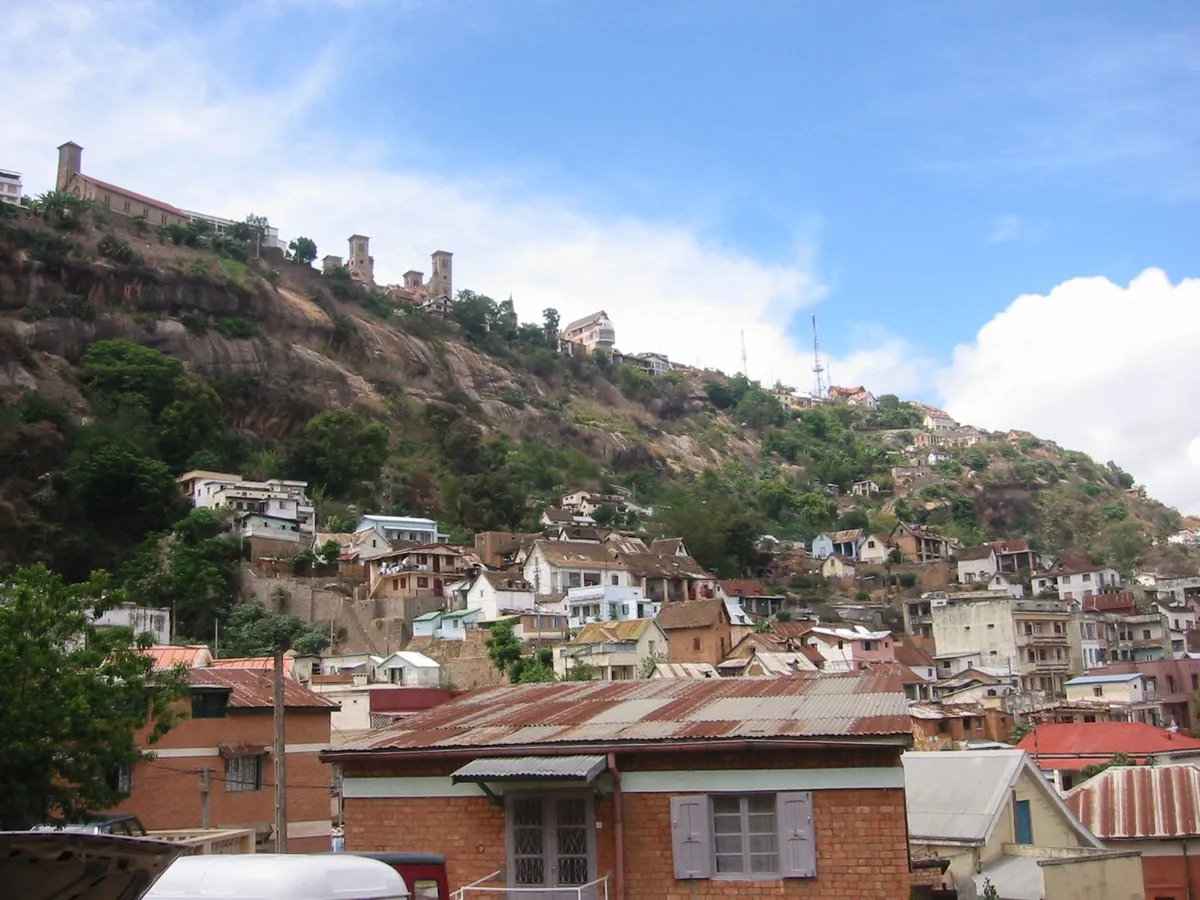
The Merina live in the central highlands around Antananarivo, and their name means Elevated People. They built the kingdom that nearly unified the whole island in the 19th century, and their dialect became the basis of standard written Malagasy. The Rova, their royal compound, crowns Analamanga hill above the capital. The photo at the top of this article shows the Rova as it stood after the 1995 fire, before restoration. At 8,749,256 people the Merina are 1.75 times the Betsimisaraka and 2.18 times the Betsileo, yet they are still smaller than the other nine groups in this top ten combined, who number 20,347,887.
Betsimisaraka
The Betsimisaraka live along the east coast around Toamasina, and their name means the Inseparable Multitude. They formed a confederation of northern groups in the 17th century to trade with Europeans, and fishing remains a major livelihood. A subset called the zana-malata traces descent from intermarriage between European pirates and traders and Betsimisaraka women. At 4,994,786 people they lead the Betsileo by 972,140, though the Joshua Project narrows that gap to 294,000.
Betsileo
The Betsileo live in the southern central highlands around Fianarantsoa, in a region of about 40,000 square kilometres, and their name means the Invincible Multitude. They farm terraced rice fields worked much as in south-east Asia, and they were once organised into the independent kingdoms of Fandriana, Fisakana, Manandriana and Isandra. Their culture is close to that of their Merina neighbours to the north. The Betsileo figure carries the largest dispute in this ranking, and it is covered in the questions below.
Tsimihety
The Tsimihety live north of the Merina highlands around Mandritsara, and their name means Those Who Do Not Cut Their Hair. They are noted for rapid population growth and a habit of migration, expanding their territory at their neighbours' expense. At 2,413,588 people they are the largest group outside the top three, and they sit 469,309 ahead of the Sakalava.
Sakalava
The Sakalava live along the west coast in a band from the Onilahy River in the south to Nosy-Be in the north, a territory of about 128,000 square kilometres, the largest of any group. Their name means People of the Long Valley. They were among the most dynamic and expansionist peoples on the island from the 16th to the early 19th centuries, until the Merina conquered them. Hinterland herders keep zebu herds that outnumber the human population, and the Sakalava were famed historically for seafaring. The Sakalava name also covers smaller groups that once formed an empire, notably the Menabe and Boina kingdoms.
Antandroy
The Antandroy live in the far south, in the Androy region, and their name means People of the Thorn Bush. Their semi-arid homeland averages about 400 millimetres of rain a year, with droughts every eight to ten years that bring kere, or famine. They are a pastoral people, and zebu are central to religious and social life and a measure of status and wealth. They kept their independence from the Merina and Sakalava kingdoms, and at the French conquest in 1895 they were divided among five small states. Their sixth place is the least secure in the top ten, as the Joshua Project puts the Antaisaka ahead of them.
Antaisaka
The Antaisaka live on the south-eastern coast south of Farafangana, around Vangaindrano. They were founded by Andriamandresy, a Sakalava prince cast out of Menabe, and they descend from a royal branch of the western Sakalava. They are known for strong marriage taboos and complex funeral rites. Their economy rests on coffee, bananas and rice, with women traditionally harvesting the rice, alongside coastal fishing. At 1,676,103 people they trail the Antandroy by 100,566, the tightest race inside the top ten. The group is also spelled Antesaka.
Tanala
The Tanala live in the forested inland region of south-east Madagascar near Manakara, between the Faraony river to the north and the Matitanana river to the south. Their name means People of the Forest. They split into two sub-groups. The southern Ikongo stayed independent of the expanding Merina kingdom in the 19th century, while the northern Menabe submitted. Their main crops are coffee and rice, and their rulers trace lineage to Antaimoro astrologer-sages. At 1,273,838 people they are the only top ten group with no rounded second source for their share, and the Joshua Project counts them higher, at 1,678,000.
Antaimoro
The Antaimoro live on the south-eastern coast, mostly between Manakara and Farafangana, and their name means People of the Banks. They developed sorabe, the Arabic script used to write Malagasy, and their ombiasy, or astrologer-sages, travelled the island as advisers and charm-makers. They make Antemoro paper, flower-embedded handmade paper now sold to tourists and exported. They formed a kingdom in the 16th century, and rice, coffee, salt and charms are their livelihoods. The group is also spelled Antemoro. At 1,139,750 people they sit 33,522 ahead of the Bara, a gap of 0.10 percentage points.
Bara
The Bara live at the southern end of the central highlands, concentrated around their historic capital Ihosy. They are the island's largest zebu-herding people, historically semi-nomadic, and they are organised into five clans. Young men traditionally proved their manhood by cattle rustling, and the kilalaky musical and dance tradition of the cattle rustlers has spread across the island. Rice planting was traditionally timed to the arrival of a migrating quail, the kibodolo. The Bara figure is the closest agreement between the two sources in this ranking. The Joshua Project counts 1,107,000 Bara, just 772 more than the scholarly figure used here.
Frequently Asked Questions
Why does this ranking use shares from 1998?
Because no Malagasy census has ever published an ethnic breakdown. The 1975, 1993 and 2018 censuses all skipped the question, so the standard scholarly compilation of shares is the only full ranking that exists. The shares are applied to the United Nations 2026 population, which is the current total. The method is stated openly so readers can judge it.
Why do some sources give a much bigger Betsileo figure?
The Joshua Project counts 5,418,000 Betsileo, which is 34.7 percent above the 4,022,646 used here and equal to 16.16 percent of the 2026 population. The scholarly share is 12.0 percent, and the EPR Atlas gives about 13 percent, between the two. The ranking follows the scholarly compilation because it is the single consistent basis for all ten groups, and the Joshua Project figure is disclosed here rather than hidden.
Why is there no Merina figure in the Joshua Project data?
The Joshua Project has no standalone Merina entry. Its only Merina entry is Merina-Vakinankaratra, at 3,340,000 people, which is a regional subgroup around Antsirabe, not the whole group. It cannot be used to check the number one rank, and it must never be added to anything. The Merina figure here rests on the scholarly compilation, corroborated by the Library of Congress at 26.2 percent and by WorldAtlas and Wikipedia at 26 percent.
Are the Vezo a separate tribe?
The Vezo are a distinct seafaring people of the west and south-west coasts, and the Joshua Project counts 417,000 of them. But they have traditionally been counted inside the Sakalava orbit, and the primary source does not give them a separate share. Adding them to the Sakalava total would double count, so they sit outside this ranking. The same applies to the Masikoro, at 841,000, a Sakalava subgroup.
What about Madagascar's French, Indian and other minorities?
They sit in the 13.2 percent outside the top ten, together with the six canonical Malagasy groups that each fall under 2 percent. The twelve quantified groups in the scholarly compilation sum to 91.5 percent of the population, and the remaining 8.5 percent covers those six groups plus the non-Malagasy minorities.
Data Sources
- United Nations World Population Prospects 2024, total population at 1 July 2026: 33,522,052. population.un.org
- Countries and Their Cultures, Culture of Madagascar, the scholarly compilation of ethnic shares (Merina 26.1 percent, Betsimisaraka 14.9 percent, Betsileo 12.0 percent, and the remaining shares used in the table). Text reproduced at culturesclouds.blogspot.com
- WorldAtlas, Ethnic Groups of Madagascar. worldatlas.com
- Library of Congress Country Studies, Madagascar, Peoples of the Central Highlands and Peoples of the West Coast (data as of August 1994). countrystudies.us
- Encyclopaedia Britannica, Madagascar, Ethnic Groups. britannica.com
- Joshua Project, Madagascar country page, accessed November 23, 2026. joshuaproject.net
- Wikipedia, Demographics of Madagascar, for the census history (1975, 1993, 2018). en.wikipedia.org
Methodology
This ranking follows the method of the Tribes by Country series. The shares come from a single basis, the scholarly compilation published in Countries and Their Cultures, referenced to a 1998 population of 14,462,509. Each share is applied to the United Nations World Population Prospects 2024 mid-2026 total for Madagascar, 33,522,052. The 2018 census counted 25,674,186 people, so the shares are applied to a total about 30 percent larger than the last census count.
No census in Madagascar has ever published an ethnic breakdown, so there is no official basis to use instead. The compilation is corroborated to rounding by second sources for eight of the twelve quantified shares: the Library of Congress gives Merina 26.2 percent, Betsileo 12.1 percent, Tsimihety 7.3 percent, Sakalava 6.2 percent and Bara 3.3 percent, and WorldAtlas and Wikipedia round the same tradition to Merina 26, Betsimisaraka 15 and Betsileo 12. No rounded second source was found for the Tanala, Antaimoro or Sihanaka shares, and those figures rest on the primary compilation alone.
The Joshua Project was read live on November 23, 2026 as a cross-check and was not spliced into the table. It diverges materially, above all on the Betsileo, which it counts at 5,418,000 against the 4,022,646 used here. It also reverses two orders: it puts the Antaisaka (2,125,000) ahead of the Antandroy (1,477,000) and the Antanosy (986,000) ahead of the Sihanaka (834,000). It has no standalone Merina entry and it splits the Betsimisaraka into north and south entries, so it cannot verify the top two ranks as stated. The Bara agree almost exactly between the two sources, at 1,107,000 against 1,106,228.
Three exclusions are deliberate. The Vezo (417,000) and the Masikoro (841,000) are not added to the Sakalava total because both sit inside the Sakalava orbit and adding them would double count. The Merina-Vakinankaratra figure (3,340,000) is a regional subset of the Merina, not an additional group. The six canonical groups listed at under 2 percent each in the primary source, the Mahafaly, Antaifasy, Makoa, Bezanozano, Antakarana and Antambahoaka, carry no exact share and are not ranked. The table follows the source's list of eighteen groups, which includes the Makoa and gives no separate Vezo figure.
The combined top ten share of 86.8 percent is published because the table uses one basis throughout. Spelling follows the primary source: Antaisaka (also Antesaka) and Antaimoro (also Antemoro). All figures were recomputed from the shares and the 2026 total before publication, and every derived claim in this article was checked against that arithmetic.