Published: November 22, 2026
One in four Mozambicans is Makhuwa. At 9.6 million people, the Makhuwa outnumber the next three groups in this ranking combined, and they outnumber the Tsonga in second place by nearly three to one. No other group in Mozambique comes close.
There is an important condition on this ranking. Mozambique has never counted tribes in a census. The census asks for mother tongue, not ethnicity, so this ranking is built on language, using the 2017 census as its base. That is why Portuguese, the mother tongue of 16.8 percent of the population, does not appear in the table. Portuguese is the official language and the language of the cities, not a tribe. The same approach was used in the previous entry in this series, which ranked the tribes of Morocco, and in our South Africa ranking, where Afrikaans and English were left out on the same ground.
The ten groups below are the peoples behind the ten largest mother tongues in the 2017 census, with the last two places broken out of the census residual bucket using the statistics office's own thematic study. Every figure is a 2017 share applied to the United Nations 2026 population of 36,639,851.
Key Facts
- The Makhuwa are Mozambique's largest group at 9.6 million people, 26.3 percent of the country, nearly three times the Tsonga in second place at 3.3 million.
- The Makhuwa alone outnumber the next three groups, Tsonga, Chewa and Lomwe, combined: 9.6 million against 8.9 million.
- Mozambique's census has never recorded ethnicity. The ranking uses mother tongue from the 2017 census as a proxy, which is why Portuguese, the mother tongue of 16.8 percent, is excluded as the official language rather than a tribe.
- Two pairs in the table are effectively tied. Lomwe and Sena sit 73,279 people apart, and Ndau and Tswa sit 73,279 apart too, and both orders could flip on a different census question.
- The Chopi, famous for the timbila xylophone orchestras, are the first group outside the top 10 on the census measure, at about 550,000 people, though one ethnic estimate puts them near 1.6 million.
The Top 10 Tribes of Mozambique by Population in 2026
| Rank | Tribe (language) | Share | Population (2026) |
|---|---|---|---|
| 1 | Makhuwa (Emakhuwa) | 26.3% | 9,636,281 |
| 2 | Tsonga (Xichangana) | 8.9% | 3,260,947 |
| 3 | Chewa (Cinyanja) | 8.3% | 3,041,108 |
| 4 | Lomwe (Elomwe) | 7.1% | 2,601,429 |
| 5 | Sena (Cisena) | 6.9% | 2,528,150 |
| 6 | Chuwabo (Echuwabo) | 4.4% | 1,612,153 |
| 7 | Ndau (Cindau) | 3.7% | 1,355,674 |
| 8 | Tswa (Xitswa) | 3.5% | 1,282,395 |
| 9 | Nyungwe (Cinyungwe) | 2.3% | 842,717 |
| 10 | Yao (Ciyaawo) | 2.0% | 732,797 |
Shares for ranks 1 to 8 come from the 2017 census definitive-results brochure. Shares for ranks 9 and 10 come from the statistics office's thematic language study of the same census. Portuguese (16.8 percent) is excluded as the official language, not a tribe. See Methodology.
Near Miss: The Chopi
The Chopi, famed for the timbila xylophone orchestras UNESCO lists as heritage, are the first group outside the top 10 on the census measure at about 550,000 people, 183,199 behind the Yao in tenth place. The gap is not settled, though. Joshua Project, an ethnic estimates database, puts the Chopi near 1.6 million, which would place them seventh, and it also puts the Ronga (877,000), the Marenje (836,000) and the Makonde (746,000) at or just below the tenth-place line. The census folds all four groups into its "Other Mozambican languages" bucket, so they cannot be ranked precisely on the official measure. The Makonde, known for the Mapiko mask dance of the Cabo Delgado plateau, have no itemised census figure at all, and that is the principal known omission in this ranking.
Selected Details
1. Makhuwa (Emakhuwa), 9,636,281
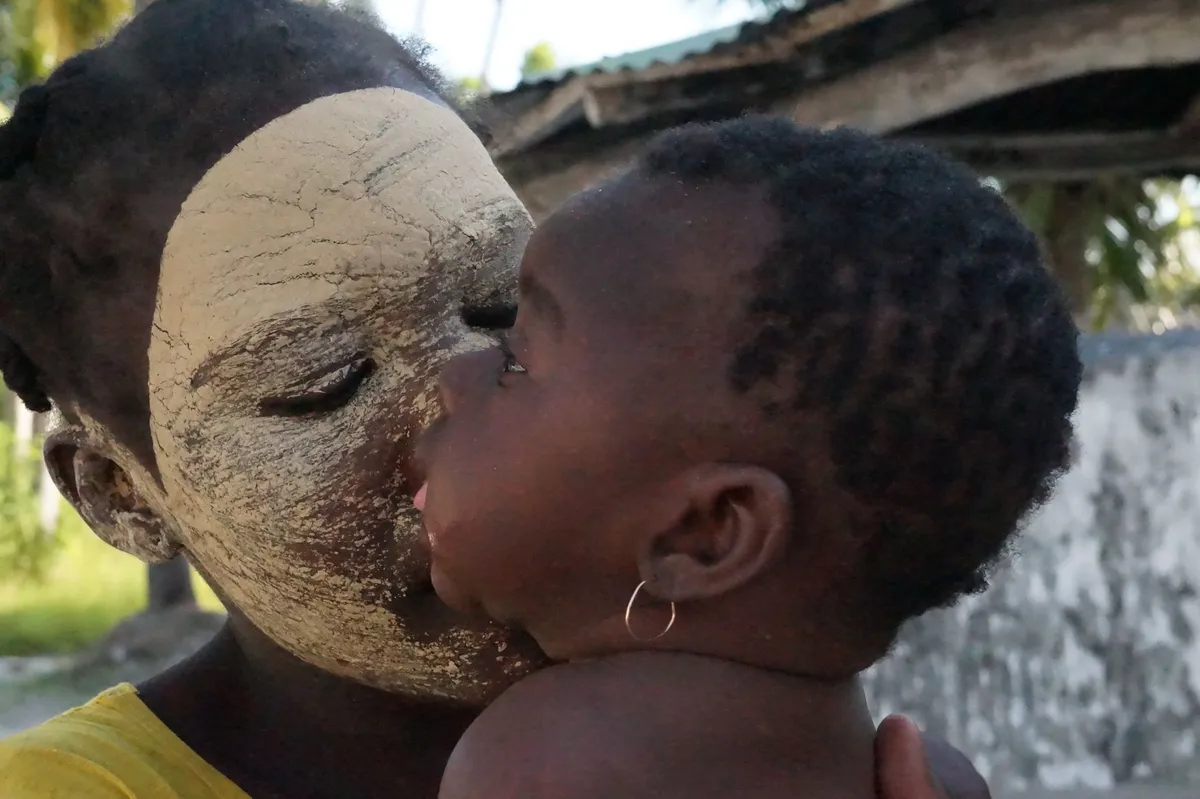
The Makhuwa are the largest people in Mozambique by a wide margin, at 26.3 percent of the country. They live mainly north of the Zambezi, in Nampula, Zambezia, Cabo Delgado and Niassa provinces. Their origin legend traces them to the Namuli mountains. Makhuwa society is matrilineal, and Makua women are known for musiro, the white face paste seen in the photograph above. Many coastal Makhuwa are Sunni Muslim, while inland communities keep the traditional religion centred on Muluku.
2. Tsonga (Xichangana), 3,260,947
The Tsonga are the largest group in southern Mozambique, centred on Maputo, Gaza and Inhambane provinces. At 3.3 million they are barely a third of the Makhuwa above them: the Makhuwa outnumber them almost three to one. Xichangana is also the language most spoken at home in the south, which is why the census and the Factbook figures for this group agree so closely.
3. Chewa (Cinyanja), 3,041,108
The Chewa live along Lake Malawi in Niassa and Tete provinces, as part of a cross-border people centred on Malawi. Their 8.3 percent share comes from the census brochure, but it needs a note. The statistics office's thematic study puts Cinyanja lower, at 5.6 percent, and lists the Nyungwe separately at 2.3 percent. The two figures together, 7.9 percent, sit close to the brochure's 8.3 percent, which suggests the brochure folds Nyungwe speakers into the Chewa count. That means ranks 3 and 9 in this table overlap slightly, and the overlap is disclosed here and in the Methodology rather than hidden.
4. Lomwe (Elomwe), 2,601,429
The Lomwe live mainly in Zambezia province, in the centre-north of the country. Their 7.1 percent share is confirmed by the Factbook, which also gives 7.1 percent, and by the census question on the language most spoken at home. But the Lomwe lead over the Sena is thin. The two groups are effectively tied at about 7 percent, and the order could flip on a different census question, as the Methodology explains.
5. Sena (Cisena), 2,528,150
The Sena live along the Zambezi valley, across Tete, Sofala, Manica and Zambezia provinces. The census brochure gives them 6.9 percent, just behind the Lomwe, but the census question on the language most spoken at home reverses the two: Sena 1,578,164 against Lomwe 1,574,237, a gap of only 3,927 people. The Factbook ties them at 7.1 percent each. This article keeps the brochure order, with the tie stated plainly.
6. Chuwabo (Echuwabo), 1,612,153
The Chuwabo live in Zambezia province, on the central coast. Their 4.4 percent share comes from the census brochure and is backed by the Factbook at 4.7 percent and by the home-language question at 4.72 percent. The thematic study gives a lower figure, 3.3 percent, which would drop them to eighth place. The brochure figure is used here because two other census presentations support it, and the lower figure is disclosed in the Methodology.
7. Ndau (Cindau), 1,355,674
The Ndau live on the Manica and Sofala border with Zimbabwe. Joshua Project counts the Senji and Tewe as Ndau-language groups, and its combined figure for them, 1.41 million, sits within 4 percent of the census figure used here, which is a good cross-check. The Ndau lead over the Tswa is small, and the two groups are effectively tied at about 3.7 percent.
8. Tswa (Xitswa), 1,282,395
The Tswa live in Inhambane province in the south. The census brochure gives them 3.5 percent, just behind the Ndau at 3.7 percent, but the home-language question reverses the two by only 606 people. The Factbook ties them at 3.8 percent each, and the thematic study gives both 3.7 percent. This article keeps the brochure order, with the tie stated plainly.
9. Nyungwe (Cinyungwe), 842,717
The Nyungwe live in Tete province, where the thematic study records Cinyanja at 50.5 percent and Cinyungwe at 20.9 percent of the provincial population. They reach ninth place on the thematic study's 2.3 percent share, broken out of the census residual bucket. As the Chewa section explains, the brochure's Chewa figure probably already includes many Nyungwe speakers, so ranks 3 and 9 overlap slightly by construction. Joshua Project puts the Nyungwe lower, at 697,000.
10. Yao (Ciyaawo), 732,797
The Yao live in Niassa province, on the eastern shore of Lake Malawi and along the Lugenda and Rovuma rivers. They are largely Muslim and were historically traders across the region. Their 2.0 percent share comes from the thematic study and sits in a consistent series: a 1998 household survey gave 2.3 percent, and the 2017 study gives 2.0 percent. Joshua Project puts the Yao far lower, at 338,000, but the census series is consistent across two decades, so the census figure is used here.
Frequently Asked Questions
Why is Portuguese not in the ranking when 16.8 percent speak it as a mother tongue?
Portuguese is the official language of Mozambique and the language of the cities, not a tribe. The statistics office's own study calls it "essentially urban": in 2017 it was the mother tongue of 39.0 percent of the urban population but only 5.1 percent in rural areas. Nearly half of Mozambicans speak Portuguese, but only about one in six speaks it as a first language, so most users speak it as a second language. This series left Afrikaans and English out of the South Africa ranking on the same ground.
Why is this ranking based on language instead of ethnicity?
Mozambique's censuses have never recorded ethnicity. They ask for mother tongue, so the ranking uses the largest mother tongues as a proxy for peoples. The Factbook's ethnic summary names only the largest groups, Makhuwa, Tsonga, Lomwe and Sena, and gives no shares for the rest, so language is the only basis that can support a full top 10.
Are the Lomwe and Sena really that close?
Yes. The census brochure puts the Lomwe 39,530 people ahead of the Sena, but the census question on the language most spoken at home puts the Sena ahead by 3,927 people, and the Factbook ties them at 7.1 percent each. The same is true of the Ndau and Tswa in seventh and eighth places. Both pairs are effectively tied, and the brochure order is kept with the tie disclosed.
Where do the Makonde fit in?
The Makonde do not appear as an itemised group in any census presentation, so they cannot be placed in the ranking. Joshua Project estimates 746,000 Makonde in Mozambique, which would put them just outside the top 10, close to the Yao. They sit inside the census "Other Mozambican languages" bucket with the Ronga and the Marenje, and the article states that openly rather than guessing a rank for them.
How old is the data behind this ranking?
The shares come from the 2017 census, the most recent census in Mozambique. They are applied to the United Nations 2026 population of 36,639,851. The census counted 28,861,863 people in 2017, so the 2026 figures assume each group's share of the population has stayed roughly the same over nine years. No group has a newer census to update it.
Data Sources
- Instituto Nacional de Estatistica (INE), IV Recenseamento Geral da Populacao e Habitacao 2017, Brochura dos Resultados Definitivos, mother-tongue counts table. ine.gov.mz
- INE, Padrao Linguistico em Mocambique, Estudo Tematico do Censo 2017 (2023), Quadro 1. mozcensus.com (PDF)
- CIA World Factbook, Mozambique, People and Society, 2017 estimates. cia.gov
- Joshua Project, Mozambique country page, accessed November 22, 2026. joshuaproject.net
- United Nations, World Population Prospects 2024, total population at 1 July 2026. population.un.org
- Wikipedia, Languages of Mozambique, 2017 census tables. en.wikipedia.org
- UNESCO, Chopi Timbila. ich.unesco.org
Methodology
This ranking is built on mother tongue, not ethnicity, because Mozambique's censuses record mother tongue and never ethnicity. Shares for ranks 1 to 8 come from the INE 2017 census definitive-results brochure, which tabulates mother-tongue counts. That table's base is 22,243,373 people, not the census total of 28,861,863, so the shares are of the tabulated base. Shares for ranks 9 and 10, Nyungwe and Yao, come from the INE thematic language study of the same census, which gives shares of the population aged 5 and over. The two bases differ, which is why no exact combined top-10 share is published: the ten shares add to 73.4 percent, but that total mixes two bases and should be read as approximate.
Every 2026 population is the 2017 share applied to the United Nations World Population Prospects 2024 mid-2026 total for Mozambique, 36,639,851. The census total of 28,861,863 in 2017 and the 2026 total differ by 7,777,988 people, or 26.9 percent, so the figures assume each group's share has stayed roughly steady over nine years.
Portuguese, at 16.8 percent, is excluded because it is the official language and a colonial lingua franca, not a tribe. The residual buckets are also excluded: "Other Mozambican languages" at 11.9 percent, "Unknown" at 1.8 percent and "Other foreign languages" at 0.4 percent. The last two places are broken out of the "Other Mozambican languages" bucket using the thematic study, which itemises Nyungwe at 2.3 percent, Yao at 2.0 percent and Chopi at 1.5 percent.
Two seams in the official data are disclosed. First, the brochure's Chewa share of 8.3 percent and the study's Nyungwe share of 2.3 percent overlap slightly: the study puts Chewa at 5.6 percent with Nyungwe separate, and 5.6 plus 2.3 is 7.9 percent, close to the brochure's 8.3 percent, which suggests the brochure folds Nyungwe speakers into the Chewa count. The brochure figure is used for the Chewa because the Factbook (8.1 percent) and the home-language question (8.05 percent) support it. Second, the brochure and the study disagree on Chuwabo, 4.4 percent against 3.3 percent. The brochure figure is used because the Factbook (4.7 percent) and the home-language question (4.72 percent) support it. The Lomwe and Sena order, and the Ndau and Tswa order, both flip between census presentations, so both pairs are reported as effective ties with the brochure order kept.
Joshua Project's ethnic estimates were used only as a cross-check, not to displace census figures, because they deviate sharply from the census on several groups: Tsonga 5,971,000 against 3,260,947, Chopi 1,564,000 against 549,598, Yao 338,000 against 732,797, Lomwe 3,583,000 against 2,601,429 and Chewa 1,834,000 against 3,041,108. Its Makhuwa cluster total, 9,534,000, sits within 1.1 percent of the census figure. Groups with no census figure, notably the Makonde, the Ronga and the Marenje, are disclosed as omissions rather than ranked on Joshua Project figures alone. Feature image: a Makua woman wearing musiro face paste with her child, Mozambique, by Kyne.nb, Wikimedia Commons, CC BY-SA 4.0.