Published: November 23, 2026
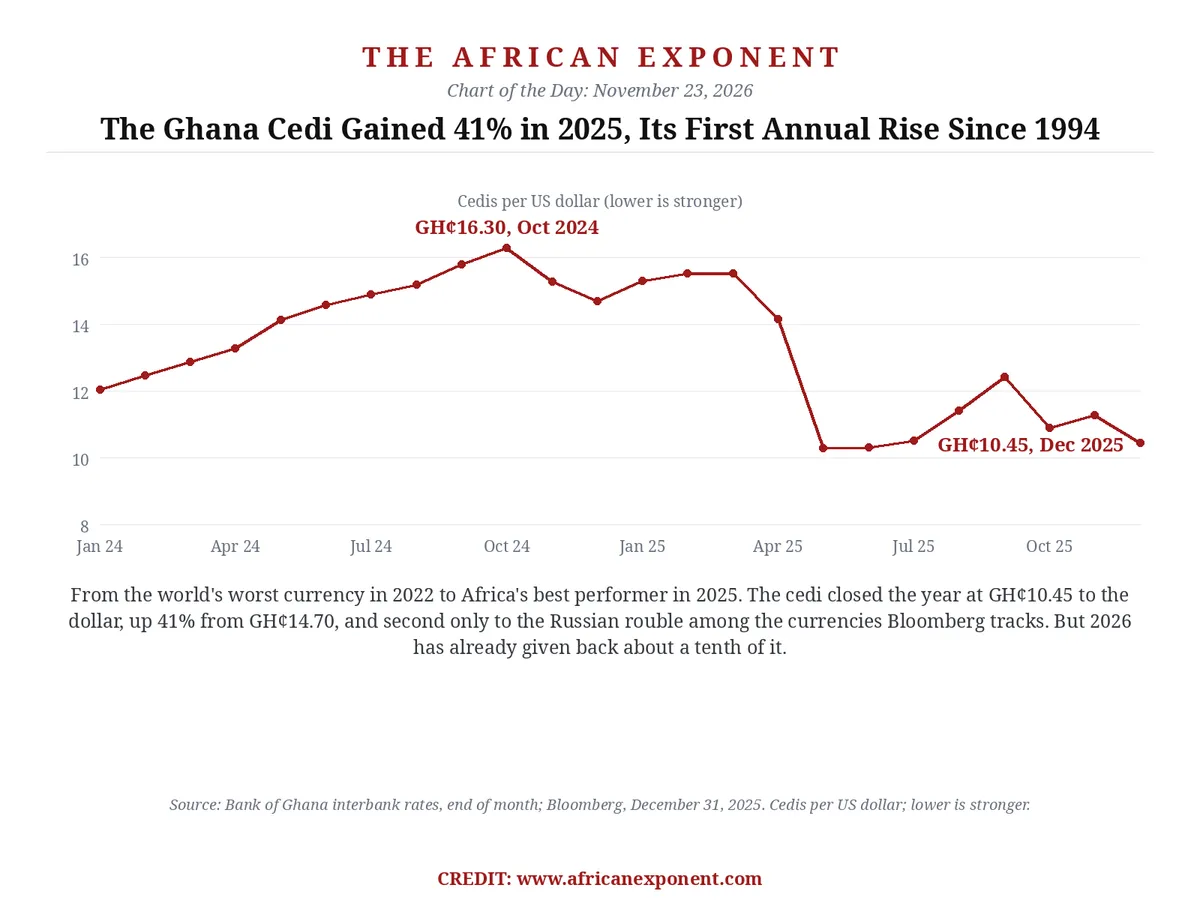
The Ghana cedi gained 41 percent against the US dollar in 2025, Bloomberg reported on December 31, its first annual gain since at least 1994, when Bloomberg began compiling the data. The Bank of Ghana's own figures agree: the interbank rate closed 2024 at GH¢14.70 to the dollar and closed 2025 at GH¢10.45, a 40.67 percent appreciation. Among the 144 currencies Bloomberg tracks, only the Russian rouble did better. The cedi was the best-performing currency in Africa.
The chart tells the story in one line. The cedi weakened through most of 2024, touching GH¢16.30 to the dollar in October, and was still at GH¢15.53 in March 2025. Then it turned, fast. By May it stood at GH¢10.28, and from its weakest point in March it had gained nearly 49 percent by the end of the year. Three years earlier, in October 2022, Bloomberg had named the cedi the worst-performing currency in the world, after it lost more than half its value in a year of 54 percent inflation and a debt default. Between 2020 and 2024 it had lost 62 percent of its value. The 2025 rally ended a losing streak that ran back three decades.
We reported the other side of this story in 2022: Ghana Cedi Named World’s Worst Currency.
Why it matters
Three things powered the rally: gold, discipline and a weaker dollar. Ghana's gold exports brought in roughly US$21 billion in 2025 under the Bank of Ghana's Gold for Reserves programme. Gross international reserves rose from US$7.4 billion in October 2024 to a record US$13.8 billion by the end of 2025. Inflation fell from above 23 percent at the start of the year to 5.4 percent in December, helped by a US$3 billion IMF programme and tight monetary policy. A stronger cedi makes imports cheaper and cuts the cedi cost of servicing dollar debts, which is why the rally mattered far beyond trading desks. The debate it splits is whether this was a real turnaround built on gold and discipline, or a sugar rush powered by record gold prices and a falling dollar. The next two years will answer that, and the early evidence from 2026 is not encouraging.
The number in context
Two honest caveats. First, the rally was not smooth. In the third quarter of 2025 the cedi was briefly the world's worst-performing currency again, losing about 13 percent in the quarter as importers scrambled for dollars, before recovering into year end. Second, the gain is already fading. The cedi has weakened about 10.6 percent in 2026 to date, according to the Bank of Ghana's November data, and at the forex bureaus where most Ghanaians actually buy dollars, the selling rate ended 2025 at GH¢12.45, 19 percent weaker than the interbank rate. The 41 percent is real, but it is a calendar 2025 number, and it describes the interbank market, not the street.
Data sources
Bloomberg, December 31, 2025 report on the cedi's 41 percent gain, quoted in full by GhanaWeb and Punch: punchng.com. Bank of Ghana, interbank exchange rates, end of month: bog.gov.gh. Bank of Ghana via JoyBusiness, on the 40.67 percent cumulative appreciation in 2025 and record reserves of US$13.8 billion: myjoyonline.com. Rand Merchant Bank, Where to Invest in Africa 2026/27, via The High Street Journal, on gold exports of about US$21 billion, the US$3 billion IMF programme and inflation falling to 5.4 percent: thehighstreetjournal.com. Pulse Ghana, January 8, 2026, on the cedi losing more than 55 percent of its value in 2022 and 62 percent between 2020 and 2024: pulse.com.gh. Citi Newsroom, October 17, 2022, on Bloomberg naming the cedi the world's worst-performing currency: citinewsroom.com. Modern Ghana, December 31, 2025, on the forex bureau selling rate of GH¢12.45: modernghana.com. AfroAsia Media, November 2026, on the cedi's 10.6 percent year-to-date depreciation in 2026: afroasiamedia.com. Fact-Check Ghana, September 2025, on the third-quarter 2025 wobble: fact-checkghana.com.
Methodology
Appreciation is measured in the cedi's value against the dollar, that is, the fall in cedis per dollar: GH¢14.70 to GH¢10.45 is a 40.67 percent gain, reported as 41 percent. Two corrections to the bank entry for this chart are disclosed here. First, the entry's rate pair (GH¢15.98 on November 15, 2024 to GH¢10.46 at end-2025) is not a year pair and implies about 53 percent, which contradicts the 41 percent both Bloomberg and the Bank of Ghana state; this post uses the year-end pair, GH¢14.70 to GH¢10.45, from the Bank of Ghana's published end-of-month table. Second, the entry's note claimed Bloomberg's count puts the cedi first in the world; the verbatim Bloomberg report carried by GhanaWeb, Punch, MyJoyOnline and NewsGhana says 144 currencies tracked and the cedi second, after the Russian rouble, so this post says second globally and best in Africa. Rates are Bank of Ghana interbank end-of-month rates unless stated otherwise; forex bureau rates, the rate most Ghanaians actually pay, were weaker (GH¢12.45 selling at end-2025) and are quoted separately. The 2025 claim is about calendar 2025 only. It does not describe 2026, when the cedi has weakened again by about 10.6 percent year to date as of November 2026, according to the Bank of Ghana.