Published: October 23, 2026
5 Key Facts
- Niger has Africa's lowest inflation rate in 2026. Prices are falling at an annual rate of 1.9%, which means Niger is in deflation. It is one of only two African countries where prices are falling this year.
- Chad is the only other African country in deflation. Its inflation rate is -0.7% in 2026, the second year in a row of falling prices after -2.6% in 2025. Both deflation economies sit in Central and West Africa.
- The CFA franc does most of the heavy lifting. Seven of the ten countries on this list use the CFA franc, a currency pegged to the euro. The peg imports price stability from the Eurozone and keeps inflation low across the zone.
- Morocco and Seychelles are the only non-CFA entries in the top six. Morocco sits at 0.9% and Seychelles at 0.9%. Cabo Verde (1.2%), whose escudo is also pegged to the euro, rounds out the euro-linked group.
- The gap to the rest of Africa is enormous. The IMF expects median inflation in sub-Saharan Africa to reach 4.3% in 2026, and countries like Nigeria (15.6%), Malawi (21.9%) and South Sudan (27.6%) are far higher. Niger's deflation sits more than 6 percentage points below the regional median.
The big picture: low inflation in Africa in 2026 is a currency story first and a harvest story second. The euro peg holds seven of the ten lowest-inflation countries near 2% or below, while good rains and food supply have pushed Niger and Chad into outright deflation. That is the mirror image of our 2026 ranking of Africa's highest inflation rates, where war, currency collapse and subsidy removal drive the numbers. For the broader price-stability picture, see our 2026 ranking of Africa's strongest currencies.
| # | Country | Inflation 2026 (%) | Supporting fact |
|---|---|---|---|
| 1 | Niger | -1.9 | Deflation for the second straight year (-4.7% in 2025); WAEMU CFA franc zone |
| 2 | Chad | -0.7 | Second year of falling prices (-2.6% in 2025); CEMAC CFA franc zone |
| 3 | Benin | 0.8 | Tied with Gabon at 0.8%; ranked above on alphabetical order |
| 4 | Gabon | 0.8 | Tied with Benin at 0.8%; ranked below on alphabetical order |
| 5 | Morocco | 0.9 | Tied with Seychelles at 0.9%; ranked above on alphabetical order |
| 6 | Seychelles | 0.9 | Tied with Morocco at 0.9%; ranked below on alphabetical order |
| 7 | Togo | 1.1 | WAEMU CFA franc zone; monthly readings near zero through 2026 |
| 8 | Cabo Verde | 1.2 | Escudo pegged to the euro; island tourism economy |
| 9 | Burkina Faso | 2.1 | Rebounded from -0.5% deflation in 2025; WAEMU CFA franc zone |
| 10 | Côte d'Ivoire | 2.2 | WAEMU's anchor economy; world's largest cocoa producer |
Inflation figures are the IMF's "Inflation rate, average consumer prices (annual percent change)" from the World Economic Outlook, October 2026 edition. Values combine actual data through about the third quarter of 2026 with the Fund's projections for the rest of the year, and are rounded to one decimal as published. Benin and Gabon tie at 0.8%; Morocco and Seychelles tie at 0.9%; tied countries are ordered alphabetically, which is disclosed in the Methodology. See Methodology for the full ranking basis.
Selected Details
1. Niger: prices falling for the second straight year
No African country is closer to price stability through falling prices than Niger. The IMF puts Niger's 2026 inflation at -1.9%, after -4.7% in 2025. A negative inflation rate is called deflation: it means the average basket of goods costs less than a year earlier. Niger uses the West African CFA franc, which is pegged to the euro and managed by the Central Bank of West African States (BCEAO). The peg anchors imported prices, while strong agricultural output has pushed food prices down. The Fund also projects Niger's economy to grow about 7% in 2026, which makes the deflation unusual: prices are falling while the economy expands. (IMF DataMapper: inflation, average consumer prices, Afrique Finance / IMF, June 2026, Measured World: Niger economy 2026)
2. Chad: Central Africa's other deflation economy
Chad's prices are falling at -0.7% in 2026, the second year of deflation after -2.6% in 2025. Chad uses the Central African CFA franc, pegged to the euro and managed by the Bank of Central African States (BEAC). Independent trackers of the IMF series confirm the -0.7% figure for 2026 and the -2.6% estimate for 2025. Monthly data shows the deflation easing as the year goes on: annual inflation stood at -2.26% in May 2026, so the full-year average lands less negative as prices stabilize. Chad is an oil producer, and lower global energy prices in 2026 helped pull the index down. (IMF DataMapper: inflation, average consumer prices, Statistics of the World: Chad inflation (IMF WEO), TheGlobalEconomy: Chad inflation)
3. Benin: the CFA zone's steadiest performer
Benin edges Gabon for third only on alphabetical order. Both countries sit at 0.8% in the IMF's 2026 figures, a genuine tie in the published one-decimal data. This ranking places Benin third and Gabon fourth by alphabetical order, which is stated openly here and in the Methodology. Benin is a WAEMU member using the West African CFA franc. Its inflation was already low entering the year: monthly readings put it at 0.9% in January 2026. The country is a major cotton producer, and stable food supply has kept the consumer basket calm. (IMF DataMapper: inflation, average consumer prices, Cbonds: Global Inflation Outlook, January 2026)
4. Gabon: oil wealth with euro-pegged prices
Gabon matches Benin's 0.8% but arrives by a different route. Gabon is a CEMAC member using the Central African CFA franc, and it is an oil exporter, so its price level usually tracks global crude. In 2026, softer energy prices plus the euro peg kept its inflation among Africa's lowest. Gabon's monthly readings were already low in 2025 (2.1% in September 2025), and the IMF's full-year 2026 figure lands at 0.8%. It is Central Africa's highest-placed country on this list, alongside Chad. (IMF DataMapper: inflation, average consumer prices, Cbonds: Global Inflation Outlook, January 2026)
5. Morocco: North Africa's price anchor
Morocco's 0.9% is the lowest inflation rate in North Africa in 2026. The dirham trades in a managed band against a euro-dollar basket, which gives Morocco more flexibility than the CFA peg but still anchors expectations. Food prices actually fell during 2026: monthly data showed inflation at -0.3% in August 2026, and the full-year average lands at 0.9%. Morocco is the only North African country in the top ten, well ahead of the region's usual inflation prints. (IMF DataMapper: inflation, average consumer prices, Compare Inflation: inflation rates by country, to September 2026)
6. Seychelles: the islands stay calm
Seychelles ties Morocco at 0.9%, ordered below it alphabetically. The island economy imports most of what it consumes, so its inflation usually mirrors global prices plus the exchange rate. In 2026 that mix stayed gentle: the August 2026 reading was 0.9%, matching the IMF's full-year figure. Seychelles has now appeared at or near the top of several of our 2026 rankings, including least corrupt countries and most literate countries, and its price stability fits the pattern. Tourism receipts and a stable rupee have kept import costs in check. (IMF DataMapper: inflation, average consumer prices, Compare Inflation: inflation rates by country, to September 2026)
7. Togo: WAEMU's quiet achiever
Togo's 1.1% continues a run of near-zero readings. The West African CFA franc and BCEAO monetary policy do the anchoring work, as they do across WAEMU. Monthly data shows how steady Togo has been: inflation printed at 0.0% in January 2026. The full-year IMF figure of 1.1% reflects modest price rises later in the year. Togo is one of five WAEMU members in the top ten, which shows how completely the currency arrangement dominates this ranking. (IMF DataMapper: inflation, average consumer prices, Cbonds: Global Inflation Outlook, January 2026)
8. Cabo Verde: the euro peg, island edition
Cabo Verde's 1.2% comes from its own euro peg. The Cabo Verdean escudo is pegged to the euro, which gives the islands the same imported stability as the CFA zone. Monthly readings were low all year: 1.4% in January 2026. Tourism is the backbone of the economy, and steady visitor spending plus the peg kept the consumer basket calm. Cabo Verde is the only Portuguese-speaking country in the top ten. (IMF DataMapper: inflation, average consumer prices, Cbonds: Global Inflation Outlook, January 2026)
9. Burkina Faso: from deflation back to mild inflation
Burkina Faso's 2.1% is a rebound, not a breakout. The country was in deflation in 2025 at -0.5%, and prices have now settled into gentle positive territory. It remains a WAEMU member on the West African CFA franc, so the move reflects domestic food and fuel prices normalizing rather than any currency shock. Monthly data caught the turn: Burkina Faso printed -2.2% in December 2025 before the recovery. At 2.1%, it is still less than half the sub-Saharan African median of 4.3% expected for 2026. (IMF DataMapper: inflation, average consumer prices, Cbonds: Global Inflation Outlook, January 2026)
10. Côte d'Ivoire: the cocoa giant holds the line
Côte d'Ivoire's 2.2% makes it the anchor of the WAEMU bloc on this list. It is the largest economy in the West African CFA franc zone and the world's biggest cocoa producer. Monthly readings were near zero early in the year (0.3% in January 2026) before food and services prices firmed. At 2.2%, its inflation is still below the BCEAO's implicit comfort zone ceiling and far below the regional median. Its presence closes out a ranking in which the CFA franc zone takes seven of ten places. (IMF DataMapper: inflation, average consumer prices, Cbonds: Global Inflation Outlook, January 2026)
Frequently Asked Questions
Which African country has the lowest inflation rate in 2026?
Niger. The IMF's October 2026 World Economic Outlook puts Niger's inflation at -1.9% for 2026, which means prices are falling. Chad is second at -0.7%. They are the only two African countries in deflation this year.
What is deflation, and is it a good thing?
Deflation means the general price level is falling: a negative inflation rate. It sounds like good news for shoppers, but economists treat it with caution. Falling prices can signal weak demand, and they raise the real burden of debt because loans are repaid in money that is worth more. Niger's case is unusual because its economy is still growing about 7% in 2026 while prices fall.
Why do so many CFA franc countries have low inflation?
The CFA franc is pegged to the euro at a fixed rate, and the two regional central banks (BCEAO for West Africa, BEAC for Central Africa) run conservative monetary policy to defend the peg. The peg imports the Eurozone's price stability: when the euro is stable, CFA-zone import prices stay stable too. Seven of this ranking's ten countries use the CFA franc.
How does Africa's lowest inflation compare to the continent's average?
The IMF expects median inflation in sub-Saharan Africa to reach 4.3% in 2026, up from 3.4% in 2025, and projects global headline inflation at 4.7%. Many African economies run far hotter: Nigeria at 15.6%, Malawi at 21.9% and South Sudan at 27.6% in the Fund's 2026 figures. Niger's -1.9% sits more than 6 percentage points below the regional median.
Did African Exponent rank the highest inflation rates too?
Yes. Our 2026 edition of the highest-inflation ranking covers the other end of the spectrum, where war, currency collapse and subsidy removal drive the numbers. You can read it here: Top 10 Countries With the Highest Inflation Rates in Africa in 2026.
Data Sources
- IMF DataMapper: Inflation rate, average consumer prices (annual percent change): 2026 country figures for all 54 African countries (Niger -1.9 through Côte d'Ivoire 2.2; full top 10 and just-missed: Djibouti 2.3, Guinea-Bissau 2.5, Eswatini 2.9). World Economic Outlook, October 2026 edition. Accessed October 23, 2026.
- Afrique Finance: Niger finance overview: average inflation -4.7% (2025) and -1.9% projected for 2026, GDP growth ~7% in 2026 (IMF, June 2026). Accessed October 23, 2026.
- Measured World: Niger GDP and economic data 2026: inflation -1.9% in 2026 (IMF WEO). Accessed October 23, 2026.
- Measured World: Chad GDP and economic data 2026: inflation -0.7% in 2026 (IMF WEO). Accessed October 23, 2026.
- Statistics of the World: Chad inflation rate: 2026 -0.7%, 2025 -2.6% (IMF World Economic Outlook). Accessed October 23, 2026.
- TheGlobalEconomy: Chad inflation: annual inflation -2.26% (May 2026). Accessed October 23, 2026.
- Cbonds: Global Inflation Outlook, January 2026: monthly readings: Benin 0.9% (Jan 2026), Togo 0.0% (Jan 2026), Cabo Verde 1.4% (Jan 2026), Côte d'Ivoire 0.3% (Jan 2026), Burkina Faso -2.2% (Dec 2025), Morocco -0.3% (Dec 2025), Gabon 2.1% (Sep 2025). Accessed October 23, 2026.
- Compare Inflation: inflation rates by country: Seychelles 0.9% (Aug 2026), Morocco -0.3% (Aug 2026), Djibouti 1.9% (Aug 2026). Accessed October 23, 2026.
- Reuters via Finance and Trade Uganda: IMF October 2026 Regional Economic Outlook: SSA median inflation 3.4% (2025), 4.3% (2026), 5.0% (2027); growth 4.5% in 2026 and 2027. Published October 15, 2026. Accessed October 23, 2026.
- ReadUS247: IMF October 2026 World Economic Outlook: global growth 3.1% in 2026, global headline inflation 4.7% in 2026; presented at the IMF/World Bank Annual Meetings in Bangkok, October 13, 2026. Accessed October 23, 2026.
Methodology
This ranking uses a single metric: the IMF's "Inflation rate, average consumer prices (annual percent change)" from the World Economic Outlook, October 2026 edition, accessed October 23, 2026. The figure is the annual average change in each country's consumer price index for the full year 2026. Because the data was pulled in late October, the 2026 values blend actual inflation outcomes through roughly the third quarter with the Fund's projections for the rest of the year. The "2026" in the title marks this as the 2026 edition of African Exponent's annual ranking, published in 2026.
Benin and Gabon tie at 0.8% in the published one-decimal data, and Morocco and Seychelles tie at 0.9%. Tied countries are ordered alphabetically here. A negative value means deflation: the average price level fell over the year. All 54 African countries have a 2026 value in the Fund's table, so no country was excluded. No figures were estimated or invented. Every figure in the top 10 was cross-checked against at least one independent tracker of the same IMF series.
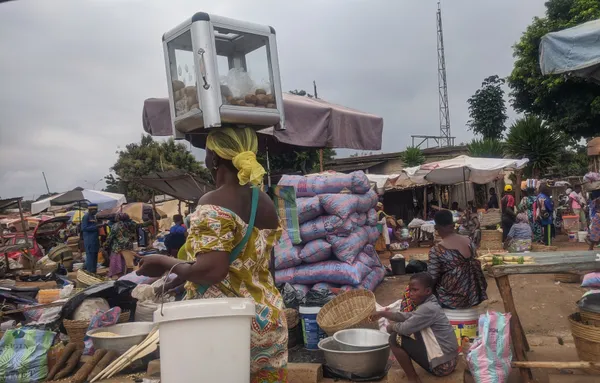
Cover image: A market in Africa. Photograph by Komavo, via Wikimedia Commons (CC0).