Published: October 24, 2026
5 Key Facts
- Shoprite is Africa's biggest private employer by far. The South African retailer employs 174,430 people. That is 44,076 more than second placed Bidvest, and larger than the workforces of the bottom three companies in this top 10 combined.
- Nine of the top 10 are headquartered in South Africa. Egypt's Orascom Construction is the only exception. It ranks fifth with 64,077 staff. No company headquartered anywhere else in Africa makes the top 10.
- Retailers employ nearly half of the top 10 workforce. Shoprite, Pick n Pay, Pepkor and TFG together employ 360,453 people. That is 46% of the 782,781 people employed by all ten companies in this ranking.
- Mining and banking fill most of the remaining places. Two platinum miners, Implats and Sibanye-Stillwater, employ 125,734 people between them. Two banks, FirstRand and Standard Bank, employ 102,163 people between them.
- State-owned employers are not counted here. This ranking covers private-sector employers only. Big state employers such as national power utilities and oil companies are excluded by design, even though some employ tens of thousands of people.
The big picture: this ranking counts people, not money. It ranks Africa-headquartered private employers by total group headcount, using each company's latest reported workforce figure. The result shows how concentrated formal private employment is in South Africa. South Africa's listed companies publish detailed staff numbers, and its retail, mining and banking sectors are the most labour intensive on the continent. For how these same companies compare on money rather than people, see our 2026 ranking of Africa's biggest companies by market cap and our 2026 ranking of African companies by revenue. For what workers at the bottom of the pay scale earn, see our 2026 minimum wage ranking for every African country.
| # | Company | Headquarters | Sector | Employees | Basis and vintage |
|---|---|---|---|---|---|
| 1 | Shoprite | South Africa | Retail | 174,430 | Permanent employees, FY2026 (June 2026) |
| 2 | Bidvest | South Africa | Services and trading | 130,354 | Group employees, FY2026 (June 2026) |
| 3 | Pick n Pay | South Africa | Retail | 90,000 | Owned and franchise operations, Oct 2025 |
| 4 | Implats | South Africa | Mining (platinum) | 67,877 | Own employees and contractors, FY2026 |
| 5 | Orascom Construction | Egypt | Construction | 64,077 | Permanent plus temporary staff, June 2026 |
| 6 | Sibanye-Stillwater | South Africa | Mining (platinum and gold) | 57,857 | Full-time employees, 2025 |
| 7 | FirstRand | South Africa | Banking | 51,712 | Group employees, June 2026 |
| 8 | Standard Bank | South Africa | Banking | 50,451 | Group employees, Dec 2025 |
| 9 | Pepkor | South Africa | Retail | 48,500 | Group employees, FY2025 (Sept 2025) |
| 10 | TFG (The Foschini Group) | South Africa | Retail | 47,523 | Group employees, FY2026 (March 2026) |
Headcounts are each company's latest reported total workforce, accessed October 24, 2026. Companies report on different bases, so the basis and vintage for each company are shown in the table. No figure was adjusted or estimated by African Exponent. See Methodology for the full ranking basis, including why group totals are used and why subsidiaries are not counted twice.
Selected Details
1. Shoprite: 174,430 people, and still hiring
Shoprite is Africa's largest private employer, and it is still growing. The group reported a permanent workforce of 174,430 in its 2026 financial year, after adding 5,491 direct jobs during the year. It operates more than 3,700 stores across eight African countries, including South Africa, under brands such as Shoprite, Checkers, Usave and OK. Shoprite describes itself as South Africa's largest private employer, and the numbers back that claim: it employs about 44,000 more people than the next company in this ranking. (Shoprite 2026 results: 174,430 permanent employees, 5,491 new jobs, Shoprite Holdings: group at a glance)
2. Bidvest: 130,354 people across services, freight and cars
Bidvest is South Africa's largest services group, with 130,354 employees at June 30, 2026. Its audited financial statements break the total down: 97,301 employees in Southern Africa and 33,053 internationally. The group runs more than 200 businesses, from cleaning and security to freight, car dealerships and pharmaceutical distribution. That spread is why Bidvest employs so many people: services businesses sell labour itself. Bidvest's headcount fell by 3,729 during its 2026 financial year, but it remains comfortably the second biggest private employer in Africa. (Bidvest Group audited annual financial statements 2026: 130,354 employees)
3. Pick n Pay: 90,000 people through owned and franchise stores
Pick n Pay employs 90,000 people through its owned and franchise operations, across its Pick n Pay and Boxer banners. The figure comes from the group's interim results announcement in October 2025. Pick n Pay is South Africa's second largest grocer, behind Shoprite, and its Boxer discount chain is one of its fastest growing parts. Note the counting basis: this figure includes franchise operations, while Shoprite's headline figure counts permanent employees only. The two bases are shown in the table so readers can compare fairly. Boxer is not ranked separately here, because it is part of the Pick n Pay group. (Pick n Pay interim results, October 2025: 90,000 people through owned and franchise operations)
4. Implats: 67,877 people at mines in three countries
Implats, formally Impala Platinum Holdings, reports 67,877 own employees and contractors at its managed operations in its 2026 financial year. Its integrated report rounds the figure to nearly 68,000 people. Implats mines platinum group metals in South Africa and Zimbabwe, and it also operates a mine in Canada. Its biggest operation, Impala Rustenburg, employs about 51,500 people on its own. Mining is labour intensive in a different way from retail: the jobs are concentrated in a few large sites, and many are underground. (Implats ESG report 2026: 67,877 own employees and contractors, up from 63,892, Implats integrated report 2026: nearly 68,000 people)
5. Orascom Construction: the only non-South African name in the top 10
Orascom Construction employed 64,077 people at June 30, 2026: 25,888 permanent employees and 38,189 temporary employees. The Cairo-headquartered builder works across the Middle East, Africa and the United States, so a large share of its workforce sits outside Africa. Temporary staff rise and fall with the project pipeline, which is why the total moves by thousands from quarter to quarter. Orascom is the only company in this top 10 headquartered outside South Africa. Its presence shows that Egypt's construction sector can match South Africa's miners and banks for sheer headcount, even if most of its projects are outside Africa. (Orascom Construction H1 2026 reviewed financial statements: 64,077 staff at June 30, 2026)
6. Sibanye-Stillwater: 57,857 people, down from its peak
Sibanye-Stillwater employed 57,857 people in 2025. The precious metals miner was once much bigger: it employed 84,775 people in 2021, before restructuring and shaft closures cut the workforce. It still ranks sixth in Africa, and it is the second miner in this top 10 alongside Implats. Together, the two platinum miners employ 125,734 people. That total mixes two counting bases: Sibanye-Stillwater reports full-time employees, while Implats reports own employees plus contractors. Both figures are used exactly as reported. (Macrotrends: Sibanye-Stillwater employee count, 57,857 in 2025)
7. FirstRand: 51,712 people, now slightly bigger than Standard Bank
FirstRand employed 51,712 people at June 30, 2026, up by 995 on the year before. FirstRand owns First National Bank (FNB), Rand Merchant Bank and WesBank, and it operates across several African countries. Its banking arm alone employs 39,545 people, with the rest in insurance, asset management and other group businesses. FirstRand also leads our 2026 ranking of Africa's biggest banks by total assets on some measures, but on headcount it now edges ahead of Standard Bank by 1,261 people. (FirstRand employee history: 51,712 at June 30, 2026)
8. Standard Bank: 50,451 people across 20 African countries
Standard Bank employed 50,451 people at December 31, 2025, according to its audited annual financial statements. The group operates in 20 African countries, and it describes itself as Africa's largest bank by assets. Its headcount has been almost flat for five years: it employed 50,316 people at the end of 2024 and 50,451 at the end of 2025. That stability is typical of banking, where branch networks change slowly and digital channels absorb growth. Standard Bank and FirstRand together employ 102,163 people, which makes banking the third biggest employment bloc in this ranking after retail and mining. (Standard Bank Group annual financial statements 2025: group employees 50,451)
9. Pepkor: 48,500 people selling value clothing and furniture
Pepkor employed 48,500 people in 2025. The Cape Town group owns PEP, Ackermans, Dunns, Tekkie Town, Incredible Connection and furniture chains such as Bradlows and Russells. PEP alone employs about 18,000 people across more than 2,600 stores, and Ackermans employs about 8,700. Pepkor also operates in Brazil, so its group total includes a few thousand staff outside Africa. Its stores target lower income shoppers, which means high volumes, many small stores, and a large shop floor workforce. (Pepkor: 48,500 employees in 2025, Who Owns Whom: Pepkor segment headcounts)
10. TFG: 47,523 people across fashion, jewellery and homeware
The Foschini Group, known as TFG, employed 47,523 people in its financial year ended March 31, 2026. The group's own releases describe the workforce as more than 47,500 people. TFG owns 39 retail brands, including Foschini, Markham, Sportscene, Jet, Exact and Totalsports, and it trades from more than 4,900 outlets across 23 countries. Its operations span Africa, the United Kingdom and Australia, so, like Pepkor and Bidvest, its group total includes staff outside Africa. TFG takes the last place in this top 10, ahead of Naspers at 45,780. (TFG: 47,523 employees, fiscal year ended March 31, 2026, TFG media release: over 47,500 employees)
Frequently Asked Questions
Which company is the biggest private employer in Africa?
Shoprite. The South African retailer employs 174,430 people, according to its 2026 financial year results. That is more than 44,000 ahead of second placed Bidvest, nearly double third placed Pick n Pay, and more than double every company ranked fourth or lower.
How many people does Shoprite employ?
Shoprite reported a permanent workforce of 174,430 in its 2026 financial year, which ended in June 2026. It added 5,491 direct jobs during the year. The group operates more than 3,700 stores across eight African countries.
Why are most of Africa's biggest private employers South African?
Three reasons stand out. First, South Africa has the continent's deepest listed company sector, and listed companies publish audited staff numbers, so they can be ranked reliably. Second, its retail, mining and banking sectors are unusually labour intensive. Third, many of these groups operate across Africa from a South African base, so their group totals are large. Companies elsewhere in Africa are often smaller, state-owned, or do not publish headcounts.
What is the biggest private employer in Africa outside South Africa?
Orascom Construction of Egypt, with 64,077 staff at June 30, 2026. It ranks fifth overall in this ranking. No other non-South African private employer reaches the top 10. The next largest, Naspers, is also South African, and it just missed the cut at 45,780.
Are state-owned companies included in this ranking?
No. This ranking covers private-sector employers only. State-owned companies, such as national power utilities, state oil companies and state airlines, are excluded even where they employ tens of thousands of people. The aim is to show where private capital creates jobs, not to rank every large employer on the continent.
Data Sources
- Shoprite 2026 results: permanent workforce of 174,430 employees, 5,491 direct new jobs in FY2026. Accessed October 24, 2026.
- Bidvest Group audited annual financial statements 2026: 130,354 employees at June 30, 2026 (97,301 Southern Africa, 33,053 international). Accessed October 24, 2026.
- Pick n Pay interim results, October 2025 (JSE SENS): 90,000 people through owned and franchise operations. Accessed October 24, 2026.
- Implats ESG report 2026: 67,877 own employees and contractors at group-managed operations, FY2026 (63,892 in FY2025). Accessed October 24, 2026.
- Orascom Construction H1 2026 reviewed financial statements: 64,077 staff at June 30, 2026 (25,888 permanent, 38,189 temporary). Accessed October 24, 2026.
- Macrotrends: Sibanye-Stillwater employee count: 57,857 in 2025 (84,775 in 2021). Accessed October 24, 2026.
- FirstRand employee history: 51,712 employees at June 30, 2026 (50,717 at June 30, 2025). Accessed October 24, 2026.
- Standard Bank Group annual financial statements 2025: group employees 50,451 at December 31, 2025. Accessed October 24, 2026.
- Pepkor company profile: 48,500 employees in 2025. Accessed October 24, 2026.
- TFG company profile: 47,523 employees, fiscal year ended March 31, 2026. Accessed October 24, 2026.
- Just missed the top 10: Naspers 45,780 at March 31, 2026 (Naspers employee history); Woolworths Holdings 37,752 at June 28, 2026 (Woolworths Holdings employee history); Absa Group about 37,030; Harmony Gold about 34,350; Sasol 27,239 at June 30, 2026 (Sasol employee history); Dangote Cement 20,614 group full-time employees at December 31, 2025 (Dangote Cement company profile); MTN Group about 17,500 (MTN Group: 17,500+ people).
Methodology
This ranking covers private-sector employers headquartered in Africa, ranked by total group headcount. "Private-sector" means the company is not owned or controlled by a government. State-owned employers are excluded, however large. Subsidiaries and divisions of a ranked parent are not counted twice: Boxer, for example, is part of Pick n Pay and is not ranked separately, even though it employs about 35,314 people.
Each headcount is the company's latest reported total workforce as of October 24, 2026. Fiscal year ends differ: Standard Bank reports at December 31, TFG at March 31, and Shoprite, Bidvest, Implats, FirstRand and Orascom at or near June 30. The vintage for each company is shown in the table. No figure was adjusted, rounded beyond the source, or estimated by African Exponent. Where a source gives a rounded figure, such as Pick n Pay at 90,000, the rounded figure is used and the basis is stated.
Companies do not all count staff the same way. Shoprite reports permanent employees. Bidvest, FirstRand, Standard Bank, Pepkor and TFG report group employees. Pick n Pay reports people through owned and franchise operations. Implats reports own employees plus contractors at managed operations. Orascom reports permanent plus temporary staff. Sibanye-Stillwater reports full-time employees. These bases are stated in the table and in each company section, so readers can see exactly what each number includes.
Group totals are used, not Africa-only totals. Several groups employ people outside Africa: Bidvest reports 33,053 international employees, TFG operates in the United Kingdom and Australia, Naspers operates globally, and Orascom works across the Middle East and the United States. Africa-only splits are not published on a consistent basis, so a group total ranking is the honest option, and the limitation is stated here rather than hidden.
The "2026" in the title marks this as the 2026 edition of African Exponent's ranking, published in 2026, using each company's latest reported workforce. It is not a claim that every figure dates from 2026: Pepkor's figure is from its 2025 financial year, Pick n Pay's from October 2025, and Standard Bank's from December 2025. Naspers illustrates why the cut-off matters: its reported headcount jumped from 27,010 at March 31, 2025 to 45,780 at March 31, 2026, and it still just missed the top 10.
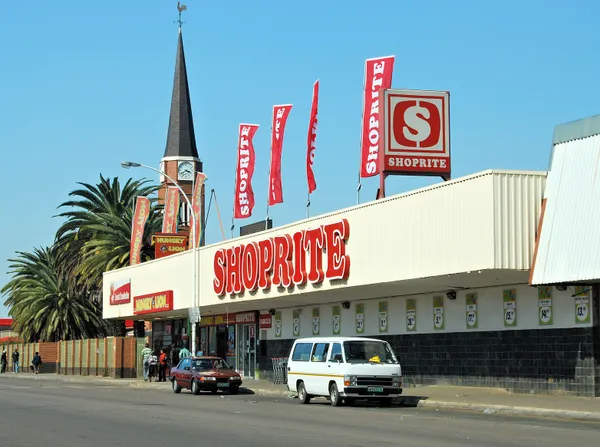
Cover image: A Shoprite store in Zeerust, South Africa. Photograph by Ossewa, via Wikimedia Commons (CC BY-SA 4.0).