Published: October 23, 2026
5 Key Facts
- Algeria is Africa's biggest military spender by a huge margin. It spent $25.4 billion in 2025, which is more than the other nine countries on this list combined ($21.0 billion).
- Algeria's military burden is among the heaviest on earth. Defense takes 8.8% of its GDP, the third highest share in the world after Ukraine (40%) and Israel (7.8%). One in every four dollars the government spends goes to the military.
- North Africa dominates the spending. Algeria, Morocco, Egypt and Tunisia together account for about $35.8 billion of the top 10's $46.5 billion total. Sub-Saharan Africa's biggest spender, South Africa, ranks only third on the continent.
- Nigeria had the fastest-growing defense budget. Its spending jumped 55% to $2.1 billion in 2025 as insurgencies and extremist violence worsened. Angola (+37%) and DR Congo (+20%) were the next fastest risers.
- Only one African country cracks the global top 40. Algeria ranks 20th in the world for military spending. Africa's total of $58.2 billion is just 2% of the record $2.89 trillion the world spent in 2025.
The big picture: African defense spending in 2025 was a tale of two regions. North Africa's $35 billion total is driven by the long-running Algeria-Morocco rivalry over Western Sahara, with Algeria outspending its neighbor four to one. South of the Sahara, South Africa is quietly cutting while Nigeria, Angola and DR Congo are spending more to fight insurgencies and insecurity. Spending does not always buy safety, as our 2026 ranking of Africa's safest countries shows. For the military-strength picture rather than the money, see our 2026 ranking of Africa's most powerful countries; our 2024 edition of this spending ranking is here.
| # | Country | Defense budget 2025 ($bn) | Supporting fact |
|---|---|---|---|
| 1 | Algeria | 25.4 | 8.8% of GDP (3rd highest in the world); 20th biggest spender globally |
| 2 | Morocco | 6.3 | Up 6.6% in real terms; less than a quarter of Algeria's budget |
| 3 | South Africa | 3.2 | Biggest spender in sub-Saharan Africa; down 19% since 2016 |
| 4 | Egypt | 2.5 | Official budget figure only; ministry does not publish a full breakdown |
| 5 | Nigeria | 2.1 | Up 55% in real terms, the fastest growth in the top 10 |
| 6 | Tunisia | 1.5 | 2.5% of GDP, a heavy burden for a small economy |
| 7 | Kenya | 1.5 | East Africa's biggest spender; up 7.9% in real terms |
| 8 | Angola | 1.5 | Up 36.7% in real terms, the second-fastest riser |
| 9 | Uganda | 1.3 | 2.0% of GDP; up 7.3% in real terms |
| 10 | DR Congo | 1.2 | Up 20.3% in real terms; the only Central African entry |
Figures are 2025 military expenditure in current US dollars from the SIPRI Military Expenditure Database, April 2026 release. Year-on-year changes are in real terms, based on constant 2024 dollars. Tunisia ($1.48bn), Kenya ($1.47bn) and Angola ($1.46bn) sit within $20 million of each other, so the order at #6-#8 could change with data revisions. Djibouti, Eritrea, Libya and Sudan have no 2025 value in the database and are excluded. See Methodology for the full ranking basis.
Selected Details
1. Algeria: in a league of its own
Algeria's $25.4 billion defense budget is larger than the rest of the top 10 put together. Its spending rose 11% in real terms in 2025, and it is up 89% since 2016. The military takes 8.8% of GDP, the third heaviest burden in the world after Ukraine and Israel. Military spending is also 25% of all government spending, the second highest share in the world after Ukraine. SIPRI says the long-standing tensions with Morocco, especially over Western Sahara, drive the spending. (SIPRI: Trends in World Military Expenditure, 2025, SIPRI Military Expenditure Database)
2. Morocco: the rival, at a quarter of the cost
Morocco spent $6.3 billion in 2025, up 6.6% in real terms. That is the second biggest defense budget in Africa, but it is less than a quarter of Algeria's. The same Western Sahara tensions drive both budgets, and they escalated in 2025. Morocco's military burden is 3.5% of GDP, far below Algeria's 8.8%. (SIPRI: Trends in World Military Expenditure, 2025, SIPRI Military Expenditure Database)
3. South Africa: sub-Saharan Africa's biggest, but shrinking
South Africa spent $3.2 billion in 2025, down 1.2% in real terms. It remains the biggest military spender in sub-Saharan Africa, but its budget is 19% lower than in 2016. Amid the persistent cuts, the Auditor General is investigating roughly $900 million in historical irregular spending by the Department of Defence. (SIPRI: Trends in World Military Expenditure, 2025)
4. Egypt: the budget is only part of the story
Egypt's official defense budget is $2.5 billion for 2025. That is the SIPRI figure, and it covers budgetary military spending only. Egypt's defense ministry does not publish a full itemised breakdown of its spending, so the figure reflects the published budget. Spending routed through other channels is not captured in this ranking. (SIPRI Military Expenditure Database, Envanter Medya: Why Egypt Has Africa's Strongest Military (2026))
5. Nigeria: the fastest riser
Nigeria's defense spending jumped 55% in real terms to $2.1 billion in 2025. That was one of the biggest increases of any country in the world. SIPRI links the surge to the worsening security situation: insurgencies and extremist violence. Nigeria is now the second biggest military spender in sub-Saharan Africa. (SIPRI: Trends in World Military Expenditure, 2025, SIPRI Military Expenditure Database)
6. Tunisia: small economy, heavy burden
Tunisia spent $1.5 billion in 2025, up 2.7% in real terms. What stands out is the weight: defense takes 2.5% of GDP, a heavy burden for a small economy and one of the highest shares in North Africa after Algeria. Tunisia edges Kenya and Angola for sixth place by less than $20 million. (SIPRI Military Expenditure Database)
7. Kenya: East Africa's biggest spender
Kenya spent $1.5 billion in 2025, up 7.9% in real terms. It is the biggest defense spender in East Africa, ahead of Uganda ($1.3 billion), Tanzania ($1.0 billion) and Ethiopia ($0.5 billion). Kenya's military burden is 1.1% of GDP, below the African average of 1.8%. (SIPRI Military Expenditure Database)
8. Angola: the second-fastest riser
Angola's defense budget rose 36.7% in real terms to $1.5 billion in 2025. That is the second fastest growth in the top 10 after Nigeria. Angola is Southern Africa's second biggest spender after South Africa. Its military burden is 1.4% of GDP. (SIPRI Military Expenditure Database)
9. Uganda: a heavy lift for its economy
Uganda spent $1.3 billion in 2025, up 7.3% in real terms. Defense takes 2.0% of GDP, which is above the African average of 1.8% and heavy for an economy of Uganda's size. Uganda sits just ahead of DR Congo in the ranking. (SIPRI Military Expenditure Database)
10. DR Congo: Central Africa's only entry
DR Congo spent $1.2 billion in 2025, up 20.3% in real terms. It is the only Central African country in the top 10. Its 20.3% rise is the third fastest growth in the ranking, after Nigeria and Angola. Its military burden is 1.4% of GDP. (SIPRI Military Expenditure Database)
Frequently Asked Questions
Which African country has the biggest defense budget in 2026?
Algeria. This 2026 edition ranks 2025 spending from the SIPRI Military Expenditure Database, released in April 2026. Algeria spent $25.4 billion, more than the next nine African countries combined.
How does Algeria's military spending compare to Morocco's?
Algeria ($25.4 billion) spends about four times as much as Morocco ($6.3 billion). The two rivals are driven by the same cause: long-standing tensions over Western Sahara, which escalated in 2025.
What counts as military expenditure in this ranking?
SIPRI counts official government spending on the armed forces and the defense ministry: personnel, operations, weapons purchases and military research. Figures are converted to US dollars at market exchange rates, not at purchasing power parity. Spending outside the official defense budget is not captured.
Why is Egypt's defense budget so much smaller than its military's real power?
SIPRI's $2.5 billion covers Egypt's official defense budget only. Egypt's defense ministry does not publish a full itemised breakdown, so the figure reflects the published budget. This is a common data limitation for countries whose militaries hold large economic interests outside the budget.
Did African Exponent rank military spending before?
Yes. Our 2024 edition ranked African military spending on the then-latest data. This is the 2026 edition, built on SIPRI's April 2026 release. For how spending translates into capability, see our 2026 ranking of Africa's most powerful countries.
Data Sources
- SIPRI Fact Sheet: Trends in World Military Expenditure, 2025 (released April 2026): Africa $58.2bn (+8.5% real, +45% vs 2016); North Africa $35.0bn (+9.3%, +67% vs 2016); sub-Saharan Africa $23.3bn (+7.4%, +21% vs 2016); Algeria $25.4bn (+11%), Morocco $6.3bn (+6.6%), South Africa $3.2bn (-1.2%), Nigeria $2.1bn (+55%); Algeria 8.8% of GDP (3rd globally), 25% of government spending (2nd globally); Algeria #20 globally. Accessed October 23, 2026.
- SIPRI Military Expenditure Database, April 2026 release (1949-2025): 2025 current-US$ figures for all top 10 (Algeria 25.44, Morocco 6.33, South Africa 3.17, Egypt 2.50, Nigeria 2.10, Tunisia 1.48, Kenya 1.47, Angola 1.46, Uganda 1.30, DR Congo 1.23, all $bn); just-missed: Tanzania 1.03, Mali 0.95, Burkina Faso 0.89; real-term changes from the constant (2024) US$ series; 2025 GDP shares. Accessed October 23, 2026.
- Envanter Medya: Why Egypt Has Africa's Strongest Military (2026): Egypt's defence ministry does not publish a full itemised order of battle, so totals are informed approximations. Accessed October 23, 2026.
- African Exponent: 2024's Top 10 African Countries Leading in Military Spending: previous edition of this ranking (2024 edition).
Methodology
This ranking uses a single metric: 2025 military expenditure in current US dollars, from the SIPRI Military Expenditure Database, April 2026 release, accessed October 23, 2026. SIPRI defines military expenditure as official government spending on the armed forces and the defense ministry, including personnel, operations, procurement and military research. Figures are converted at market exchange rates for the year, not at purchasing power parity, and SIPRI marks its own estimates in brackets in the source tables. Year-on-year changes in this article are in real terms, computed from SIPRI's constant (2024) US$ series. The "2026" in the title marks this as the 2026 edition of African Exponent's annual ranking, published in 2026.
No figures were estimated or invented. Djibouti, Eritrea, Libya and Sudan have no 2025 value in the database and are excluded. Tunisia ($1.48bn), Kenya ($1.47bn) and Angola ($1.46bn) sit within $20 million of each other, so the order at #6 through #8 could change with future data revisions. There are no other ties in the top 10. Internal links point to related African Exponent rankings, and every figure in the top 10 traces to the SIPRI database or fact sheet.
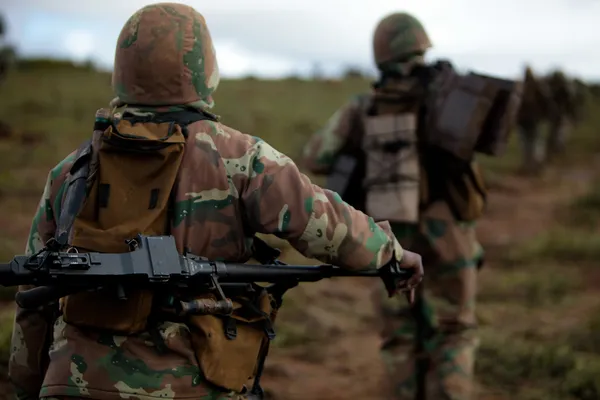
Cover image: South African National Defence Force soldiers during Exercise Shared Accord 2011. Photograph by Cpl. Jad Sleiman, U.S. Marine Corps, via Wikimedia Commons (public domain).