Published: October 15, 2026
5 Key Facts
- Eswatini has the highest unemployment rate in Africa, and the world, at 34.2%. More than one in every three people in the labour force is jobless, according to the World Bank's 2025 modelled estimates.
- South Africa is second at 32.4%, and its official rate keeps climbing. Statistics South Africa put the first quarter of 2026 at 32.7%, confirming the crisis is not easing.
- Half of the top 10 are in Southern Africa. Eswatini, South Africa, Botswana, Namibia and Lesotho all rank in the continent's worst 10, pointing to a regional jobs emergency.
- Sudan would top this list at around 60%, but it is not ranked. The IMF projects Sudanese unemployment near 60% for 2026, yet the war has collapsed data collection, so no verified 2025 figure exists.
- Young people suffer far worse than the headline rates. Modelled youth unemployment reaches 52.2% in Eswatini, while Botswana's statistics agency reports 28.9% of young people aged 15 to 35 without work.
Top 10 African Countries with the Highest Unemployment Rates
| Rank | Country | Unemployment rate (2025) |
|---|---|---|
| 1 | Eswatini | 34.2% |
| 2 | South Africa | 32.4% |
| 3 | Djibouti | 26.0% |
| 4 | Botswana | 24.5% |
| 5 | Gabon | 20.2% |
| 6 | Republic of Congo | 19.9% |
| 7 | Namibia | 19.3% |
| 8 | Somalia | 18.9% |
| 9 | Libya | 18.8% |
| 10 | Lesotho | 16.3% |
Rates are World Bank modelled ILO estimates for 2025, the latest comparable figures. See Methodology for why national figures can differ.
Africa holds an unhappy global record: the four highest unemployment rates in the world are all African, led by Eswatini at 34.2%. While countries like Niger report jobless rates below 1%, because most people farm for survival, the economies at the top of this list face a genuine shortage of work.
1. Eswatini, 34.2%: The World's Highest Rate
Eswatini's unemployment rate of 34.2% is the highest recorded among countries with comparable 2025 data, anywhere in the world. The World Bank says unemployment rose from 23% in 2016 to 35.4% in 2023, driven by low job creation, the decline of agriculture, limited skills and a mismatch between skills and available jobs. The crisis is worst among the young: 52.2% of people aged 15 to 24 were unemployed in 2025. Eswatini's own 2025 Labour Force Survey put the national rate slightly lower, at 33.5%, but the picture is the same.
2. South Africa, 32.4%: A Crisis That Will Not Ease
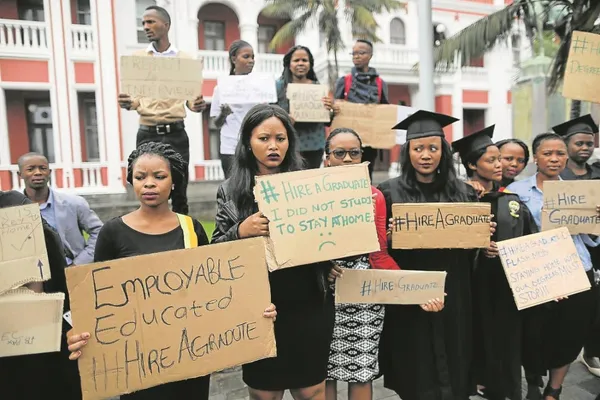
South Africa's modelled 2025 rate of 32.4% makes it the second worst in Africa and the world. The official figure is even bleaker: Statistics South Africa reported 32.7% in the first quarter of 2026. Around 8 million South Africans are jobless. Economists blame structural problems: a skills gap between what schools produce and what employers need, weak economic growth, and an economy that has not created enough formal jobs for decades.
3. Djibouti, 26.0%: Growth Without Jobs
Djibouti shows that economic growth alone does not create employment. Its port-driven economy grew about 7% in 2024, yet 26.0% of the labour force is unemployed. A small population and an economy concentrated in ports and logistics leave few opportunities for ordinary jobseekers.
4. Botswana, 24.5%: When Diamonds Stop Delivering
Botswana, long seen as Africa's best-managed economy, recorded 24.5% unemployment in 2025. Diamonds still generate about a third of government revenue, but softer global demand and competition from lab-grown stones hit hard: the economy shrank 2.8% in 2024 and 0.7% in 2025. The national statistics agency reports youth unemployment at 28.9%, and the number of unemployed graduates rose by nearly half in five years. Botswana's challenge is no longer turning diamonds into development, but creating prosperity that can survive without them.
5. Gabon, 20.2%: Oil Wealth, Few Jobs
Gabon's oil wealth has not translated into broad employment. At 20.2%, its unemployment rate shows the classic resource curse: a rich extractive sector that employs few people, alongside an economy that has failed to diversify into job-creating industries.
6. Republic of Congo, 19.9%: Same Oil, Same Problem
The Republic of Congo mirrors Gabon at 19.9%. Oil dominates exports and government revenue, but the jobs it creates are few and highly skilled. Most Congolese remain locked out of the formal economy.
7. Namibia, 19.3%: A Small Market Struggle
Namibia's 19.3% reflects the limits of a small domestic market. With a population under 3 million and an economy tied to mining and a large public sector, private job creation has lagged behind the number of young people entering the workforce.
8. Somalia, 18.9%: Conflict's Economic Toll
Decades of conflict and insecurity have hollowed out Somalia's formal economy, leaving 18.9% unemployment. Where institutions are fragile and investment is scarce, few stable jobs exist outside subsistence and informal trade.
9. Libya, 18.8%: Instability After Conflict
Libya's 18.8% stems from years of political division and conflict since 2011. Oil production has recovered in fits and starts, but the instability has scared off the investment needed to rebuild a functioning labour market.
10. Lesotho, 16.3%: In South Africa's Shadow
Lesotho, entirely surrounded by South Africa, records 16.3%. Its small economy depends heavily on its neighbour, on textile exports and on remittances from Basotho working in South African mines. When South Africa struggles, Lesotho feels it.
Why Sudan Is Not on the List
Sudan's unemployment would dwarf every country above. The IMF projects a rate near 60% for 2026, driven by the civil war that erupted in 2023. But Sudan is excluded from this ranking because the war has collapsed the data collection that modelled estimates rely on. No verified 2025 figure exists. If and when credible data returns, Sudan would almost certainly rank first in Africa and the world.
Frequently Asked Questions
Which African country has the highest unemployment rate?
Eswatini, at 34.2% in 2025 according to World Bank modelled estimates. It is also the highest rate in the world among countries with comparable data.
Why is unemployment so high in South Africa?
Economists point to structural causes: a mismatch between the skills workers have and the skills employers need, years of weak economic growth, and rigid labour markets. The official rate reached 32.7% in early 2026.
How does the World Bank measure unemployment across countries?
It uses the International Labour Organization's modelled estimates, which apply one consistent method everywhere. This makes countries comparable, but the figures can differ from national statistics, which use each country's own methods. For example, Eswatini's own survey found 33.5% for 2025, versus 34.2% modelled.
Why do some poor countries report very low unemployment?
Countries like Niger (0.39%) and Burundi (0.92%) top the lowest unemployment ranking because most people farm or trade informally to survive. They are counted as employed even when they earn very little. Low unemployment does not mean a strong economy.
Is youth unemployment worse than the headline rate?
Almost everywhere, yes. In Eswatini, 52.2% of 15 to 24 year olds are unemployed, versus 34.2% overall. In Botswana, 28.9% of young people aged 15 to 35 are jobless. Africa's youth bulge means the jobs crisis falls hardest on the young.
Data Sources
- World Bank, modelled ILO unemployment estimates 2025, via TheGlobalEconomy Africa ranking
- Eswatini Observer: Eswatini 34.2%, South Africa 32.4%, Djibouti 26.0%, Botswana 24.5%, Lesotho 16.3%, Namibia 19.3% (October 2026)
- Investopedia: world's highest unemployment rates, end-2025 World Bank data
- Forbes Africa: South Africa official unemployment 32.7%, Q1 2026 (Statistics South Africa)
- Measured World (IMF WEO): Sudan unemployment projected near 60% for 2026
- Gabz FM / Statistics Botswana: Botswana youth unemployment 28.9%, 2024/25
Methodology
This ranking uses the World Bank's modelled International Labour Organization (ILO) estimates for 2025, the latest year with comparable figures for all African countries. Modelled estimates apply a single consistent method across countries, which makes them the fairest basis for a continental ranking. They can differ from national statistics: Eswatini's own 2025 Labour Force Survey reported 33.5% against the modelled 34.2%, and Botswana's household surveys have ranged from 21% to 27.6% against the modelled 24.5%. Sudan is excluded because the ongoing war has made verified 2025 data unavailable; the IMF's 2026 projection of around 60% is cited separately. Figures are rounded to one decimal place in the text; the table uses the source values.