Published: October 5, 2026 | Last updated: October 5, 2026
Key Facts
- Niger has the lowest unemployment rate in Africa at 0.4%, followed by Burundi (0.9%) and Chad (1.1%) (ILO modelled estimates, December 2025, via Trading Economics)
- All ten countries on the list sit between 0.4% and 2.7%, while South Africa (32.4%) and Eswatini (34.2%) record Africa's highest rates (World Bank/ILO modelled data via WorldData.info, September 2026)
- Six of the ten countries are in West Africa: Niger, Benin, Togo, Côte d'Ivoire, Guinea-Bissau and Senegal (ILO modelled estimates, 2025)
- Informal jobs make up 87.6% of employment in sub-Saharan Africa, and around 60% of workers live in households below $4.20 a day (ILOSTAT, 2026; Ecofin Agency)
- The region's labour force grew by 15.4 million in 2025 while only 14.6 million jobs were created (ILO Employment and Social Trends 2026, via Ecofin Agency)
| Rank | Country | Unemployment Rate | Share of Workers in Agriculture (2023) | GDP Growth Forecast 2026 | As of |
|---|---|---|---|---|---|
| 1 | Niger | 0.4% | 70.6% | 6.7% | ILO, 2025 |
| 2 | Burundi | 0.9% | 85.1% | 4.1% | ILO, 2025 |
| 3 | Chad | 1.1% | 69.1% | 5.2% | ILO, 2025 |
| =4 | Benin | 1.6% | Not available | 7.0% | ILO, 2025 |
| =4 | Tanzania | 1.6% | 65.4% | 6.1% | ILO, 2025 |
| 6 | Togo | 2.0% | 30.3% | 5.0% | ILO, 2025 |
| 7 | Côte d'Ivoire | 2.3% | Not available | 5.8% | ILO, 2025 |
| =8 | Guinea-Bissau | 2.7% | Not available | 4.8% | ILO, 2025 |
| =8 | Senegal | 2.7% | Not available | 2.2% | ILO, 2025 |
| =8 | Uganda | 2.7% | 65.9% | 6.8% | ILO, 2025 |
Rates are ILO modelled estimates. Growth forecasts are from the World Bank's June 2026 Global Economic Prospects. Ties are listed alphabetically. Mali (2.8%) and Liberia (2.9%) just miss the top 10.
Selected Details About Each Country
1. Niger
0.4%. Niger has the lowest rate on the continent, and the ILO figure has stayed between 0.3% and 0.5% for years. Agriculture employs 70.6% of workers, and GDP per capita is only about $822, so most people cannot afford not to work. The World Bank projects growth of 6.7% in 2026 after 7.0% in 2025.
2. Burundi
0.9%. Burundi has the highest dependence on farming of any country on the list, with 85.1% of workers in agriculture. Real GDP grew 4.0% in 2025, driven by agriculture, and the economy is small at about $8 billion. GDP per capita is about $546.
3. Chad
1.1%. Agriculture employs 69.1% of workers, and the economy depends heavily on oil. GDP grew an estimated 5.6% in 2025 and is projected to grow 5.2% in 2026. Chad also hosts more than 1.5 million refugees.
4. Benin (tied)
1.6%. Benin has been a lower-middle-income country since 2020 and has sustained growth of 6.8% in the years since. The World Bank projects growth of 7.0% in 2026, with public debt at 56.8% of GDP.
4. Tanzania (tied)
1.6%. The 1.6% is a modelled figure. ILOSTAT's 2024 estimate was 2.6%, and a compilation of national survey data shows 9.3%. Informal employment is high: the ILO has put it at 76.2% of jobs, and agriculture employs 65.4% of workers. Growth is forecast at 6.1% in 2026.
6. Togo
2.0%. Togo is the only country on the list where farming employs less than a third of workers, at 30.3%. It posted 5.9% growth in 2025, and the World Bank projects 5.0% in 2026.
7. Côte d'Ivoire
2.3%. Growth reached 6.3% in 2025 and the World Bank projects 5.8% in 2026, though it lowered its outlook because of falling cocoa prices. The World Bank also notes that high informality persists despite strong growth.
8. Guinea-Bissau (tied)
2.7%. Guinea-Bissau has a very small economy of about $3 billion, with GDP per capita near $1,449. Growth is forecast at 4.8% in 2026. ILOSTAT's 2024 estimate for the country was 2.6%.
8. Senegal (tied)
2.7%. The low rate sits alongside a slowdown: the World Bank cut its 2026 growth forecast to 2.2% after revelations of hidden debt and the freezing of IMF funding. A compilation of national survey data puts unemployment at 20.0%, far above the modelled figure.
8. Uganda (tied)
2.7%. Informal jobs made up 93.5% of employment in older ILO data, and agriculture employs 65.9% of workers. Growth is forecast at 6.8% in 2026, a figure the World Bank lowered because of oil project delays.
Quick Answers to Commonly Asked Questions About this Topic
Which African country has the lowest unemployment rate?
Niger, at 0.4%, followed by Burundi at 0.9% and Chad at 1.1%, according to the ILO's modelled estimates for 2025.
Does a low unemployment rate mean a strong job market?
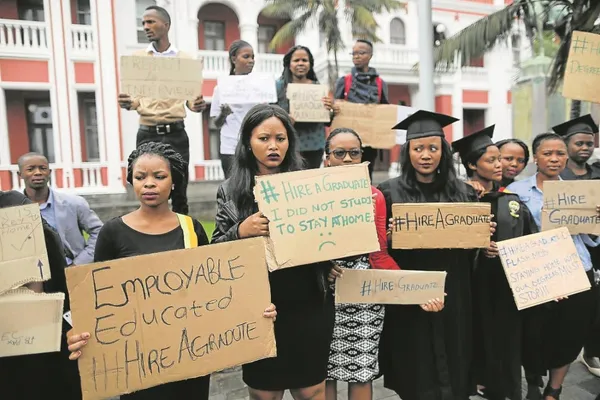
No. In sub-Saharan Africa, 87.6% of workers are in informal jobs and around 60% live in households below $4.20 a day. In 2025 the labour force grew by 15.4 million people but only 14.6 million jobs were created. Most people in poor countries cannot afford to be unemployed, so they take any work available.
Where do Nigeria, Ghana and South Africa rank?
Nigeria's modelled rate is 3.1%, while Trading Economics shows 4.9% from Nigerian data for December 2024. Ghana and Madagascar are at 3.0%. South Africa (32.4%) and Eswatini (34.2%) have the highest rates in Africa.
Why do different sources give different numbers?
The ILO counts someone as employed if they worked even one hour a week, which keeps modelled rates low. National surveys can use stricter definitions of employment or broader measures of joblessness, so they often give much higher figures: for example, 9.3% for Tanzania and 20.0% for Senegal in one compilation.
Why are these rates so low in poorer countries?
In low-income countries without unemployment benefits, people cannot go without work, so they farm, trade or take casual jobs. Those jobs count as employment even when pay is low, and measured unemployment is therefore low alongside widespread working poverty.
Data Sources
- Trading Economics, "Unemployment Rate – Africa" (ILO data, December 2025). Pulled October 4, 2026. https://tradingeconomics.com/country-list/unemployment-rate?continent=africa
- TheGlobalEconomy.com, "Unemployment rate in Africa" (World Bank/ILO, 2025). https://www.theglobaleconomy.com/rankings/unemployment_rate/Africa/
- WorldData.info, "Unemployment rates by country" (ILO modelled, updated September 2026). https://www.worlddata.info/unemployment-rates.php
- German Federal Statistical Office (ILOSTAT), "Key table: Unemployment rate" (2024). https://www.destatis.de/EN/Themes/Countries-Regions/International-Statistics/Data-Topic/Tables/BasicData_Unempl_Rate.html
- ILOSTAT, "The world of work and the 2030 Agenda: a ten-year review." https://ilostat.ilo.org/blog/the-world-of-work-and-the-2030-agenda-a-ten-year-review/
- Ecofin Agency, "Sub-Saharan Africa Adds 15.4 Million Workers in 2025, Straining Labor Markets." https://www.ecofinagency.com/news-services/0903-53598-sub-saharan-africa-adds-15-4-million-workers-in-2025-straining-labor-markets
- World Bank, Global Economic Prospects: Sub-Saharan Africa, June 2026. https://thedocs.worldbank.org/en/doc/2b672b3b0415d6b66c45b66579db4ef5-0050012026/related/GEP-Jun-2026-Regional-Highlights-SSA.pdf
- World Bank, Macro Poverty Outlook, April 2026. https://documents1.worldbank.org/curated/en/099641404152625843/pdf/IDU-c1534265-e00f-451f-961c-3ebde5e7f1da.pdf
- Wikipedia, "List of countries by employment in agriculture" (ILO modelled, 2023). https://en.wikipedia.org/wiki/List_of_countries_by_employment_in_agriculture
- ILO, "Facing the growing unemployment challenges in Africa" (informal employment shares). https://www.ilo.org/resource/news/facing-growing-unemployment-challenges-africa
- MyJobMag, "Unemployment Rates in Africa 2026" (national survey compilation). https://www.myjobmag.com/blog/unemployment-rates-in-africa
Methodology
This ranking orders African countries by their ILO modelled unemployment estimate for 2025, which the World Bank publishes as series SL.UEM.TOTL.ZS and which Trading Economics, TheGlobalEconomy.com and WorldData.info compile. It is the latest harmonised data available, so "2026" refers to the publication year. The ILO model puts countries on a common definition, counting as employed anyone who works even one hour a week, which keeps rates low in economies with large informal sectors. Rates are rounded to one decimal, and Guinea-Bissau, Senegal and Uganda tie at 2.7%, so the order within that tie is alphabetical. Mali (2.8%) and Liberia (2.9%) sit just outside the top 10, and differences of 0.1 point are within modelling error. Tanzania's figure comes from the World Bank series, while ILOSTAT's 2024 estimate was 2.6%. Côte d'Ivoire's comes from Trading Economics. National surveys use different definitions and can give far higher rates, as shown for Tanzania and Senegal. Countries without comparable estimates are not ranked. Agriculture shares, informality and growth forecasts come from separate sources and are not part of the ranking, and the rate says nothing about job quality, pay or underemployment.