Published: November 24, 2026
Key Facts
- Kenya leads Africa at 87.5% of adults using a mobile money service in the past year. Ghana is second at 78.3%.
- The top ten average 64.6% of adults. The Sub-Saharan African average is 41%.
- Nigeria, the continent's most populous country, sits at 32.8%. South Africa is at 31.6%. Both miss the top ten and sit below the regional average.
- Ghana rose from 13.0% in 2014 to 78.3% in 2024. Senegal rose from 6.2% to 66.9% over the same period, more than tenfold.
- The figures count adults who used a mobile money service in the past year, not registered accounts. Lesotho and Côte d'Ivoire are split by 0.1 point, inside the survey margin of error.
| Rank | Country | Adults using mobile money, 2024 | Same measure, 2014 | Note |
|---|---|---|---|---|
| 1 | Kenya | 87.5% | 58.4% | Home of M-Pesa |
| 2 | Ghana | 78.3% | 13.0% | Up 65.3 points in ten years |
| 3 | Zambia | 69.3% | 12.1% | Up 27.7 points since 2021 |
| 4 | Uganda | 67.7% | 35.1% | Women trail men by 12.9 points |
| 5 | Senegal | 66.9% | 6.2% | More than ten times its 2014 rate |
| 6 | Gabon | 61.6% | 6.6% | Small country, deep adoption |
| 7 | Cameroon | 55.1% | Not published | First country below 60% |
| 8 | Lesotho | 53.5% | Not published | Remittances equal 20.9% of GDP |
| 9 | Côte d'Ivoire | 53.4% | Not published | Up 13.0 points since 2021 |
| 10 | Tanzania | 52.9% | Not published | Holds tenth place by 1.3 points |
Three of the ten are in West Africa, three in East Africa, two in Southern Africa and two in Central Africa. The story of this ranking is not only who leads. It is who is missing. Nigeria, the continent's most populous country, and South Africa, its largest economy, both sit below the regional average of 41%. Mobile money is now the main way most Africans in the top ten hold and move money, and the two biggest economies are still catching up. For the wider market behind these numbers, see The Mobile Money Market in Africa: Size, Players, Rules and Outlook in 2026, and for the scale of the flows, $1.4 Trillion Moved by Phone in Sub-Saharan Africa in 2025.
Kenya sets a pace nobody else can touch
M-Pesa launched in Kenya in 2007, years before most rivals existed. By 2014, 58.4% of Kenyan adults already used mobile money. The rate dipped to 68.7% in 2021, then jumped 18.8 points to 87.5% in 2024. That is more than double the Sub-Saharan African average of 41%. It is also 2.67 times the rate in Nigeria. Mobile money in Kenya is the default payment rail, not an alternative to banking. M-Pesa moved KES 41.7 trillion in one year, more than twice Kenya's entire GDP. One gap remains inside the lead. Women use mobile money at 83.5%, against 91.7% for men.
How Ghana went from 13% to 78% in a decade
Ghana sits second at 78.3%, 9.2 points behind Kenya. In 2014 only 13.0% of Ghanaian adults used mobile money. The rise since then is 65.3 points, a sixfold increase in ten years, the biggest ten year climb among the countries with published 2014 figures. MTN Mobile Money leads the market, and the wallet has become the way Ghanaians send money home. In 2024, 77.7% of Ghanaian adults sent or received a domestic remittance, the highest rate in the world. See also Top 10 African Countries by Diaspora Remittances in 2026.
Zambia, the quiet climber
Zambia is third at 69.3%. In 2014 the figure was 12.1%. Zambia added 27.7 points between 2021 and 2024 alone, a sharp late climb. Mobile money arrived later in Zambia than in Kenya, and the early years were slow. The last three years changed that. Zambia now sits above Uganda and Senegal, two countries with much longer mobile money histories.
Uganda's gap runs between men and women
Uganda is fourth at 67.7%. In 2014 it was already at 35.1%, second only to Kenya among the countries with published 2014 figures. The gap inside Uganda is gender. Women use mobile money at 61.7%, against 74.6% for men, a difference of 12.9 points. MTN MoMo and Airtel Money share the market. Uganda's rate is more than double Nigeria's, even though Nigeria's economy is far larger.
Senegal multiplied its rate more than tenfold
Senegal is fifth at 66.9%. In 2014 only 6.2% of adults used mobile money. The 2024 figure is 10.8 times the 2014 figure. Wave, the Dakar startup, pushed prices down and forced the older operators to compete. Senegal also ranks near the top on domestic remittances: 75.9% of adults sent or received money inside the country in the past year. The wallet is now how most Senegalese move money day to day.
Gabon, the small country that outranks the giants
Gabon is sixth at 61.6%. In 2014 it was 6.6%. Gabon is far smaller than Nigeria or Egypt, yet its adoption rate is nearly double Nigeria's 32.8% and almost four times Egypt's 15.6%. Size has nothing to do with this ranking. A small market with cheap phones, dense agent networks and light regulation can beat a giant. Gabon proves it.
Cameroon clears the halfway mark
Cameroon is seventh at 55.1%, the first country in the ranking below 60%. MTN Mobile Money and Orange Money are the main wallets. Cameroon is the fourth country in the top ten where French is an official language, after Senegal, Gabon and Côte d'Ivoire. Mobile money crossed the halfway mark here, which means most adults now use the rail at least some of the time.
Lesotho, the remittance economy
Lesotho is eighth at 53.5%. Money sent home from abroad equals 20.9% of GDP, one of the highest shares in the world. That shapes everything about how Lesotho pays. Digital payment adoption is 58.4% of adults, and mobile money is the rail that carries it. Lesotho leads Côte d'Ivoire by 0.1 point, a gap smaller than the survey margin of error, so the order between the two is not certain.
Côte d'Ivoire, up 13 points in three years
Côte d'Ivoire is ninth at 53.4%. The figure rose 13.0 points since 2021, its highest reading yet. Overall account ownership is 57.6% of adults, so more than nine in ten adults with any account use mobile money. Orange Money, MTN MoMo and Wave compete hard in Abidjan and beyond. The Ivorian story is competition: three big wallets fighting for the same street corners pushed adoption up fast.
Tanzania rounds out the ten
Tanzania is tenth at 52.9%. It holds the last place by 1.3 points over Botswana and the Republic of Congo, both at 51.6%. Only 21.9% of Tanzanian adults have a bank account, against 59.8% with any account at all. The gap is mobile money. M-Pesa, Tigo Pesa and Airtel Money do the work that bank branches never did. For the cost of staying connected, see Top 10 Countries With the Cheapest Mobile Data in Africa in 2026.
Frequently Asked Questions
Which African country uses mobile money the most?
Kenya. In 2024, 87.5% of Kenyan adults used a mobile money service in the past year, according to the World Bank Global Findex 2025 survey. Ghana is second at 78.3%.
What share of adults in Nigeria use mobile money?
32.8% in 2024. That is far below Kenya and below the Sub-Saharan African average of 41%. Nigeria ranks 40th of the 96 countries in the Findex dataset on this measure.
Is mobile money more common than bank accounts in Africa?
In Sub-Saharan Africa, yes. In 2024, 40% of adults in the region had a mobile money account, just ahead of the 38% with a bank account. One in five adults in the region relies on a mobile money account alone, with no bank account at all.
Why is Kenya so far ahead on mobile money?
M-Pesa launched in Kenya in 2007, years before most rivals. By 2014, 58.4% of Kenyan adults already used mobile money. The agent network grew with it, so cash in and cash out were never far away. The rate dipped to 68.7% in 2021, then jumped to 87.5% by 2024.
How does the World Bank measure mobile money use?
Through the Gallup World Poll. About 1,000 adults in each country, chosen to represent the whole adult population, are asked whether they personally used a mobile money service in the past year. The 2024 wave was published in the Global Findex Database 2025.
Data Sources
- World Bank, Global Findex Database 2025, indicator "Mobile money account (% age 15+)", 2024 survey wave. Download: worldbank.org/en/publication/globalfindex/download-data. Methodology: worldbank.org/en/publication/globalfindex/methodology.
- FinStatGlobe, "Top 10 Countries for Mobile Money Accounts (Findex 2024)", data.finstatglobe.com/articles/top-10-mobile-money-countries. Independent extraction of the same Findex dataset. All ten values match the World Bank figures to 0.1 point.
- Azenha BullDozer, "Mobile Money Account by Country, 2024", azenha.ai/bulldozer/dataset/wb-mobile-money/. Full 96 country ranking from World Bank Open Data.
- FXC Intelligence, "Cross-border insights from the World Bank's Global Findex 2025", fxcintel.com/research/reports/ct-world-bank-global-findex-2025-remittances. Confirms the top five rounded values.
- Ezo, "2025 Global Findex: Financial Inclusion and Mobile Tech in Sub-Saharan Africa", ezo.app/blog/2025-global-findex-financial-inclusion-and-mobile-tech-in-sub-saharan-africa. Regional context: 20% of adults in Sub-Saharan Africa rely solely on a mobile money account.
Methodology
This ranking uses the World Bank Global Findex indicator "Mobile money account (% age 15+)". It measures the share of adults aged 15 and above who report personally using a mobile money service in the past year. It is a use measure, not a count of registered accounts. A person who used mobile money once to receive a transfer counts. The data come from the Gallup World Poll, about 1,000 adults per economy, nationally representative. All ten values in the table are from the 2024 survey wave, published in the Global Findex Database 2025 in July 2025. The 2014 column shows the same indicator ten years earlier where published. Ranks 7 to 10 carry no 2014 value because the cited tables do not publish one, and no value was estimated. Countries with no Findex mobile money observation are excluded, not ranked last. They include Algeria, Angola, Guinea-Bissau, Libya, Sudan, Seychelles, Cabo Verde, Djibouti, Central African Republic, Equatorial Guinea and Eritrea. Rwanda's latest Findex observation is from 2017 (31.1%), so it is not ranked on 2024 data. A 2024 national survey in Rwanda reports higher mobile money use, but it is a different survey and is not mixed into this ranking. Two near ties deserve care. Lesotho leads Côte d'Ivoire by 0.1 point, inside the survey margin of error, so their order is not certain. Tanzania leads Botswana and the Republic of Congo by 1.3 points. Every table value was checked against two independent republications of the Findex dataset, and all ten matched to 0.1 point. No disagreements were found. Provider counts, such as the IMF count of active accounts per 1,000 adults, measure registered accounts rather than people, and are not used in this ranking. All derived claims in this article were recomputed from the final table values.
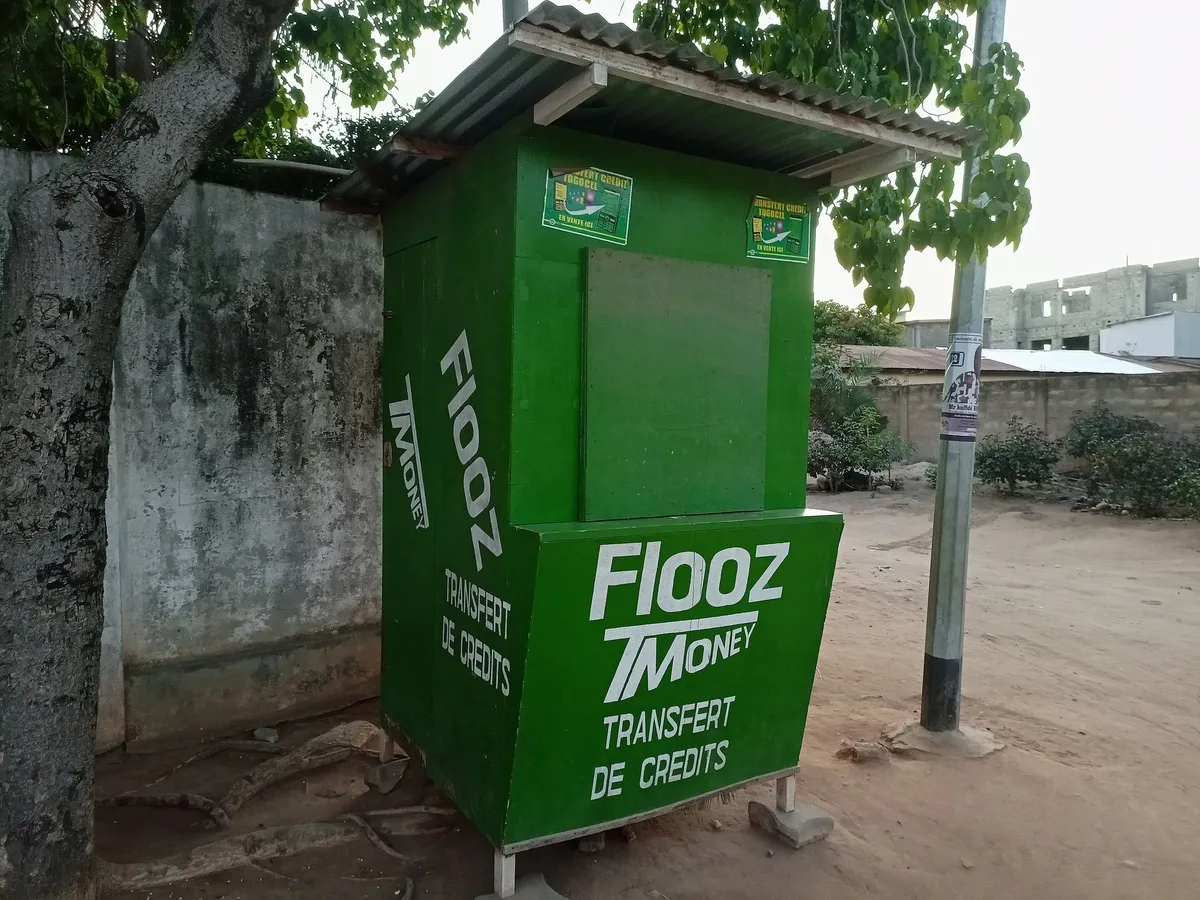
Feature image: A Flooz and TMoney mobile money kiosk in Lomé, Togo. Photo: Saliousoft via Wikimedia Commons.