Published: November 24, 2026
Cameroon is the seventeenth country in this series, and it is the first where the ranking itself has to admit what it is. No census in Cameroon has ever published an ethnic breakdown. The 1987 census asked the question and never published the results, and the 2005 census did not ask it at all. The ranking below therefore rests on the only complete breakdown that exists, the CIA World Factbook's 2018 estimates, applied to the United Nations 2026 population of 30,640,817. It is the best count the record allows, and the article says plainly where the record is thin.
The result is a table of umbrella categories, not single tribes, and the article is honest about that from the start. The Bamileke-Bamu lead at 7,445,719 people, or 24.3 percent of the country, and they alone outnumber the bottom five groups in this ranking combined, by just 30,641 people. The top three groups together pass 60 percent of the population, and the nine ranked groups together reach 95.7 percent. Cameroon is often called Africa in miniature, and the table shows why: the Joshua Project lists 292 peoples in one country. The previous article in this series covered the top 10 tribes of Madagascar.
Key Facts
- Cameroon's population in 2026 is 30,640,817, the 15th largest in Africa, according to the United Nations World Population Prospects 2024.
- The Bamileke-Bamu are the largest group at 7,445,719 people, or 24.3 percent of the country.
- The Bamileke-Bamu alone outnumber the bottom five groups in this ranking combined, by 30,641 people.
- The top three groups together number 18,537,694 people, or 60.5 percent of Cameroon.
- No census in Cameroon has ever published an ethnic breakdown, so this ranking uses the CIA World Factbook's 2018 estimates, and it is an honest Top 9 because the tenth Factbook category is a residual bucket, not a tribe.
The Ranking
| Rank | Group | Share | Population in 2026 | Basis |
|---|---|---|---|---|
| 1 | Bamileke-Bamu | 24.3% | 7,445,719 | CIA World Factbook, 2018 est. |
| 2 | Beti/Bassa/Mbam | 21.6% | 6,618,416 | CIA World Factbook, 2018 est. |
| 3 | Biu-Mandara | 14.6% | 4,473,559 | CIA World Factbook, 2018 est. |
| 4 | Arab-Choa/Hausa/Kanuri | 11.0% | 3,370,490 | CIA World Factbook, 2018 est. |
| 5 | Adamawa-Ubangi | 9.8% | 3,002,800 | CIA World Factbook, 2018 est. |
| 6 | Grassfields | 7.7% | 2,359,343 | CIA World Factbook, 2018 est. |
| 7 | Kako/Meka/Pygmy | 3.3% | 1,011,147 | CIA World Factbook, 2018 est. |
| 8 | Cotier/Ngoe/Oroko | 2.7% | 827,302 | CIA World Factbook, 2018 est. |
| 9 | Southwestern Bantu | 0.7% | 214,486 | CIA World Factbook, 2018 est. |
Just Outside the Top 9
The tenth Factbook category is "foreign/other", at 4.5 percent or 1,378,837 people. It is a residual bucket for foreigners and everyone the classification could not place, not a tribe, so it is not ranked. That is the whole reason this article is a Top 9 rather than a Top 10. No tenth indigenous group can be verified on the same basis, and the Joshua Project's finer groups sit inside the nine umbrellas rather than below them.
The Joshua Project's largest divergence is its count of urban Pidgin speakers. It lists two Cameroonian Creole entries, at 1,847,000 and 1,646,000 people, a combined 3,493,000. Counted as one group they would rank fourth in this table, between the Biu-Mandara and the Arab-Choa/Hausa/Kanuri. They are not ranked here because they are defined by a shared urban language, Cameroonian Pidgin, rather than by descent, and the Factbook classification has no equivalent category. The gap between the two counts is a reminder that Cameroon counts its people differently depending on who is doing the counting.
Bamileke-Bamu
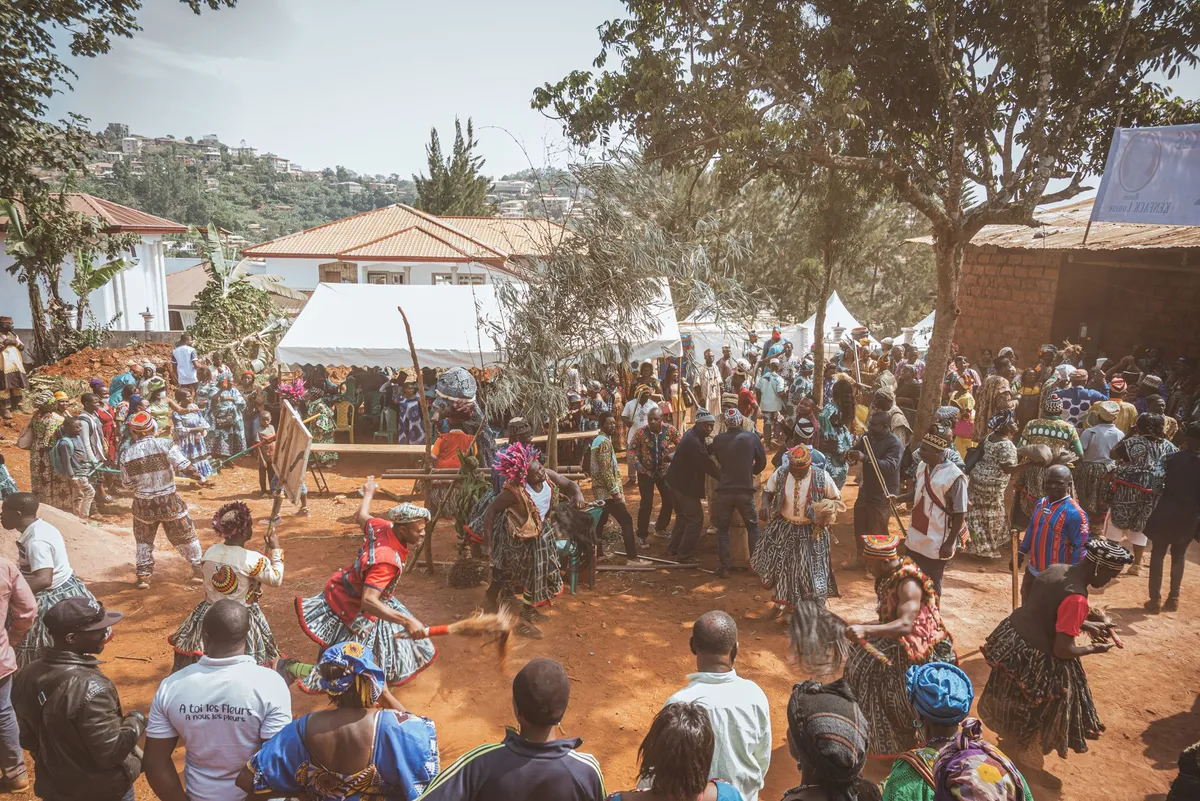
The Bamileke are the largest ethnic group in Cameroon, a Grassfields people of the West and Northwest Regions, organised in chiefdoms under a fon. Their beaded elephant mask, the mbap mteng, is worn by dancers of the Kuosi society at funerals and palace festivals, and the photo at the top of this article shows a Bamileke folk dance at a funeral in Dschang. The Bamu, or Bamum, bring the kingdom of Foumban into the same umbrella, a kingdom whose Sultan Njoya devised the Bamum script. At 7,445,719 people the Bamileke-Bamu lead the Beti/Bassa/Mbam by 827,303, and they are 34.7 times the size of the Southwestern Bantu in ninth place.
Beti/Bassa/Mbam
The Beti are the peoples of the forested Centre and South, and Yaounde, the capital, stands in Ewondo country. The Joshua Project counts the Ewondo at 2,358,000 and the Bulu at 1,450,000, together 3,808,000 of this umbrella's 6,618,416, with the Bassa of the coast and the peoples of the Mbam river making up the rest. The Beti are part of the wider Beti-Pahuin world that stretches into Gabon and Equatorial Guinea. At 6,618,416 people they trail the Bamileke-Bamu by 827,303 and lead the Biu-Mandara by 2,144,857.
Biu-Mandara
The name is a language label, not a tribe. It groups the peoples of the Mandara mountains and the plains of the Far North, in the Biu-Mandara branch of the Chadic language family. They farm the mountain terraces and the dry plains below them, in the driest corner of the country, and their neighbours in the ranking include the Choa Arabs and Kanuri who share the Lake Chad basin. At 4,473,559 people they lead the Arab-Choa/Hausa/Kanuri by 1,103,069 and sit 2,144,857 behind the Beti/Bassa/Mbam.
Arab-Choa/Hausa/Kanuri
Three peoples share this rank, all tied to the north. The Choa Arabs, also called Shuwa Arabs, herd cattle across the Far North, and the Joshua Project counts 220,000 of them in Cameroon. The Hausa are traders whose networks run across West Africa, and the Kanuri are the people of the old Bornu kingdom around Lake Chad. At 3,370,490 people they trail the Biu-Mandara by 1,103,069 and lead the Adamawa-Ubangi by 367,690.
Adamawa-Ubangi
The Adamawa plateau gives this category its name, and the Fulani give it its weight. The Joshua Project counts 3,012,000 Fulani Adamawa in Cameroon, its largest single group in the country, and that figure alone is 9,200 more than this whole umbrella, a sign of how loosely the two sources fit together. The category is a language family label covering the peoples of the plateau and the Ubangi basin fringe. At 3,002,800 people it trails the Arab-Choa/Hausa/Kanuri by 367,690 and leads the Grassfields by 643,457.
Grassfields
The Grassfields are the highland peoples of the Northwest Region who are not Bamileke, organised in fondoms such as Bafut, Kom and Nso. Their separation from the Bamileke-Bamu in this table is the Factbook's choice, and the two vintages agree on the total. The 2008 Factbook put the Cameroon Highlanders at 31 percent, and the 2018 split of Bamileke-Bamu 24.3 and Grassfields 7.7 comes to 32.0 percent. At 2,359,343 people they trail the Adamawa-Ubangi by 643,457 and lead the Kako/Meka/Pygmy by 1,348,196.
Kako/Meka/Pygmy
The Kako and the Meka live in the forested East Region, and the umbrella also holds the forest Pygmy peoples, including the Baka of the south-eastern forests. They are the smallest of the country's forest peoples to be counted as a group in this classification, and the Pygmy communities inside it are among the oldest inhabitants of the Congo Basin forests. At 1,011,147 people they trail the Grassfields by 1,348,196 and lead the Cotier/Ngoe/Oroko by 183,845.
Cotier/Ngoe/Oroko
The coastal peoples of the Southwest Region, the Sawa world of Douala and the creeks, who hold the annual Ngondo festival on the Wouri river. The Duala, Bakweri, Oroko and their neighbours are traders and fishers, and their towns grew up around the trading posts of the coast. At 827,302 people they trail the Kako/Meka/Pygmy by 183,845 and lead the Southwestern Bantu by 612,816.
Southwestern Bantu
The smallest category in the ranking covers the small Bantu groups of the far Southwest, between the coast and the Nigerian border. At 214,486 people they are 34.7 times smaller than the Bamileke-Bamu, and the gap to the Cotier/Ngoe/Oroko above them, 612,816 people, is nearly three times their whole population.
Frequently Asked Questions
Why is this a Top 9 and not a Top 10?
Because the tenth Factbook category is "foreign/other", 4.5 percent of the population, a residual bucket for foreigners and unplaced people, not a tribe. No tenth indigenous group can be verified on the same basis, and the Joshua Project's finer groups sit inside the nine umbrellas. Padding the list with one of them would double count.
Are these really tribes, or something else?
They are umbrella categories from the CIA World Factbook's 2018 estimates. The Bamileke-Bamu alone covers many chiefdoms plus the Bamum kingdom, and the Biu-Mandara and Adamawa-Ubangi ranks are language family labels. Cameroon has never published a census count of individual tribes, so these umbrellas are the finest full breakdown that exists.
Why does the Joshua Project count the Fulani higher than this whole category?
It counts 3,012,000 Fulani Adamawa, which is 9,200 more than the 3,002,800 in the Adamawa-Ubangi umbrella. The two sources use different taxonomies and cannot be reconciled line by line, so the Joshua Project is used here only as a cross-check, never spliced into the table.
What about the Cameroonian Creole?
The Joshua Project lists two Cameroonian Creole entries totalling 3,493,000 people, which would rank fourth if counted as one group. They are defined by Cameroonian Pidgin, an urban lingua franca, rather than by descent, and the Factbook has no equivalent category, so they sit outside this ranking.
Why are the Grassfields and the Bamileke-Bamu listed separately?
Because the Factbook lists them separately, and the two vintages agree. The 2008 edition put the Cameroon Highlanders at 31 percent, while the 2018 split of Bamileke-Bamu 24.3 and Grassfields 7.7 comes to 32.0 percent. The Bamileke are the Grassfields' largest people, but the classification treats the remaining highland chiefdoms as their own category.
Data Sources
- United Nations World Population Prospects 2024, total population at 1 July 2026: 30,640,817. population.un.org
- CIA World Factbook, Cameroon, Ethnic groups (2018 est.), as reproduced by IndexMundi and verified live on November 24, 2026. indexmundi.com
- CIA World Factbook, Cameroon, Ethnic groups (2008 edition, archived). webarchive.library.unt.edu
- Joshua Project, Cameroon country page, accessed November 24, 2026. joshuaproject.net
- Wikipedia, Bamileke people. en.wikipedia.org
- Google Arts and Culture, Hat for elephant mask, Bamileke Kuosi society. artsandculture.google.com
- World Population Review, Countries in Africa (UN World Population Prospects 2024, Cameroon 30,640,817). worldpopulationreview.com
Methodology
This ranking follows the method of the Tribes by Country series. The shares come from a single basis, the CIA World Factbook's 2018 estimates for Cameroon, as carried in the site's Peoples of Africa dataset and verified live against the IndexMundi reproduction on November 24, 2026. Each share is applied to the United Nations World Population Prospects 2024 mid-2026 total for Cameroon, 30,640,817, which World Population Review reproduces exactly from the same UN revision.
No census in Cameroon has ever published an ethnic breakdown. The 1987 census collected ethnic data that was never officially published, and the 2005 census did not record ethnicity, so there is no official basis to use instead. The ten Factbook shares sum to 100.2 percent, a rounding gap in the source that is carried through the table. The nine ranked shares sum to 95.7 percent, and the remaining 4.5 percent is the Factbook's "foreign/other" bucket, which is excluded as a residual category, not a tribe. That exclusion is why this article is an honest Top 9.
The Joshua Project was read live on November 24, 2026 as a cross-check and was not spliced into the table. It lists 292 groups totalling 30,456,000 people against a UN 2026 figure of 30,641,000, and its taxonomy is far finer than the Factbook's. Its largest group, the Fulani Adamawa at 3,012,000, alone exceeds the Adamawa-Ubangi umbrella by 9,200. Its Ewondo (2,358,000) and Bulu (1,450,000) sit inside the Beti/Bassa/Mbam umbrella, with 2,810,416 left for the Bassa and Mbam peoples. Its two Cameroonian Creole entries, 1,847,000 and 1,646,000, have no Factbook equivalent and are not ranked. Its figures also drift between snapshots: an older prayer card put the Ewondo at 2,299,000 against the current 2,358,000.
Three exclusions are deliberate. The "foreign/other" bucket (1,378,837) is excluded as a residual, not a group. The Cameroonian Creole entries are excluded because they are defined by language rather than descent. No Joshua Project subgroup is added to any umbrella total, because the subgroups sit inside the umbrellas and adding them would double count. The combined top nine share of 95.7 percent is published because the table uses one basis throughout. Spelling follows the Factbook: "Cotier" keeps the source spelling, and Bamu is used for the Bamum in the umbrella name. All figures were recomputed from the shares and the 2026 total before publication, and every derived claim in this article was checked against that arithmetic.