Table of Contents
1. Trump's double-digit tariffs land on seven African economies
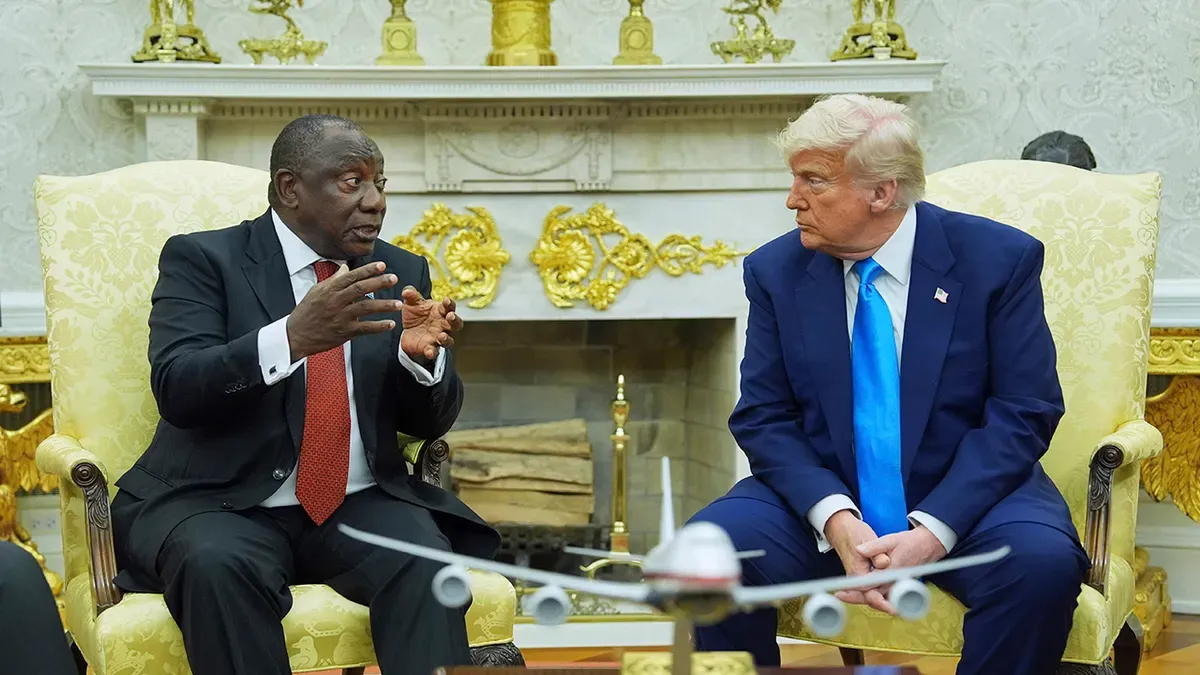
The United States imposed tariffs of up to 12.5 percent on imports from 60 trading partners covering about 99 percent of US imports, effective 12:01 a.m. Friday as Trump's temporary 10 percent global levies expired, with the administration charging that the countries inadequately enforce bans on goods made with forced labor. South Africa sits in the highest tier at 12.5 percent, and Algeria, Angola, Egypt, Libya, Morocco and Nigeria join it in the 12.5 percent band reserved for countries that have not adopted a forced-labor import prohibition. The new levies replace stopgap duties Trump imposed after the Supreme Court struck down his earlier tariff regime.
Why it matters: Every major African exporter to the US now pays the top rate, and the forced-labor framing gives Washington a lever it can tighten country by country without new legislation. The 2.5-point gap between tiers is a compliance price list. Adopting a forced-labor import ban buys the lower rate, which is exactly the kind of legal homework AGOA's successor negotiations will now be held hostage to.
Source: AP / Africanews / ABC News
2. Tinubu approves Nigeria's largest army expansion in decades
Nigeria's President Bola Tinubu approved an expansion of the army from eight to 12 divisions and the recruitment of 28,000 additional personnel, the presidency said on Friday, with new divisions in Makurdi, Ilorin, Jalingo and Benin City and increased spending on equipment, operational readiness and troop welfare. Implementation runs in two phases, with the 5, 9 and 10 Divisions and reorganised formations completed by September 2026 and the 83rd Division in Benin City operational by December.
Why it matters: The new headquarters map is the tell. Makurdi, Ilorin, Jalingo and Benin City ring the Middle Belt and the routes along which violence has spread south and west, an admission that the northeast-centred force structure no longer matches the war. The binding constraint is manpower, since the army has struggled with recruitment turnout, and 28,000 recruits on paper fix nothing until barracks pay and casualty rates make the uniform worth wearing.
Source: Reuters via CNBC Africa / Punch / allAfrica
3. Africa's leaders sign the Accra Declaration and bet on health sovereignty
African heads of state adopted the Accra Declaration at the close of the 20th Extraordinary Session of the AU Assembly on Health, committing member states to end AIDS as a public health threat by 2030, cut preventable maternal and child deaths, and achieve universal health coverage by 2030. The Accra summit drew presidents including Ghana's John Mahama, Tanzania's Samia Suluhu Hassan and Burundi's Évariste Ndayishimiye alongside WHO chief Tedros Adhanom Ghebreyesus, put local pharmaceutical manufacturing and diversified domestic financing at the top of the agenda, and closed with delegates adopting a fully costed continental roadmap. Leaders framed the push as a drive for continental health sovereignty and self-reliance in the face of major cuts to international funding, and the coverage and national follow-through rolled across the continent through Friday.
Why it matters: This is the AU's first summit devoted solely to health, and it happened because the donor money is leaving, with the US and European retreat forcing the continent to price its own disease burden for the first time. The phrase to hold onto is fully costed, since every previous continental health pledge died for lack of a number attached. The test is whether finance ministers, who did attend, put the roadmap into national budgets before the next AU ordinary summit, because sovereignty claimed in a declaration is only purchased in appropriations.
Source: Ghanaian Times / Modern Ghana / allAfrica
4. Bamako jails its former spy chief for 15 years over a coup plot
A court sentenced Colonel Kassoum Goita, Mali's former head of domestic intelligence, to 15 years in prison on Friday for conspiracy against the government, ending a ten-day trial in which he denied plotting a coup and openly accused the ruling junta of embezzling funds and torturing him. Prosecutors had sought 20 years, and co-defendants including former presidency secretary-general Kalilou Doumbia received seven-year terms, with defence lawyers calling the case politically motivated and tied to the accused's links to former transitional president Bah N'Daw.
Why it matters: Assimi Goita is now jailing the men who made the 2020 coup with him, and the charge sheet reads like a purge of anyone connected to the civilian transition figures the junta displaced. The defendant's courtroom accusations of embezzlement and torture are the real news, since they came from someone who ran the surveillance state and knows where its files are. Every conviction like this narrows the junta's coalition and raises the cost of ever leaving power.
Source: AFP via Africanews / Jeune Afrique
5. Uganda's courts cannot find the opposition deputy president
Human Rights Watch says soldiers dragged Muhammad Muwanga Kivumbi from his car at a roadblock on July 10, a day after a court released him on bail on terrorism charges, and that he remains a victim of enforced disappearance. The High Court in Kampala declined to issue a writ of habeas corpus and instead ordered the Chief of Defence Forces, the Inspector General of Police and the Attorney General to file an affidavit within seven days detailing investigations into his whereabouts, adjourning the case to July 29. Police deny holding him, and the judge said the writ would be ineffective while no detaining authority has been identified.
Why it matters: The ruling exposes the trap built into enforced disappearance, since habeas corpus requires a named jailer and the state simply declines to name one. The respondents ordered to investigate include the army chief his lawyers accuse of taking him. July 29 is the date to watch, because a court deadline the security services ignore openly will tell donors and the region exactly how much law survives in Kampala ahead of the post-election consolidation.
Source: Human Rights Watch / URN via The Independent / ChimpReports
6. Kenyan court convicts ex-governor Obado of Sharon Otieno's murder
The High Court found former Migori governor Okoth Obado and his former aides Michael Oyamo and Caspal Obiero guilty of the 2018 murder of Sharon Otieno, a 26-year-old university student who was abducted, raped and killed while 28 weeks pregnant with Obado's child. Justice Cecilia Githua ruled that Obado supplied the motive, instigation and funds for the killing while Obiero provided logistical support and concealment, and held that the chain of circumstantial evidence from 42 prosecution witnesses irresistibly pointed to the guilt of all three. The three were remanded pending sentencing.
Why it matters: Eight years is how long it took to convict a sitting-class politician of killing a woman, and the verdict lands in the middle of Kenya's femicide reckoning. A governor financing a murder and losing in court is the strongest signal Kenya's judiciary has sent about impunity in years. The sentence is now the test, since anything short of a heavy custodial term converts the precedent back into theatre.
Source: Daily Nation / Citizen Digital / The Star
7. Namibia's parliament opens the door to an ICC exit
Affirmative Repositioning leader and MP Job Amupanda tabled a motion in the National Assembly calling for Namibia's withdrawal from the International Criminal Court, arguing the court is a Western-driven instrument undermining African sovereignty and that Namibia spends millions yearly to legitimise a system that serves neither the continent's objective nor subjective interests. The push follows the ICC exits of Niger, Mali and Burkina Faso, with analysts arguing withdrawal would fit Namibia's independent foreign policy, though the government has announced no plan to leave. Other analysts counter that reform should come before exit and warn of isolation costs.
Why it matters: The Sahel exits changed the arithmetic, since leaving the ICC no longer makes a state an outlier and Windhoek's debate shows the idea migrating from junta capitals into stable democracies. Namibia has flirted with withdrawal since 2016, but a formal parliamentary motion forces SWAPO to take a position it has avoided for a decade. Watch whether the motion reaches committee, because that is the difference between theatre and treaty action.
Source: Windhoek Observer / New Era / The South African
8. South Africa swats away an ICC petition over migrant attacks
South Africa dismissed as "opportunistic" a petition filed at the ICC by two Ghanaian nationals seeking an investigation into attacks on foreign migrants, with foreign ministry spokesperson Chrispin Phiri saying the filing fails the court's statutory triggers and jurisdictional requirements and that South Africa maintains full confidence in its domestic legal framework. The petition argues the violence could amount to crimes against humanity, and tensions with Ghana have grown since Accra repatriated citizens and claimed one was killed in the unrest. Pretoria says more than 53,000 foreign nationals were recently deported or voluntarily repatriated, while an AFP tally based on home-government figures puts departures above 160,000 in two months.
Why it matters: Read with the Namibia story above, the ICC's African standing is being contested from both directions in the same week, with one state debating exit and another invoking the court's own complementarity rules to keep it out. The petition itself is legally weak but diplomatically potent, since it further publicizes the migrant crisis ECOWAS has already condemned. The number that matter is 160,000 departures, a labour and remittance shock West African capitals will answer for at the AU.
9. Tunisia logs 900 fires in three days as the grid buckles at 49C
At least 900 fires broke out across Tunisia between July 20 and 22, civil protection official Khalil Mechri told AFP on Friday, covering forests, brushland, crops and houses, with two major blazes still burning. Temperatures ranged from 40C to 49C, eight to 14 degrees above seasonal averages, and the country is running daily planned power cuts to ease pressure on the grid. Electricity demand may have hit a record six gigawatts, the state utility STEG says heavy air-conditioner use has pushed the network to its limit, and business groups warn the unscheduled outages are halting production.
Why it matters: The fires are the visible crisis, but the six-gigawatt record is the structural one, since Tunisia's gas-dependent, import-reliant, cash-starved utility now fails exactly when demand peaks. Every summer this cycle repeats with less fiscal room than the last. For a government allergic to IMF conditions, the choice is narrowing to energy investment it cannot fund alone or rationing that taxes its own economy, and this week showed what rationing looks like.
Source: AFP via Arab News / France 24 / Africanews
10. A beauty crown fight reaches Malawi's parliament and a minister's doorstep
Malawi's parliament was disrupted after Lilongwe Likuni MP Kelvin Mphande banged his desk and chanted "Thandi must go!", demanding that reigning Miss Malawi Thandie Chisi represent the country at Miss World instead of first princess Ireen Navicha, before Speaker Sameer Suleman ruled pageant selections are no parliamentary emergency. Navicha is the daughter of Minister of Women and Gender Mary Navicha, and organisers say Chisi exceeds the age limit. The Miss Malawi Organisation has now changed its explanation a third time after reporting established that the 27-year-old meets Miss World's published eligibility rules, while Prophet Shepherd Bushiri's Goshen City, whose board chairs the pageant, disclosed on Friday that Chisi has contractual disputes with the organisation.
Why it matters: Strip away the sashes and this is a nepotism story with receipts, a minister's daughter handed a national slot on a justification that collapsed under basic fact-checking, defended by an organisation chaired by the Bushiri family. The shifting explanations matter more than the pageant, since #JusticeForThandie has become shorthand for how connected families capture opportunities in Malawi. Small stakes, perfect clarity.
Source: Nyasa Times / Malawi24 / allAfrica
Africa Today is The African Exponent's daily briefing on the continent as it is. Summaries are written by our editors. Click through to the original sources for full reporting.