Published: November 26, 2026
Niger is the nineteenth country in this series, and it is the first where the ranking has to stop at eight. The country's last census to record ethnicity was in 2001, and it names only eight peoples. The census after that, in 2012, collected no ethnicity data at all. There is no ninth group the record will support, and this article does not invent one. What the record does support is a clear picture: the Hausa alone are more than half the country, and the top two peoples together are more than three quarters of it.
The Hausa lead at 15,951,916 people, or 55.36 percent of Niger, and the eight peoples in this table together reach 99.94 percent of the population. That near-total coverage is itself the story. Niger's census leaves almost nobody unclassified, which is why the gap after the eighth group is a fact rather than a failure of research. The residual "Other" category holds just 14,407 people in 2026 terms, and every candidate for a ninth place is either a subgroup of a people already ranked or a community of foreign nationals the census never counted.
Key Facts
- Niger's population in 2026 is 28,814,878, according to the United Nations World Population Prospects 2024.
- The Hausa are the largest people at 15,951,916, or 55.36 percent of the country, and 2.6 times the Zarma-Songhai in second place.
- The Hausa alone outnumber the other seven peoples combined by 3,106,243 people.
- The eight peoples in this ranking together number 28,797,589 people, or 99.94 percent of Niger.
- Niger's census names only eight peoples, and the 2012 census collected no ethnicity data, so this is an honest top eight rather than a padded top ten. The bottom three peoples are separated by fewer than 3,000 people each.
The Ranking
| Rank | Group | Share | Population in 2026 | Basis |
|---|---|---|---|---|
| 1 | Hausa (Haoussa) | 55.36% | 15,951,916 | 2001 census share x UN 2026 |
| 2 | Zarma-Songhai (Djerma Sonrai) | 20.99% | 6,048,243 | 2001 census share x UN 2026 |
| 3 | Tuareg (Touareg) | 9.27% | 2,671,139 | 2001 census share x UN 2026 |
| 4 | Fulani (Peuhl) | 8.53% | 2,457,909 | 2001 census share x UN 2026 |
| 5 | Kanuri (Kanouri Manga) | 4.68% | 1,348,536 | 2001 census share x UN 2026 |
| 6 | Toubou (Tubu) | 0.38% | 109,497 | 2001 census share x UN 2026 |
| 7 | Arab | 0.37% | 106,615 | 2001 census share x UN 2026 |
| 8 | Gurma (Gourma) | 0.36% | 103,734 | 2001 census share x UN 2026 |
Why There Is No Ninth Tribe
The three peoples at the bottom of this table are separated by almost nothing. The Toubou lead the Arabs by 2,882 people, and the Arabs lead the Gurma by 2,881. A single village moving across a border would reorder them. That is one of the tightest finishes in this series, and it is also the end of the ranking. Below the Gurma there is only the census "Other" category, 14,407 people in 2026 terms, and no named people sits inside it.
The Joshua Project lists 36 peoples in Niger, and its candidates for ninth place all fail the same test. The Dendi, at 156,000, are a Songhai people of the Niger Bend, and they sit inside the census Zarma-Songhai figure. The Mossi, at about 262,000 in the Joshua Project's last published guide, are Burkinabe nationals living in Niger, and the census ethnic table covers Nigerien nationals only. The Bambara, at 60,000, are the same story from Mali. The Kanembu, at 38,000, are a Chad-based people the census counts inside the Kanuri figure or not at all. The Daza, at 102,000, are a Toubou subgroup. None of them can be added on top of a census family total without counting the same people twice, so none of them is ranked. The Methodology sets out each exclusion and its ground.
Hausa
The Hausa are the settled farmers of Niger's southern belt, in Maradi, Zinder, Tahoua and Dosso, and they are the largest people in the country by a distance no other group approaches. At 15,951,916 they lead the Zarma-Songhai by 9,903,673, and they alone outnumber the next two peoples combined by 7,232,534. Their language is the most spoken in the country and the trade language of the Sahel, and their old city states, Gobir among them, stood in what is now Niger long before the borders were drawn. The same people top our ranking of the tribes of Nigeria, where they number 72.7 million, so the Hausa of Niger and Nigeria together pass 88 million people. The CIA World Factbook puts the Hausa lower, at 53.1 percent, against the census 55.36 percent, but both sources agree the Hausa are more than half the country.
Zarma-Songhai
The Zarma-Songhai are the river people of the west, along the Niger River in Tillaberi, Dosso and the capital, Niamey, which sits in the Zarma homeland. They are the heirs of the Songhai Empire, the great state of the fifteenth and sixteenth centuries that ruled from Gao, and the Zarma are its largest surviving subgroup. The census counts them as one people and never separates them, so this article does the same. The Joshua Project does split them, and its Zarma entry alone is 5,229,000, which is 86.5 percent of the census combined figure. At 6,048,243 people they trail the Hausa by 9,903,673 and lead the Tuareg by 3,377,104.
Tuareg
The Tuareg are the nomadic and semi-nomadic pastoralists of the north, in the Aïr Mountains and around Agadez, and they are the people whose numbers disagree most in this article. The census gives them 9.27 percent. The CIA World Factbook gives them 11 percent. The Joshua Project, counting its four Tuareg entries together, gives them 1,383,000 people, or 4.8 percent. Nomadic peoples are the hardest to count in any census, and the Tuareg move across the borders of Mali, Algeria, Libya and Burkina Faso as well as Niger, so the spread is not surprising. The census figure is the official one and it is the one this table uses. The Tuareg gather each September at In-Gall for the Cure Salee, the salt cure festival, where their camel races and the Wodaabe dances draw thousands. At 2,671,139 people they trail the Zarma-Songhai by 3,377,104 and lead the Fulani by 213,230.
Fulani
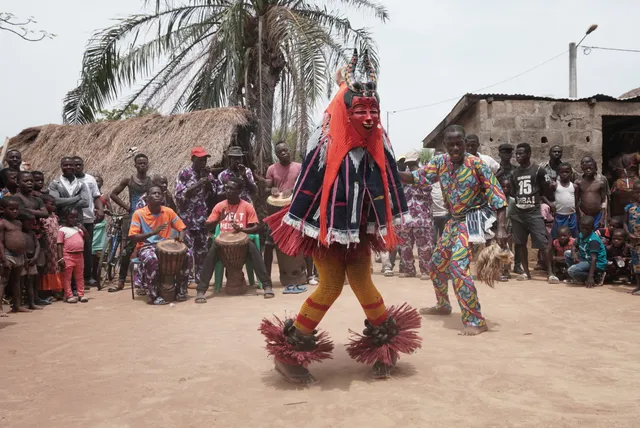
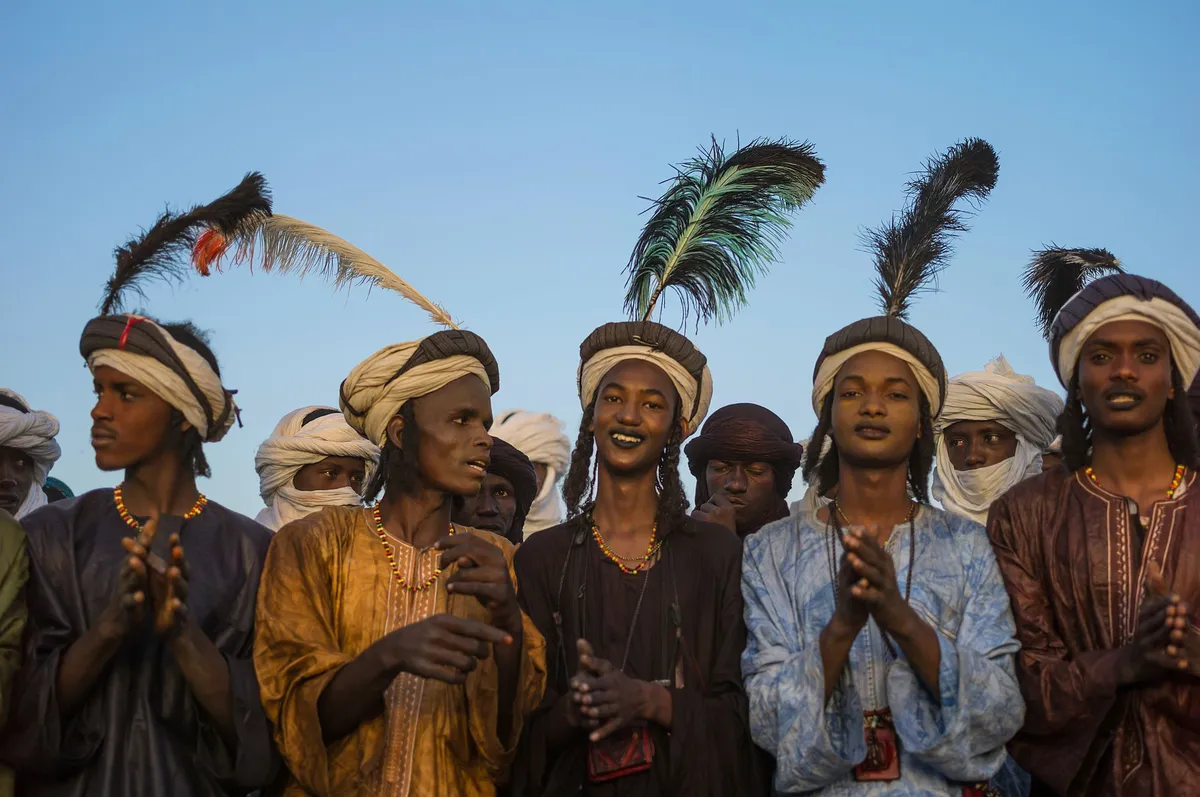
The Fulani are the cattle herders of the Sahel, and in Niger they are concentrated in Tahoua, Tillaberi and Maradi, moving with their herds between the rainy-season pastures of the north and the dry-season grazing of the south. They are the most widespread people in West Africa, and their language, Fulfulde, is spoken from Senegal to Cameroon. The Wodaabe, the Fulani subgroup in the photograph at the top of this article, hold their Gerewol courtship dances at the Cure Salee in In-Gall, where young men in face paint and feathered headdresses dance for the choice of the women watching. The Joshua Project splits the Fulani into four entries that sum to 2,352,000, close to the census figure, which is the best agreement between the two sources in this article. At 2,457,909 people they trail the Tuareg by 213,230 and lead the Kanuri by 1,109,373.
Kanuri
The Kanuri of Niger are the Manga Kanuri of Diffa, in the far east by Lake Chad, and they are the heirs of the Kanem-Bornu Empire, one of the longest-lived states in African history. They also live across the borders in Nigeria, where Borno is their heartland, and in Chad and Cameroon. The census counts them as Kanouri Manga, and the Joshua Project counts its four Kanuri entries at 1,186,000, about 12 percent below the census figure. The Factbook runs the other way, at 5.9 percent against the census 4.68 percent. At 1,348,536 people they trail the Fulani by 1,109,373 and lead the Toubou by 1,239,039, the widest gap between neighbours in the lower half of the table.
Toubou
The Toubou are the desert people of the north-east, the Teda and the Daza, camel herders of the Tibesti Mountains and the Kawar oases on the road to Libya. They are one of the smallest peoples in this ranking, and they are also one of the most disputed. The census gives them 0.38 percent. The International Work Group for Indigenous Affairs put them at 1.5 percent in 2011, which would be about 432,000 people in 2026 terms, four times the census figure. The Joshua Project counts its two Toubou entries, the Daza at 102,000 and the Teda at 30,000, at 132,000 together, between the two. The census figure is the official count and it is the one this table uses. At 109,497 people they trail the Kanuri by 1,239,039 and lead the Arabs by 2,882.
Arab
The Arabs of Niger are the pastoralists of the Diffa region in the east, the Mahamid Arabs and the Shuwa, or Baggara, Arabs of the Lake Chad basin, and they are the second most disputed figure in this table. The census gives them 0.37 percent, or 106,615 people in 2026 terms. The Joshua Project counts the Arabs and Moors of Niger at 346,800 together, more than three times the census figure, and its Diffa Arab entry alone, at 268,000, is two and a half times the census Arab total. The two sources are counting different things, or counting the same people under different names, and the article cannot reconcile them. The census figure is the official count and it is the one this table uses. At 106,615 people they trail the Toubou by 2,882 and lead the Gurma by 2,881.
Gurma
The Gurma, also spelled Gourma and known as the Gourmantche, are the farmers of the south-west, along the borders with Burkina Faso and Benin. They are a much larger people across the border, where Fada N'Gourma in Burkina Faso is their historic capital, but in Niger they are the smallest ranked people. The Joshua Project counts them at 89,000, about 14 percent below the census figure. At 103,734 people they trail the Arabs by 2,881, and below them there is no ninth group, only the census "Other" category.
Frequently Asked Questions
Why are there only eight tribes in this ranking, and not ten?
Because Niger's census names only eight peoples. The 2001 census ethnic table lists the Hausa, Zarma-Songhai, Tuareg, Fulani, Kanuri, Toubou, Arabs and Gurma, plus an "Other" category of 5,951 people. No other official count exists, and every Joshua Project candidate for ninth place is either a subgroup of a people already ranked or a community of foreign nationals. The series publishes the number the record supports, as it published a top nine for South Africa, Algeria and Cameroon, and it does not pad the table.
Why is the data from 2001?
Because 2001 is the last census that asked about ethnicity. The 2012 census, RGP/H-2012, appears to have collected no ethnicity data at all, and the ethnic distribution often attributed to 2012, Hausa 55 percent, Zarma-Songhai 21 percent, Tuareg 9 percent, is the 2001 census quoted under the wrong year. The 2001 shares are old, but they are the only official ethnic count Niger has, and the article applies them to the United Nations 2026 population rather than presenting 25-year-old counts as current.
Are the Hausa really more than half of Niger?
Yes, on every source. The 2001 census counts them at 55.36 percent of Nigerien nationals. The CIA World Factbook's 2006 estimate puts them at 53.1 percent. The Joshua Project counts 15,355,000 Hausa in Niger, plus a separate Maouri entry of 1,088,000, which together would be slightly above the census figure. The exact share is disputed by about two percentage points. The fact of a Hausa majority is not.
Why do the Tuareg figures disagree so much?
Because the Tuareg are nomadic, and nomadic peoples are the hardest to count. The census gives them 2,671,139 people, or 9.27 percent. The Factbook gives them 11 percent, which would be 3,169,637 in 2026 terms. The Joshua Project gives them 1,383,000, or 4.8 percent. The census is the official count, taken when enumerators visited settlements across the north, and it is the figure this table uses. The gap is a warning about the precision of the third place, not about the order: no other source puts any other people above the Tuareg.
What about the Dendi, the Mossi and the Bambara?
The Dendi are a Songhai people of the Niger Bend, and they sit inside the census Zarma-Songhai figure, so ranking them separately would count them twice. The Mossi and the Bambara are mostly nationals of Burkina Faso and Mali who live and work in Niger, and the census ethnic table covers Nigerien nationals only, so they were never in the count. The same ground excludes the Kanembu, who are counted inside the Kanuri figure, and the French and American residents, who are expatriates.
Data Sources
- United Nations World Population Prospects 2024, total population at 1 July 2026: 28,814,878. population.un.org
- UNdata, UN Demographic Yearbook, Population by national and/or ethnic group (INS Niger, RGP/H-2001 census). data.un.org
- CIA World Factbook, Niger, Ethnic groups (2006 est.): Hausa 53.1%, Zarma/Songhai 21.2%, Tuareg 11%, Fulani 6.5%, Kanuri 5.9%, Gurma 0.8%, Arab 0.4%, Tubu 0.4%, other/unavailable 0.9%. theodora.com
- Joshua Project, Niger country page, 36 people groups, accessed November 26, 2026. joshuaproject.net
- Joshua Project prayer cards, Zarma in Niger (5,229,000). joshuaproject.net
- Minority Rights Group, Niger country profile. minorityrights.org
- International Crisis Group, Africa Report 208, Niger: Another Rupture in the Sahel (2013), citing INS RGP/H-2001. crisisgroup.org
Methodology
This ranking follows the method of the Tribes by Country series. The figures come from a single basis: the 2001 census ethnic table published by the Institut National de la Statistique du Niger and republished by the United Nations Demographic Yearbook. Each group's 2001 share is applied to the United Nations World Population Prospects 2024 mid-2026 total of 28,814,878. The 2001 counts are Hausa 6,069,731, Djerma Sonrai 2,300,874, Touareg 1,016,883, Peuhl 935,517, Kanouri Manga 513,116, Toubou 42,172, Arab 40,085, Gourma 39,797 and Other 5,951. The shares derived from those counts reproduce the published rounded shares exactly. Every figure and derived claim in this article was recomputed from those counts before publication.
The census table covers Nigerien nationals only. Its total is 10,964,126, against a full enumerated 2001 census total of 11,060,291. The difference of 96,165 is the non-Nigerien population, which the ethnic table does not classify. The 2026 figures apply the nationals-only shares to the full 2026 population. That is the same treatment the series dataset uses for every country whose census table is nationals-only, and the article states it rather than hiding it. The 2012 census collected no ethnicity data, so no newer official table exists. The ethnic distribution often attributed to 2012 is the 2001 census quoted under the wrong year.
The second source is the CIA World Factbook's 2006 estimate, which is still the current Factbook entry for Niger. It agrees with the census on the order of all eight groups and on the Hausa majority. It disagrees by more than two percentage points on two groups: Hausa 53.1 percent against the census 55.36 percent, and Fulani 6.5 percent against 8.53 percent. The Factbook also puts the Tuareg higher, at 11 percent against 9.27 percent, and the Kanuri higher, at 5.9 percent against 4.68 percent. Its shares sum to 100.2 because of rounding in the source.
Joshua Project counts were read live on November 26, 2026 and used as a cross-check, not spliced into the table. Its family totals are: Hausa 15,355,000, with a separate Hausa Maouri entry of 1,088,000 whose relationship to the Hausa figure is not stated; Fulani 2,352,000 across four entries; Tuareg 1,383,000 across four entries; Kanuri 1,186,000 across four entries; Toubou 132,000 across the Daza and Teda entries; and Gurma 89,000. Its Arab total is 346,800 across six entries (Diffa Arab, Baggara, Libyan, Algerian, Moor and Lebanese). For the Zarma-Songhai the Joshua Project splits the census combined category, and its Zarma entry alone is 5,229,000. The split cannot be summed cleanly against the census combined figure, so no Joshua Project family total is stated for that group.
Exclusions are deliberate. The Dendi (156,000) are a Songhai-cluster people of the Niger Bend and sit inside the census Djerma Sonrai figure. The Mossi (about 262,000 in the Joshua Project's last published guide) and the Bambara (60,000) are nationals of Burkina Faso and Mali resident in Niger. The census table covers Nigerien nationals only, so they were never in the count. The Kanembu (38,000) are a Chad-based people counted inside the census Kanouri Manga figure or among non-nationals. The Daza (102,000), Igdalen (75,000), Hausa Maouri (1,088,000), Fulani subgroups and Kanuri subgroups are inside ranked families and are not added on top of them. The Deaf entry (17,000) is excluded because it is not a tribe, and the French (7,900) and other expatriate entries are excluded as non-indigenous. The census "Other" residual of 0.05 percent, 14,407 people in 2026 terms, is not ranked.
The combined top eight share of 99.94 percent is published because the table uses one basis throughout, the 2001 census shares. No top ten share is published, because there is no ninth or tenth group. Spelling follows the census French forms in the table, with the standard English forms first: Haoussa for Hausa, Djerma Sonrai for Zarma-Songhai, Touareg for Tuareg, Peuhl for Fulani, Kanouri Manga for Kanuri, Toubou for Tubu, and Gourma for Gurma. The photograph at the top of this article shows Wodaabe men at the Gerewol during the Cure Salee festival at In-Gall, Niger, in September 2014. The Wodaabe are a Fulani subgroup, ranked fourth here. Photograph by Alfred Weidinger, CC BY, via Wikimedia Commons.