Published: November 25, 2026
Côte d'Ivoire is the eighteenth country in this series, and it is the first where the census gives the answer at the wrong level of detail. Every Ivorian census, from 1975 to 2021, has counted only five broad cultural areas: Akan, Mandé du Nord, Voltaïque, Krou and Mandé du Sud. No census has ever counted the Baoulé, the Bété, the Sénoufo or any other single people. The ranking below therefore rests on the Joshua Project's counts of 105 peoples in the country, applied to the United Nations 2026 population of 33,494,346 and checked against the census umbrellas. It is the best count the record allows, and the article says plainly where the record is thin.
The Baoulé lead at 8,763,000 people, or 26.16 percent of the country, and the ten peoples in this table together reach 68.60 percent. But the Baoulé figure is the one number in this article to read with a caveat. Published sources put the Baoulé at 15 to 20 percent of the population, well below the Joshua Project's 26.16 percent, and the Joshua Project's count is larger than the entire Akan population the 2021 census recorded. The ranking itself is not in doubt. Every source agrees the Baoulé are the largest single people by a wide margin. Only the exact size of the lead is disputed. The Akan peoples cross the border into Ghana, where the same family tops our ranking of the tribes of Ghana.
Key Facts
- Côte d'Ivoire's population in 2026 is 33,494,346, according to the United Nations World Population Prospects 2024.
- The Baoulé are the largest people at 8,763,000, or 26.16 percent of the country, and 2.7 times the Sénoufo in second place.
- The Sénoufo alone outnumber the Bété, the Wè and the Attié combined, by 393,000 people.
- The ten peoples in this ranking together number 22,976,000 people, or 68.60 percent of Côte d'Ivoire.
- No Ivorian census has ever counted individual tribes, so this ranking uses Joshua Project counts checked against the 2021 census umbrellas. The Mossi and the Hausa are excluded as non-indigenous, although they would rank sixth and seventh.
The Ranking
| Rank | Group | Share | Population in 2026 | Basis |
|---|---|---|---|---|
| 1 | Baoulé | 26.16% | 8,763,000 | Joshua Project, 2026 |
| 2 | Sénoufo | 9.69% | 3,244,000 | Joshua Project, 2026 (8 dialect entries merged) |
| 3 | Agni | 7.44% | 2,493,000 | Joshua Project, 2026 (2 entries merged) |
| 4 | Dioula | 6.82% | 2,283,000 | Joshua Project, 2026 |
| 5 | Dan (Yacouba) | 6.02% | 2,018,000 | Joshua Project, 2026 (2 entries merged) |
| 6 | Bété | 3.04% | 1,017,000 | Joshua Project, 2026 (3 dialect entries merged) |
| 7 | Wè (Guéré / Wobé) | 2.91% | 976,000 | Joshua Project, 2026 (3 entries merged) |
| 8 | Attié | 2.56% | 858,000 | Joshua Project, 2026 |
| 9 | Gouro | 2.41% | 807,000 | Joshua Project, 2026 |
| 10 | Koulango | 1.54% | 517,000 | Joshua Project, 2026 (2 entries merged) |
Just Outside the Top 10
The Mahou (Mau) miss the ranking by 33,000 people, at 484,000 against the Koulango's 517,000, and the Dida are just 16,000 further back at 468,000. The Mahou are a Mandé people of the north-west around Touba, and the Dida are a Kru people of the south-west around Lakota. Either would enter the table if a single count moved by a fraction.
The most consequential exclusion sits above them both. The Joshua Project counts 640,000 Fulani (Maasina) in Côte d'Ivoire, which would take the tenth slot and push the Koulango out. They are not ranked because the Joshua Project flags them as non-indigenous: a cross-border Sahelian people, in Côte d'Ivoire largely of Malian and Guinean origin. The same ground excludes the Mossi at 1,833,000, who would rank sixth, and the Hausa at 1,392,000, who would rank seventh. If the series ever counted long-settled immigrant peoples as Ivorian, the table would change at three ranks, and the Koulango would become the near-miss.
Baoulé
The Baoulé are the Akan people of the centre, around Bouaké and Yamoussoukro, the political capital. Tradition traces them to the Ashanti migration led by Queen Abla Pokou in the 18th century, and they are the largest Akan people in the country. They are cocoa and coffee farmers, and they are famous for carved masks, for Baoulé cloth, and for the yam festival that marks the harvest. At 8,763,000 people they lead the Sénoufo by 5,519,000, and they alone outnumber the next three peoples combined, by 743,000. That lead is the widest in this series, and it is also the least certain number in the table, for the reasons set out in the Methodology.
Sénoufo
The Sénoufo are the farmers of the northern savanna around Korhogo, and they also live across the borders in Mali and Burkina Faso. They are organised in the Poro society, and they are known for woodcarving and for Korhogo cloth, the painted cotton of the north. The Joshua Project splits them into eight dialect entries, from the southern Sénoufo at 2,168,000 down to the Palaka at 18,000, and this article counts them as one people, as the ethnography does. At 3,244,000 people they trail the Baoulé by 5,519,000 and lead the Agni by 751,000.
Agni
The Agni are the Akan people of the south-east, in the old kingdoms of Sanwi and Indénié around Abengourou, and they are part of the Akan world that stretches into Ghana. They farm cocoa and coffee in the forest zone, and their kings still hold court in Abengourou. The Joshua Project counts them as the Anyi at 1,924,000 and the Anyin Morofo at 569,000, and this article counts them as one people. At 2,493,000 people they trail the Sénoufo by 751,000 and lead the Dioula by 210,000.
Dioula
The Dioula are the Muslim trading people of the north, centred on Kong, the historic trading town whose mosques in Sudano-Sahelian style still stand. Their language, Dyula, is the trade language of much of West Africa, and the Joshua Project counts them under that name, as Jula. The count is the most solid of the large figures in this table: the 2021 census language table gives Dioula as the most spoken language of 2,064,287 people, close to the Joshua Project's 2,283,000. At 2,283,000 people they trail the Agni by 210,000 and lead the Dan by 265,000.
Dan (Yacouba)
The Dan, also called the Yacouba, are the people of the forested west around Man, under Mount Tonkoui, and they also live across the border in Liberia. They are rice farmers, and they are famous for Dan masks, among the most collected African masks in the world. The Joshua Project counts them as the Dan Yakuba at 1,978,000 and the Kla-Dan at 40,000, and this article counts them as one people. At 2,018,000 people they trail the Dioula by 265,000 and lead the Bété by 1,001,000.
Bété
The Bété are the people of the centre-west around Daloa and Gagnoa, cocoa farmers of the forest zone. Their masks are carved in the same forest tradition as their Dan neighbours, and Laurent Gbagbo, president from 2000 to 2011, is Bété. The Joshua Project splits them into three dialect entries, Daloa, Gagnoa and Western, at 307,000, 403,000 and 307,000, and this article counts them as one people. Counted separately, none of the three would reach the Top 10. At 1,017,000 people they trail the Dan by 1,001,000 and lead the Wè by 41,000, the tightest gap in the top ten after the Koulango race.
Wè (Guéré / Wobé)
The Wè are the people of the far west around Guiglo and Duékoué, in the forest near the Liberian border. The Guéré of the south and the Wobé of the north are two dialect groups of one people, and their masks are among the best known in West Africa. The Joshua Project counts them as Guéré at 564,000, Wobé at 354,000 and Western Guéré at 58,000, and this article counts them as one people. At 976,000 people they trail the Bété by 41,000 and lead the Attié by 118,000.
Attié
The Attié are the Akan people of the south-east near Abidjan, around Adzopé and Alépé, in the lagoon country. They farm cocoa, coffee and palm in the forest belt that runs back from the lagoons, and they are part of the Akan family that also gives this table its first and third places. At 858,000 people they trail the Wè by 118,000 and lead the Gouro by 51,000.
Gouro
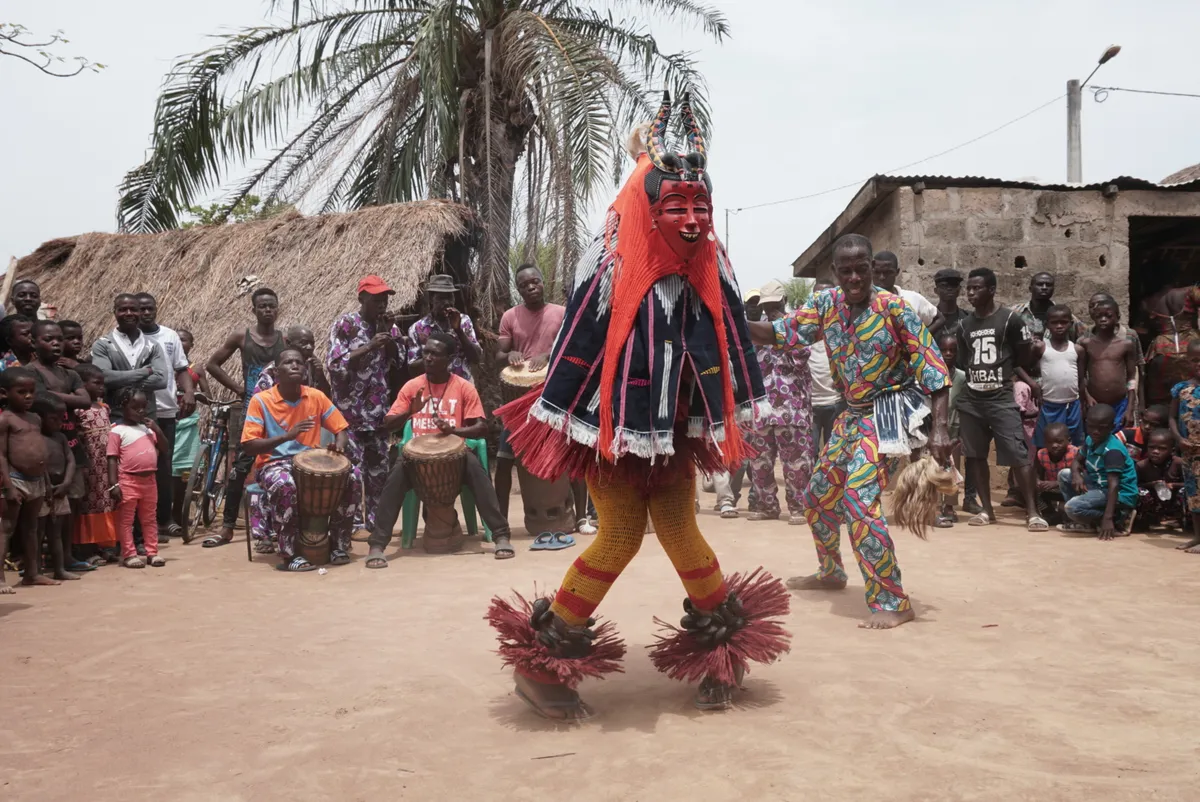
The Gouro are the people of the centre-west around Bouaflé, Sinfra and Zuénoula. Their Zaouli mask dance was inscribed by UNESCO in 2017. In it, a dancer in a carved mask spins to fast drum rhythms, and the photo at the top of this article shows a Zaouli dancer at Manfla. The Gouro are Mandé du Sud people, and their masks are carved in the same tradition as their Dan neighbours. At 807,000 people they trail the Attié by 51,000 and lead the Koulango by 290,000.
Koulango
The Koulango are the people of the north-east around Bouna and Bondoukou, near the Ghana border, in the historic kingdom of Bouna. They are Gur people, and their country is gold country, around the old trading towns of the north-east. The Joshua Project counts them as the Kulango of Bouna at 335,000 and of Bondoukou at 182,000, and this article counts them as one people. Counted separately, neither entry would reach the Top 10. At 517,000 people they trail the Gouro by 290,000 and lead the Mahou by 33,000.
Frequently Asked Questions
Why does this ranking use Joshua Project counts instead of the census?
Because the census cannot answer the question. Every Ivorian census has counted only five broad cultural areas, Akan, Mandé du Nord, Voltaïque, Krou and Mandé du Sud, and has never published a count for any single people. The Joshua Project is the only complete breakdown of individual peoples in the country, with 105 groups, and this article uses its counts and checks them against the census umbrellas. The check is reported in the Methodology.
Is the Baoulé figure of 8.76 million reliable?
It is the high end of the range. The Joshua Project puts the Baoulé at 26.16 percent of the population, while published sources put them at 15 to 20 percent. Its count is larger than the entire Akan population the 2021 census recorded, 8,719,247. The 2021 census language table gives Baoulé as the most spoken language of 3,636,828 people. That is not the same measure as ethnicity, but the gap is a strong signal that the Joshua Project figure is high. The ranking is certain. Every source agrees the Baoulé are the largest single people by a wide margin. The exact size of the lead is disputed, and the article does not build its headline comparison on the Baoulé figure alone.
Why are the Mossi and the Hausa not in the Top 10?
Because they are not indigenous peoples of Côte d'Ivoire. The Joshua Project counts 1,833,000 Mossi and 1,392,000 Hausa in the country, which would rank sixth and seventh, and 640,000 Fulani, which would take the tenth slot. All three are immigrant populations, the Mossi from Burkina Faso and the Hausa from Nigeria and Niger, and the Joshua Project flags each of them as non-indigenous. They are not ranked here, on the same ground that excluded the Moroccan Arabs from the Algeria ranking and the Lebanese from the Morocco ranking. The Mossi very likely sit inside the census Voltaïque umbrella, which is why the Gur reconciliation in the Methodology needs them.
Where are the Malinké?
They are the gap in this table. The Joshua Project lists no Malinké or Maninka entry for Côte d'Ivoire at all. Its northern Mandé peoples sum to 3,371,000, against a 2021 census count of 5,036,063 for Mandé du Nord. That is a shortfall of about 1.7 million before any growth to 2026. The missing people are most plausibly the Malinké, whom the census's own category description includes. The Dioula rank, counted by the Joshua Project as Jula, is the language-label count for that world, and the Odienné Jula at 171,000 are counted separately and not added to it. The northern figures in this table are the least precise, and the article says so.
Why are the Akan not ranked as one group?
Because Akan is a cultural area, not a tribe. The 2021 census gives the Akan 38.0 percent of Ivorian nationals. The Joshua Project lists an Akan entry of its own at 482,000, but ranking it would double count people already inside the Baoulé, Agni and Attié figures. This article ranks the Akan peoples separately, as it ranks the Sénoufo subgroups together and the Bété dialect groups together, and it says which merges it made in the table and the Methodology.
Data Sources
- United Nations World Population Prospects 2024, total population at 1 July 2026: 33,494,346. population.un.org
- Joshua Project, Côte d'Ivoire country page, 105 people groups, accessed November 25, 2026. joshuaproject.net
- ANStat (Agence Nationale de la Statistique), RGPH 2021 indicator series, counts by broad ethnic group for 1975 to 2021. rp2021.stats.ci
- CIA World Factbook, Côte d'Ivoire, Ethnic groups (2021 est.): Akan 38%, Voltaic or Gur 22%, Northern Mande 22%, Kru 9.1%, Southern Mande 8.6%, other 0.3%. theodora.com
- Wikipedia, Senufo people (total about 3 million, 2013; southern Senufo over 2 million). en.wikipedia.org
- Minority Rights Group, Côte d'Ivoire (Baoulé 15 to 20 percent of the population). minorityrights.org
- UNESCO, Zaouli, popular music and dance of the Guro communities of Côte d'Ivoire, inscribed 2017. ich.unesco.org
Methodology
This ranking follows the method of the Tribes by Country series. The figures come from a single basis, the Joshua Project's in-country counts for Côte d'Ivoire, read live on November 25, 2026, applied to the United Nations World Population Prospects 2024 mid-2026 total of 33,494,346. The Joshua Project lists 105 groups totalling 32,930,000 people, with 564,000 unclassified. Shares are each group's count divided by 33,494,346, and every figure and derived claim in this article was recomputed from those counts before publication.
No Ivorian census has ever published a count for an individual tribe. The five censuses from 1975 to 2021 tabulate only five broad cultural areas, Akan, Mandé du Nord, Voltaïque (Gur), Krou and Mandé du Sud, for Ivorian nationals only. In 2021 the Ivorian total was 22,924,530 against 29,389,150 residents, so the census shares cover 78.0 percent of the people in the country. The 2021 shares are Akan 38.0 percent, Mandé du Nord 22.0 percent, Voltaïque 22.0 percent, Krou 9.1 percent and Mandé du Sud 8.6 percent, corroborated exactly by the CIA World Factbook's 2021 estimates.
Six merges are made, and each is flagged in the table. The Sénoufo are the sum of eight Joshua Project dialect entries (Southern 2,168,000, Tagwana 326,000, Dyimini 224,000, Shempire 217,000, Supyire 129,000, Niarafolo 98,000, Tyelibele 64,000 and Palaka 18,000). The Agni are the Anyi (1,924,000) plus the Anyin Morofo (569,000). The Dan are the Dan Yakuba (1,978,000) plus the Kla-Dan (40,000). The Bété are the Daloa (307,000), Gagnoa (403,000) and Western (307,000) entries. The Wè are the Guéré (564,000), Wobé (354,000) and Western Guéré (58,000) entries. The Koulango are the Bouna (335,000) and Bondoukou (182,000) entries. In each case the Joshua Project splits one recognised people by dialect, and the series ranks peoples, not language splits, on the same precedent as the DR Congo, Egypt and Tanzania rankings. The unmerged alternative would put the Sénoufo Southern alone in third place and leave the Bété and the Koulango out of the Top 10 entirely.
Exclusions are deliberate. Twenty-one Joshua Project entries are not ranked. The Mossi (1,833,000), Hausa (1,392,000), Fulani Maasina (640,000), Soninke (258,000), Busanga (177,000), Lebanese (77,000), French (52,000) and twelve smaller entries are excluded as non-indigenous, on the Joshua Project's own flag, and the Deaf entry (133,000) is excluded because it is not a tribe. The Akan entry (482,000) is excluded as a double-counting trap, since it overlaps the Baoulé, Agni and Attié counts. The Odienné Jula (171,000) are not added to the Dioula, because the Joshua Project treats them as a distinct people and Dioula is partly a trade and language identity. No Joshua Project subgroup is added on top of any ranked family total.
The reconciliation against the census umbrellas is mixed, and the article reports it rather than hiding it. The Krou umbrella agrees well: the Joshua Project's Krou peoples sum to 2,876,300 against a census-implied 3,047,985, a gap of 5.6 percent. Mandé du Sud runs high at 3,219,700 against 2,880,514, up 11.8 percent. The Akan umbrella runs high at 13,809,700 against 12,727,851, up 8.5 percent, and the overshoot is essentially the Baoulé dispute. The Gur umbrella runs low at 4,066,300 against 7,368,756, down 44.8 percent, but adding the Mossi and Busanga, both Gur-language peoples who very likely sit inside the census Gur umbrella, closes the gap to 17.5 percent. The Mandé du Nord umbrella runs low at 3,371,000 against 7,368,756, down 54.3 percent, and it cannot be explained away: the Joshua Project's northern Mandé total is 1,665,063 below the 2021 census count itself, because the Joshua Project lists no Malinké entry for Côte d'Ivoire. The Dioula rank is therefore the least precise figure in the table, though its place in the top five is secure, since it leads the Dan by 265,000 and trails the Agni by 210,000.
The combined top ten share of 68.60 percent is published because the table uses one basis throughout, the Joshua Project counts. Spelling follows the standard French forms, with the Joshua Project's forms in parentheses where they differ: Baule for Baoulé, Anyi for Agni, Jula for Dioula, Guere and Wobe for the Wè, Kulango for Koulango, and Mau for Mahou.