Published: November 26, 2026
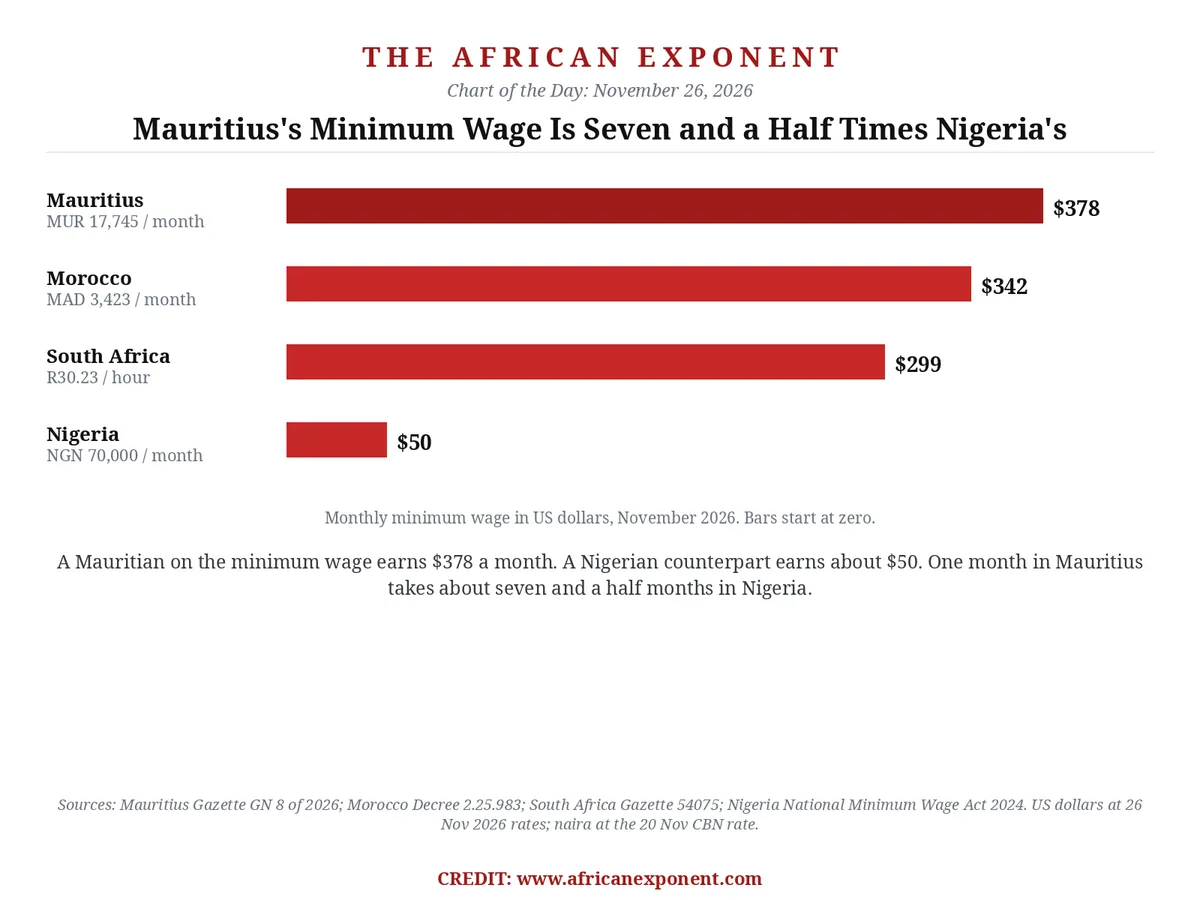
Mauritius's national minimum wage is MUR 17,745 a month, about $378 at 26 November 2026 exchange rates. Nigeria's is ₦70,000 a month, about $50. The Mauritian floor is seven and a half times the Nigerian one. A worker on the minimum wage in Mauritius earns in one month what takes a Nigerian counterpart about seven and a half months to earn. Over a full year the gap is about $3,937: $4,542 against $604.
The chart puts the two floors beside the next two highest in Africa. Morocco pays MAD 3,423 a month, about $342. South Africa pays R30.23 an hour, about $299 a month. The top three sit within $79 of each other. Nigeria is the cliff: its floor is 13.3 percent of Mauritius's, and $249 below South Africa's. All three leaders raised their floors in 2026: Mauritius 3.7 percent in January, Morocco 4.8 percent in January, South Africa 5 percent in March. Nigeria's floor has not moved since it was set in July 2024, and the review is not due until June 2027.
We ranked every African country's minimum wage here: Minimum Wage by African Country in 2026: Every Country Ranked
Why it matters
Nigeria is Africa's most populous country and one of its largest economies, yet its legal wage floor is the lowest of the four by a distance, and the naira keeps shrinking it in dollar terms. The currency slipped from ₦1,346 to the dollar on 30 October to ₦1,390 on 20 November, so the same ₦70,000 bought about $52 three weeks ago and about $50 today. At current petrol prices, 50 litres costs more than a whole month at the minimum wage. A basic diet plus cooking gas eats about 93 percent of it, before rent, transport or school fees. And the law does not even reach everyone: firms with fewer than 25 workers are exempt.
The question is whether a minimum wage that buys less every month is a floor at all, or a number the law prints while the economy ignores it. The gap also reframes the migration debate: the legal floor in one African country is seven and a half times the floor in another, inside the same continental free trade area.
The number in context
Two honest caveats. First, these are dollar conversions, not cost-of-living comparisons. Mauritius is a far more expensive place to live than Nigeria, so the gap in what the money buys is narrower than 7.5 times. But it is still a gap of several times, not a rounding difference, and no cost-of-living adjustment turns $50 into $378. Second, Mauritius is not Africa's highest floor outright. Tiny Seychelles pays more, about $433 to $495 a month on its hourly rate of SCR 40.95. Mauritius has the highest floor among African countries with more than a million people. Worse, several large economies have no functioning floor at all. Ethiopia has no statutory private-sector minimum wage, Uganda's has not changed since 1984, and Rwanda's since 1974. A low floor is, for tens of millions of workers, still better than none.
Data sources
Government Gazette of Mauritius, National Minimum Wage (Amendment) Regulations 2026, GN No. 8 of 2026: supremecourt.govmu.org. WageIndicator, Mauritius national minimum wage increased from 1 January 2026, 11 February 2026: wageindicator.org. Betternship, Minimum Wage by Country in Africa (2026): betternship.com. Nairametrics research via PM News, Mauritius tops Africa's minimum wage ranking, 30 July 2026: pmnewsnigeria.com. Upsilon Consulting, SMIG and SMAG Morocco 2026: upsilon-consulting.com. South Africa Department of Employment and Labour, National Minimum Wage to R30.23 per hour, 3 February 2026: labour.gov.za. Newspot Nigeria cost-of-living trackers, 2, 9 and 23 November 2026: newspotng.com. Exchange rates: Finnhub, 26 November 2026.
Methodology
US dollar figures are conversions at stated rates, not cost-of-living comparisons. Rates at 26 November 2026 (Finnhub, 10:01 UTC): 1 dollar = 46.885 Mauritian rupees, 10.0193 Moroccan dirhams, 17.5484 South African rand and 14.3298 Seychelles rupees. The naira uses the Central Bank of Nigeria's NFEM volume-weighted average of 20 November 2026, ₦1,389.73 per dollar; at the 30 October rate of ₦1,346.26 the Nigerian figure would be $52, so the $50 is dated and will move again. South Africa's monthly figure is R30.23 times a 173.33-hour month (a 40-hour week), the basis used by the July 2026 Nairametrics ranking; on a 45-hour week the department's own flyer gives R5,894.40 a month, about $336. Morocco's figure is the non-agricultural SMIG, 17.92 dirhams an hour times 191 hours; the agricultural SMAG is lower, 97.44 dirhams a day from 1 April 2026. Mauritius's MUR 17,745 includes the MUR 635 additional remuneration and must not be topped up. Seychelles' rate is set hourly at SCR 40.95, so its monthly equivalent depends on the hours basis: SCR 7,098 on a 40-hour week (about $495) or SCR 6,211 on the 35-hour basis (about $433). One correction to the bank entry for this chart is disclosed here. The entry's dollar figures ($374, $366, $311 and $51) were July to September 2026 conversions; this post re-prices all four at 26 November 2026 rates ($378, $342, $299 and about $50), and the ratio moves from about 7.3 times to 7.5 times. The entry also flagged a Seychelles check before calling Mauritius Africa's highest. That check is done: Seychelles pays more, so this post does not make that claim. Nigeria's floor is ₦70,000 a month under the National Minimum Wage (Amendment) Act 2024, unchanged since July 2024, with a review due by 1 June 2027. Firms with fewer than 25 workers are exempt.