Published: November 27, 2026
Burkina Faso is the twentieth country in this series, and it is the first where the source itself needs a warning label. No census in Burkina Faso has ever recorded ethnicity. The census asks about the main language spoken, never about the people a person belongs to, so there is no official ethnic count to build on. This ranking rests instead on the CIA World Factbook's 2021 estimates. Those estimates were cross-checked line by line against the 2019 census language table and against Joshua Project counts read live this week. The picture that emerges is clear at the top and contested in the middle. The Mossi alone number 13,211,113 people, more than half the country. The next nine peoples together do not match them.
The ten peoples in this table together number 21,530,030, or 87.51 percent of Burkina Faso. One number needs explaining before the table. The Factbook's 2021 list names the Bissa twice, at 5.4 percent and again at 1.5 percent. This article ranks Bissa once, at 5.4 percent. It does not rank the second line, because the Factbook gives no way to tell what group it really is. The Methodology sets out the ruling in full, and the Bissa section below gives the evidence. Two ranks in this table, the Samo and the Dagara, come from Joshua Project counts rather than the Factbook. The Factbook names only nine peoples, and the series completes the table from the best available count rather than padding it.
Key Facts
- Burkina Faso's population in 2026 is 24,601,700, according to the United Nations World Population Prospects 2024. See the full ranking of every African country's population in 2026.
- The Mossi are the largest people at 13,211,113, or 53.7 percent of the country, and 7.9 times the Fulani in second place.
- The Mossi alone outnumber the other nine peoples combined by 4,892,196 people.
- The ten peoples in this ranking together number 21,530,030 people, or 87.51 percent of Burkina Faso.
- No census has ever recorded ethnicity in Burkina Faso, so this ranking rests on the CIA World Factbook's 2021 estimates, with the Samo and the Dagara completed from Joshua Project counts. The Factbook lists Bissa twice; this article ranks Bissa once, at 5.4 percent.
The Ranking
| Rank | Group | Share | Population in 2026 | Basis |
|---|---|---|---|---|
| 1 | Mossi | 53.7% | 13,211,113 | Factbook 2021 share x UN 2026 |
| 2 | Fulani (Peuhl) | 6.8% | 1,672,916 | Factbook 2021 share x UN 2026 |
| 3 | Gurunsi | 5.9% | 1,451,500 | Factbook 2021 share x UN 2026 |
| 4 | Bissa | 5.4% | 1,328,492 | Factbook 2021 share x UN 2026 |
| 5 | Gurma | 5.2% | 1,279,288 | Factbook 2021 share x UN 2026 |
| 6 | Bobo | 3.4% | 836,458 | Factbook 2021 share x UN 2026 |
| 7 | Senufo | 2.2% | 541,237 | Factbook 2021 share x UN 2026 |
| 8 | Samo | 1.76% | 432,000 | Joshua Project count |
| 9 | Dagara | 1.66% | 408,000 | Joshua Project count |
| 10 | Lobi | 1.5% | 369,026 | Factbook 2021 share x UN 2026 |
What Sits Just Outside the Top 10
The cut below the Lobi is not especially tight. The Birifor, at 270,000 in the Joshua Project count, trail the Lobi by 99,026, and the Marka, at 223,000, trail them by 146,026. Neither appears in the Factbook's 2021 list, which is why both come from the Joshua Project. The tightest race in the table is higher up: the Samo lead the Dagara by only 24,000, and the Dagara lead the Lobi by 38,974.
The group that should worry a careful reader is the one that is not in the table at all. The Joshua Project counts the Bwaba, split by language into the Buamu at 443,000, the Bwamu Laa Laa at 141,000 and the Bwamu Twi at 50,000, a combined 634,000 people. Counted together they would rank seventh, ahead of the Senufo. They are not ranked. The Factbook's Bobo figure of 3.4 percent matches the combined Bobo and Bwamu language bloc of 3.5 percent in the 2019 census almost exactly. That suggests the Factbook's Bobo already contains the Bwaba. Ranking them separately would risk counting 634,000 people twice. The unmerged alternative is stated here so the reader can see it: the Buamu alone, at 443,000, would rank eighth. The same caution keeps the Dyula out. The Joshua Project counts 2,510,000 Dyula, which would rank second, but Dyula is the trade language of the west, not an ethnic count. The 2019 census counts Dyula as a main language at 5.7 percent. Ethnic Dioula was 0.8 percent in the Factbook's 2010 list, or 196,814 people in 2026 terms. The Tuareg and Bella, at 24,602, sit far below the cut. They were 1.9 percent in the Factbook's 2010 list, or 467,432 people in 2026 terms. Their collapse to 0.1 percent in 2021 is one of the largest revisions in the Factbook's Burkina Faso entry.
Mossi
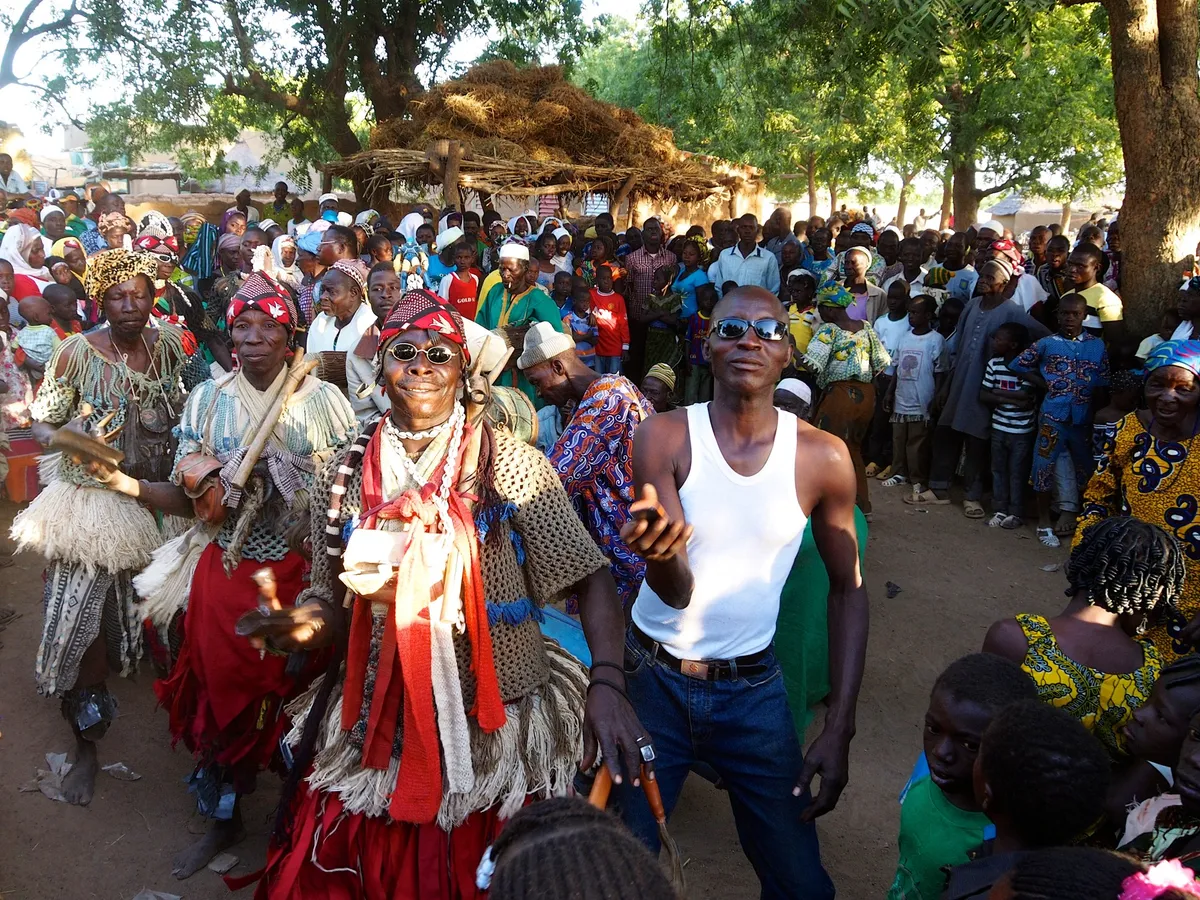
The Mossi are the people of the central plateau, around Ouagadougou and the old kingdom of Yatenga, and they have dominated Burkina Faso since their kingdoms were founded centuries ago. The Mogho Naba still holds court in Ouagadougou. His Friday ceremony is one of the country's living traditions: the chiefs gather, and the king appears first in red as if for war, then in white as if for peace. The dancers in the photograph at the top of this article are Mossi, performing at the Nakoobo ceremony of chief Naaba Zomb Wobgo at Andemtenga. At 13,211,113 people the Mossi lead the Fulani by 11,538,197 and outnumber the other nine peoples in this table combined by 4,892,196. The top two peoples together number 14,884,029, or 60.50 percent of the country, and the top three reach 16,335,529, or 66.40 percent. The Joshua Project counts fewer Mossi, at 11,746,000, which would be 47.7 percent of the country rather than a majority. The census language figure sits with the Factbook. Mooré was the main language of 52.9 percent of the population in 2019, and 50.5 percent in 2006. Across the border in Niger, the Mossi are counted as foreign nationals rather than as a Nigerien people, as our ranking of the tribes of Niger explains.
Fulani (Peuhl)
The Fulani are the cattle herders of the Sahel north. They move with their herds between the dry-season grazing of the south and the rainy-season pastures near the Malian and Nigerien borders. They are the most widespread people in West Africa, and their language, Fulfulde, is spoken from Senegal to Cameroon. The Joshua Project splits them into three entries that sum to 1,946,000, about 16 percent above the Factbook figure. The 2019 census counts Fulfulde as the main language of 7.8 percent of the population, against the Factbook's ethnic share of 6.8 percent. The Factbook itself has cut them since 2010, when it put them at 8.4 percent. At 1,672,916 people they trail the Mossi by 11,538,197 and lead the Gurunsi by 221,416.
Gurunsi
The Gurunsi are the peoples of the south-central plateau, in the Centre-Sud and Centre-Ouest regions, and the name is an umbrella rather than a single people. It covers the Lyélé, the Nuni and the Kasséna, each with its own language. The census counts them that way. Lyélé, Nuni and Kasséna appear as separate language lines, and the residual Gourounsi line holds only 0.3 percent. The Kasséna are the painters of Tiébélé, whose royal court is covered in hand-painted geometric murals. The gap between the Factbook's ethnic figure of 5.9 percent and the census language figure of 3.2 percent is the widest in this article. The census split explains it: many Gurunsi speak Mooré as their main language. At 1,451,500 people they trail the Fulani by 221,416 and lead the Bissa by 123,008.
Bissa
The Bissa are the people of the east-central regions, around Tenkodogo in Boulgou province, farmers of the country between the Mossi plateau and the Ghanaian border. They are the one group in this ranking whose number carries a formal warning. The Factbook's 2021 list prints Bissa twice, at 5.4 percent and again at 1.5 percent. This article ranks Bissa once, at 5.4 percent, or 1,328,492 people. The second line cannot be identified as a distinct group from the Factbook alone. It could be a duplicated entry, a mislabelled group, or a Bissa subgroup split out in the Factbook's source. At 1.5 percent it would tie the Lobi exactly, at 369,026 people each, a tie no source resolves. Every other source puts Bissa lower than either reading. The Factbook's 2010 list gave 3.7 percent. The 2019 census counts Bissa as a main language at 3.3 percent. The Joshua Project's only Bisa-language entry, the Busanga, counts 737,000. The Busanga are a Bissa subgroup and sit inside the ranked Bissa total, so they are not added on top of it. The dataset behind this series merged the two Factbook lines into 6.9 percent, or 1,697,518 people, which would make Bissa second in the table. That merge is not used here, and the dataset is flagged for correction. At 1,328,492 people the Bissa trail the Gurunsi by 123,008 and lead the Gurma by 49,204, the tightest gap in the top five.
Gurma
The Gurma, also spelled Gourmantché and Gourma, are the farmers of the east, in the Est region, where Fada N'Gourma is their historic capital. They are a much larger people across the border in Benin and Togo, and in Burkina Faso they are the eastern anchor of the ranking. Their figure is the best agreed in this article. The Joshua Project counts 1,276,000 Gourma, only 3,288 people below the Factbook figure, a difference of 0.3 percent. The 2019 census counts Gourmantché as a main language at 6.8 percent, against the Factbook's ethnic share of 5.2 percent. The Factbook has cut them since 2010, when it put them at 7.0 percent. At 1,279,288 people they trail the Bissa by 49,204 and lead the Bobo by 442,830.
Bobo
The Bobo are the people of the west, in the Hauts-Bassins region. Bobo-Dioulasso, the country's second city, takes the first half of its name from them and the second from the Dioula traders who settled there. Their figure is the most disputed in the upper half of this table. The Factbook gives them 3.4 percent, down from 4.9 percent in 2010. The Joshua Project splits them into the Bobo Madare at 299,000 and the Bobo Fing at 83,000, a combined 382,000, less than half the Factbook figure. The 2019 census counts Bobo as a main language at only 1.5 percent. Part of the gap may be the Bwaba question set out above. If the Factbook's Bobo contains the Bwaba, as the language figures suggest, the two sources are counting different things. At 836,458 people they trail the Gurma by 442,830 and lead the Senufo by 295,221.
Senufo
The Senufo are the people of the south-west, in the Cascades region around Banfora, on the border with Côte d'Ivoire and Mali. Their languages and their carving traditions cross the border with them. Their figure has moved more than any other in the Factbook's Burkina Faso entry: 4.5 percent in 2010, 2.2 percent in 2021, a halving. The census language figures sit lower still, at 1.4 percent in 2006 and 1.5 percent in 2019. The 2021 figure is used because it is the latest estimate, but the halving is stated here rather than smoothed over. The Joshua Project has no single Senufo entry; it splits the Senufo languages, with the Karaboro Eastern at 83,000 among them. At 541,237 people they trail the Bobo by 295,221 and lead the Samo by 109,237.
Samo
The Samo, also called the San, are the people of the north-west, in the Boucle du Mouhoun region, farmers of the country around Tougan and the Sourou valley. They are the first of the two Joshua Project ranks in this table, and they enter it as a merged figure. The Joshua Project counts the Samo Matya at 248,000 and the Samo Southern at 184,000, two entries for one people split by language. Together they number 432,000, and the merge is corroborated by the census, which counts San as a single main language at 1.7 percent in 2019, against the merged Joshua Project share of 1.76 percent. At 432,000 people they trail the Senufo by 109,237 and lead the Dagara by 24,000, the tightest gap in the table.
Dagara
The Dagara are the people of the far south-west, in the Sud-Ouest region around Dano and Diébougou, on the Ghanaian border. The same people live on both sides of it. They are the second Joshua Project rank in this table, and they are here because the Factbook's 2021 list leaves them out entirely. The Factbook's 2010 list gave them 2.4 percent, or 590,441 people in 2026 terms. The 2019 census counts Dagara as a main language at 2.0 percent. The Joshua Project counts them at 408,000, below both, and that is the figure this table uses. Their absence from the 2021 Factbook list is itself a finding. A people the Factbook counted at 2.4 percent a decade ago has vanished from its latest list without explanation. At 408,000 people they trail the Samo by 24,000 and lead the Lobi by 38,974.
Lobi
The Lobi are the people of the south-west, around Gaoua in the Sud-Ouest region, on the borders with Côte d'Ivoire and Ghana. Their kin live in the same hills on all three sides of the border. They are known for their fortified earthen houses, built as small compounds that could be defended. They have also kept their distance from the Mossi kingdoms to the north. The Lobi also appear in our ranking of the tribes of Côte d'Ivoire, where the same borderland history puts them further down the table. Their figure is one of the best agreed in this article. The Joshua Project counts 364,000 Lobi, only 5,026 below the Factbook figure, a difference of 1.4 percent. The 2019 census counts Lobi as a main language at 1.2 percent, against the Factbook's ethnic share of 1.5 percent. At 369,026 people they trail the Dagara by 38,974, and below them the next people, the Birifor, trail by 99,026.
Frequently Asked Questions
Why does this ranking use estimates instead of a census?
Because no census in Burkina Faso has ever asked about ethnicity. The 2006 and 2019 censuses asked about the main language spoken, religion and nationality. The Oxford Handbook of the Burkina Faso Economy states plainly that government censuses have eschewed questions about ethnic identification. The ethnic figures in circulation are therefore estimates, and this article uses the latest set, the CIA World Factbook's 2021 estimates. Those estimates were cross-checked against the census language tables and Joshua Project counts. The language shares are close enough to corroborate the order of the largest groups, and the article states every disagreement larger than two percentage points.
Why is Bissa listed once when the Factbook lists it twice?
Because the second line cannot be identified. The Factbook's 2021 list prints Bissa at 5.4 percent and again at 1.5 percent, and every mirror reproduces the duplication. That makes it a Factbook error rather than a transcription error. The 1.5 percent line was presumably another group, but the Factbook does not say which one. The Dagara are one candidate. They appear in the 2010 list at 2.4 percent and vanish from the 2021 list. But that is a guess, not evidence. This article ranks Bissa at 5.4 percent, or 1,328,492 people, and leaves the second line unranked. At 1.5 percent it would tie the Lobi exactly, at 369,026 people each. The dataset behind this series merged the two lines into 6.9 percent, which would make Bissa second in the table. That merge is not used here.
Why do the Samo and the Dagara come from Joshua Project while the rest come from the Factbook?
Because the Factbook's 2021 list names only nine peoples, and the series completes the table from the best available count rather than padding it. The Samo and the Dagara are the two largest peoples the Factbook does not itemise, and both are verifiable. The Samo enter as a merged Joshua Project figure of 432,000, corroborated by the census San language share of 1.7 percent. The Dagara enter as a single Joshua Project entry of 408,000, corroborated by the 2010 Factbook share of 2.4 percent and the 2019 census language share of 2.0 percent. Both are flagged as Joshua Project counts in the table and in the Methodology. The same rule supplied the ninth and tenth ranks in the Nigeria and Ghana articles in this series.
Why are the Bwaba and the Dyula not in the top 10?
For different reasons. The Bwaba are probably already counted. The Factbook's Bobo figure of 3.4 percent matches the combined Bobo and Bwamu language bloc of 3.5 percent in the 2019 census, which suggests the Factbook's Bobo already contains the Bwaba. Ranking them separately would risk counting 634,000 people twice, so they are left out and the alternative is stated in the article. The Dyula are a different case. The Joshua Project counts 2,510,000 Dyula, which would rank second, but Dyula is the trade language of the west, spoken as a main language by 5.7 percent of the population. Ethnic Dioula was 0.8 percent in the Factbook's 2010 list. A language community is not a tribe, so the Dyula are not ranked.
Are the Mossi really more than half of Burkina Faso?
On the two strongest sources, yes. The Factbook puts them at 53.7 percent, and the 2019 census counts Mooré as the main language of 52.9 percent of the population. The Joshua Project counts fewer Mossi, at 11,746,000, which would be 47.7 percent of the country rather than a majority. The exact share is disputed by about six percentage points. The order is not in doubt. No other source puts any other people above a quarter of the country. The Mossi lead the second people by 11,538,197.
Data Sources
- United Nations World Population Prospects 2024, total population at 1 July 2026: 24,601,700. population.un.org
- CIA World Factbook, Burkina Faso, Ethnic groups (2021 est.): Mossi 53.7%, Fulani (Peuhl) 6.8%, Gurunsi 5.9%, Bissa 5.4%, Gurma 5.2%, Bobo 3.4%, Senufo 2.2%, Bissa 1.5%, Lobi 1.5%, Tuareg/Bella 0.1%, other 12.8%, foreign 0.7%. Final Factbook edition (January 2026), as transcribed and verified across the Factbook mirrors by the African Exponent Peoples dataset audit.
- CIA World Factbook, Burkina Faso, Ethnic groups (2010 est.): Mossi 52%, Fulani 8.4%, Gurma 7%, Bobo 4.9%, Gurunsi 4.6%, Senufo 4.5%, Bissa 3.7%, Lobi 2.4%, Dagara 2.4%, Tuareg/Bella 1.9%, Dioula 0.8%, unspecified/no answer 0.3%, other 7.2%. theodora.com
- INSD, 5e RGPH 2019, definitive results (1 July 2022): main language spoken, Mooré 52.9%, Fulfuldé 7.8%, Gourmantché 6.8%, Dioula 5.7%, Bissa 3.3%, Gourounsi 3.2%, Bwamu 2%, Dagara 2%, San 1.7%, Marka 1.6%, Bobo 1.5%, Sénoufo 1.5%, Lobi 1.2%, Birifor 0.7%. Census total 20,505,155. Reproduced in the CIA World Factbook Languages field (2019 est.). theodora.com
- Joshua Project, Burkina Faso country page, 77 people groups, accessed November 27, 2026. joshuaproject.net
- Oxford Handbook of the Burkina Faso Economy (2024), chapter on regional and ethnic inequality: government censuses have eschewed questions about ethnic identification.
Methodology
This ranking follows the method of the Tribes by Country series. The figures come from two bases, stated in the table. Eight ranks use the CIA World Factbook's 2021 ethnic estimates, applied to the United Nations World Population Prospects 2024 mid-2026 total of 24,601,700. Two ranks, the Samo and the Dagara, use Joshua Project in-country counts read live on November 27, 2026. The Factbook's 2021 list is set out in full in the Data Sources above. It sums to 99.2 percent as published. A live re-check of the mirrors on November 27, 2026 could not reproduce the 2021 list. The Factbook was retired in 2026, and the mirrors have moved on or gone stale. The article relies on the dataset's audited transcription and says so. Every figure and derived claim in this article was recomputed from the table before publication.
The Bissa ruling is the one judgment in this article that changes the order. The Factbook lists Bissa twice, at 5.4 percent and 1.5 percent. This article ranks Bissa at 5.4 percent, or 1,328,492 people, and does not rank the second line, because its group identity cannot be established from the Factbook. At 1.5 percent it would tie the Lobi exactly, at 369,026 people each. The two lines sum to 1,697,518 people, or 6.9 percent, which would make Bissa second in the table. That merged figure, which the dataset behind this series carries, is not used here, and the dataset is flagged for correction. The second source on Bissa points lower, not higher. The Factbook's 2010 list gave 3.7 percent. The 2019 census counts Bissa as a main language at 3.3 percent. The Joshua Project's only Bisa-language entry, the Busanga, counts 737,000.
The Joshua Project seam follows the series rule. Where the official basis itemises fewer than ten groups, the table is completed from Joshua Project in-country counts, flagged in the table. The Samo figure of 432,000 merges two Joshua Project entries, Samo Matya 248,000 and Samo Southern 184,000, on the ground that they are one people split by language. The census corroborates the merge, counting San as a single main language at 1.7 percent. The Dagara figure of 408,000 is a single Joshua Project entry. Joshua Project counts were used as a cross-check for the Factbook ranks as well. Its largest family totals are Mossi 11,746,000, Fulani 1,946,000 across three entries, Gourma 1,276,000, Lobi 364,000 and Busanga 737,000. The seam and near-miss figures are Birifor Northern 270,000, Marka Dafing 223,000, Buamu 443,000, Bwamu Laa Laa 141,000 and Bwamu Twi 50,000. Its total across 77 groups is 24,381,000, 0.90 percent below the United Nations 2026 total.
Exclusions are deliberate. The Bwaba, at a combined 634,000 in the Joshua Project counts, are not ranked separately. The Factbook's Bobo figure of 3.4 percent matches the combined Bobo and Bwamu language bloc of 3.5 percent in the 2019 census, which suggests the Bwaba sit inside the ranked Bobo total. The Dyula, at 2,510,000 in the Joshua Project, are a language community, not an ethnic count. They are excluded on the same ground as the Lingala in the DR Congo article. The Deaf entry of 104,000 is excluded because it is not a tribe. Algerian Arabic-speaking 25,000, Bambara 7,900, Yoruba 85,000, Ewe 47,000, French 18,000 and Maninka Eastern 13,000 are excluded as non-indigenous in the Joshua Project's own flagging. The Gurunsi subgroups Nuna Southern 243,000, Kasem 138,000, Gur Ninkare 66,000 and Lyélé sit inside the ranked Gurunsi total. The Busanga sit inside the ranked Bissa total. None is added on top of a family total. The Factbook residuals Other 12.8 percent (3,149,018 people) and Foreign 0.7 percent (172,212 people) are not ranked. The Tuareg and Bella, at 0.1 percent (24,602 people), sit below the cut.
The combined top ten share of 87.51 percent is published because the ten ranked groups do not overlap. The eight Factbook groups are distinct peoples, and the two Joshua Project groups sit inside the Factbook's unranked Other residual rather than inside any ranked family. Spelling follows the Factbook forms in the table, with the standard forms first: Peuhl for Fulani, Gourmantché for Gurma, Gourounsi for Gurunsi. The photograph at the top of this article shows a Mossi dance company performing at the Nakoobo ceremony of chief Naaba Zomb Wobgo. It was taken at Andemtenga, Kouritenga province, Burkina Faso, in 2013. Photograph by Sputniktilt, CC BY-SA 3.0, via Wikimedia Commons.