Published: November 27, 2026
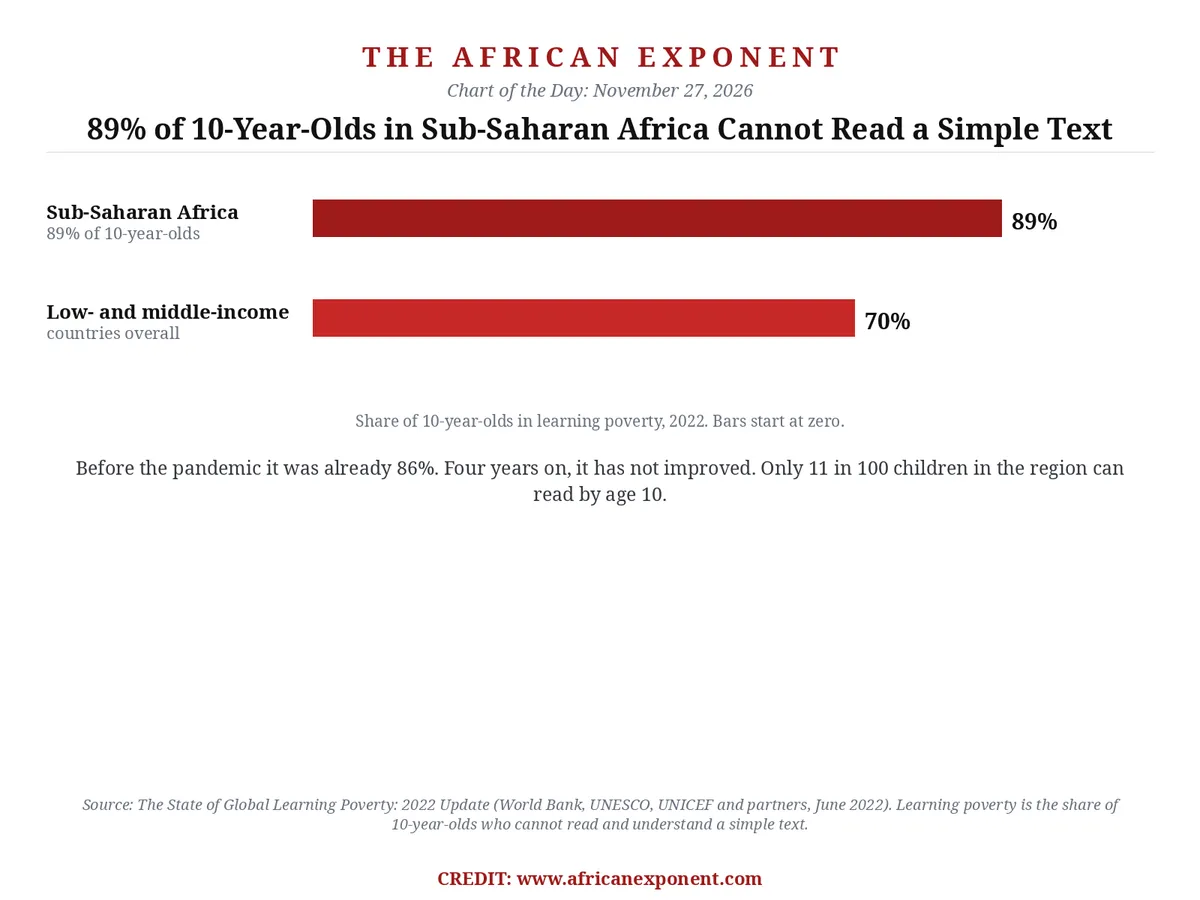
89% of 10-year-olds in Sub-Saharan Africa cannot read and understand a simple text. That is the World Bank's measure of learning poverty, and it makes the region the worst in the world by a distance. Across all low- and middle-income countries the share is 70%, so Sub-Saharan Africa sits 19 points above the average. Put the other way round, only 11 in 100 children in the region can read by age 10, against 30 in 100 across the wider group.
The chart carries a second, quieter shock. Before the pandemic the Sub-Saharan figure was already 86%. The pandemic pushed the global average from 57% to 70%, a rise of 13 points. Schools in Latin America and South Asia stayed shut for a year or more. In Sub-Saharan Africa schools closed for only a few months, so the rate rose just 3 points. The crisis was not created by COVID. It was already there, and four years on it has not improved.
Related reading: Top 10 African Countries with the Highest Education Global Ranking on African Exponent.
Why it matters
Enrolment is no longer the binding problem. Children are in school, in classrooms, for years, and leave unable to read a sentence. That caps every other skill the economy needs from them. A child who cannot read by 10 struggles to catch up in maths, science and every subject after. The World Bank puts the cost at $21 trillion in lifetime earnings for this generation of students, about 17% of today's global GDP. The debate is what fixes it first: teacher training and structured pedagogy, or the language children are taught in and the size of their classes. Either way, the money spent getting children into school is wasted if nothing is learned once they are there.
The number in context
A newer African measure makes the picture look worse, not better. A joint African Union and UNESCO report published in October 2025 found that only about 1 in 10 children in Africa complete primary school with minimum proficiency. That covers both reading and maths. By Grade 3, most pupils in the Democratic Republic of Congo, Nigeria and Zambia could not read a single word. In Chad, Mali, Niger and the Democratic Republic of Congo, learning poverty runs above 90%. The honest counterpoint is that access has improved. The same report says Africa's out-of-school population may have stopped rising, at 44 million children in 2023. The problem has moved from getting children into classrooms to teaching them once they are inside. One caution on the headline number itself. The 89% is a 2022 estimate built on the last comparable measured data, from 2019, so it is the latest published figure, not a fresh count.
Data sources
World Bank, UNESCO, UNICEF, FCDO, USAID and Gates Foundation, The State of Global Learning Poverty: 2022 Update, press release 23 June 2022: worldbank.org. World Bank, Ending Learning Poverty brief (with the UNESCO Institute for Statistics): worldbank.org. The Standard (Kenya), More African children enter school, yet nine in 10 cannot read, 5 October 2026: standardmedia.co.ke. African Union, UNESCO Global Education Monitoring Report and ADEA, Lead for foundational learning, Spotlight Report, 29 October 2025: topafricanews.com. The Life You Can Save, Education Sector Report 2026-2028: thelifeyoucansave.org. UNESCO, Global Education Monitoring Report 2026, Access and Equity: Countdown to 2030, Irish launch report: ifut.ie.
Methodology
Learning poverty is the World Bank and UNESCO measure of the share of children at the end of primary school age who cannot read and understand a simple text, counting both children in school who read below the minimum level and children out of school. The figures in this post are from The State of Global Learning Poverty: 2022 Update, published 23 June 2022. The 2022 figures are simulations of the effect of pandemic school closures on the 2019 measured baseline, and the latest comparable measured data are from 2019; the 89% is the latest published regional estimate and was still being cited as current by Kenyan national media in October 2026. One claim found during research is not used here: a single secondary page asserts a 2026 update of the same report, released 14 October 2026, with the global average at 72%. No World Bank release for such an update could be located, and the World Bank's own learning poverty database, updated in September 2026, still cites the 2022 report, so the 72% figure does not meet this series' two-source standard. Even that unverified page agrees the Sub-Saharan figure remains 89%. All arithmetic in this post was recomputed from the published figures: the 19-point gap (89 minus 70), the 1.27 times ratio (89 divided by 70), the 3-point rise since 2019 in Sub-Saharan Africa against a 13-point rise in the wider group, and the 11 in 100 who can read against 30 in 100. 89% is rendered as "nine in ten" only as rounded shorthand; nine in ten would be 90% exactly.