Published: November 29, 2026
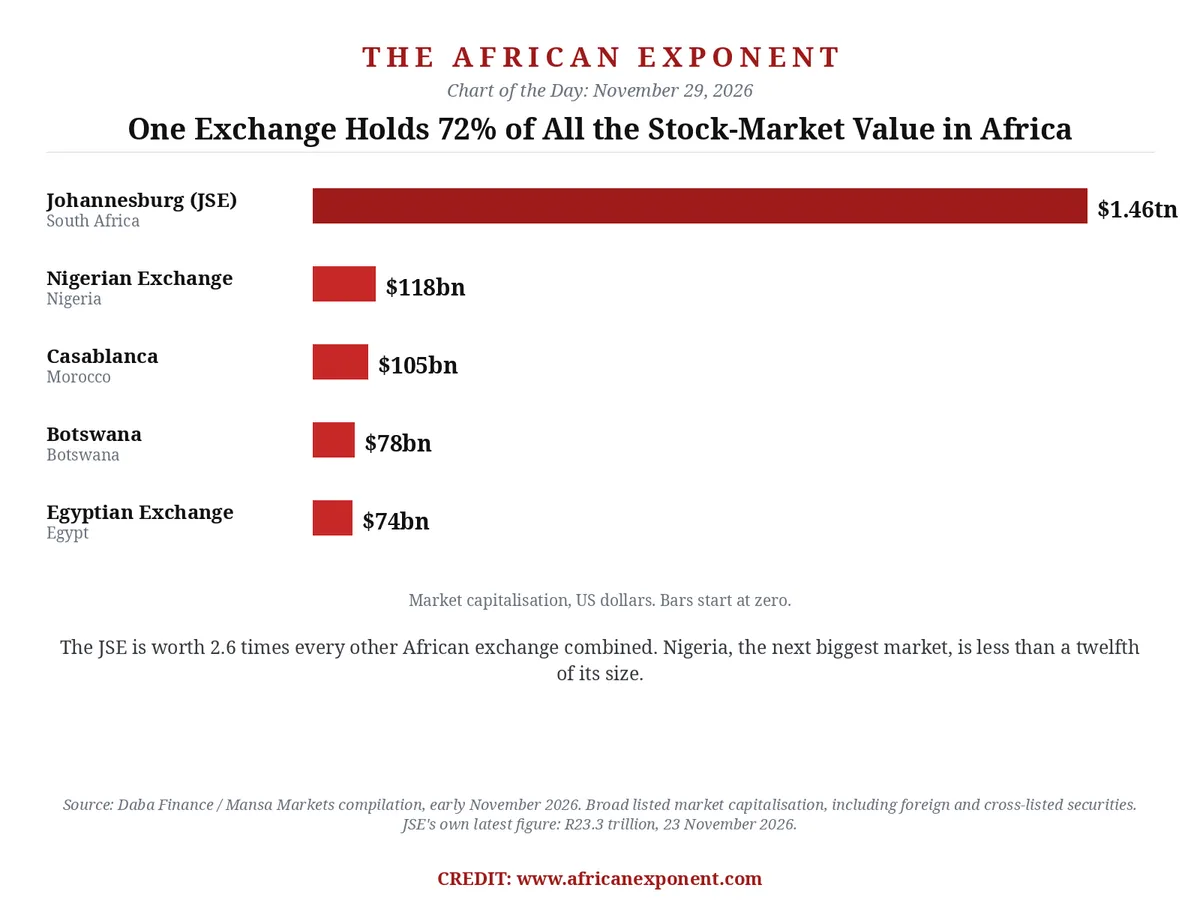
"African capital markets" is, in value terms, mostly one city. The Johannesburg Stock Exchange is worth about $1.46 trillion. Every other stock exchange in Africa combined is worth $556 billion. The JSE holds about 72 percent of the roughly $2.02 trillion of listed value across the continent, and it is worth 2.6 times all the rest put together.
The chart shows the cliff. Nigeria's exchange, the second largest, is worth $118 billion, less than a twelfth of the JSE. Casablanca follows at $105 billion, Botswana at $78 billion, Egypt at $74 billion. Add those four together and they reach $375 billion, about a quarter of the JSE on its own. The JSE is also larger than the other nine largest African exchanges combined, nearly three times over. In the third quarter of 2025 the JSE was worth $1.22 trillion, about 70 percent of the continent's total. The values have risen since then, but the share has not moved.
We ranked the continent's exchanges in October: Top 10 African Stock Exchanges by Market Capitalization in 2026, where the JSE led at $1.43 trillion.
Why it matters
A stock exchange is where a country's savings become investment, where pension funds buy shares and where companies raise money to build factories. When one exchange holds nearly three quarters of the continent's listed value, it sets the terms for all of it. It has the deepest pool of capital, the best liquidity, the benchmark prices, and the listing venue every ambitious company wants. That depth is an asset for South Africa and for the foreign companies that list there, but it is also a concentration risk. The continent's listed wealth rises and falls with one market, one currency and one set of rules. For the other 53 countries, the practical question is whether to build their own small markets or plug into Johannesburg's, and the numbers say most of them have barely started.
The number in context
Two cautions keep the number honest. First, the JSE's size flatters South Africa. About two thirds of its value sits in inward-listed companies, foreign businesses such as Anglo American, Richemont and Prosus that list in Johannesburg for its liquidity but earn most of their money elsewhere. Count only domestic companies, and the picture changes. The OECD puts the value of all listed African companies at about $561 billion at the end of 2024, a quarter of the broad $2 trillion figure. Second, the dollar figure moves with the rand. The JSE's own latest count, on November 23, is R23.3 trillion across 261 companies. At the November 27 exchange rate of R17.35 to the dollar, that is about $1.34 trillion, down from $1.46 trillion at the start of the month mainly because the rand weakened by about 4 percent in November. The share barely moves either way: roughly two thirds to three quarters of the continent's listed value sits on one exchange.
Data sources
Daba Finance, Largest African Stock Exchanges by Market Capitalization in 2026, market data available in early November 2026, built on Mansa Markets data: academy.daba-dev.dabafinance.com. Johannesburg Stock Exchange, Coca-Cola HBC joins the JSE, 23 November 2026 (261 companies, R23.3 trillion): jse.co.za. Africa Business Insight, Top 10 African stock exchanges by market capitalization (2025), JSE about $1.22 trillion in the third quarter of 2025, roughly 70 percent of Africa's total: africabusinessinsight.com. TMAfrica, Africa's Bourses Wake Up, November 2026 (combined African market capitalisation passed US$2 trillion; JSE around three-quarters): tmafrica.co.ug. Finnhub and OANDA, USD/ZAR daily rates (27 November 2026 close 17.35388; 1 November open 16.69626): finnhub.io.
Methodology
The figures in this post come from a single compilation by Daba Finance, built on Mansa Markets data and market data available in early November 2026, covering 16 African exchanges. The basis is broad listed market capitalisation, which includes foreign and cross-listed securities, so the totals are larger than domestic-only measures. The JSE's own release of 23 November 2026 gives its latest figure, R23.3 trillion across 261 companies, converted here at the 27 November close of R17.35 per dollar. Two independent checks agree on the story: the African Securities Exchanges Association puts the continental total at about $2 trillion, which gives the JSE a share of about 73 percent, and Africa Business Insight's third-quarter 2025 ranking put the JSE at $1.22 trillion and about 70 percent. Botswana's $78 billion includes foreign and cross-listed securities; on a domestic-only basis it would be far smaller, which would only widen the JSE's lead. All arithmetic was recomputed from the published figures: the $556 billion rest-of-Africa total, the $2.02 trillion continental total, the 72.4 percent share, the 2.63 ratio against the rest combined, and the 12.35 ratio against Nigeria.