Published: November 28, 2026
Mali is a landlocked West African nation of 25,932,275 people in 2026, according to the United Nations World Population Prospects 2024. Its fifth national census, held in 2022 and analysed in a report published in January 2025, did something no Malian census had done in decades: it asked people their ethnicity directly. The result is the clearest picture yet of who Malians are, and it leaves no doubt about who leads it.
The Bambara, also called the Bamanan, number 9,317,466 people in 2026, or 35.93 percent of the country. That is 2.8 times the second group, the Peulh, and more than the Peulh and the Malinké combined, with 3,806,857 people to spare. No other group comes close. The top two groups together hold 48.76 percent of Mali, and the top three hold 57.18 percent. The ten groups in this table account for 23,774,711 people, or 91.68 percent of the country, leaving only 2,157,564 people spread across the twelve remaining census categories.
This is a clean census ranking. Unlike several countries in this series, Mali needed no patchwork from other sources: the 2022 census published a full ethnic table of 22 categories, and every group in the top ten comes straight from it. The one thing to know about the numbers is the denominator. The census asked the ethnicity question of Malian nationals only, a base of 21,200,118 people out of the 22,395,485 counted in total. The shares below are shares of that national population, applied to the United Nations 2026 total, as they are for every country in this series.
Key Facts
- The Bambara lead with 9,317,466 people (35.93 percent), 2.8 times the Peulh at 3,327,111 (12.83 percent).
- The Bambara alone outnumber the second and third groups combined by 3,806,857 people.
- The top two groups hold 12,644,577 people (48.76 percent), and the top three hold 14,828,075 (57.18 percent).
- The top ten groups total 23,774,711 people (91.68 percent of Mali in 2026). The other twelve census categories share the remaining 2,157,564 (8.32 percent).
- The tightest cut in the table is at the bottom: the Bozo missed the top ten by 67,424 people, with 492,713 against the Bobo at 560,137.
The Ranking
| Rank | Group | Population in 2026 | Share of Mali |
|---|---|---|---|
| 1 | Bambara (Bamanan) | 9,317,466 | 35.93% |
| 2 | Peulh (Fulani) | 3,327,111 | 12.83% |
| 3 | Malinké (Maninka) | 2,183,498 | 8.42% |
| 4 | Soninké (Sarakole) | 2,118,667 | 8.17% |
| 5 | Dogon | 1,579,276 | 6.09% |
| 6 | Mamala (Minianka) | 1,387,377 | 5.35% |
| 7 | Songhay (Sonrhai, Zarma) | 1,242,156 | 4.79% |
| 8 | Senoufo | 1,045,071 | 4.03% |
| 9 | Tamasheq (Touareg) | 1,013,952 | 3.91% |
| 10 | Bo (Bwa, Bobo) | 560,137 | 2.16% |
Shares are from Mali's 2022 census (RGPH5), Tableau 2.05, applied to the United Nations 2026 population of 25,932,275. See Methodology for the denominator and the exclusions.
Who Just Missed Out
The Bozo, the fishing people of the Niger River, are the nearest miss in this ranking. At 492,713 people (1.90 percent), they sit 67,424 behind the Bobo in tenth place. Behind them come two categories the census publishes that are not tribes at all. "Autre ethnie du Mali" is a residual bucket of 303,408 people (1.17 percent). The Khassonké follow at 300,814 (1.16 percent). The census also counts two cross-border groups as Malian nationals: the Mossi at 95,949 and the Haoussa at 15,559 in 2026 terms. Both are far below the cut. The gap between the top ten and the rest is unusually wide for this series. The tenth group is more than twice the size of the eleventh. No group outside the ten reaches even 2 percent of the country.
Selected Details
1. Bambara (Bamanan): 9,317,466
The Bambara are the largest Mande people of the middle Niger. Bamako, the capital, sits in the Bambara heartland on the Niger River, and Bamanankan is Mali's lingua franca, used in markets, on the radio and in everyday life far beyond the ethnic Bambara. The Bambara Empire of Ségou ruled the middle Niger through the 18th and early 19th centuries under Bitòn Coulibaly and his successors. The census figure is the one point of real argument in this table. The CIA World Factbook's 2018 estimate put the Bambara at 33.3 percent, 2.63 points below the census. The census figure is used here because it is a count, not an estimate.
2. Peulh (Fulani): 3,327,111
The Peulh, known across West Africa as the Fulani or Fula, are the great pastoralists of the Sahel, and Mali holds one of their largest populations. Their historic centre in Mali is the Inland Niger Delta, where Seku Amadu founded the Macina Empire in the early 19th century. Fulfulde is one of Mali's national languages. The census share of 12.83 percent sits close to the Factbook's 13.3 percent, one of the closest agreements between the two sources in this table.
3. Malinké (Maninka): 2,183,498
The Malinké built the Mali Empire under Sundiata Keita in the 13th century. The country takes its name from that empire. Its heartland is the Manding region of southern Mali and Guinea. The griot tradition, the hereditary storytellers and musicians who carry Mande history, is Malinké at its root. The Epic of Sundiata remains the region's founding story. The Malinké and the Bambara are closely related Mande peoples, and their languages are closely related too, which is one reason older sources sometimes blurred the two.
4. Soninké (Sarakole): 2,118,667
The Soninké founded the Wagadu Empire, also called the Ghana Empire. It was the oldest of the great West African empires. The Soninké were the historic long-distance traders of the western Sahara, moving salt and gold between the desert and the forest. That trading tradition continues in a modern form: Mali's Soninké have one of West Africa's largest diasporas in France. The Factbook folds the Soninké together with the Marka into one category of 9.8 percent. The census counts the Soninké alone at 8.17 percent, and the Marka, listed as Dafing, separately at 0.47 percent. Together they make 8.64 percent.
5. Dogon: 1,579,276
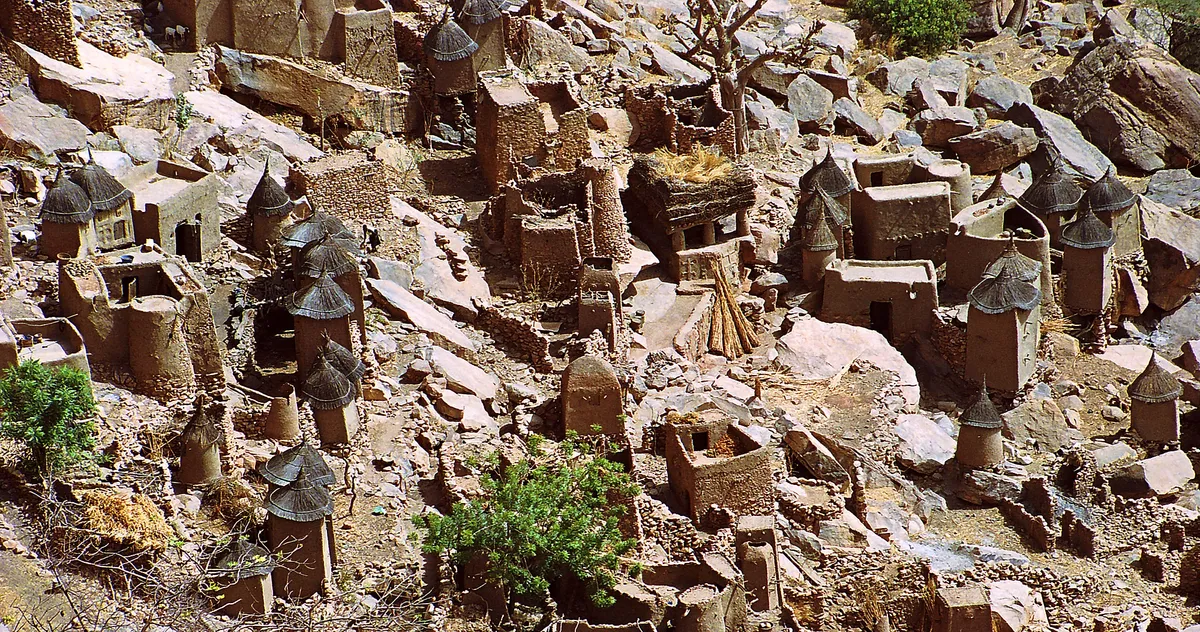
The Dogon live on the Bandiagara Escarpment, a UNESCO World Heritage site since 1989, in cliff villages of mud and stone like the one pictured above. Their mask dances and the Sigui festival, held once every sixty years, are among the most photographed traditions in Africa. French ethnographer Marcel Griaule's work in the 1930s and 1950s made them famous in the West. The Dogon carry the second-largest disagreement in this table: the census counts them at 6.09 percent, while the Factbook's 2018 estimate put them at 8.7 percent, a gap of 2.61 points. The census figure is used here. The gap is a reminder that the Dogon live in one of Mali's hardest regions to survey. They are the group most likely to be undercounted or overestimated, depending on the method.
6. Mamala (Minianka): 1,387,377
The Minianka, also called Mamala or Mamara, are a Senufo-related farming people of the Sikasso region in southern Mali. They are closely related to the Senoufo, who are ranked separately at number eight, and the census split between the two is a matter of self-identification rather than language or custom. Add the two together and they total 2,432,448 people (9.38 percent). That is close to the Factbook's combined Senufo and Manianka category of 9.6 percent. The split is real, but the combined total is stable across sources.
7. Songhay (Sonrhai, Zarma): 1,242,156
The Songhay are the heirs of the Songhai Empire, the largest of the medieval West African empires, which under Askia Muhammad in the 15th and 16th centuries controlled Gao, Timbuktu and Djenné. Today they live along the Niger River in the east of Mali. The same people, called Zarma, are the second largest group in neighbouring Niger. They number 6,048,243 in our ranking of that country. The census share of 4.79 percent sits below the Factbook's 5.9 percent for the Sonrai, but the order is unaffected.
8. Senoufo: 1,045,071
The Senoufo live in the Sikasso region of southern Mali and across the border in northern Côte d'Ivoire, where they are one of the largest groups. Their Poro society, a male initiation association, shapes community life. Their carved masks and the balafon, the wooden xylophone of the region, are famous well beyond Mali. The census counts the Senoufo separately from the Minianka at number six, although the two are closely related; together they are the third largest bloc in the country by combined size.
9. Tamasheq (Touareg): 1,013,952
The Tamasheq, known as the Touareg or Tuareg, are the Berber-speaking nomads of the Sahara, centred on the Kidal, Gao and Timbuktu regions of northern Mali. Their rebellions in the north, most recently the 2012 rebellion that preceded the declaration of Azawad, have shaped Mali's modern politics more than any other group's history. Their census share of 3.91 percent is far above the Factbook's 1.7 percent for its "Tuareg/Bella" category. But the two are not measuring the same thing. The census has no separate Bella category, so its figure covers a wider population than the Factbook's.
10. Bo (Bwa, Bobo): 560,137
The Bo, also called the Bwa or Bobo, are a farming people of the Sikasso region and across the border in Burkina Faso, around the city of Bobo-Dioulasso, which takes its name from them. Their plank masks are among the most recognisable in African art. The Bobo are the one group in the top ten where the census and the Factbook agree almost exactly. The census counts 2.16 percent, and the Factbook estimated 2.1 percent.
Frequently Asked Questions
What is Mali's population in 2026?
25,932,275 people, according to the United Nations World Population Prospects 2024, medium variant, for 1 July 2026. Mali's own census counted 22,395,485 people in 2022. The 2026 figure is 3,536,790 higher, a gap of 13.64 percent. It reflects four years of population growth, and the difference between a census count and a United Nations projection.
Why do some sources say the Bambara are 46 percent of Mali?
Because they are measuring language, not ethnicity. The 2009 census did not record ethnicity at all. Researchers inferred ethnic groups from mother tongue instead. They found 46.64 percent of Malians aged three and over spoke Bambara as their first language. The 2022 census asked ethnicity directly and found 35.93 percent identify as Bambara. The difference is real and expected: many Malians speak Bambara without being Bambara. This ranking uses the 2022 ethnic figure.
Why do the census shares not cover all 25.9 million Malians?
The 2022 census asked the ethnicity question of Malian nationals only, a base of 21,200,118 people out of the 22,395,485 counted. The 1,195,367 people not asked were residents of other nationalities. The shares in this table are shares of the national population, applied to the United Nations 2026 total. That assumes the same ethnic mix among non-nationals. That is the convention used for every country in this series, and it is stated here so the reader can see it.
Where do the Tuareg fit in this ranking?
Ninth, at 1,013,952 people (3.91 percent). The census figure is higher than the Factbook's older estimate of 1.7 percent because the two sources group people differently. The Factbook's category is "Tuareg/Bella", while the census has no separate Bella category. The census figure is a count from 2022, and it is the figure used here.
Which group just missed the top ten?
The Bozo, the fishing people of the Niger River, at 492,713 people (1.90 percent). They sit 67,424 behind the Bobo in tenth place. Behind them, the census's "Autre ethnie du Mali" residual bucket holds 303,408 people, but it is not a tribe and was not ranked.
Data Sources
- INSTAT Mali, Cinquième Recensement Général de la Population et de l'Habitat (RGPH5), Rapport d'analyse des données du RGPH5: Caractéristiques culturelles de la population, January 2025, Tableau 2.05. Archived copy of the INSTAT report (PDF).
- United Nations, World Population Prospects 2024, medium variant, total population at 1 July 2026: Mali 25,932,275. population.un.org.
- CIA World Factbook, Mali, ethnic groups (2018 estimates), accessed through the Factbook archive. archive.govglance.org/factbook/mali.
- GREAT (Groupe de recherche en économie appliquée et théorique), Réfléchir à changer No. 051, March 2015, Tableau 2 (2009 mother-tongue analysis, language proxy only). greatmali.net (PDF).
- Wikipedia, "Demographics of Mali", summary of the 2022 census shares, used for corroboration only. en.wikipedia.org/wiki/Demographics_of_Mali.
Methodology
This ranking is built on Mali's own census. The primary source is the Institut National de la Statistique (INSTAT) report on the cultural characteristics of the population. It comes from the fifth general census (RGPH5, 2022), Tableau 2.05, which publishes counts and shares for 22 ethnic categories. The census asked the ethnicity question of the Malian-nationality population only, a base of 21,200,118 people, not the headline census total of 22,395,485. Every share in the table is a share of that 21,200,118 base, exactly as published. Every 2026 population is that share applied to the United Nations World Population Prospects 2024 total for Mali at 1 July 2026 (25,932,275). Applying nationals-only shares to the full population assumes the same ethnic mix among the 1,195,367 residents not asked the question. That assumption is disclosed here rather than hidden.
The second source is the CIA World Factbook's 2018 estimate set for Mali, which corroborates the order of the ranking and agrees closely on most groups. Where the two sources disagree by more than two percentage points, the census figure is used and the rival figure is recorded. Bambara: 35.93 percent (census) against 33.3 percent (Factbook). Dogon: 6.09 percent against 8.7 percent. Tamasheq: 3.91 percent against 1.7 percent for the Factbook's differently grouped "Tuareg/Bella" category. Two apparent disagreements disappear once the groupings are combined. The Factbook's Senufo and Manianka category of 9.6 percent matches the census Senoufo (4.03 percent) plus Mamala/Minianka (5.35 percent) at 9.38 percent. Its Sarakole/Soninke/Marka category of 9.8 percent is close to the census Soninké (8.17 percent) plus Dafing/Marka (0.47 percent) at 8.64 percent. No Joshua Project figures were needed, and none were used.
Two census categories were not ranked. "Autre ethnie du Mali" (1.17 percent) and "Autre ethnie non malienne" (0.17 percent) are published residual buckets, not ethnic groups. Two small printing inconsistencies in the source were kept as published. The Khassonké share is printed as 1.16 percent in Tableau 2.05 but 1.17 percent in Tableaux 2.06 to 2.08 for the same count. The Arabe sex components in Tableau 2.05 sum to 126,174, one less than the printed ensemble count of 126,175. The published counts therefore sum to 21,200,119 against a printed table total of 21,200,118. Neither affects any rank. The 2009 vintage, a language proxy derived from mother tongue, was not used for the ranking and is cited only to explain why some sources give a higher Bambara figure. The same Songhay people appear as the second largest group in neighbouring Niger; see our ranking of the top tribes of Niger.