Published: October 30, 2026
Key Facts
- The Hausa rank first on the African Exponent Power Index with 82 points out of 100, one point ahead of the Yoruba on 81.
- Five of the top 10 groups currently hold a presidency or a prime ministership: the Yoruba, Oromo, Somali, Shona and Tutsi.
- The Fulani score the maximum 15 points for geographic spread, with a significant presence in more than 20 countries.
- The top 10 groups have a combined estimated population of about 355 million people.
- The Zulu, about 15 million people, miss the top 10 by one point. They score 52, behind the Tutsi on 53.
| Rank | Tribe / Ethnic group | Power Index (/100) | Population (est.) | Power base |
|---|---|---|---|---|
| 1 | Hausa | 82 | ~86M | Northern Nigeria and Niger |
| 2 | Yoruba | 81 | ~53M | Lagos and south west Nigeria |
| 3 | Oromo | 70 | ~40M | Ethiopia, federal government |
| 4 | Fulani | 67 | ~39M | The Sahel belt, Senegal to Sudan |
| 5 | Somali | 65 | ~28M | Somalia and Djibouti presidencies |
| 6 | Igbo | 58 | ~38M | South east Nigeria trade networks |
| 7 | Akan | 57 | ~25M | Ghana and Ivory Coast |
| 8 | Berber / Amazigh | 56 | ~30M | The Maghreb, Morocco and Algeria |
| 9 | Shona | 54 | ~13M | Zimbabwe, ruling party and state |
| 10 | Tutsi | 53 | ~3M | Rwanda, presidency and ruling party |
The average score across the top 10 is 64.3. The top two groups, both rooted in Nigeria, score 163 points between them. Read our earlier ranking of the largest tribes in Africa to see how this power ranking differs from a simple population count.
Selected Details
1. Hausa (82/100)
The Hausa take first place without holding a presidency. Their strength is breadth. With about 86 million people, they are the largest ethnic group in West Africa. They anchor northern Nigeria and southern Niger, and Hausa trading communities reach across the whole region.
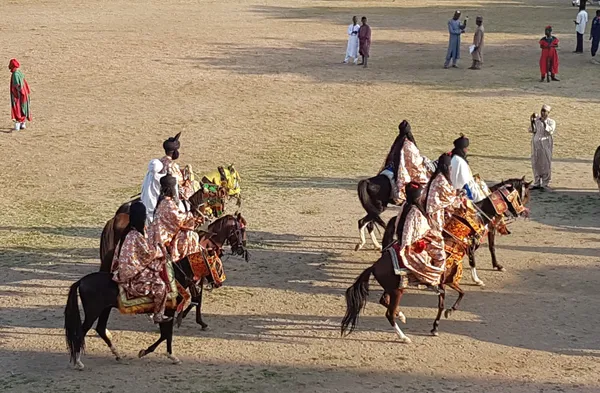
Politically, the Hausa are permanent kingmakers. No Nigerian president wins without the northern vote, and the Speaker of the House of Representatives, Tajudeen Abbas, is a Hausa prince of the Zazzau Emirate. The emirate system, led by the Emir of Kano, still commands real loyalty, and the Kano Durbar festival fills streets with thousands of horsemen each year.
Hausa is also a language of trade and media far beyond the group itself. It works as a lingua franca across West Africa, and the BBC Hausa service reaches tens of millions of listeners each week. The limit is division: Hausa political weight is shared with Fulani partners, and the north remains poorer than southern Nigeria.
2. Yoruba (81/100)
The Yoruba finish one point behind, and they hold the single biggest prize in this ranking. President Bola Tinubu, a Yoruba from Lagos, has led Nigeria since May 2023. His party, the APC, grew out of his south western political machine.
The economic score is the highest of any group. Lagos, the Yoruba heartland, is the largest city economy in West Africa and the commercial capital of Nigeria. Yoruba traders, banks and media houses shape business from Lagos to Benin and Togo.
Yoruba culture travels well. The Yoruba language, Nollywood roots and Yoruba religion all have global reach, including large diaspora communities in the Americas. The limit is geography: outside Nigeria, Benin and Togo, the Yoruba presence is diaspora rather than homeland.
3. Oromo (70/100)
The Oromo are Ethiopia's largest group, at about 40 million people, and since 2018 they have held the top job. Prime Minister Abiy Ahmed, the son of an Oromo father, is the first Oromo to lead Ethiopia. He came to power through the Oromo Democratic Party.
Addis Ababa, the federal capital, sits inside Oromia, the Oromo regional state. That gives the Oromo a claim on the land under Africa's diplomatic capital. Oromia also produces most of Ethiopia's coffee, the country's top export earner.
The limits are real. Abiy's mixed Oromo and Amhara heritage means rivals dispute his Oromo mandate, and armed conflict in Oromia has weakened the region's economy. Afaan Oromo is widely spoken in Ethiopia but has little reach beyond it and northern Kenya.
4. Fulani (67/100)
No group is spread wider than the Fulani. About 39 million people live in more than 20 countries, from Senegal on the Atlantic coast to Sudan and the Central African Republic. That spread earns the maximum 15 points in this index.
The Fulani cattle economy moves meat and milk across the Sahel, and Fulani scholars spread Islam across West Africa centuries ago. The Sultan of Sokoto, a Fulani throne, remains the most senior Muslim authority in Nigeria.
What the Fulani lack in 2026 is a presidency. No Fulani currently leads a major state, and pastoral communities face land pressure and violent conflict with farming groups in Nigeria, Mali and Burkina Faso. Spread without a state caps the score.
5. Somali (65/100)
The Somali hold two presidencies at once. Hassan Sheikh Mohamud, of the Abgaal sub clan of the Hawiye, leads Somalia. Ismail Omar Guelleh, of the Issa clan, has led Djibouti since 1999 and won a sixth term in April 2026.
Somali economic reach is bigger than Somalia's economy. Somali traders run networks from Nairobi's Eastleigh district to Dubai and Minneapolis. Remittances and telecoms firms such as Hormuud keep money moving where banks do not.
The discount is state weakness. Somalia's federal government still fights al Shabaab for territory, and Somaliland's status stays unresolved. Somali power is real, but it is power without one strong state behind it.
6. Igbo (58/100)
The Igbo score on commerce, not office. About 38 million people run some of the densest trading networks in Africa. Onitsha hosts one of the largest markets in West Africa, and Nnewi has built a home grown manufacturing base.
Igbo traders stock shops from Lagos to Douala and Johannesburg. The Igbo apprenticeship system, in which a trader trains and then funds a young apprentice, has become a studied model of business building.
Politics is the weak point. No Igbo has held Nigeria's presidency since 1966, and the south east holds fewer federal posts than its economic weight suggests. Peter Obi's strong third place finish in the 2023 presidential election showed the demand for change, but demand is not office.
7. Akan (57/100)
The Akan are the largest group in Ghana and a major presence in Ivory Coast, at about 25 million people combined. Their political position is strong but shared. Ghana's president, John Mahama, is Gonja, not Akan, yet the vice president, Jane Naana Opoku-Agyemang, is a Fante Akan, and the president until January 2025, Nana Akufo-Addo, is an Akyem Akan.
The Asantehene, king of the Ashanti, remains one of the most influential traditional rulers in West Africa. His court in Kumasi is a political address no Ghanaian leader can ignore.
Economically, the Akan sit on Ghana's cocoa belt and much of its gold belt, and Accra is an Akan region capital. Twi, the main Akan language, is understood across most of Ghana. The limit is that Akan power is split between two states and several subgroups.
8. Berber / Amazigh (56/100)
The Amazigh, often called Berbers, are the indigenous people of North Africa. About 30 million live across at least nine countries, from Morocco and Algeria to Libya, Mali and Niger. Only the Fulani score higher for spread.
The Amazigh have won recognition without holding a state. Tamazight became an official language in Morocco in 2011 and in Algeria in 2016. Amazigh activism forced both governments to teach the language and print it on public signs.
The ceiling is political. Both Morocco and Algeria are led by Arab identified governments and monarchies, and no Amazigh party holds national power. Economic weight is regional, in tourism, farming and remittances, rather than control of a major capital.
9. Shona (54/100)
The Shona show how a majority group converts numbers into state power. They are about 80 percent of Zimbabwe's population, and ZANU-PF, a Shona led party, has governed since independence in 1980.
President Emmerson Mnangagwa is a Karanga Shona, and the cabinet and security leadership draw heavily on Shona networks. Harare, the capital, sits in Shona country, and the Shona language is spoken by most Zimbabweans.
The discount is the economy itself. Zimbabwe's long economic crisis shrinks the value of holding the state, and Shona presence outside Zimbabwe and Mozambique is thin. Power at home, little reach abroad.
10. Tutsi (53/100)
The Tutsi are the smallest group in this top 10, at roughly 3 million people. They take the last place on political power alone. Paul Kagame, born into a Tutsi family, has led Rwanda since 2000, and the Rwandan Patriotic Front has run the state since 1994.
Rwanda under Kagame punches far above its size in African diplomacy, peacekeeping and conference tourism. Kigali hosts continental institutions, and Rwanda's army is a regional actor, for good and ill, in eastern Congo.
The limits are scale and history. Tutsi in Burundi and Congo do not share Kigali's power, and the memory of the 1994 genocide shapes every discussion of Tutsi influence. One strong state cannot fully offset the smallest population in the ranking.
Just missed: the Zulu score 52, one point behind the Tutsi. About 15 million Zulu hold the KwaZulu-Natal premiership through the IFP, won the province's largest vote share in 2024 through the MK party, and speak South Africa's most common home language. No presidency since Jacob Zuma left office in 2018 keeps them at number 11. Compare this list with our ranking of the most powerful countries in Africa and our soft power ranking.
Frequently Asked Questions
Which is the most powerful tribe in Africa in 2026?
On the African Exponent Power Index, the Hausa rank first with 82 points out of 100. They combine the largest population in West Africa, a kingmaker role in Nigerian politics and the widest media reach of any African language group in the region.
How is the Power Index calculated?
Each group is scored out of 100 across five parts. Population is worth 30 points, current political power 30, geographic spread 15, economic weight 15 and cultural and linguistic reach 10. The full method is set out in the Methodology section below.
What is the difference between the largest tribe and the most powerful tribe?
Size is only one part of power. The Igbo, at about 38 million people, hold no presidency and score in the middle of this table. The Tutsi, the smallest group ranked here at about 3 million, hold a state and take the final top 10 place.
Why are the Zulu not in the top 10?
The Zulu score 52 points, one point behind the Tutsi. They hold provincial power in KwaZulu-Natal and their language is South Africa's most spoken home language, but they have not held the national presidency since 2018 and they are concentrated in one country.
Are the population figures exact?
No. Most African states do not publish a current ethnic census, so the figures are estimates built from national censuses, official shares and reference sources. The Methodology section explains the basis used for each group.
Data Sources
- African Exponent, Top 10 Largest Tribes in Africa in 2026 (population basis for the ten largest groups).
- Encyclopaedia Britannica, profiles of Bola Tinubu and Ismail Omar Guelleh.
- Kenya National Bureau of Statistics, 2019 Population and Housing Census (Kikuyu count of 8,148,668).
- Uganda Bureau of Statistics, 2014 Population and Housing Census (Baganda 5,555,319, 16.5 percent).
- IDOS Policy Brief 12/2024, on President Bassirou Diomaye Faye of Senegal (Serer background).
- Wikipedia reference entries for Paul Kagame, Emmerson Mnangagwa, John Mahama, Hassan Sheikh Mohamud, Shona people, Wolof people and the 2024 KwaZulu-Natal provincial election, each cross checked against a second source listed in our research notes.
Methodology
This ranking uses the African Exponent Power Index, an editorial composite index built for this article. It is not an official statistic. Fifteen candidate groups were scored, and the 10 highest scores are ranked above. The five near misses, in order, are the Zulu (52), Amhara (50), Kikuyu (47), Wolof (43) and Baganda (34).
Population (30 points) uses fixed bands: 80 million or more scores 30; 50 to 79 million scores 26; 35 to 49 million scores 22; 25 to 34 million scores 18; 15 to 24 million scores 14; 8 to 14 million scores 10; under 8 million scores 6. Population figures match our October 2026 largest tribes ranking for the 10 groups it covered. Census counts are used where they exist, for example Kenya 2019 and Uganda 2014.
Political power (30 points) judges the position held in October 2026. It asks whether the group holds a presidency or prime ministership, controls a ruling bloc, or acts as a kingmaker. Leaders were credited to a group only where two credible sources confirm their background. Abiy Ahmed is scored for the Oromo, through his Oromo father and his Oromo party roots, and his Amhara heritage is noted in his section rather than scored twice.
Geographic spread (15 points) counts countries with a significant population of the group: 15 or more countries scores 15; 8 to 14 scores 12; 4 to 7 scores 9; 2 to 3 scores 6; one country scores 3. Economic weight (15 points) judges control of commercial capitals, trade networks, land and resources. Cultural and linguistic reach (10 points) judges whether the group's language is used as a lingua franca beyond the group, and the size of its media footprint.
Three caveats apply. First, ethnic population figures are estimates, because most states do not publish ethnic census data. Second, the component scores are judgement calls made against the criteria above, and a different weighting would produce a different order. Third, every derived figure in this article, including the top 10 average of 64.3 and the combined population of about 355 million, was recomputed from the final table before publication.