As the mountain gorilla population in Rwanda’s Volcanoes National Park continued to increase, these young gorillas symbolized the future of the species and the ongoing conservation efforts behind this remarkable event.
Thousands of people gather at the foot of these volcanoes not for a wedding, a festival, or a football match, but for a birthday party of sorts, one thrown for the newest members of Rwanda's mountain gorilla families. It is called ‘Kwita Izina’, and it may be the only ceremony in the world where a nation gathers, in full pomp and colour, to name baby apes. Visitors on organized Rwanda tours, conservationists, celebrities, local people converge at the Kinigi Village to take part in the gorilla naming ceremony.
To an outsider, it might sound strange. For over two decades, it has been one of the most quietly powerful conservation tools ever devised a tradition that has helped pull the mountain gorilla back from the edge of extinction while giving Rwanda a global stage to celebrate its identity, its healing, and its hope. The mountain gorilla population, marked as an endangered species in the 1980s with fewer than 250 individuals, has experienced a remarkable resurgence. By 2010, the population grew to 480, reached 604 by 2016. Today, there are about 1060 mountain gorillas thriving in the Virunga Volcanoes and Bwindi, thanks to dedicated conservation efforts. This significant recovery has led to the mountain gorilla being removed from the critically endangered species list.
Name Borrowed from the Cradle
Long before it involved gorillas, Kwita Izina belonged entirely to people. In Rwandan culture, when a child is born, the family waits several days before gathering relatives, friends, and neighbors for a naming ceremony.
The name chosen is never arbitrary. It carries meaning, hope, or a reflection of the circumstances of the birth. It is a moment where a community collectively welcomes a new life and, in doing so, takes a small share of responsibility for it.
In 2005, Rwanda borrowed this centuries-old custom and gave it an entirely new subject: the infant mountain gorillas born in Volcanoes National Park over the previous year. The idea was elegant in its simplicity. If naming a child draws a community closer to that child's wellbeing, then naming a baby gorilla might do the same for a species teetering on the brink of disappearing altogether.
Before the ceremony existed in its official form, this naming instinct was already alive among the people who spent their days with the gorillas. However, it was later ordered into a scientific pattern that had nothing to do with the Rwandan Kwita Izina culture.
Dian Fossey herself, the primatologist whose life's work in these very mountains gave the world its first intimate understanding of mountain gorilla behavior, named the individuals she studied so that her team could track them accurately.
Rangers and researchers continued the habit for decades before Rwanda's government formalized it into a national event, turning a scientist's practical shorthand into a public celebration of conservation.
The Real Purpose behind the Ceremony
It would be easy to mistake Kwita Izina for pageantry alone, but its deeper function is scientific. Mountain gorillas live in tightly knit family groups, each led by a dominant silverback, and every individual within that group needs to be identifiable if researchers and rangers are to track its health, its relationships, and its movements through the forest.
A name transforms an anonymous infant into a documented individual whose growth, behavior, and survival can be followed for the rest of its life.
This matters enormously in Volcanoes Park, part of the Virunga Massif that straddles Rwanda, Uganda, and the Democratic Republic of Congo. The mountain gorillas here are among the most intensively studied great apes on the planet, monitored daily by trackers who can recognize each individual by sight, a skill only possible because every gorilla, from birth, has a name and a story attached to it.
Beyond the science, the ceremony exists to build a bridge between the gorillas and the wider world. Rwanda has used Kwita Izina to draw both local and international attention to the fragility of the species and the importance of protecting its habitat in the Virunga Mountains.
A gorilla with a name becomes a gorilla that people care about, and in a country whose economy leans on conservation tourism understands better than most that affection is a powerful form of protection.
Inside Volcanoes National Park
The stage for all of this is Volcanoes Park, a rugged expanse of five volcanic peaks in Rwanda's Northern Province, bordering the Virunga Mountains shared with neighboring Uganda and the DRC.
It is here, among Hagenia forests, alpine meadows, and cloud-wrapped summits, that the country's entire population of mountain gorillas makes its home and it is here, each year, that the naming ceremony itself unfolds, usually in the small town of Kinigi at the park's edge.
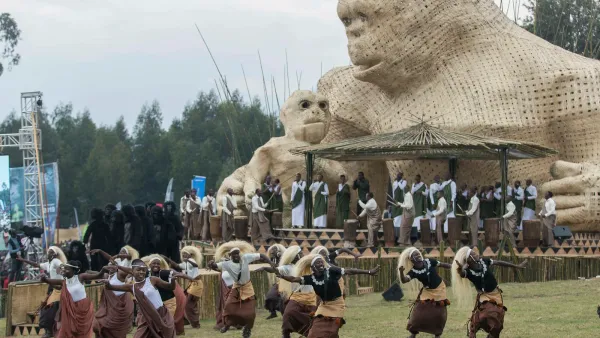
Kinigi is an unassuming settlement for most of the year, but during Kwita Izina it transforms. A purpose-built ceremonial ground fills with Intore dancers, drummers, traditional attire, and a crowd that has grown to include thousands of Rwandans and visitors from around the world.
How a Baby Gorilla Gets Its Name
The process behind each name is more layered than it might appear. Throughout the year, Rwanda Development Board (RDB) rangers and trackers who spend their days observing the gorilla groups compile a shortlist of suggested names for every infant born, often inspired by a birth story, a family trait, a section of the park, or a value the trackers wish to honour.
These suggestions are then handed to a rotating cast of "namers" chosen for the ceremony itself: a mix of Rwandan officials, international dignitaries, conservationists, musicians, athletes, and business leaders.
Each Namer steps forward, often dressed for the occasion; to publicly announce the name they have chosen for a specific infant, usually accompanied by a short explanation of its meaning.
The names themselves are rarely decorative; they tend to speak of unity, gratitude, resilience, or the natural world words like harvest, symbol, family, or increase have all made their way into the gorilla family tree over the years.
Surrounding the naming itself is now an entire week of activity. Community project launches funded by park revenue, conservation exhibitions, youth education programmes, a "Conservation is Life"-style thematic conference on the business of protecting biodiversity, and for visiting guests gorilla trekking expeditions into the very forest the ceremony celebrates.
Kwita Izina 2026, the 21st Edition
The most recent chapter in this story unfolded on 4 September 2026, when Rwanda hosted the 21st Kwita Izina at Kinigi, Musanze District. Twenty-two baby mountain gorillas received their names that day, in a ceremony that drew an estimated 10,000 attendees, a crowd of Rwandan leaders, conservationists, tourism figures, musicians, and athletes from around the world all gathered in the shadow of the Virunga volcanoes.
Among the roughly two dozen public figures invited to name a gorilla that year were football personalities Patrice Evra and Miguel Ángel Gil Marín, chief executive of Atlético Madrid, each stepping up to christen an infant born earlier in the year.
For Evra, the moment reportedly fulfilled a personal promise made to President Paul Kagame a small but telling sign of how deeply the ceremony has woven itself into Rwanda's international relationships and its reputation as a rising force in conservation diplomacy.
The 2026 event also carried extra weight because of what came before it. A Marburg virus outbreak had forced Rwanda to skip the ceremony the previous year, meaning that gorillas born across two seasons those held over from the missed year and the newest arrivals were finally welcomed into the record together.
It was a reminder that even a celebration built around new life must sometimes bend to the realities the country faces, and that resilience, too, is part of the Kwita Izina story.
Since its founding in 2005, Kwita Izina has named 438 mountain gorillas, a running tally that grows a little each September and stands as one of the more understated population records in modern conservation.
Each entry on that list represents a life that rangers, trackers, and researchers have followed from infancy, contributing to one of the most detailed long-term studies of any wild great ape population on Earth.
The ceremony's reach extends well past the gorillas themselves. Rwanda has funneled a significant share of park tourism revenue back into the communities living around Volcanoes National Park, and by 2026 that investment had grown to more than Rwf23 billion, roughly US$16 million spread across nearly 1,300 community projects.
Schools, health centers, clean water systems, and livelihood programmes have all been built on the back of a naming ceremony that, on paper, sounds like nothing more than a celebration for baby apes.
That is, perhaps, the quiet genius of Kwita Izina. It takes something as simple and human as the act of naming a newborn and uses it to bind together conservation science, national pride, community development, and international goodwill all in a single September afternoon at the base of the Virunga volcanoes.
Why It Still Captivates the World Even After Two Decades
Two decades on, Kwita Izina has grown from a modest local gathering into one of Africa's most distinctive conservation events, watched, attended, and shared by people who have never set foot in Rwanda.
Part of its pull is spectacle the drumming, the dancing, the roll call of international guests. But its deeper appeal lies in what it represents: proof that a country can turn near-catastrophic loss into one of the great comeback stories in wildlife conservation, and that something as small as a name can carry the weight of an entire species' survival.
For travellers who make their way to Kinigi during ceremony season, or who simply trek into Volcanoes National Park to sit quietly a few metres from a family of gorillas, Kwita Izina offers something rare a chance to witness conservation not as an abstract cause, but as a living, named, breathing thing, cradled in the forests of the Virunga Mountains.