Published: October 3, 2026 | Last updated: October 3, 2026
Key Facts
- The naira has lost about 77% of its dollar value since 2016, falling from ₦305/$1 to ₦1,326/$1 by late September 2026 (Central Bank of Nigeria, Investing.com, 2026)
- The steepest single move came in June 2023, when the Central Bank unified its exchange rate windows and the official rate jumped from about ₦461 to ₦899 by year-end (FocusEconomics, 2023)
- The naira hit its weakest point on record in December 2024, closing the year at ₦1,535/$1, before recovering ground through 2025 and 2026 (FocusEconomics, Vanguard, 2024-2026)
- The naira has strengthened for two straight years, closing 2025 at about ₦1,435/$1 and trading near ₦1,326/$1 by late September 2026 (FocusEconomics, Investing.com, 2026)
- The rate held almost flat for four years running, trading between ₦305 and ₦307 from 2016 to 2019, before the first COVID-era devaluation in 2020 (Central Bank of Nigeria, 2016-2020)
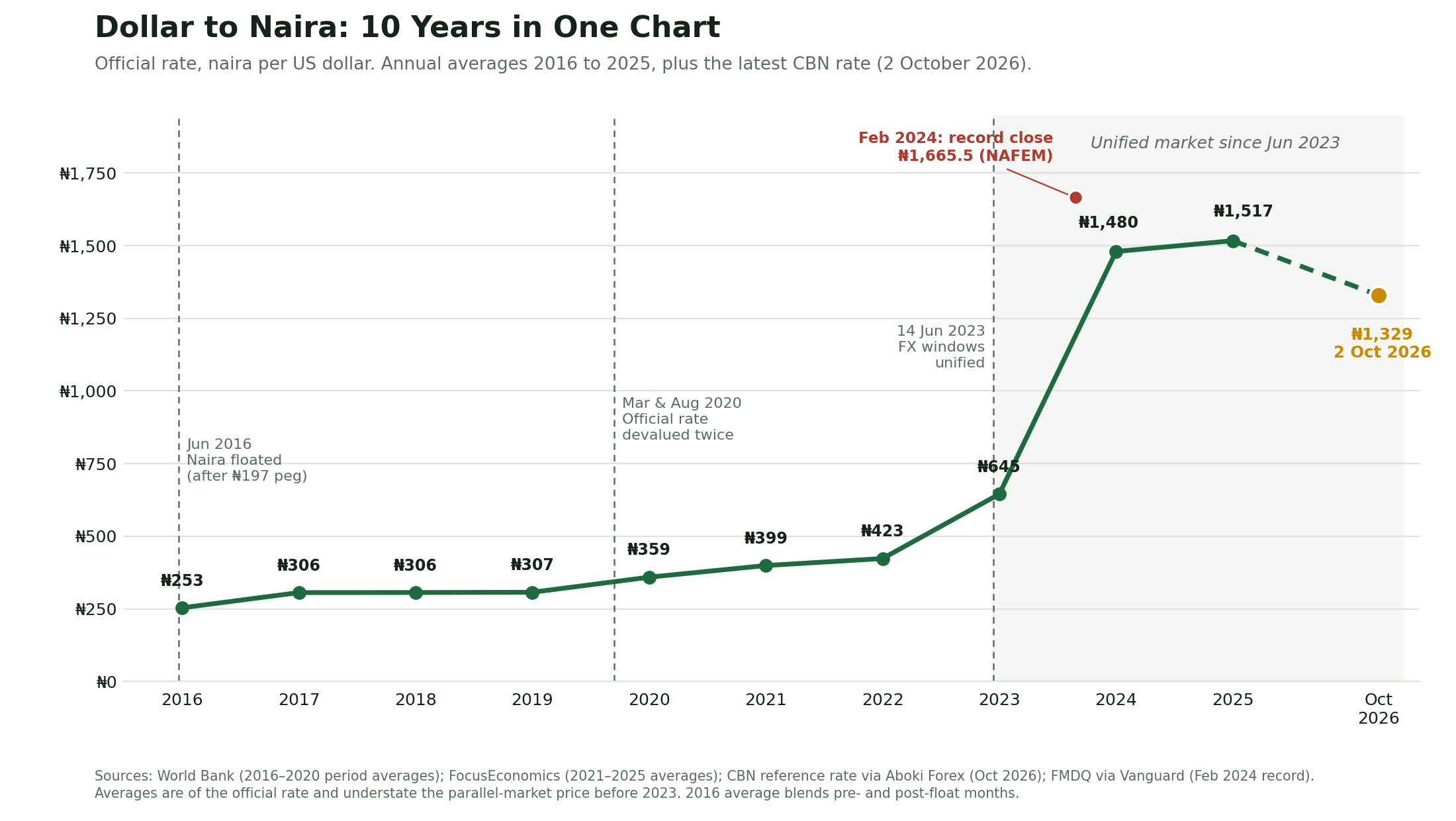
| Year | Naira per US Dollar (Official Rate) |
|---|---|
| 2016 | 305 |
| 2017 | 306 |
| 2018 | 307 |
| 2019 | 307 |
| 2020 | 410 |
| 2021 | 413 |
| 2022 | 449 |
| 2023 | 899 |
| 2024 | 1,535 |
| 2025 | 1,435 |
| 2026* | 1,326 |
*2026 figure is the latest available rate (late September), not a year-end close.
How the Naira Got Here
2016 to 2019: The Frozen Years
The Central Bank devalued and floated the naira in June 2016, moving the official rate from about ₦199 to ₦305. The rate then barely moved for three years. It closed 2019 at ₦307, even as the parallel market traded well above it.
2020: The COVID devaluation
The Central Bank devalued the naira twice during the pandemic, first in March and again in July. The official NAFEX rate ended the year at ₦410, a jump of roughly 33% from 2019.
2021 to 2022: A Slow Slide
The naira weakened gradually across both years, closing 2021 at ₦413 and 2022 at ₦449. The Central Bank held the official rate steady for long stretches, even as the parallel market pulled further ahead.
2023: The Unification Shock
The Central Bank merged its multiple exchange rate windows into a single market-driven rate in June 2023. The official rate jumped from about ₦461 to ₦770 within days and kept falling, closing the year near ₦899.
2024: The All-Time Low
The naira kept sliding through 2024, touching an official rate above ₦1,600 in late November before a Central Bank intervention pulled it back to close the year at ₦1,535.
2025 to 2026: A Partial Recovery
The naira has gained ground for almost two years straight. It closed 2025 at about ₦1,435 and traded near ₦1,326 by late September 2026, a gain the Central Bank links to higher dollar supply on the official market and stronger diaspora remittance inflows.
Quick Answers to Commonly Asked Questions About this Topic
Why did the Naira fall so sharply in June 2023?
The Central Bank merged its multiple exchange rate windows into one market-driven rate in June 2023. That move removed the subsidy that had held the official rate far below its market value, and the rate jumped from about ₦461 to ₦770 within days.
Is the Naira recovering?
The data points to two consecutive years of gains after the December 2024 low of ₦1,535/$1. The rate closed 2025 near ₦1,435/$1 and traded near ₦1,326/$1 by late September 2026.
What is the difference between the official rate and the black market rate?
The official rate, now called the NAFEM window, is the Central Bank-supervised rate that banks and licensed dealers use. The parallel or black market rate, used for cash transactions outside the banking system, has traded only a few percentage points above the official rate since the 2023 unification, though the gap was far wider in the years before it.
How much has the Naira lost against the dollar over the past decade?
About 77%. A dollar that cost 305 naira in 2016 cost 1,326 naira in September 2026, based on Central Bank of Nigeria and market data.
Data Sources
- Central Bank of Nigeria, Monthly Average Exchange Rates of the Naira, 2016-2021 editions. Pulled September 30, 2026.
- FocusEconomics, "Nigeria Exchange Rate Forecast & Data". Pulled September 30, 2026.
- Investing.com, "USD/NGN Historical Data". Pulled September 30, 2026.
- Nairametrics, "Naira closes January at N1,475/$1 NAFEM rate, strongest since June 2024", February 3, 2025.
- Vanguard, "Dollar to Naira exchange rate today, December 31, 2025", December 31, 2025.
Methodology
The chart uses one official reference rate per year: the Central Bank's interbank/IFEM rate for 2016 to 2019, the NAFEX window rate for 2020 to 2022, and the unified NAFEM rate from 2023 onward, reflecting the official window's own name changes over the decade. Figures are year-end snapshots, not annual averages, except 2026, which uses the most recent available rate in late September since the year has not closed. Parallel market rates, which ran well above the official rate for most of the period shown, are not plotted on this chart.