Kenya's tourism story has moved past the pre-pandemic rebound. The question now is whether infrastructure, including hotel inventory, conference facilities, airport throughput and destination services, can absorb the rising demand. In 2024, international arrivals reached 2,394,376, a 14.6 percent gain over 2023's 2,089,259. Tourism earnings also climbed 19.79 percent to a record KSh 452.2 billion, according to the Tourism Research Institute.
The mix of visitors makes the infrastructure question more urgent. Holiday and leisure travelers were the largest group in 2024, at 44.2% of all arrivals. Business and MICE (Meetings, Incentives, Conferences, and Exhibitions) travelers are growing quickly, making up 27% of arrivals, or 643,595 visitors, in 2024. That is up from 24% the previous year. A further 22% of arrivals were visiting friends and relatives.
This healthier mix means the sector is now supported by corporate travel, diaspora visitors and domestic travel, not just seasonal holiday demand. As a result, Kenya's tourism cash flow is becoming broader, and potentially less cyclical.
How will new hotels, MICE and cruise facilities unlock the infrastructure dividend?
Rising arrivals are fueling demand, but infrastructure may soon prove to be the real constraint. Kenya's 2024 tourism performance report puts the country's licensed hotel bed base at 135,085, with the largest concentrations in Nairobi, Kilifi, Nakuru and Mombasa.
Kenya's hospitality market is geared for further expansion, but the next step is not about building more rooms everywhere. New bed capacity must be added in strategic locations close to airports, conference centers, beaches, parks and urban business districts. If rooms and services do not expand to match the rising number of guests, the result will be pricing pressure, service deterioration and missed opportunities in the events business.
MICE infrastructure is central to the next phase of Kenya's tourism plan. The Ministry of Tourism and Wildlife's 2023–2027 strategic plan identifies the Kenyatta International Convention Centre (KICC) as the official government venue for Meetings, Incentives, Conferences and Exhibitions, with capacity for over 4,000 delegates, and prioritises its modernisation and refurbishment. The plan also makes tourism infrastructure and the visitor experience a core objective, consistent with Kenya's wider tourism strategy for 2025–2030. Under that strategy, the government plans to build a world-class convention and exhibition centre in Mombasa, alongside mid-size regional MICE centres in Kisumu, Eldoret, Naivasha and Isiolo or Nanyuki. Together, these signal that Kenya intends to support business travel with a comprehensive infrastructure system.
Cruise tourism is still relatively small, but its rapid expansion underscores Kenya's need for better infrastructure. The number of cruise visitors jumped 163.5%, from 2,490 in 2023 to 6,561 in 2024. That is a sharp percentage gain off a small base, not yet a large-scale market. Cruise visitors will only keep coming if the full chain works smoothly, including docking facilities, passenger processing, local tours, transport links and urban amenities. The new solar-powered passenger cruise terminal at the Port of Mombasa, with its duty-free shops, restaurants and conference facilities, is a step in that direction. Cruise tourism is a useful example of how Kenya can monetise connected, integrated infrastructure.
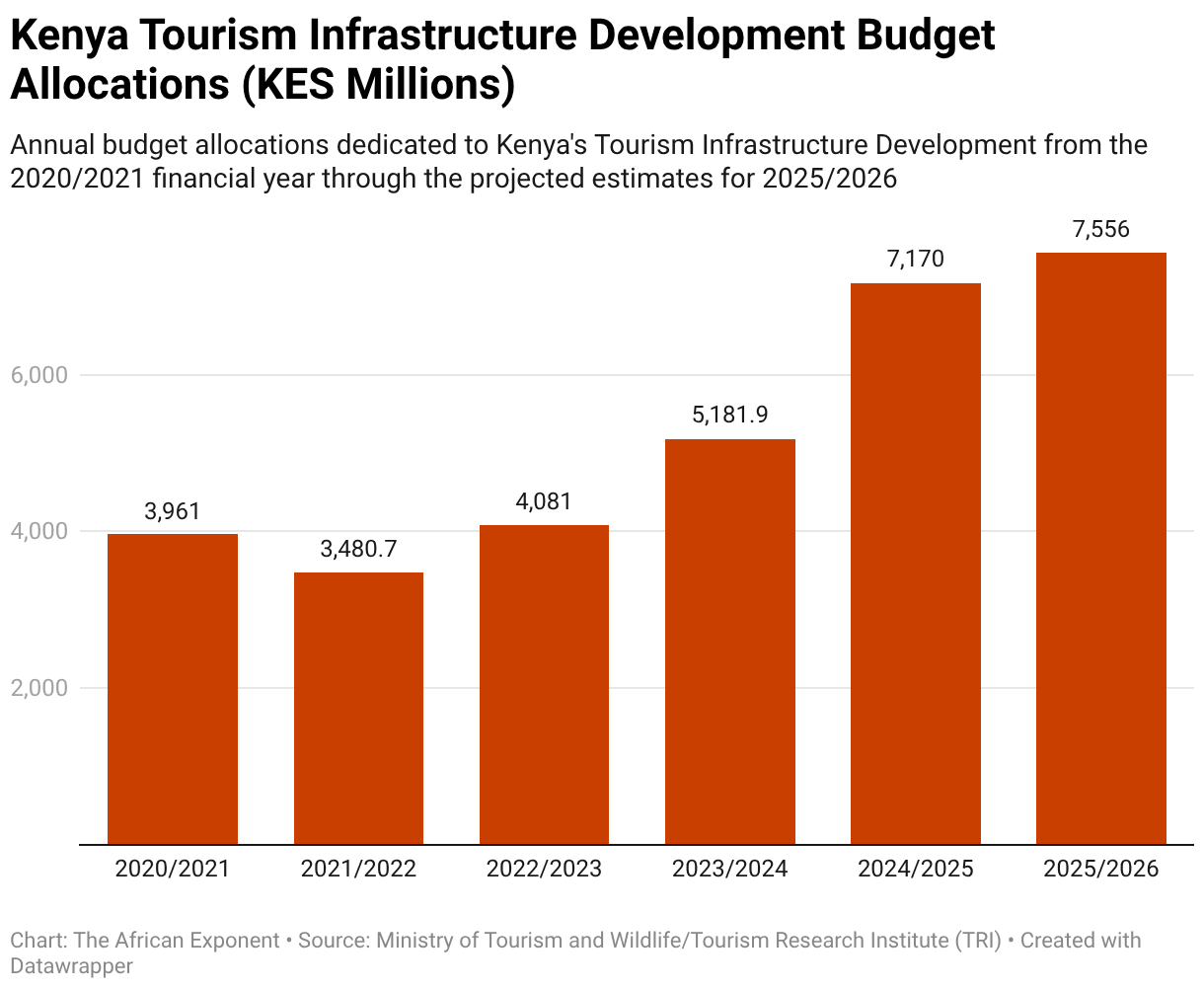
The Kenyan government is investing more in tourism infrastructure. According to Open Budget Kenya, the allocation for Tourism Infrastructure Development has risen steadily, from KSh 4.081 billion in 2023 to KSh 5.182 billion in 2024 and KSh 7.170 billion in 2025. The trajectory shows that the sector is now treated as a priority for construction and development, not just for marketing.
What is needed to achieve Kenya’s 2030 tourism targets?
The Kenyan government's tourism targets are now explicit enough to be modelled. The Kenya National Tourism Strategy 2025–2030 sets out a target of 5 million international arrivals, KES 1.2 trillion (~USD 9 billion) in tourism revenue and a GDP contribution of 12 percent. The government also aims to grow classified bed stock to 125,000 by 2030.
Hitting these targets is challenging. Doubling international arrivals to 5 million and growing MICE to one-third of total bookings will require a substantial expansion of classified hotel capacity, alongside new and upgraded conference space. Given hospitality build-out timelines, much of this capital must be committed within the next 18 to 24 months. The primary investment risk has therefore shifted from predicting future arrivals to whether Kenya can build the infrastructure to capture them.
Two overlooked parts of the government strategy reinforce the infrastructure framing. First, the plan emphasises year-round, multi-experience offerings to soften the seasonal fluctuations that have historically squeezed hotel profits. Second, sustainability is moving from a marketing choice to a regulatory one, with the Tourism Regulatory Authority's revived classification programme and the new National Accreditation Scheme putting greater weight on energy, water and waste standards. For investors, that makes green spending part of the cost of staying classified, not a discretionary add-on.
What are the opportunities for investors and operators?
Kenya's hospitality and tourism sector is increasingly being treated as a long-term infrastructure play, with three clear ways for investors to participate.
The first is hotel capacity. The immediate task is closing the gap between Kenya's current classified bed stock and the 125,000 target for 2030, with new construction in priority locations and the upgrading of existing facilities into the classified standard. This suits hospitality REITs, development finance institutions and pension funds looking for physical assets with inflation-linked income. The income profile is also becoming less cyclical, as growing MICE and corporate bookings smooth the seasonality that has long defined hotel revenue.
The second is MICE and convention infrastructure. The opportunity extends beyond physical venues to the supporting layer: event-management software, professional conference organisers, hybrid-event technology and airport-to-venue logistics. Government capex de-risks part of this story; the tourism infrastructure allocation has nearly doubled in three budget cycles, from KSh 4.1 billion in 2023 to KSh 7.2 billion in 2025. The pattern is familiar: the state builds the convention centres, and private capital builds the services around them.
The third is the digital and sustainability layer: booking platforms, dynamic pricing systems, energy and water retrofits, and ESG-linked refinancing of legacy hotel stock. These are lower-ticket, higher-velocity opportunities that align with the government's classification and sustainability agenda. They suit funds that want tourism exposure without the capital intensity and build-out risk of greenfield hotel development.
Kenya's tourism sector is evolving from a seasonal, cyclical business into something closer to a stable infrastructure asset class. Diversified demand, explicit capacity targets and rising public investment are the drivers. Investors who recognise the shift early will own the hotels, conference venues and digital systems that generate the next KES 1.2 trillion in tourism revenue.