

Something fundamental is changing in how Uganda spends on cybersecurity. For ages, it was treated as a regulatory cost driven by audit requirements and central bank checklists. However, that framing is now giving way to something more urgent. As digital adoption accelerates across mobile money, internet banking, and telecom infrastructure, the attack surface has expanded with it. These threats now directly jeopardise financial stability, erode consumer trust, and weaken vital national infrastructure.
The sheer scale of transaction growth tells the story. Uganda’s mobile money sector processed UGX 326.3 trillion in the year ending June 2025, representing a 28.6 percent surge from the UGX 253.7 trillion recorded the previous year, according to Bank of Uganda data. This momentum accelerated, as annual transaction volumes rose 20.6 percent from 7 billion to 8.4 billion transactions. Simultaneously, the Uganda Communications Commission (UCC) reports a massive digital footprint of 45.7 million active mobile subscriptions and 35.6 million mobile money accounts as of the third quarter of 2025.
What does the threat landscape actually look like?
Uganda’s digital threat landscape reveals a story of progress complicated by new vulnerabilities. According to UCC’s Communications Sector Cyber Security Posture Report, telecom networks recorded 1,411,933 malware infections in FY 2024/25, representing a 10.9% decrease from the 1,585,170 infections seen in FY 2023/24. This decline signals that recent investments in cybersecurity are finally yielding results. However, beneath this topline improvement, the nature of the threat is also changing. While botnet activity dropped by 31%, spam propagation surged from 464 to 2,723 instances, and the number of potentially exploited devices climbed from 362,764 to 485,945. Mobile devices remain the primary target as nine of the top ten malware strains attack these platforms directly. The malware strain, InMobi, alone accounts for just over 1 million infections.
The UCC report highlights a troubling rise in AI-driven phishing and deepfake scams. Cybercriminals now exploit artificial intelligence to create convincing voice and video clones that impersonate executives and government officials. Meanwhile, attackers constantly refine their phishing emails with sharper, error-free language that makes them harder for anyone to detect. These shifts confirm that modern digital attacks are organised, well-resourced, and adaptive.
The Uganda Communications Commission offers perhaps the most telling insight into the sector’s health through its latest security rating. The commission assigns the country a score of 577.5 out of 900, categorising Uganda's telecom cybersecurity as 'basic' while flagging an elevated risk level. Although the rating improved by a marginal 0.8 percent over the past year, it remains stuck in this lower tier. This stagnation confirms that current defences are failing to keep pace with the increasingly sophisticated threats the country faces.
How are cyber losses showing up in the real economy?
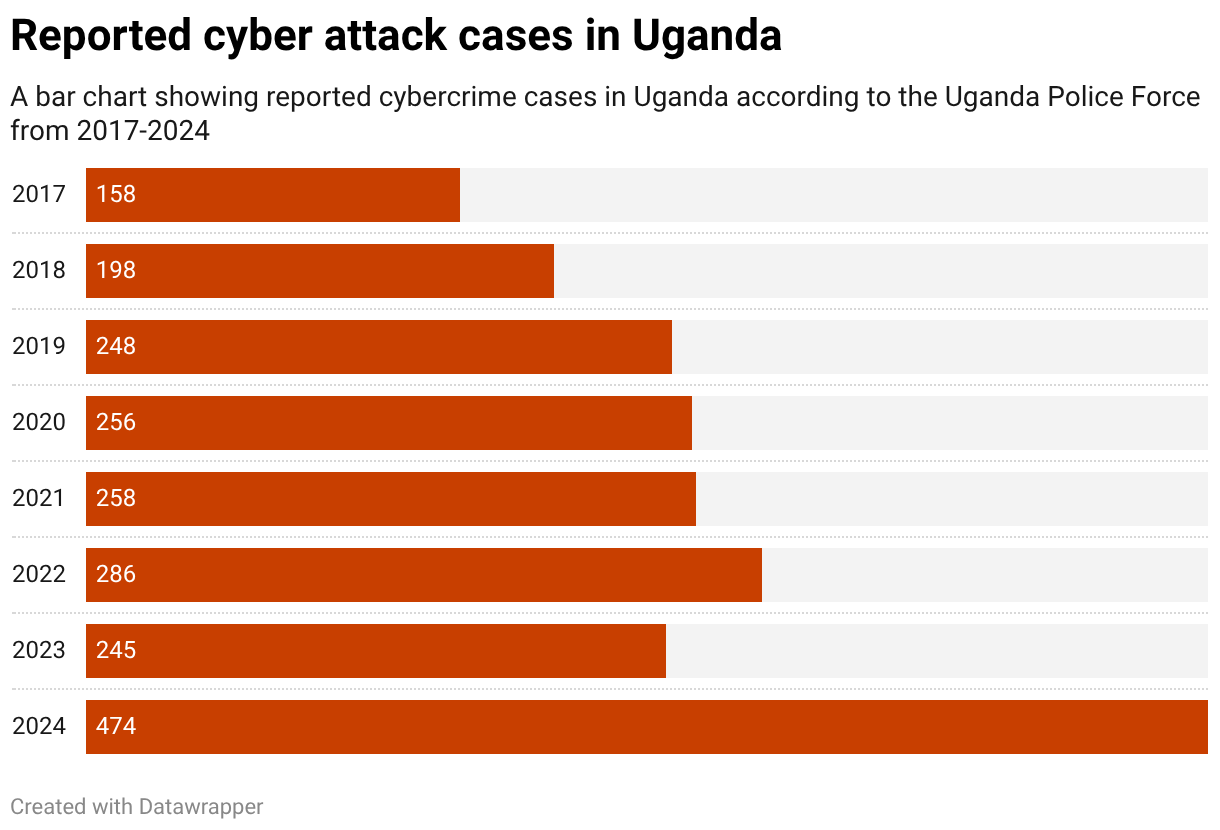
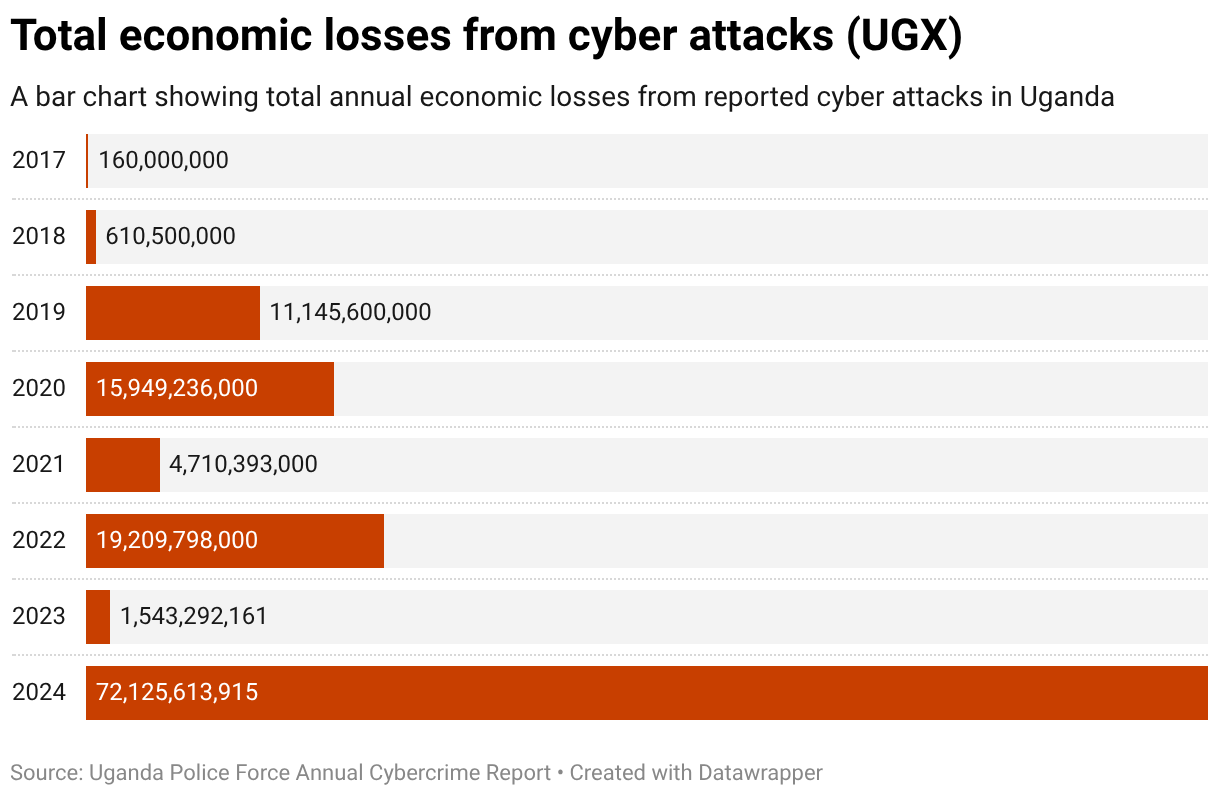
Cyber attacks now inflict measurable financial damage across the economy. In 2024, the Uganda Police Force investigated 474 cybercrime cases and identified losses totaling UGX 72.1 billion (approximately USD 20 million). Authorities recovered only UGX 420 million of those funds.
The banking sector currently faces these pressures firsthand. The Bank of Uganda’s Integrated Annual Report 2024/25 shows that active internet banking users fell by 6.6 percent, sliding from 960,000 in June 2024 to 900,000 in June 2025. Transaction volumes sank by 19.5 percent in the same window. The central bank identifies a clear culprit for this decline: growing user anxiety about the digital threat landscape. Conversely, mobile banking grew by 6.5 percent during that period as transaction values surged nearly 40 percent. This divergence shows that customers are abandoning digital channels they deem insecure in favour of those they trust more.
How is policy responding to the shift?
Policy makers are changing the regulatory outlook, though the progress is not uniform. In December 2024, the Bank of Uganda introduced its Cyber and Technology Risk Management Guidelines, requiring all supervised financial institutions to implement stronger cybersecurity defences. The central bank enforces these rules strictly, with penalties for non-compliance. Additionally, through its Anti-Fraud Consortium, the central bank now operates an AI-powered Payments Control System to detect and block fraudulent activity across payment networks in real time.
FSD Uganda and the Uganda Bankers Association are teaming up to build a shared Cyber Security Operations Centre (C-SOC). This centralised platform will allow financial institutions to monitor threats, report incidents, and share intelligence together. Meanwhile, the Anti-Fraud Consortium unites the Bank of Uganda, Tier IV institutions, the Capital Markets Authority, and the Financial Intelligence Authority under one cohesive fraud-fighting framework.
However, the government’s Digital Transformation Annual Monitoring Report for FY 2024/25 paints a sobering picture. The report rates the current cybersecurity-strengthening intervention as 'poor' grade with a performance score of just 49.2 percent, with the stated reason mainly being lack of funds. The Ministry of ICT blames this on the sluggish rollout of digital authentication tools and low adoption rates for unified messaging platforms, particularly among local governments. Ultimately, this confirms a persistent divide between the government’s policy ambitions and the reality of its on-the-ground execution.
Where are the investable opportunities?
The move from compliance spending to critical-infrastructure spending creates a definable market opportunity. Several segments stand out for investors and operators entering or expanding in Uganda.
Telecom operators and ISPs urgently require Managed Security Services (MSS) and Security Operations Centre (SOC) capabilities. Because the UCC rates the current security posture as only "basic," these providers need external partners to handle threat monitoring, incident response, and vulnerability management. Organisations can easily replicate the C-SOC model currently under development for the financial sector to protect telecoms and government agencies.
Fraud prevention and transaction monitoring represent a second high-growth segment. For instance, MTN Uganda’s network alone processes over 5 billion mobile money transactions annually which creates immense demand for real-time fraud analysis. This environment creates a prime opening for machine learning-based anomaly detection, behavioural biometrics, and AI-driven transaction scoring to provide the necessary oversight.
Endpoint and mobile security offers a third significant opportunity. Since nine of the top ten malware strains now target mobile devices, a substantial market awaits providers of robust security solutions for both everyday consumers and enterprises.
Small businesses, public agencies, and rural financial institutions currently lack tailored cybersecurity support. A backlog of unresolved cybercrime cases at the Uganda Police suggest that law enforcement simply lacks the specialized tools and capacity to investigate digital offences at scale. This gap presents a clear opportunity for providers offering training, digital forensics services, and cyber hygiene consulting to step in and meet this urgent demand.
The next phase of growth will favor operators who provide practical, scalable security services. Providers who build managed detection capabilities, fraud analytics platforms, and mobile-first endpoint protection tailored to Uganda’s digital economy will discover a large, expanding market that increasingly prioritises resilience. Ultimately, the question remains whether suppliers can innovate quickly enough to outpace these evolving threats


