Table of Contents
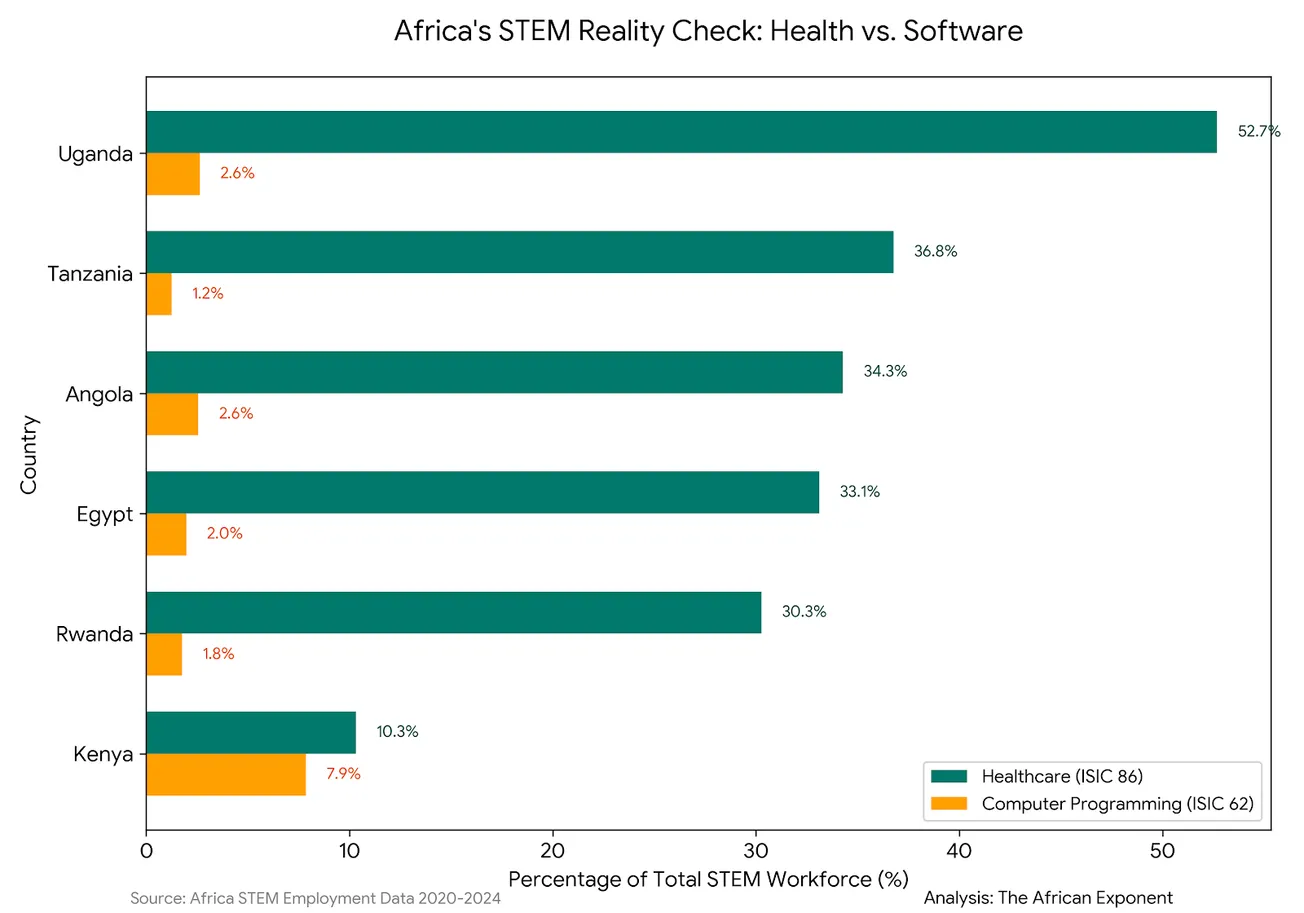
When we discuss STEM in Africa, the conversation usually revolves around software developers, and the next big fintech app. However, a deep dive into the employment data reveals a striking reality: Africa’s technical economy is not powered by code, but by the stethoscope. In many of the continent’s leading economies, the "STEM" workforce is overwhelmingly healthcare professionals, with computer programming making up only a tiny fraction of the total.
What is the most unique insight from Africa's STEM sector data?
The data reveals a massive "Sector Gap" that challenges the popular narrative of a digital-first Africa. In Uganda, for example, over 52% of the entire STEM workforce is employed in "Human Health Activities," while "Computer Programming" accounts for a mere 2.6%. Even in Egypt, a regional industrial giant, healthcare workers outnumber software developers by a ratio of nearly 17 to 1. This suggests that while digital technology gets the headlines, the true backbone of Africa's technical capacity remains the healthcare sector.
Why does this "Health-to-Tech" disparity exist Africa?
This trend reflects a fundamental stage of economic development where essential services- healthcare, construction, and basic engineering take priority over high-level digital services. Countries like Kenya show a more balanced profile (with coding making up nearly 8% of STEM), but they are the exception. For most nations, the urgent need for medical infrastructure and specialized health workers has naturally funneled the majority of technical talent into the medical sciences. This is "Essential STEM"-the technical skills required to keep a population healthy before a digital services economy can fully scale.
What are the implications for the "Future of Work" in Africa?
This data highlights a critical opportunity for policymakers and investors. While there is a global push to train "a million coders," the immediate reality is that Africa already possesses a massive, highly skilled technical workforce in the health sector. The real breakthrough might not be moving everyone into software, but rather integrating digital tools into the existing health-dominated STEM workforce. If Africa can successfully merge its massive healthcare engine with emerging technologies like AI and telemedicine, it won't just be "coding the future", it will be building the world’s most advanced tech-enabled health economy.